Gifted singer Tracy Melon has launched a scathing attack on individuals creating AI versions of artists’ songs and uploading them to music streaming platforms, urging them to stop what she described as an unfair practice.
Tracy argues that musicians pour their hearts, time, money and energy into recording music, only to wake up and find AI-generated versions of their songs circulating online—sometimes performing even better than the original releases.
According to the singer, the situation is particularly heartbreaking because artists endure long hours in the studio, strain their voices and make huge investments to deliver quality music, only for someone to recreate the same work using artificial intelligence with little or no effort.
“Remove our music from AI versions. We put in a lot of effort to do music, then someone releases an AI version. We have a reason why we go to the studio. Otherwise, if I didn’t want to, I would just go to the computer, put in the lyrics and let AI sing. But I go to the studio and voice, strain my voice, and then I wake up the following morning and find the AI version having more views than the original version. You’ve got to get serious, guys.”
The “Ogenda Kukilaba” singer went on to describe people behind such AI projects as “unserious guys,” questioning why they would take artists’ original work and reproduce it through AI before pushing it onto streaming platforms.
Her outburst comes amid the growing trend of AI-generated versions of popular songs being shared online by unknown individuals, a development that has increasingly frustrated musicians and other creatives.
Tracy is also not the first Ugandan artist to raise concerns about AI-generated music, as several creatives have voiced fears before.
Earlier in May, city beautician Sherry Matovu tied the knot with her husband, Abdul Salam Ssendegeya, in a colourful Islamic wedding ceremony held at Kibuli Mosque.
Since then, the couple has largely kept their marriage away from the limelight, enjoying what appears to be a peaceful and drama-free relationship compared to some of Sherry’s past relationships.
In a recent interview, Sherry opened up about the trust and openness in her new marriage, revealing that she sometimes checks her husband’s phone—and surprisingly, the two even share the same passwords.
With a lovely smile, Sherry explained that she has no major reason for checking his phone because she feels secure and comfortable in their relationship.
I do check my husband’s phone. However, there is nothing much as to why I check it, and I’m very comfortable in our relationship. We share the same passwords. I think he just loves me so much and deeply. I think he even fears losing me. I don’t know, but that is it.
Although Abdul Salam is slightly younger and, according to Sherry, still very active, she admits that she cannot completely rule out the possibility of him having side chicks.
However, rather than allowing such possibilities to disturb her peace, Sherry says she is not bothered by them.
Smallholder farmers and rural businesses in East Africa are set to gain greater access to climate adaptation finance following the launch of a US$200 million financing mechanism designed to help them invest in climate-resilient agriculture.
The Africa Rural Climate Adaptation Finance Mechanism (ARCAFIM) was launched on Friday by the International Fund for Agricultural Development (IFAD) and Equity Group at the Africa Food Systems Forum 2026 in Kigali, Rwanda.
The 12-year initiative will operate in Uganda, Kenya, Tanzania and Rwanda, targeting about 260,000 smallholder farmers and 500 rural micro, small and medium-sized enterprises (MSMEs).
At least half of the intended beneficiaries will be women, while 30 per cent will be young people. The programme is expected to strengthen food security for about 1.2 million people and benefit an estimated 1.5 million people directly and indirectly.
ARCAFIM comprises US$180 million in lending capital and about US$20 million in technical assistance. The lending funds are expected to revolve through approximately four investment cycles, potentially generating about US$266 million in loans for farmers and rural businesses.
A key feature of the mechanism is Equity Group’s commitment to put its own money at risk alongside public and concessional financing.
Of the US$180 million lending base, Equity Group will provide US$90 million from its own balance sheet, matching the concessional funding on a one-for-one basis.
The financing will use a risk-sharing structure in which international partners provide first-loss protection, a second layer of risk is shared with Equity, while the bank takes on the senior risk.
The model is intended to encourage commercial banks to treat climate adaptation as a viable business opportunity rather than relying on development funding alone.
Speaking at the launch, IFAD Vice President Dr Gérardine Mukeshimana said the initiative was designed to turn climate adaptation commitments into practical investments for rural communities.
“ARCAFIM’s ambition is to make rural climate adaptation a recognizable, viable and sustainable business line for African financial institutions,” Mukeshimana said.
She said the mechanism would provide financial institutions with tailored products, technical expertise and a climate adaptation financing taxonomy to help them identify and finance viable climate-resilience investments.
Although the programme will begin in East Africa, Mukeshimana said the model could later be adapted and replicated in other parts of Africa.
The technical assistance component will support microfinance institutions and savings and credit cooperative organisations (SACCOs) to develop and provide climate adaptation loans.
Farmers and rural businesses will also receive support to identify investments that can protect their livelihoods from climate-related risks. These include irrigation and water harvesting, resilient livestock and dairy production, improved post-harvest storage, renewable energy and climate-resilient agro-processing.
Equity Group Holdings Chief Executive Officer Dr James Mwangi said the programme would change how financial institutions view smallholder farmers.
“Africa’s smallholder farmers are not waiting to be rescued. They are entrepreneurs operating in the most demanding risk environment on earth, and what they have lacked is a financial system built to back them,” Mwangi said.
He said Equity’s decision to commit its own balance sheet alongside concessional funding was intended to create a sustainable market for climate-resilience lending.
Equity Bank Kenya Managing Director Moses Nyabanda said the bank would provide financing directly to farmers and agricultural producers while also working through microfinance institutions, SACCOs and agricultural value-chain companies.
Seated L-R Equity Bank Kenya Managing Director, Moses Nyabanda, and Gérardine Mukeshimana, IFAD Vice President, during the signing ceremony of the Africa Rural Climate Adaptation Finance Mechanism.
The financing will also target rural MSMEs, with the programme supporting businesses to adopt sustainable technologies and practices that can improve production, revenues and resilience.
The Green Climate Fund (GCF), which has committed US$55 million to the initiative, said ARCAFIM demonstrates how public funding can be used to mobilise larger amounts of private capital for climate adaptation.
Catherine Koffman, Director of the GCF’s Department of Africa Region, said the fund’s support helped bring together partners and structure a mechanism capable of expanding climate finance for farmers and rural businesses.
The mechanism is also backed by the Ministry for Foreign Affairs of Finland and the Nordic Development Fund, with additional co-financing from Denmark and the European Union.
Finland’s Ministry for Foreign Affairs Director General Juha Savolainen said mobilising private capital for sustainable development was central to the country’s development policy.
Nordic Development Fund Managing Director Satu Santala said the organisation had supported ARCAFIM from its early stages, describing it as an example of how risk-sharing and blended finance can help unlock investment in climate adaptation.
The launch brought together representatives of governments from Uganda, Kenya, Tanzania and Rwanda, development partners, private-sector investors and climate-finance institutions.
The agreements were signed by Mukeshimana on behalf of IFAD and Nyabanda for Equity Bank Kenya, in a ceremony presided over by Equity Bank Rwanda Managing Director Hannington Namara.
Beyond financing farmers and rural businesses, IFAD and Equity Group hope ARCAFIM will provide lessons for expanding blended climate-finance models to other parts of Africa.
Southern and West Africa have already been identified as potential next regions for the mechanism.
Pretty Banks has no plans to let public criticism get in the way of her life or music career, saying she knew what she was signing up for when she put herself in the spotlight.
The Ugandan singer shared her attitude toward criticism during an interview with Sanyuka Uncut, where she acknowledged that people will always have different opinions about those who choose to live and work in the public eye.
I really do not mind any criticism. You cannot control how people talk about you because you put yourself out there.
Pretty Banks said she went into the public space knowing that not everyone would respond to her in the same way. Some people would support her, others would criticise her, while some would simply speak what they believe is the truth.
That expectation has helped her put public reactions into perspective instead of allowing every negative comment to affect her personally.
Personally, it does not affect me because I came knowing that others would be negative, others would be positive, and some would speak the truth. So, it depends on how you see it.
Hellen Lukoma believes a man should be able to take care of the woman he is with, but she also has a message for young girls who expect provision in relationships: make sure you can take care of yourself too.
The Ugandan actress, singer, fashion designer, and model shared her views during an interview with Sanyuka Uncut, where she discussed whether women should expect men to provide for them or focus on becoming financially independent.
For Lukoma, provision is part of what a woman should expect from a man in a relationship, and she advised young girls to walk away if their partners cannot take care of them.
The first truth is that a man is supposed to look after you. I would advise every girl that a man is supposed to be able to take care of you. If he is not taking care of you, leave.
Her own expensive cars also came up during the interview after claims that a man bought them for her, something Lukoma did not deny as she explained why she believes she deserves that kind of treatment.
And what they said, that the man is the one who bought the cars, it is true, he is the one who bought them, with his money. They did not lie. But they should try and see if a man can buy them a Range Rover. I am given because I deserve it. I am a beautiful woman, I am a very talented woman, and I am a very humble, decent woman, so I am given. I am supposed to be given.
Having a man who provides, however, does not mean women should stop working for themselves, and Lukoma pointed to her own life as an example because she has her own money and continues to work.
But let me let them in on some wise words: work for yourself because I have my own money. I work.
Crysto Panda has questioned why only a handful of Ugandan artists attended Dokta Brain’s press conference despite the singer-songwriter having worked with many musicians in the country.
Dokta Brain, real name Nkwanga Geoffrey Adam, held the press conference at Protea Hotel Kampala Skyz on Monday, September 7, 2026, to officially announce his maiden concert, “The DoorKey Experience,” scheduled for Saturday, September 26.
Crysto Panda, who was among those in attendance, said he expected to see more notable artists at the event, especially musicians who have worked with Dokta Brain.
And I do not know if the musicians did not know about the press conference today, but it really hurts me to just not see notable figures in the game that you have written for. We have the names, yes, we are artists, but I expect many more artists here because you have written for many more people.
He said he regularly checks on Dokta Brain and has also told him that people need to appreciate his contribution.
Crysto Panda added that he expected the venue to have many more artists because of Dokta Brain’s work and the number of hit songs he has helped create.
I expected this place to be crowded with artists because of what he has done for the game. This man is the reason why we have very many hits in Uganda. In the last one year, you cannot name five hit songs and not name three songs from him. That is how big he is.
He then called on fellow artists to show Dokta Brain more support, saying appreciation should come while he is still around.
So I am calling upon every artist. I do not know if this is just an opening press conference, but if we are going to have another press conference, we need to show this man love. We do not need to wait for him to die and then appreciate his talents.
Dokta Brain will stage “The DoorKey Experience” on Saturday, September 26, 2026, marking his maiden concert.
In moments of transition, particularly those marked by grief, uncertainty and competing interpretations of tradition, institutions are tested, and so are the people entrusted with leading them.
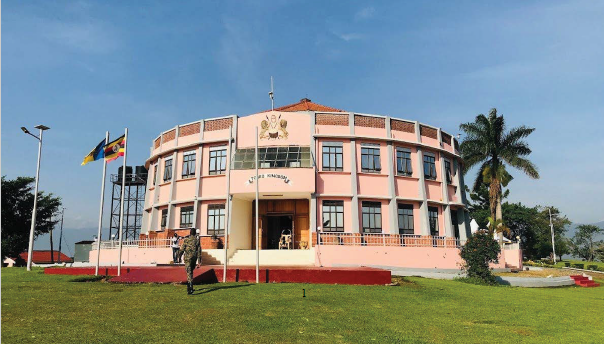
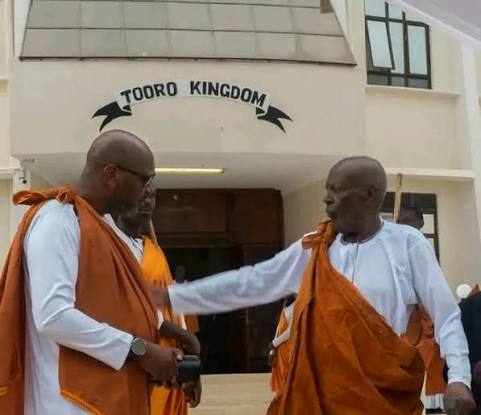
Since the passing of His Majesty King Oyo Nyimba Kabamba Iguru Rukidi IV, the Prime Minister of Tooro, Rt Hon. Calvin Armstrong Rwomiire Akiiki, has found himself at the centre of public attention, with much of the debate focusing on the statements he has made without asking the more fundamental question: Who exactly is Calvin Armstrong Rwomiire, and why did King Oyo entrust him with the administration of the Kingdom?
TO UNDERSTAND THE MAN, START WITH HIS ROOTS
Rt Hon. Calvin Armstrong Rwomiire’s relationship with Tooro’s royal institution is neither recent nor limited to his service as Prime Minister, because it is rooted in a family history closely intertwined with the Babiito Royal House and with generations of service to the Kingdom.
Through his mother, Princess Rebecca Kimoome, Rwomiire traces his lineage through his grandfather, Prince Kiranga Kimoome, son of Prince Samwiri Nyamugabo Kwita Kurumuki, who was descended from Omukama Isingoma Rukiidi I and, ultimately, from Kaboyo I Kasusunkwanzi, the founder and first Omukama of Tooro.
There is a further intersection between the families through the maternal lineage of the Royal House, with Queen Damali, mother of Omukama Rukiidi, having been a sister to Mirika Alyomubandi, the wife of Prince Samwiri Nyamugabo Kwita Kurumuki.
Prince Samwiri was the father of Prince Kiranga Kimoome, whose daughter, Princess Rebecca Kimoome, is the mother of Rt Hon. Calvin Armstrong Rwomiire, creating another historic connection between the Prime Minister’s lineage and the Royal House.
These genealogical ties place Rwomiire within the extended Babiito royal family and establish a longstanding familial relationship with the late King through Rwomiire’s maternal ancestry.
His paternal heritage carries an equally significant tradition of service to Tooro, with Rwomiire being a grandson of Owek. Ham Rwomiire Akiiki, a Mugweri who served as a Saza Chief in the late nineteenth century and was also honoured as Omujwara Kondo, a distinction of particular significance in Tooro that represents recognition by the Crown of exceptional standing, loyalty and service.
His connection to the throne must therefore be understood within this wider history because, long before he assumed administrative responsibility in the Kingdom, his family had been connected to the institution of the Omukama through kinship, leadership and service.
The Kimoome family, in particular, has maintained a longstanding association with the Kingdom, with Rwomiire’s maternal uncle, Prince John Victor Kimoome Isingoma, remaining actively involved in Kingdom affairs while also serving as both a relative and trusted confidant of King Oyo’s father, Omukama Patrick David Matthew Kaboyo Olimi III.
Princess Rebecca Kimoome has similarly devoted much of her life to service, particularly through her work caring for vulnerable children, and her contribution was publicly recognised by King Oyo, who later became Patron of the Rebecca Kimoome Foundation, an acknowledgement of her work and of a family tradition in which proximity to the Royal House has been accompanied by a responsibility to serve.
For Rt Hon. Calvin Armstrong Rwomiire, therefore, service to the Kingdom represents more than the holding of public office, because it forms part of a much longer story of family, heritage, duty and responsibility to the institution of the Omukama and to the people of Tooro.
BUT LINEAGE ALONE DOES NOT EXPLAIN HIS RISE
But lineage alone does not explain Rwomiire’s rise to the office of Omuhikirwa.
Before returning to serve Tooro, Rwomiire had built a life and career away from the Palace, and as a young man in the mid-1990s, he began his professional journey at Stanbic Bank before relocating to the United Kingdom to pursue further academic opportunities and broaden his professional experience.
There, he established himself in the logistics sector and eventually built a successful company that secured major commercial contracts and created employment opportunities, including for Ugandans living in the diaspora.
He had, by any ordinary measure, built a comfortable and successful life abroad, yet distance did not loosen his connection to home.
Rwomiire remained active in Tooro and Ugandan community activities in the diaspora, travelling to Uganda regularly, often every few months, to check on his family and reconnect with the Kingdom, and during these visits, he made a point of meeting King Oyo.
Their discussions reportedly went beyond family ties and ceremony, centring instead on the condition of the Kingdom, its development priorities and the contribution that Batooro in the diaspora could make.
Long before he held public office, therefore, he had begun offering his time, networks and ideas to the Kingdom, meaning that he was not waiting for a title before taking an interest in Tooro.
THE KING’S TRUST
King Oyo eventually appointed him Omujwara Kondo, a title associated with defending and protecting the throne, and this was not an ordinary appointment because, during King Oyo’s reign, the distinction was bestowed very sparingly.
Among the figures publicly associated with the title were President Yoweri Museveni and the late Libyan leader Muammar Gaddafi, while Rwomiire’s inclusion in such limited company was a powerful expression of the King’s confidence in his loyalty and capacity.
The appointment also carried particular significance because, unlike the other prominent holders of the title, Rwomiire was not a head of state, and what he brought was not political office but demonstrated commitment, a personal relationship of trust with the King and an abiding interest in the future of Tooro.
King Oyo subsequently appointed him Deputy Prime Minister before naming him Prime Minister on 14 February 2025, and the progression, from trusted adviser and Omujwara Kondo to Deputy Prime Minister and finally Omuhikirwa, suggests a relationship in which responsibility was earned gradually.
The King had observed his work, tested his commitment and entrusted him with increasing responsibility.
Accepting the office required considerable personal sacrifice, as Rwomiire had to divide his attention between an established business in the United Kingdom and the increasingly demanding responsibilities of serving the Kingdom in Uganda.
Ultimately, he chose to spend more time at home and answer the call to serve his King.
That decision deserves acknowledgement because many people express love for their homeland from a distance, while fewer are prepared to reorganise their lives, careers and businesses to serve it directly.
REFORMING THE KINGDOM
His first months as Prime Minister were marked by institutional restructuring, and following his appointment, the Cabinet was dissolved and reorganised to reduce duplication and improve coordination.
Related ministries were merged, administrative responsibilities were clarified, and new sub-county chiefs were appointed, while the Kingdom’s 2025 Annual Report says these reforms were intended to strengthen accountability, decentralised governance and results-based service delivery.
The Office of the Prime Minister also conducted engagements across Tooro’s counties, consulting more than 2,000 community stakeholders, including chiefs, elders, women, young people, religious leaders and opinion leaders.
These consultations helped prepare for the King’s Royal Tour and brought grassroots priorities into the Kingdom’s planning.
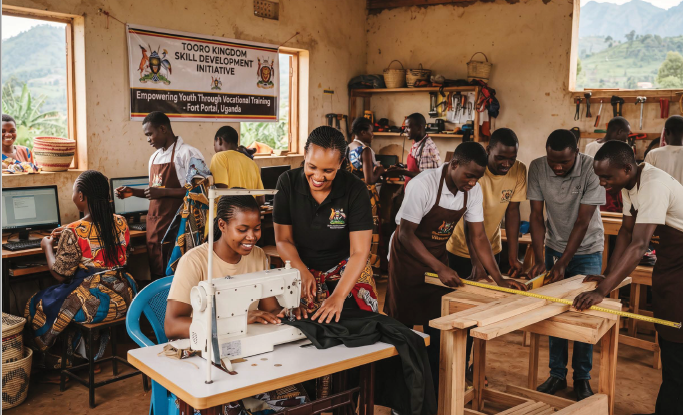
Under the joint leadership of King Oyo and his administration, Tooro recorded several development initiatives, with 59 children receiving corrective orthopaedic surgery during the King’s Birthday Health Week, while the Kingdom expanded youth participation through sports, entrepreneurship, agriculture and the Tooro Kingdom Youth Economic Empowerment Programme.
It engaged investors and development institutions, hosted more than 500 business leaders through the Presidential CEOs Forum and pursued partnerships in tourism, agro-processing, housing, technology, education and youth development.
The administration also supported the establishment of a solar-powered community ICT hub serving 484 learners, mobilised assistance for vulnerable children at Tooro Babies Home and signed cooperation agreements with institutions including Mountains of the Moon University, MTN Uganda, Housing Finance Bank and Habitat for Humanity.
THE KING’S VISION
Perhaps the clearest indication of the working relationship between the King and his Prime Minister is the Kingdom’s Strategic Development Plan for the financial years 2025/26 to 2029/30.
The document sought to translate King Oyo’s long-term vision into measurable programmes covering agriculture, education, health, tourism, infrastructure, culture, communication, governance and environmental protection.
In the plan’s foreword, King Oyo emphasised disciplined implementation and called upon the people of Tooro to imagine the Kingdom they wished to leave to future generations.
The document, in turn, credits Rwomiire with spearheading the planning process and convening the Cabinet that helped translate the King’s vision into actionable strategies.
The two men were, therefore, not simply occupying neighbouring offices, because they were working on a shared programme for Tooro’s future.
Some initiatives had already begun, while others remained in development, and according to those familiar with their final exchanges, the King responded warmly to a progress report from his Prime Minister, thanked him for the work being done and expressed his eagerness to return and advance their plans together.
THEN TRAGEDY STRUCK
That future was tragically interrupted.
In the days following King Oyo’s death, Rwomiire has had to shoulder responsibilities few people could adequately prepare for, including announcing the death of a King who was also his relative and friend, coordinating the return of his body from abroad, leading funeral arrangements and managing an administration confronting grief, public scrutiny and disagreement.
He has also faced criticism over communication surrounding the King’s illness and questions concerning the succession, and these are legitimate matters for the proper traditional and institutional authorities to clarify.
Tooro’s succession customs belong to the Babiito royal clan and its recognised cultural leadership, while the Prime Minister carries responsibility for the Kingdom’s administration, meaning that at a time such as this, both spheres must work together with restraint, mutual respect and fidelity to custom.
Rwomiire has publicly indicated his willingness to engage the Omujwera Musuuga and other royal leaders to resolve disagreements away from the heat of public confrontation, and that is the correct instinct.
Tooro does not need the administrative and cultural arms of the Kingdom pulling against each other while the King is yet to be laid to rest.
SCRUTINY IS STILL NECESSARY
Understanding Rwomiire’s background does not place him beyond scrutiny because no public or cultural leader should be, but it does challenge the simplistic portrayal of him as an outsider or a commoner with no stake in the Babiito royal institution.
He is connected to that institution by ancestry, family history, appointment and service.
More importantly, his authority as Prime Minister did not arise from public speculation, but came directly from King Oyo, who appointed him after years of engagement and progressively entrusted him with some of the Kingdom’s most significant responsibilities.
History will eventually judge the decisions made during this difficult transition, but for now, judgment should be informed by facts, custom and an appreciation of the enormous burden resting upon those leading Tooro through its grief.
Calvin Armstrong Rwomiire is a royal descendant, a businessman who returned from the diaspora, a servant who accepted personal sacrifice and an administrator whom King Oyo deliberately chose.
His duty now is not to replace the King or the traditional authority of the Babiito, but to protect the dignity of the Crown, preserve the administration they built together and help create the conditions in which Tooro’s lawful cultural authorities can guide the Kingdom forward in unity.
The strongest tribute to King Oyo will not be victory by one faction over another, but the survival of the united, modern and development-focused Tooro that he and his Prime Minister had begun working to build.
GOT A HOT STORY? LET US KNOW!
Got breaking news, explosive secrets, or hard evidence?
Gerard’s six-week run in the Big Brother Naija House came to an end on Sunday night, making him the eighth housemate to be evicted from the competition.
Speaking to Ebuka Obi-Uchendu after his eviction, Gerard admitted that he had become somewhat checked out towards the end of his time in the House. He explained that he was more guarded about what he said, not wanting an offhand comment to be taken the wrong way, and described the House as increasingly political.
The night also saw Barry emerge as this week’s Most Influential Player of the Week (MIPOW) after being selected by the housemates. However, with The Switch as the theme of the week, his reward came with a change: instead of the usual immunity, Barry will receive Biggie Bucks alongside his betPawa Elite reward, an Air fryer.
Barry.
The live show also put some of the housemates on the spot.
Abi used the moment to clarify that her frustration after the House won its wager was not about the result, but about feeling overlooked by Biggie despite being Head of House.
Oyin’s reaction to Temi calling her names came under scrutiny, given that she also frequently calls other housemates names. She was also challenged over expecting cooperation from the housemates during her leadership of the wager task, despite her own approach during the task. Aikou, meanwhile, spoke about feeling physically exhausted and seeing some housemates repeatedly do the same things, saying he had lost his curiosity.
Sheba and Tram were also asked about their relationship following their fallout, with both having to speak about where they currently stand.
Their conversation allowed viewers to hear directly from both sides and offered another glimpse into the relationships that continue to evolve as the competition progresses.
With friendships, alliances and disagreements forming and shifting throughout the season, the evolving relationship between the two housemates remains another storyline for viewers to follow.
Gerard may have been the only housemate to leave the House on Sunday, but the live show gave viewers plenty to discuss, from Barry’s unusual MIPOW reward to the questions that put several housemates on the hot seat.
Sunday night’s live show once again demonstrated that eviction is only one part of the Big Brother Naija experience. From Barry’s unexpected MIPOW reward and the implications of The Switch, to the questions confronting Abi, Oyin, Aikou, Sheba and Tram, the night provided plenty for viewers to debate and discuss.
The competition continues with the remaining 16 housemates on DStv Channel 198 and GOtv Channel 349, as well as DStv Stream. Viewers can also catch the live shows every Sunday on Pearl Magic Prime on Channel 148 on DStv and 303 on GOtv.
Legendary Ugandan singer Juliana Kanyomozi was left deeply touched after fellow songstress Lydia Jazmine publicly celebrated her as one of the biggest influences on her musical journey.
The heartfelt moment unfolded at Lydia’s recently concluded “One & Only” concert at Lugogo Cricket Oval, where the younger singer stepped away from the spectacle of the night to pay tribute to one of the women whose music helped shape her artistic journey.
During her performance, Lydia sang covers of some of Juliana’s iconic songs, including “Nabikowa”, turning the concert stage into an unexpected celebration of the veteran singer’s musical legacy.
For the thousands gathered at Lugogo, it was more than a performance of familiar songs. It was a moment that illustrated how music can travel across generations, with songs recorded years ago finding new life through artists who grew up listening to them.
Juliana, whose career has spanned decades, appeared moved by the gesture and by Lydia’s decision to publicly acknowledge the influence her music had on her development as an artiste.
“Dear LydiaJazmine, My heart is so full. Watching you honor me the way you did, hearing you say my music helped shape your voice and your journey, that’s the kind of moment an artiste prays for. To know that something I created didn’t just reach you, but became part of how you found your sound..that’s a gift I’ll carry with me,” Juliana wrote on X.
Dear @LydiahJazmine , my heart is so full ???. Watching you honor me the way you did, hearing you say my music helped shape your voice and your journey, that’s the kind of moment an artiste prays for. To know that something I created didn’t just reach you, but became part of how… pic.twitter.com/qaAmMsBLCC
The recognition offered Juliana more than a moment of nostalgia. It highlighted the lasting impact of her work on a generation of artistes who followed in her footsteps.
For an artiste, there may be few greater acknowledgements than hearing a younger musician say that the songs you created helped them discover their own voice.
And for Lydia, performing Juliana’s music on one of the biggest nights of her own career served as a reminder that influence in music is not always measured by charts, awards or sales.
Sometimes, it is measured by the artists who come after you, the songs they choose to sing and the stories they tell about how your music helped them find their way.
Lydia Jazmine paying a heartfelt tribute to Juliana Kanyomozi and her timeless legacy at her recently concluded concert. ???#SqoopUpdatespic.twitter.com/OKJPR28Exj
The Uganda Revenue Authority (URA) has started biometric tax profiling using the National Identification Number (NIN) as the government moves to phase out the Tax Identification Number (TIN).
The exercise is being led by URA, with the National Identification and Registration Authority (NIRA) providing support mainly in verifying taxpayers’ identity data. It comes just days after the government approved the adoption of the NIN as the default tax identification number for Ugandan citizens, replacing the traditional process of obtaining a separate TIN.
According to URA, linking taxpayers’ identities to their NIN will harmonise government data, improve tax compliance and help curb tax evasion and fraud, which continue to undermine domestic revenue collection.
Speaking to journalists shortly after the launch of the National Identity Day Symposium ahead of National Identity Day celebrations on September 16 at Kololo Independence Grounds, Christine Mirembe, the URA Assistant Commissioner for Client Services, said the authority has started mapping and profiling taxpayers using their NINs.
Mirembe said the first phase, which requires taxpayers to provide their NINs, is expected to run until the end of September. “We have given Ugandans up to the end of this month to provide us with their NINs. In this first phase, we have started with improving the taxpayer’s profile with a picture. Currently, when you open your taxpayer profile, it has no picture, and someone can easily take advantage,” Mirembe said.
She said the biometric system will make it harder for individuals to fraudulently access or conduct transactions on another person’s tax profile. “We want to eliminate fraud. Aligning people’s TIN with their NIN means we shall have your biometrics as well, and anyone who does a transaction on that profile will be the owner, and access will be through biometric fingerprint,” Mirembe said.
She added that taxpayers who already provided their NINs when registering for a TIN will have to wait for the second phase of the rollout, which will involve giving consent for the full registration process.
Mirembe, however, warned that taxpayers who refuse to provide their NINs could have their information obtained through URA’s partnership with NIRA, saying the authority has a legal mandate to register taxpayers.
Mirembe said replacing the TIN with the NIN is also expected to improve domestic revenue collection by enabling URA to establish taxpayers’ actual income and close existing gaps in tax collection.
Mirembe said the NIN would serve as a unique identifier for government, enabling URA to link taxpayers’ information across banks, trading licences and mobile money transactions. She said the system would make it difficult for individuals to claim they were no longer in business or unable to pay taxes when their financial transactions remained visible to the tax authority.
However, Rosemary Kisembo, the Executive Director of NIRA, clarified that NIRA will not merge its database with that of URA. Kisembo said each institution will retain its own data, with NIRA supporting URA by verifying identity information where necessary.
“We shall only help them in verifying that the person who registered for taxes is the right person, with all his data corresponding with what we have. But Ugandans should know that every data access will be backed by biometric authentication consent.
“For the data to be retrieved from NIRA, there has to be consent proof from the owners. It is not going to be that we share it anyhow,” Kisembo said.
The move comes as the government steps up efforts to increase domestic revenue mobilisation to finance the national budget and reduce reliance on external borrowing. With the NIN now adopted as the government’s single reference for citizen identification, tax authorities expect greater interoperability between systems holding information on land ownership, banking, mobile money and business registration.
The integration is expected to give government agencies a more comprehensive view of economic activity and strengthen efforts to identify taxpayers and improve compliance.
GOT A HOT STORY? LET US KNOW!
Got breaking news, explosive secrets, or hard evidence?