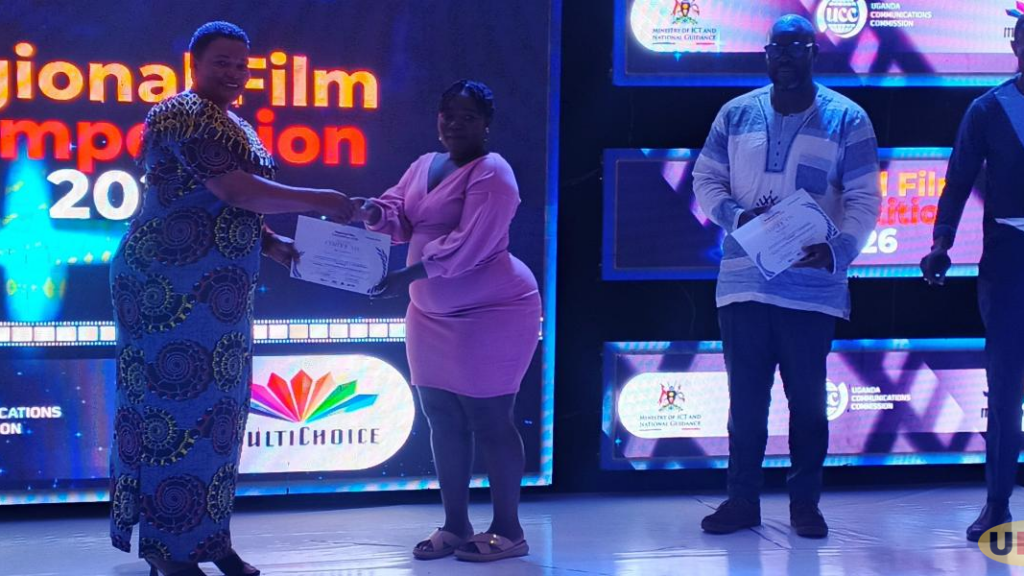
Uganda Communications Commission-UCC the regulator of the Telecom and Film Industry has held its maiden edition of regional film competitions in Arua City on Friday evening, calling on youth to explore the country’s lucrative Film Industry.
The awards event which was organized in partnership with Ministries of ICT, National Guidance and Multichoice Uganda, attracted Actors, Actresses and Producers from Karamoja, Lango, Acholi and West Nile.
The event was preceeded by a one-week training for film actors, actresses, producers and script writers in West Nile by the regulator as a way of promoting the film industry.
Dignitaries from Culture, Security, Local Governments, Hospitality, Tourism and and Music industry attended the event held at Desert Breeze Hotel in Arua City.
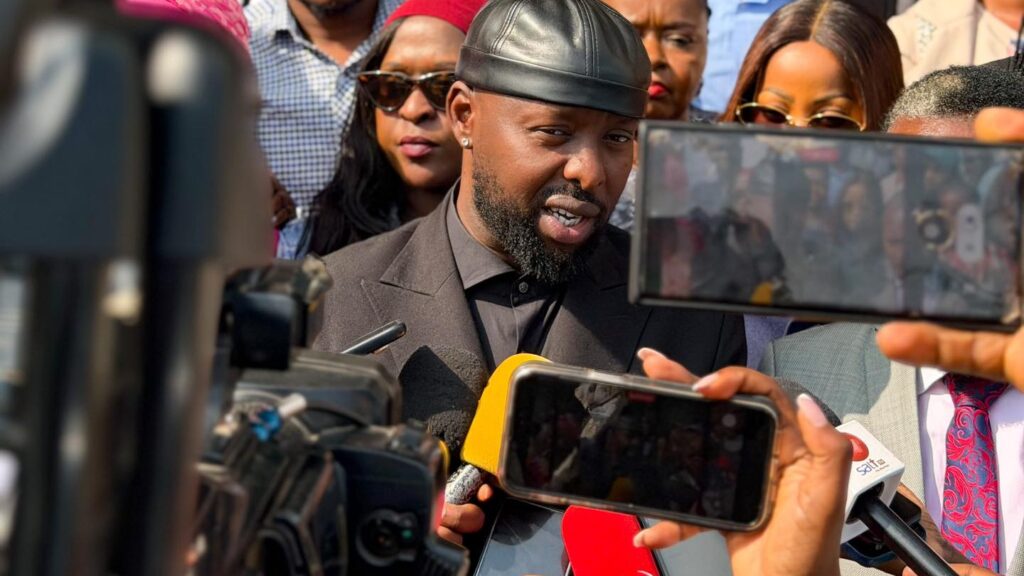
After being trolled for nearly two days for misinterpreting Uganda’s new Copyright and Neighbouring Rights Amendment Bill passed by Parliament on March 17, musician Eddy Kenzo has swallowed a humble pie and admitted ignorance.
The globally recognized Ugandan singer, real name Edrisah Musuuza, during one of his interviews with a vlogger described neighbouring rights as safeguards for music from nearby nations.
Social media users, especially music fans did not take his interpretation kindly.
They explained it actually protects performers, producers, and broadcasters behind the work, like those on his hit Sitya Loss.
The music executive and the current President of the Uganda National Musicians Federation (UNMF) posted after, owning the mistake with “All along I thought neighbouring rights means neighbouring countries” and sharing the correct definition, thanking fans for the lesson. The bill promises stronger penalties and better royalties for Uganda’s artists after years of weak enforcement.
All along I thought neighboring righte means neighboring countries ????
Greetings sebbo, I have seen the video on the comment on neighboring rights.
Allow me to share as follows; The law on copyright talks of neighboring rights, it doesn’t mean neighboring countries.…
The comedian came under fire after jokingly translating the famous chant “Nants’ingonyama bagithi Baba” as “Look, there’s a lion. Oh my God.”
The clip quickly spread online and drew mixed reactions.
However, Lebo M did not take it lightly. He argues that the chant carries deep cultural meaning and should not be simplified or misrepresented for humor.
His legal team has now stepped in, framing the issue as more than entertainment. They insist it touches on cultural respect and proper representation.
Despite the backlash, Learnmore Jonasi has stood by his content, saying the moment was purely comedic and never meant to offend.
As the case moves forward, the situation has sparked a wider conversation about the limits of comedy when it intersects with cultural identity.
Eddy Kenzo has ruled out a return to London, despite continued calls from Ugandans in the United Kingdom asking him to perform there.
The BET Award winner says he will not go back if it means performing at The Royal Regency, a venue that has long hosted Ugandan concerts and cultural events.
Speaking during a sit-down with YouTuber Allan Cruz, Kenzo said his decision is not random, but based on how he now views the venue after performing there at different stages of his career.
I refused to go back to London because I do not like that hall. It is like a wedding place, and I have performed there a lot. I performed in that place when I was just coming and trying to stabilise, after establishment.
Having used the same venue while coming up and even after establishing himself, he said going back to it now no longer matches where he sees himself.
I feel I have clients from other countries, and I cannot bring them to that hall. I deserve a place where I can come with a band, rehearse properly, and have good sound. A well-proofed venue for concerts, not a wedding or conference hall. At least take me to a festival setting, maybe outdoors, where my people will listen to the sound.
He also made it clear that his position is not about dismissing the venue, but about recognising what it has done and where he stands now.
I am sorry, with due respect, I am not trying to downplay the hall because it has been there for us. It has fed us, including me, and I thank God for it. But I feel I outgrew it. That is what I think.
Kenzo then pointed to how often he has performed at the venue and the results he has consistently delivered, saying he has filled it every time.
For him, that history is exactly why he feels there is no reason to keep returning to the same space.
I have filled that hall so many times that I cannot count. Every time I would go to London, I would fill that hall. My shows there have never flopped. So, should I remain doing that, and till when? I deserve better performance places that were built for music performances.
Kenzo said the issue is not filling the hall, but whether staying there reflects his growth as an artiste.
Ugandan vibe is set to shake the UK as DJs Ssuuna Ben and Mbaziira Tony prepare to export their fast-rising ‘Binyanya’ sound to London at the highly anticipated UG Fest 2026.
The duo will take center stage on July 4th, 2026, at the Newham Leisure Centre, where thousands are expected to gather for one of the biggest Ugandan diaspora events in Europe.
Known for their electrifying ‘Binyanya’ style, DJ Ssuuna Ben and Mbaziira Tony will share the spotlight with a powerhouse lineup of Uganda’s top entertainers. Music lovers should brace for performances from Cindy Sanyu, A Pass, Ray G, Omega 256, Vyroota and Stabua Natooro, among others.
suuna Ben and Mbaziira Tonny of the ‘binyanyanya’ Fame
The UG Fest is brainchild of city-based promoter Joseph Kiggundu, popularly known as Jose of Jobslink Group. He describes the event as more than just a music show — a full cultural experience aimed at uniting Ugandans across the diaspora.
“This festival is all about family, culture, and community,” Kiggundu said, noting that unlike previous shows, UG Fest 2026 is designed as an all-day, all-age celebration.
To encourage family participation, children under 12 will pay just £5, a move aimed at giving young Ugandans in the diaspora a chance to connect with their roots through music, food, and cultural showcases.
Promoter Joseph Kiggundu of Jobslink Group who is behind the event
Beyond the music, the festival will also feature exhibitions of Ugandan-made products, tourism showcases, and networking opportunities for Ugandans living across the UK and Europe.
Powered by brands like New Vision, Bukedde, Housing Finance Bank, Victoria University, Ethiopian Airlines, Centenary Bank, and others, UG Fest 2026 is shaping up to be a major cultural export — and a loud reminder that Ugandan music is going global.
Ecko Star Fullybad is carving out a distinct sound in Uganda’s dancehall scene, and it all traces back to the music that first pulled him in.
The rising artiste has built a high-energy “new school” dancehall style, blending Afro-dancehall with both traditional and urban Ugandan influences.
While appearing on Level Up, he opened up about the songs that pushed him into dancehall, saying a few key Jamaican tracks changed everything for him early on.
There are songs that really hit far and wide. There is a song, “Let’s Go” by Beenie Man, that song really got to me. I remember saying then, “I have to sing dancehall. I am not supposed to sing anything else but dancehall.” Then “Gal a Bubble” by Konshens, and I was like, I have to do ragga.
Today, that influence comes through clearly, with his sound carrying the same energy and rhythm that first drew him in.
With songs like “Ekidigida,” “Mamilila,” and “Obujiji,” Ecko Star Fullybad continues to build on that foundation and shape his identity.
During an interview on KFM, A Pass faced a simple but pointed question: what do Ugandan artistes lack most: talent, discipline, or vision?
He chose discipline and explained why he believes many artistes fall short in that area.
Instead of dismissing talent, the singer, born Alexander Bagonza, explained that music does not follow one standard.
In his view, the industry includes different levels of artistes, and that balance matters.
They lack discipline. Talent, I think, is very subjective. People create music differently because it is an art form. Art comes in different layers. There are amateur artistes, and then there are very exceptional artistes. So there is a balance, and we need everyone.
He then addressed the idea that every artiste should be talented and said that expectation does not reflect reality.
You cannot say that someone has to be top and we only have top artistes. It is impossible. There is no school you have been to where everyone gets 99%. It is impossible.
Turning to how artistes judge each other, A Pass pushed back against dismissing people based on talent alone and argued that discipline and direction often matter more.
You cannot beat down people because they are not talented. I feel like if someone is disciplined, hardworking, and knows what they are trying to do, that person can go further than an artiste who is actually very talented.
He also explained how that difference plays out, saying artistes who rely on talent often become comfortable, while those without it push themselves to improve.
People who are talented tend to depend on talent. People who do not have talent get serious. They will go and put in a lot of hard work to improve, maybe their stage performances, maybe vocally. They will put in a lot of effort, and they actually come good and do a better job than someone who is talented, because the talented one may even be very timid.
In the end, A Pass beleives the gap between artistes comes down to effort and discipline, not just ability.
A Pass may be one of the most outspoken artistes in Uganda, but he has managed to stay away from industry beef for years.
Despite spending over a decade in the game and openly criticizing fellow musicians, the singer has rarely found himself in direct conflict.
Apart from playful banter, especially with Lil Pazo, A Pass has largely avoided serious fallouts.
Over the years, he has not held back when speaking about the state of Ugandan music, at one point calling many artistes “mediocre” and even describing some as “dead people walking.”
Still, those comments have never turned into full-blown feuds.
Speaking during an interview on KFM, the “Love Infection” singer explained that his approach comes down to intention and respect.
I feel like I respect other artistes, and if I say something, I genuinely say it from a good place. I am not the kind of person to beef someone. There is nothing to gain, and I learned that a long time ago. I am not the kind of person to stir or start wars. I prefer to bring love rather than hate.
He also pointed to how he carries himself in public, saying he avoids overexposure on purpose.
While many artistes try to stay visible at all times, A Pass keeps his appearances limited and selective.
And the reason I am not out all the time is that I do not feel like anything valuable should be everywhere. These T-shirts they buy at 5K, you can find them everywhere. But T-shirts they sell at 150 to 200K, you are not going to find them everywhere. I am that T-shirt.
It is that balance of honesty and restraint that has kept A Pass out of conflicts, even when his views stir conversation.
A disturbing new report from the Uganda Bureau of Statistics has lifted the lid on a growing but largely ignored national crisis — the silent disappearance of fathers from Ugandan households, leaving millions of children vulnerable, abandoned, and struggling to survive.
The findings, released this week in Kampala, paint a grim picture of a country where fatherhood is increasingly becoming a missing link in the family structure.
According to the report on Orphans and other Vulnerable Children (OVC), Uganda currently has a staggering 2.9 million orphans, with a significant number having lost their fathers — a trend that experts warn could have long-term social and economic consequences.
“This is not just data. This is a national alarm,” a social policy analyst said. “We are watching a generation grow up without fathers, and the implications are huge.”
The numbers tell a chilling story.
At least 6.2% of children surveyed had lost their fathers, compared to 3% who had lost their mothers, clearly showing that fathers are dying at nearly double the rate of mothers. Meanwhile, 4% of children have lost both parents, while 13% have lost one parent, pushing many into vulnerability.
“This confirms what many communities have been quietly experiencing,” the analyst added. “Fathers are disappearing — through death — at a worrying rate.”
Even more concerning is the number of children living in uncertainty.
Thousands of children — over 60,000 — do not even know whether their fathers are alive, a statistic that underscores not just death, but absence, broken families, and lack of connection.
“How do you grow up not knowing if your father is alive?” one child welfare advocate asked. “That is trauma in itself.”
The report breaks down the crisis further, revealing that orphanhood is more severe in rural areas than in urban centres. In rural Uganda, 6.3% of children have lost their fathers, slightly higher than the 6% recorded in urban areas. Similarly, children who have lost both parents are more in rural areas at 4.5%, compared to 3.5% in urban settings.
“This tells you where the burden is heaviest,” an expert noted. “Rural communities are carrying the biggest share of this crisis.”
The data also shows a worrying pattern — the older children get, the more likely they are to have lost their fathers. This suggests a continuous and increasing loss of male parental figures as children grow.
“It’s like a ticking clock,” the analyst explained. “The longer a child grows, the higher the chances the father is no longer there.”
The report categorizes children into those without fathers only, without mothers only, those who have lost both parents, and those with one or both parents dead. Across both boys and girls, the trend remains consistent — father loss is higher.
In some cases, the situation is even more complex. Among children whose parental status is unknown, thousands fall into troubling categories — those whose mothers are dead but father’s status is unknown, those whose fathers are alive but mothers’ status is unknown, and even those who do not know the status of either parent.
“This is more than death — it’s disconnection,” a child rights activist said. “We are seeing a breakdown in family tracking and support systems.”
While the report stops short of explaining why more fathers are dying, experts point to a mix of factors — risky lifestyles, occupational hazards, limited health-seeking behavior among men, and social pressures that keep men away from healthcare services.
“Men tend to delay going to hospital,” a public health expert explained. “By the time they seek help, it is often too late.”
The findings now raise urgent questions for policymakers.
What is killing Uganda’s fathers? Why are men more vulnerable? And what happens to a nation where millions of children grow up without paternal support?
“This is a silent crisis because it is not talked about enough,” the expert warned. “But if ignored, it will shape the future of this country in ways we are not prepared for.”
As Uganda grapples with this emerging reality, one thing is clear — behind the statistics are millions of children growing up with gaps that no numbers can fully explain.
And unless urgent action is taken, the absence of fathers may soon become one of the country’s most defining — and devastating — social challenges.
In today’s evolving workplace, building an inclusive environment is no longer optional. It is essential for sustainable growth, innovation, and social progress. At Equity Bank Uganda, inclusion is not simply a policy statement but a deliberate strategy embedded across recruitment, leadership development, employee wellness, and career advancement.
As the world commemorates International Women’s Day every March, organizations are reminded of the importance of empowering women both socially and economically. At Equity Bank, this moment is an opportunity to reflect on how intentional workplace practices can unlock the potential of women and, in turn, transform communities.
Creating an inclusive workplace begins with equitable systems. At Equity Bank, the recruitment process is designed to ensure there is no discrimination based on gender. Talent is recognized as talent, regardless of who it comes from.
This approach has helped the bank maintain a workforce that is nearly balanced in gender representation. However, achieving balance in numbers is only the first step. The real work lies in creating opportunities for growth, leadership, and influence.
Women are encouraged to take up space, share ideas, and participate actively in shaping the future of the organization. Providing such opportunities ensures that women are not only represented but empowered to contribute meaningfully.
Over the past five years, the bank has implemented targeted programs aimed at strengthening women’s leadership within the organization.
One notable initiative is the Girls for Girls mentorship program, which has seen more than 100 staff members participate. Through this initiative, women receive mentorship, professional guidance, and leadership exposure that prepares them for more senior roles.
The results have been encouraging. More than 30 women from middle management have transitioned into senior leadership roles, while others have taken on new leadership responsibilities across the organization.
The progress is also visible at the executive level. In 2019, only three women served on the bank’s Executive Committee (EXCO). Today, gender representation at that level has reached parity.
This transformation demonstrates how deliberate leadership development programs can change organizational structures and create pathways for women to lead.
True empowerment requires supporting employees not just professionally but also personally.
Over the years, the bank has introduced several workplace policies aimed at improving the well-being of working mothers. For example, mothers are entitled to 60 days of maternity leave, which can be combined with 21 days of annual leave, giving them additional time to bond with their newborns.
Upon returning to work, mothers are granted two hours off within the eight-hour workday to attend to their babies. The workplace also provides dedicated nursing rooms where mothers can breastfeed or express milk in privacy and comfort.
These provisions allow women to meet professional deadlines while continuing to nurture their children during those critical early months.
Complementing these initiatives is a strengthened medical scheme that ensures mothers and their newborns have access to quality healthcare services during and after childbirth.
Such policies demonstrate that supporting women at work is not just about representation but about creating systems that enable them to thrive.
An inclusive workplace benefits both employees and organizations. At Equity Bank, these policies have contributed to a high retention rate among female staff, increased recruitment of women, and steady progression of women into senior management roles.
The organization is also revitalizing employee engagement platforms such as women’s and men’s clubs to equip staff with the skills, tools, and networks needed to thrive professionally and personally.
When employees feel supported and valued, they are more productive, more innovative, and more committed to organizational goals.
Organizations that aspire to build inclusive workplaces must be intentional in their approach. First, recruitment processes must be designed to eliminate bias and provide equal opportunities for both men and women.
Second, companies should analyze internal data to identify gaps and develop targeted programs that address those gaps. Mentorship initiatives, leadership training, and professional development opportunities should be accessible to everyone while also addressing the unique challenges faced by different groups.
Third, organizations must pay attention to broader societal trends that affect employees. Issues such as mental health, workplace stress, and burnout have become increasingly prevalent and require thoughtful intervention.
Employers that respond proactively to these realities are better positioned to build resilient and productive workforces.
For young women stepping into professional environments, the journey requires clarity, resilience, and continuous learning.
Understanding your strengths, abilities, and purpose is a crucial first step. Aligning personal goals with professional ambitions helps create a meaningful career path.
Mentorship is equally important. Finding a mentor in a field you admire can provide valuable guidance, insight, and encouragement during moments of uncertainty.
Equally important is maintaining balance. In a fast-changing world, flexibility and openness to new opportunities are essential qualities for growth.
Above all, young professionals should remember to value themselves, nurture their well-being, and enjoy the journey of personal and professional development.
Empowering women in the workplace goes beyond individual success. It creates ripple effects across families, communities, and economies.
When women are supported to grow, lead, and thrive, organizations become stronger and societies become more equitable.
At Equity Bank Uganda, the philosophy is simple but powerful-when you invest in people, you transform lives.
And when women are given the opportunity to lead, the impact reaches far beyond the workplace.
Juliet Muheirwe is the Head of Human Resource at Equity Bank Uganda.
About Post Author
About UGNEWS24
UGNEWS24 is a Uganda local news service, a product of
SOLAVIA GROUP LIMITED,
Reg. No. 80048169153974.