Burna Boy has reached another career milestone after becoming the first male artist to top Spotify‘s newly launched Global Music Video Chart.
The Nigerian star claimed the No. 1 spot with “Dai Dai,” his FIFA World Cupcollaboration with Colombian singer Shakira. The achievement also makes him the first African artist to lead the new chart.
The song continues to gain momentum across major music platforms. This week, “Dai Dai” climbed to a new peak of No. 13 on the Billboard Hot 100.
Industry projections suggest it could enter the top 10 next week after Burna Boy and Shakira performed it during the FIFA World Cup Final Halftime Show on Sunday.
The success does not stop there.
“Dai Dai” remains the most-streamed music video of 2026 on YouTube, with nearly 500 million views. It also reached No. 1 on the Apple Music Global Songs Chart.
The song’s worldwide performance has lifted Burna Boy’s streaming numbers to new heights.
He now holds the record for the most monthly Spotify listeners by an African artist with more than 53 million listeners.
He has also set another African record on YouTube Music, where his monthly audience has grown beyond 600 million listeners.
Women’s football across Africa has entered a new chapter. Clubs now compete for more than domestic trophies. The biggest prize lies beyond national borders. A place in the CAF Women’s Champions League offers prestige, stronger competition, and wider recognition.
That opportunity has changed the way clubs approach their seasons. League campaigns now serve as proving grounds for continental ambitions, encouraging teams to improve training standards and strengthen their squads. Supporters may keep www.1xbet.ug/en alongside official fixtures, match reports and club updates while following performances throughout the season. The road to continental football starts at home, and every league match can influence a club’s position.
Domestic leagues have become the foundation of continental success
The CAF Women’s Champions League has raised expectations across the continent since its launch in 2021. Clubs no longer measure success only through local titles. They now seek a place among Africa’s strongest teams.
Domestic leagues provide the foundation on which those ambitions take shape. Players gain valuable match experience throughout a demanding season. Coaches test tactical ideas and build consistency. Clubs learn how to handle pressure over several months.
The strongest league teams often share similar qualities:
Consistent performances throughout the season.
Stable coaching structures and tactical discipline.
Strong squad depth for demanding schedules.
Better leagues produce better players
Talent has always existed across African women’s football. The challenge often involved creating the right conditions for that talent to grow.
Strong leagues provide regular high-level competition. Players improve decision-making, positioning, and physical conditioning through frequent matches. Match experience remains one of the most effective teachers in football.
Clubs from organized leagues usually show greater composure and adapt faster to different playing styles during continental tournaments.
One interesting trend stands out. Teams that dominate weaker domestic competitions sometimes struggle internationally. They rarely face serious resistance at home. Continental football quickly exposes those weaknesses.
Competitive leagues reduce that problem. They force clubs to solve challenges every week rather than only during major tournaments.
Professional standards are changing the game
The modern women’s game demands much more than technical ability. Successful clubs invest in fitness, analysis, nutrition, and sports science.
Domestic leagues encourage those improvements. Clubs understand that better preparation creates a competitive edge. Small details often decide close matches.
Several developments have become more common across ambitious clubs:
Expanded coaching and performance staff.
Improved medical and recovery programs.
Greater use of video analysis and match data.
A demanding league season reveals weaknesses quickly. Clubs that ignore preparation often fall behind. Teams that embrace professional standards usually move ahead.
The difference becomes obvious during continental qualifiers. Better-prepared clubs often maintain intensity longer and manage difficult moments more effectively.
Football remains a simple game in many ways. Yet the margins between victory and defeat continue to shrink. Professional standards help clubs stay on the right side of those margins.
Continental qualification creates new motivation
The introduction of the CAF Women’s Champions League added a powerful incentive for clubs. Winning a domestic title now opens the door to something much bigger.
Players understand the significance of continental football. Coaches see it as an opportunity to test their work against elite opposition. Club officials recognize the visibility that international competition brings.
The result is greater urgency throughout the season.
League matches that once attracted limited attention now carry higher stakes. Every point matters. Every result can influence qualification hopes.
That competitive pressure can benefit clubs, players and domestic competitions. Clubs push harder. Players improve faster. Supporters become more engaged.
A single successful campaign can transform a club’s reputation, attracting sponsors, supporters, and new players.
The rewards extend far beyond one tournament appearance.
Regional qualifiers raise the competitive bar
Before reaching the CAF Women’s Champions League, clubs must navigate regional qualification tournaments. These competitions have become major tests in their own right.
Regional qualifiers expose teams to unfamiliar opponents and different tactical approaches. Clubs must adjust quickly. There is little room for error.
A fascinating pattern has emerged during recent editions. Clubs with strong domestic structures usually perform better during qualification events. Their players appear more comfortable under pressure. Their tactical systems remain organized.
Regional qualification leaves little room for error. One mistake can end months of preparation, while one strong performance can open the door to continental football.
Recent developments have highlighted the importance of these qualification tournaments. CAF and regional football authorities have already confirmed plans for the next cycle of CAF Women’s Champions League qualifying competitions, with several regional events scheduled across the continent. The announcements have increased attention on clubs aiming to secure a place in Africa’s premier women’s club tournament and continue their progress on the continental stage.
That intensity helps raise standards across women’s football.
The growing popularity of women’s football has expanded interest in sports betting markets. More bookmakers now cover domestic leagues and continental qualifiers, while fans closely monitor team form and qualification races. Digital platforms have benefited from this trend, with features such as the 1xbet mobile download helping users follow matches and betting markets from their smartphones. As the sport grows, betting activity continues to reflect its increasing visibility among football audiences.
Growing visibility brings new opportunities
Continental tournaments attract wider audiences than domestic competitions. Media coverage increases. Supporters follow clubs from different regions. Players gain greater exposure.
Successful continental campaigns often attract commercial partners. Clubs improve their financial position. Better resources lead to stronger infrastructure and improved player development.
Recent CAF data has shown steady growth in interest around women’s continental competitions. Broadcast distribution and digital coverage have increased. More distribution channels now carry CAF club competitions.
That growth creates a positive cycle. Better leagues produce stronger clubs. Stronger clubs perform well internationally. Continental success attracts attention. Increased attention encourages further investment.
Women’s club football across Africa is entering another qualification cycle. Progress rarely follows a straight line, yet the direction remains clear.
Domestic leagues now play a larger role in continental preparation. They support player development, test coaches, and prepare clubs for the highest levels of competition. Every successful continental campaign begins with months of hard work in league matches that many people never see.
The CAF Women’s Champions League has become a target worth pursuing. It rewards consistency, ambition, and preparation. Clubs that build strong foundations at home place themselves in the best position to compete internationally.
Strong leagues create strong clubs, and strong clubs earn their place on the continental stage.
Do you have a story in your community or an opinion to share with us: Email us at Submit an Article
Sharon Adeleke, the sister of Afrobeats star Davido, has urged celebrities to stop feeling pressured to wear new outfits for every event.
The businesswoman shared her thoughts in a recent vlog, where she urged public figures to ignore the pressure to avoid repeating clothes.
She revealed that she recently attended an event in an outfit she had worn before after deciding not to have a new one made.
Although members of her team warned that people would notice she had already worn the outfit, Sharon stood by her decision.
Last Sunday, I have an event and I did not have anything made for it. So, I decided to wear something that I have wore before and my team objected that people have seen it before and they will see it again. But I wore it anyway.
She said no one should allow outside opinions to dictate their wardrobe.
Do not let anybody tell you you cannot repeat your clothes. I will re-rock as many times as I like. I am not going to let anybody put unnecessary pressure on me.
Sharon ended her message by encouraging others to embrace outfit repetition without hesitation.
Do not be afraid to repeat your clothes. Re-rock as many times as you like.
Bad Black has put an end to speculation surrounding her health after revealing that she is recovering well from a Brazilian Butt Lift (BBL).
The Ugandan socialite shared before-and-after photos on social media, using the images to introduce her new look while dismissing claims that she was in critical condition.
Long before undergoing the procedure, Bad Black had told her followers that she planned to have cosmetic surgery to enhance her appearance.
She said she wanted to be transparent about the decision rather than leave people guessing how she achieved the transformation.
Her latest post offered reassurance to fans who had become concerned after reports about her health circulated online.
Instead of allowing the rumors to continue, she chose to provide the update herself.
With the procedure now behind her, Bad Black says her focus is on recovery as she embraces the next chapter of her cosmetic transformation.
Uganda Industrial Research Institute (UIRI) Executive Director Prof. Charles Kwesiga has suffered a major legal setback after the High Court ordered him to immediately surrender a motor vehicle he retained for years following a bitter Shs300 million land transaction, bringing to a close a protracted dispute that saw him first compelled by court to hand over land titles before being dragged back to court over the vehicle.
In a judgment delivered by Justice Flavia Nassuna Matovu of the High Court Land Division and seen by RedPepper, the court ruled that Motor Vehicle Registration No. UBJ 928Y Toyota Hilux did not form part of the purchase price for land comprised in Kyaddondo Block 223 Plots 3825 and 4525, as Prof. Kwesiga had claimed.
The court ordered Prof. Kwesiga to immediately return the vehicle to its rightful owner, Swithin Beijuka, pay Shs5 million in general damages for unlawfully retaining it, and meet the costs of the suit.
The case pitted Blue Swan Products Ltd and its director Swithin Beijuka against C&J Ventures Ltd, Prof. Charles Kwesiga and the Commissioner Land Registration.
SHS300M DEAL TURNS SOUR
The dispute originated from a land sale agreement signed on July 1, 2021, under which C&J Ventures Ltd agreed to sell prime Namugongo land to Blue Swan Products Ltd.
According to the plaintiffs, the written agreement clearly fixed the purchase price at Shs300 million.
They paid Shs280 million before temporarily handing over Beijuka’s Toyota Registration No. UBJ 928Y merely as security for the outstanding balance.
After clearing the remaining balance, the buyers expected Prof. Kwesiga to hand over the duplicate certificates of title together with the vehicle.
Instead, they accused him of refusing to release either.
Prof. Kwesiga admitted signing the agreement but insisted the actual purchase price had been Shs380 million, claiming the car—valued at Shs80 million—formed part of the agreed consideration.
DEMAND LETTER IGNORED
Court records show that before rushing to court, Blue Swan Products first attempted to recover both the land titles and the vehicle through lawyers.
On September 16, 2022, Simon Tendo Kabenge (STEK) Advocates served Prof. Kwesiga with a formal Demand and Notice of Intention to Sue.
The lawyers reminded him that Blue Swan Products had fully paid for the land and that he had already executed transfer forms.
They further stated that the car had only been surrendered as security for payment of the purchase price and demanded that Prof. Kwesiga immediately release both the duplicate certificates of title and the vehicle.
The lawyers gave him seven days, up to September 23, 2022, warning that failure to comply would leave them with no option but to institute legal proceedings.
The notice concluded with the warning:
“EXPECT NO FURTHER NOTICE!”
Despite receiving the demand, Prof. Kwesiga allegedly failed to comply.
COURT FIRST FORCED HIM TO RELEASE LAND TITLES
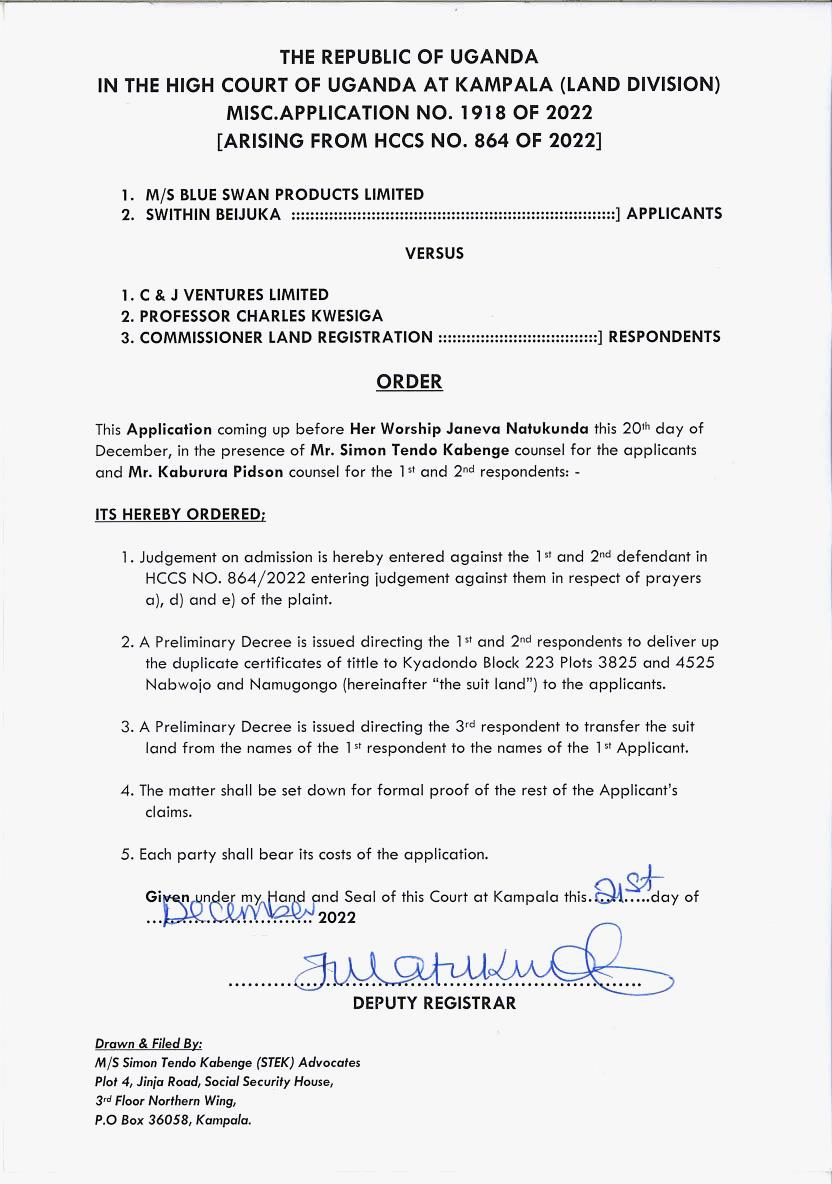
Following the ignored demand notice, Blue Swan Products filed High Court Civil Suit No. 864 of 2022, together with Miscellaneous Application No. 1918 of 2022 seeking judgment on admission.
On December 20, 2022, the High Court Land Division granted the application.
The court entered judgment on admission against C&J Ventures Ltd and Prof. Charles Kwesiga, ordering them to immediately surrender the duplicate certificates of title for Kyaddondo Block 223 Plots 3825 and 4525.
The court further directed the Commissioner for Land Registration to transfer ownership of the land into the names of Blue Swan Products Ltd.
Following that order, the land titles were finally surrendered and the property was successfully transferred.
However, the Toyota car remained in Prof. Kwesiga’s possession.
That forced Blue Swan Products and Beijuka to continue with the remaining claims before the High Court, seeking recovery of the vehicle and compensation.
FORMER BOSS VS FORMER EMPLOYEE
During the hearing, Swithin Beijuka told court he personally knew Prof. Kwesiga because he had previously worked under him at UIRI.
He testified that he trusted his former boss enough to hand over the vehicle at UIRI without demanding formal documentation.
According to Beijuka, Prof. Kwesiga promised to return the vehicle after the outstanding balance of the purchase price had been cleared.
When payment was completed, however, Prof. Kwesiga allegedly became elusive, forcing him to lodge caveats on the land before filing suit.
KWESIGA INSISTS CAR WAS PAYMENT
Prof. Kwesiga maintained throughout the proceedings that the land had first been valued at Shs400 million before he agreed to sell it at Shs380 million.
He argued that the car, valued at Shs80 million, was voluntarily surrendered as part payment.
He further told court that he had remained in possession of the vehicle since receiving it and had been using it for domestic purposes.
However, under cross-examination, several cracks appeared in his defence.
Prof. Kwesiga admitted that the vehicle remained legally registered in Swithin Beijuka’s names.
He also admitted having no written authority permitting transfer of ownership.
The car in question parked at Kwesiga’s home
Most importantly, he conceded that he possessed no written agreement proving the vehicle formed part of the purchase price.
When shown the signed sale agreement, he acknowledged that the only purchase price appearing in the document was Shs300 million.
He also admitted receiving all instalments towards that amount and confirmed that the land had since been transferred into Blue Swan Products Ltd’s names.
KEY WITNESS FAILS TO SAVE DEFENCE
The defence also called engineer Spencer Sabiti, who testified that he had witnessed meetings between the parties over the land transaction.
Sabiti claimed that Beijuka once tore up an acknowledgment indicating the vehicle formed part of the transaction.
But under cross-examination, Sabiti admitted he had not been present when the vehicle arrangement was allegedly made.
He further acknowledged that no document existed proving the car officially became part of the purchase price.
JUDGE REJECTS ORAL CLAIMS
Justice Flavia Nassuna Matovu ruled that Ugandan law does not permit parties to contradict the terms of a written agreement using unsupported oral evidence.
The court observed that the sale agreement clearly fixed the purchase price at Shs300 million.
If the alleged additional agreement involving the Shs80 million vehicle truly existed, the judge held, the law required it to be reduced into writing.
No such document was ever produced.
The court therefore concluded that the Toyota car had merely been handed over as security pending completion of payment.
Once the balance was cleared, the vehicle ought to have been returned.
Justice Matovu also rejected Prof. Kwesiga’s argument that Beijuka lacked company authority to pledge the vehicle.
The judge held that Prof. Kwesiga willingly accepted the vehicle without demanding any company resolution and therefore could not later rely on that omission to justify retaining it.
Invoking the equitable principle that “he who comes to equity must come with clean hands,” the judge ruled that Prof. Kwesiga could not benefit from an irregularity in which he had willingly participated.
FINAL ORDERS
Justice Matovu entered judgment in favour of Blue Swan Products Ltd and Swithin Beijuka.
The court declared that Swithin Beijuka remains the lawful owner of Motor Vehicle Registration No. UBJ 928Y.
Prof. Charles Kwesiga was ordered to return the vehicle forthwith.
He was also directed to pay Shs5 million in general damages for unlawfully retaining the vehicle, while the defendants were condemned to pay the costs of the suit.
With the High Court having now spoken twice in the long-running dispute, all eyes are on Prof. Charles Kwesiga.
The UIRI Executive Director first resisted handing over the duplicate certificates of title until the High Court entered judgment against him and ordered their release, paving the way for the transfer of the Namugongo land into Blue Swan Products Ltd’s names.
Now, another court has ordered him to immediately return Motor Vehicle Registration No. UBJ 928Y, pay Shs5 million in general damages, and settle the costs of the suit.
The car in question parked at Kwesiga’s home
The big question is whether Prof. Kwesiga will voluntarily comply with the latest judgment or whether the dispute is headed for yet another courtroom battle.
If the orders are not obeyed, the successful parties may choose to commence enforcement proceedings available under the law. Depending on the circumstances and the procedures followed, these could include applications relating to execution of the judgment, garnishee proceedings if a monetary decree remains unpaid, or contempt of court proceedings for alleged non-compliance with court orders. Any such remedies would require further legal action and court determination.
For now, the ball is firmly in Prof. Kwesiga’s court.
GOT A HOT STORY? LET US KNOW!
Got breaking news, explosive secrets, or hard evidence?
Ruth alleges that she has been raising the child on her own, covering school fees, daily expenses and other necessities without financial assistance from the rapper.
She also warned that she could publicly disclose information about Kamenyo if he does not address her concerns and take responsibility for their son.
A person familiar with the matter said Ruth has grown increasingly frustrated after allegedly carrying the responsibility of raising the child for an extended period.
Kamenyo has yet to comment on the allegations, and there has been no public response from him at the time of writing.
If you ask most young people where they learned about sex, chances are the answer will not be “school.” It will be TikTok, YouTube, a cousin, or simply figuring things out through trial and error.
For something that affects almost everyone, sex education remains one of the most uncomfortable conversations in many homes and classrooms.
Parents avoid it because they find it embarrassing. Teachers often rush through it because they have limited time or must follow strict guidelines.
As a result, many young people are left to piece together information from the internet, where facts and myths exist side by side.
The result is a generation that can name every dating trend, such as “soft launching,” but may still have basic questions about consent, contraception, sexually transmitted infections, and healthy relationships.
The problem is not just a lack of information. It is also the type of information that is available.
Social media has become a major source of education, but it was not designed to be a classroom.
One video may contain medically accurate advice, while the next spreads misinformation. This can leave young people confused about what is true.
Sex education is often misunderstood as simply teaching people how to have sex.
In reality, comprehensive sex education is much broader. It can include topics such as consent, respect, communication, contraception, prevention of sexually transmitted infections, anatomy, puberty, digital safety, and recognizing unhealthy or abusive relationships.
These conversations matter because relationships today do not exist only in person.
They also develop through Snapchat streaks and disappearing messages. Modern relationships come with new challenges that many traditional lessons never covered.
Another common misconception is that talking about sex encourages young people to become sexually active.
However, that is not the case. Research has shown that comprehensive sex education helps young people make more informed decisions and is associated with safer behaviors rather than encouraging earlier sexual activity.
Of course, people disagree about what should be taught, when it should be introduced, and who should teach it.
Regardless, one fact remains: young people will ask questions, and silence does not stop curiosity. It simply changes where they look for information.
Perhaps the goal of sex education should not be to tell young people what choices to make.
Instead, it should provide accurate information so they can make informed and responsible decisions while respecting their own values and those of their families.
Knowledge does not remove personal responsibility. It makes responsible choices more possible.
King Saha has received support from an unexpected source ahead of his August 14 concert after former presidential candidate Munyagwa Mubarak Sserunga, popularly known as Mugati Gwa Bata, publicly urged fans to attend the show.
Speaking on Sanyuka TV, Munyagwa encouraged music lovers to turn up for the concert at Kololo Airstrip despite the public disagreement the two once had.
I call upon everyone to come and support Saha’s show at Kololo Airstrip on 14th August.
The endorsement comes years after the pair clashed over politics when King Saha questioned Munyagwa’s suitability for the presidency.
Munyagwa said he only responded because he felt the singer had unfairly criticized his political ambitions.
I was simply responding to him because he came out and talked badly about me when I stood for the presidency. He was putting me down, so I had to answer him.
Looking back, Munyagwa admitted that politics influenced some of the remarks he made during that period.
He insisted they never reflected how he truly felt about King Saha’s music.
I am a propagandist. I had to pretend that I did not like his music, but the truth is I do. I enjoy his song ‘Mpa Love.’
His latest remarks mark a sharp contrast to their earlier exchanges, with the former presidential candidate now openly backing both King Saha’s music and his upcoming concert.
Vivienne Jolie-Pitt has filed a legal petition to remove “Pitt” from her last name.
According to court documents, the 18-year-old wants to change her legal name from Vivienne Marcheline Jolie-Pitt to Vivienne Marcheline Jolie. The filing states that the request is for “personal” reasons.
Vivienne is the latest of Brad Pitt and Angelina Jolie‘s children to seek a name change. Her sister Shiloh legally dropped “Pitt” from her surname after turning 18, while Zahara and Maddox have also moved to use the Jolie name.
The move follows a change Vivienne had already made publicly. In 2024, she was credited as “Vivienne Jolie” in the Playbill for the Broadway production of “The Outsiders,” which she helped produce alongside her mother.
Brad Pitt and Angelina Jolie finalized their divorce in late 2024 after years of legal proceedings. They continue to face each other in court over Château Miraval, the French winery they once jointly owned.
Kyambogo University’s Academic Registrar has summoned more than 100 students to appear before the Senate Examinations Committee in the Faculty of Arts and Humanities Board Room, with hearings scheduled to run over three days between Tuesday, 28th July and Thursday, 30th July 2026, starting at 10:00 am each day.
According to the notice, affected students are required to collect their invitation letter and charge sheet from the Examination Division, Block 2, Room 6, ahead of their scheduled appearance. Students have been asked to check the official list to confirm which of the three dates they have been assigned to, and to appear on that specific day.
ADVERTISEMENT
Students named on the list are advised to visit the Examination Division promptly to collect their invitation letter and charge sheet, as these documents will outline the specific matter they are required to respond to before the Committee. Given the tight timeline before the first hearing date, affected students are encouraged to act quickly rather than wait until the last moment.
Given the sensitivity of individual disciplinary and examinations matters, CampusBee is not publishing the full list of names here. Students who believe they may be affected should check directly with Kyambogo University’s Examination Division or their faculty’s notice board to confirm their status.
CampusBee will continue to follow up on outcomes from the Senate Examinations Committee proceedings as they are made public through official channels.
About UGNEWS24
UGNEWS24 is a Uganda local news service, a product of
SOLAVIA GROUP LIMITED,
Reg. No. 80048169153974.