Blog

  • Why Kyambogo University Sports Management Graduates Cannot Be Recognised As PE Teachers

    Why Kyambogo University Sports Management Graduates Cannot Be Recognised As PE Teachers

    A long-running dispute between Kyambogo University and a group of its former students has reignited questions over what actually qualifies someone to teach in Uganda’s secondary schools, with the university insisting that a Diploma in Sports Management was never meant to produce classroom teachers.

    The graduates, who joined the university in 2017 and are led by Haruna Muwanguzi and Julius Kimanje, say they enrolled expecting to come out as secondary school Physical Education teachers. Instead, they were awarded Diplomas in Sports Management, a qualification that has since been rejected by the Ministry of Education and Sports, the Education Service Commission, and other potential employers when the graduates sought jobs as PE teachers.

    ADVERTISEMENT

    Kyambogo University sees it differently. According to Vice Chancellor Prof. Eli Katunguka, the graduates completed exactly what their academic records show, an accredited Diploma in Sports Management, not a teacher training programme. He explained that any reference to a Diploma in Physical Education and Sports Management was the result of an admission error corrected early in the course, and clarified that PE falls under the department of education while sports management sits in the department of sports science.

    What Actually Makes Someone A Teacher

    Education expert Prof. George Wilson Kasule weighed in on the dispute, explaining that knowing a subject well is not the same as being trained to teach it. He described teacher education as a distinct professional pathway that combines subject knowledge with the skills needed to run a classroom, plan lessons, and assess learners.

    Kasule pointed out that every recognised teacher training programme includes a set of compulsory foundation courses, among them the psychology, sociology, and philosophy of education, alongside pedagogy, curriculum studies, education management, assessment, guidance and counselling, and educational technology. He added that supervised teaching practice, where trainees are placed in real schools to teach under supervision, is another core requirement student teachers must complete.

    A review of the graduates’ transcripts reportedly shows four semesters heavy on sports management, sports administration, and various sports disciplines, plus general courses like communication skills and computer applications. None of the professional education courses Kasule described, including teaching practice, appear on those transcripts.

    Katunguka has also pushed back on the graduates directly, asking them to specify which teaching subjects they would actually present for registration, since their diploma was never structured as a teacher education qualification in the first place. He suggested the push for recognition may be linked to how competitive and well paid PE positions have become in secondary schools, where the subject is now treated among the science-related disciplines.

    Katunguka’s advice to the graduates has been to treat their Diploma in Sports Management as a stepping stone rather than a teaching credential, and to enrol for a proper education degree that includes Physical Education and other recognised teaching subjects if they want to join the profession.

    The graduates, however, are standing their ground. They have written to the university requesting a meeting with the Vice Chancellor and are pushing for two things: formal letters confirming their qualification is valid for employment and further studies, and compensation for what they call wasted years, lost earnings, and emotional distress.

    Muwanguzi told Uganda Radio Network that the group is still waiting on the university’s response, maintaining that they enrolled and completed the programme genuinely believing they were training to become PE teachers.

    The National Council for Higher Education (NCHE) has since stepped into the matter, writing to Kyambogo University on 3rd July 2026 asking it to respond to the graduates’ complaints. NCHE says it has not yet made any determination on the merits of the case, noting only that Kyambogo had previously been accredited to run a Diploma in Physical Education and Sports Management back in 2010, and a separate Diploma in Sports Management and Administration in 2015.

    That history is now central to the graduates’ questions, as they seek clarity on why they ended up with a qualification that appears distinct from either of the two programmes NCHE says the university was accredited to offer.

    CampusBee will follow this story as it develops.

  • SESEMAT CASH SCANDAL! Schools Accused of Overcharging Parents, Sitting on Millions

    SESEMAT CASH SCANDAL! Schools Accused of Overcharging Parents, Sitting on Millions

    A programme designed to strengthen science and mathematics education in Uganda’s secondary schools is facing a funding crisis as schools collect money from parents but fail to remit the funds to support planned activities.

    Stephen Bigirwa, the SESEMAT coordinator in Bunyoro, said many secondary schools are charging learners far above the approved contribution for the Secondary Science and Mathematics Teachers (SESEMAT) programme, while some remit only part of the money collected or fail to send any funds at all.

    Bigirwa said some schools are demanding between Shs10,000 and Shs30,000 from learners, despite the official contribution being set much lower. His concern, he added, is that after collecting the money, some schools do not remit any funds to SESEMAT, leaving planned teacher training and learner support activities affected.

    SESEMAT was introduced by the Ministry of Education with help from international development partners in 2005 to address poor performance in science subjects, including Biology, Chemistry, Physics and Mathematics. The programme focuses on improving teachers’ skills through continuous professional development, lesson studies, regional workshops and support for curriculum implementation.

    As Uganda rolls out the lower secondary competence-based curriculum, SESEMAT has become a key platform for helping science teachers adopt new teaching approaches, including learner-centred and inquiry-based methods. To support these activities, the Ministry of Education authorised schools to collect Shs1,000 per learner per term as a contribution towards SESEMAT activities.

    According to the Uganda Bureau of Statistics (UBOS), Uganda has more than two million secondary school learners. If every learner contributed the approved Shs1,000 per term, the programme would receive about Shs6 billion annually to support teacher training, student science fairs, seminars and other capacity-building activities. SESEMAT officials say failure by schools to remit the money has affected the organisation of training programmes and other activities aimed at improving science education. Namiti, a SESEMAT official, said some schools delay payments, while others remit amounts far below what they collected from learners.

    Namiti added that the programme has since sought support from other education agencies to compel schools to comply. He added that they have explored working with the Uganda National Examinations Board (UNEB) to request schools to get a certificate of clearance from SESMAT before they are given UNEB examination materials.

    The remittance challenge comes at a time when Uganda is placing greater emphasis on science, technology, engineering and mathematics (STEM) education to improve learning outcomes and prepare learners for a changing labour market. For parents already facing rising education costs, the concern is not only the additional charges but whether the money collected is serving the purpose for which it was introduced.

    Muhammad Keeya, a parent from Nabweru in Wakiso, described the failure by schools to remit SESEMAT funds as a form of mismanagement that requires urgent attention from the Ministry of Education. He said schools often include numerous charges in their fee structures, presenting them as essential contributions, and put pressure on parents and learners to pay.

    “When you read a school circular, there are many items listed as compulsory. If these fees are not paid, our children are sometimes harassed or sent back home. When we later hear that some of this money is not being remitted for the intended purpose, we ask where the government’s oversight is,” he said.

    The concerns over unremitted school collections extend beyond SESEMAT. In recent years, the Uganda National Students’ Association also raised complaints over schools collecting student association funds but failing to forward the money as required, affecting planned activities and programmes.


    GOT A HOT STORY? LET US KNOW!

    Got breaking news, explosive secrets, or hard evidence?

    Email us: redpeppertips@gmail.com

    We accept tips, documents, videos, photos, and recordings—the more evidence you have, the better.

    CONFIDENTIALITY IS OUR TOP PRIORITY. SOURCES ARE ALWAYS PROTECTED!

    About Post Author

  • Comment on Contact Us by Jeffrey Tuh

    Recently I have been exploring numismatics and antiques. I love reading about the stories behind old coins and valuable antiques.
    During one of my searches I found https://groshi.xyz . It was exactly what I was looking for. There was an impressive amount of valuable content about coins.
    What impressed me most was the practical content. Although the project is still developing, it has great potential.
    From what I understand the website will officially launch soon. I’m looking forward to it, because I’m convinced there will be a lot more interesting publications for collectors of historical items.
    If you enjoy coin collecting or antiques, it’s worth keeping an eye on this site. It has the potential to become a great place for collectors.

  • Diamond Platnumz Posts Mystery Woman Hours After Zuchu Announces Split

    Diamond Platnumz Posts Mystery Woman Hours After Zuchu Announces Split

    Just hours after Zuchu announced that she and Diamond Platnumz had ended their relationship and were going through a divorce, the Tanzanian superstar gave fans something else to talk about.

    The singer shared a photo of an unidentified woman on his Instagram Story without a caption or any explanation, immediately prompting questions about who she was and why he had posted her.

    The timing of the post quickly drew attention.

    Coming so soon after Zuchu’s announcement, it led some fans to wonder whether Diamond was hinting at a new chapter in his personal life. Others, however, cautioned against reading too much into a single Instagram Story.

    As the image spread across social media, more people joined the conversation, offering their own theories about the woman’s identity. Despite the growing speculation, none of those claims has been confirmed.

    For now, Diamond Platnumz has neither identified the mystery woman nor explained why he shared her photo, leaving the Story open to interpretation.

  • Davido Dreams of Building a Therapy Center for Former Stars

    Davido Dreams of Building a Therapy Center for Former Stars

    Davido has revealed that one of his biggest ambitions outside music is to build a therapy center for people who have experienced fame and later struggled with life away from the spotlight.

    The Afrobeats star said the facility would provide emotional and mental health support to people who were once highly successful but later found it difficult to adjust as public attention faded.

    If there was one thing I could build, I would build a school… a center for people that have been popular and very successful before. It’s a center for them to have therapy.

    Davido explained that watching people rise to the top before facing criticism or losing public attention inspired the idea.

    It’s crazy being on top of the world and the next moment you’re not.

    Drawing from the world of football, the singer pointed to Cristiano Ronaldo as an example of how even the most accomplished figures can become targets of public criticism despite years of success.

    Look at Ronaldo. When he left the World Cup, I remember people on the internet were abusing him so much after everything he has done.

    Davido said the experience reinforced his belief that people who have lived under intense public scrutiny need emotional support to navigate life after fame.

    He added that the idea remains a personal dream he hopes to turn into reality one day.

  • ‘Kabiite’ Star Diana Nalubega Explains Why She Disappeared From Music

    ‘Kabiite’ Star Diana Nalubega Explains Why She Disappeared From Music

    Diana Nalubega never planned to disappear from music.

    Yet somewhere along the way, the songs became fewer, public appearances slowed, and she gradually drifted away from the industry.

    Looking back, “Kabiite” singer says there was no defining moment that led to her absence.

    Instead, she told Sanyuka Uncut that life simply took a different direction.

    Photo | VIC MEDIA

    I did not intend to take a break from music, but it just happened. I also became reluctant, and the other things I was doing outside music gradually took the front seat.

    Her absence has often fueled speculation that marriage and pregnancy forced her away from the industry.

    Diana, however, says those assumptions miss the real reason.

    Marriage cannot hinder a musician who knows what they want, especially when their spouse is supportive. As for pregnancy, musicians today give birth and continue with their careers. Those issues do not hold anyone back, and they are not the reason I took a break.

    While Diana Nalubega has finally explained why she stepped away from music, she stopped short of revealing when she plans to return.

  • ‘Jurassic Park’ Star Sam Neill Dies Suddenly at 78

    ‘Jurassic Park’ Star Sam Neill Dies Suddenly at 78

    Hollywood has lost one of its most beloved stars.

    Acclaimed New Zealand actor Sam Neill, best known for playing Dr. Alan Grant in the Jurassic Park franchise, has died suddenly at the age of 78.

    Neill’s family confirmed that he died on Monday in Sydney, Australia, describing his passing as “sudden and unexpected.” They also revealed that he remained cancer-free following his highly publicized battle with stage-three blood cancer.

    Born in Northern Ireland in 1947 and raised in New Zealand, Neill built an acting career that spanned more than five decades.

    Although he appeared in dozens of acclaimed films and television series, he became a global star in 1993 after starring as palaeontologist Dr. Alan Grant in Steven Spielberg’s Jurassic Park. He later returned to the role in Jurassic Park III and Jurassic World Dominion.

    Beyond the dinosaur blockbuster, Neill earned praise for his performances in The Piano, Dead Calm, The Hunt for Red October, Event Horizon and television productions including Peaky Blinders, Merlin, and The Tudors.

    In 2022, New Zealand honored Neill with a knighthood for his services to acting and charitable causes, recognizing a career that made him one of the country’s most celebrated performers.

    Tributes quickly poured in following news of his death.

    Australian Prime Minister Anthony Albanese remembered Neill as an actor who faced illness with “dignity, humour and conviction,” while fellow actors and filmmakers praised his warmth, generosity and extraordinary talent.

    Neill is survived by his four children and eight grandchildren, leaving behind a legacy that spans generations of film lovers and some of cinema’s most memorable performances.

  • HEARTLESS OR HEROIC? Mbarara Hospital Branded Insensitive Over ICU Death Toast Post

    HEARTLESS OR HEROIC? Mbarara Hospital Branded Insensitive Over ICU Death Toast Post

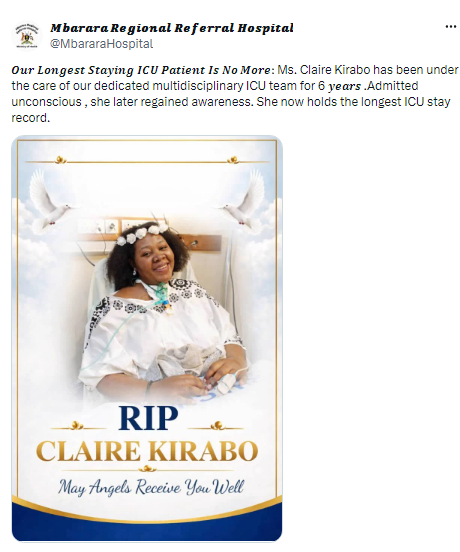
    Mbarara Regional Referral Hospital has found itself at the centre of a social media storm after announcing the death of what it described as its “longest staying ICU patient,” a post that many Ugandans branded insensitive while others defended it as recognition of an extraordinary medical achievement.

    The hospital posted on its official X account: “Our Longest Staying ICU Patient Is No More: Ms. Claire Kirabo has been under the care of our dedicated multidisciplinary ICU team for 6 years. Admitted unconscious, she later regained awareness. She now holds the longest ICU stay record.”

    The announcement immediately triggered heated debate online, with critics accusing the hospital of appearing to celebrate the death of a patient instead of expressing sympathy to her grieving family.

    Claire Kirabo reportedly worked at the Resident District Commissioner’s office in Lwengo District before she was admitted to the Intensive Care Unit. The circumstances that led to her prolonged hospitalization remain unclear.

    The six-year ICU stay has also sparked questions about the financial burden involved. Reports indicate that ICU services at the hospital cost about Shs600,000, prompting many social media users to wonder how much was spent over the six years she remained under intensive care.

    Many users faulted the wording of the hospital’s statement.

    Ludwig questioned whether the hospital had confused professional communication with a search for social media engagement, writing that a family was mourning while the hospital appeared to be celebrating a record.

    Jackline argued that it was not only the hospital that had invested resources in Claire’s care but also the family, saying it was unfortunate that someone could think the end of such a long and costly journey was something to publicize in that manner.

    Grace described the post as “bragging,” while Phiona similarly said the hospital sounded like it was boasting instead of mourning.

    Charlotte strongly criticized the hospital, accusing it of indirectly celebrating someone’s death and questioning the judgment behind publishing such a message.

    Albert also questioned the motive behind highlighting the record, wondering what exactly was being celebrated when a patient had died after years of treatment.

    Nkwasibwe urged people to first understand how unusual a six-year ICU stay is before judging the post, while another Joel took the opposite view, arguing that the hospital should instead celebrate patients recovering quickly rather than remaining in intensive care for years.

    Bonny described it as “the worst celebration in history,” arguing that hospitals should celebrate shorter treatment periods and successful recoveries instead of prolonged ICU admissions.

    Ronald said the message lacked empathy and questioned the thinking behind the communication.

    Zoa criticized the wording, saying describing someone as holding the “longest ICU stay” sounded insensitive because being admitted to intensive care was never an achievement.

    Namanya went even further by claiming the patient had made a mistake staying at the hospital, describing the facility as a “death trap.”

    Others, however, defended the hospital.

    Dr. Oliba Dan Langoya congratulated the hospital’s doctors, nurses and ICU team, saying sustaining a critically ill patient in intensive care for six years was an extraordinary medical accomplishment deserving recognition. He also prayed for Claire’s soul to rest in peace.

    Mugisa argued that keeping a patient alive in ICU for six years was itself a milestone because many critically ill patients die within a much shorter period.

    Sunday described Claire’s journey from being admitted unconscious to later regaining awareness as a remarkable story of resilience and praised the dedication of the caregivers.

    Muleme suggested that most criticism was coming from people without medical backgrounds, while Akandwanaho said the wording might appear controversial to ordinary members of the public but medically represented an important milestone.

    Rodrigo believed the backlash stemmed more from the wording than the intention, suggesting the hospital administration could have communicated the achievement more carefully.

    Omar praised the specialists for extending Claire’s life by six years despite the severity of her condition, while Nicholas said such a prolonged ICU stay deserved to be documented as a medical case report.

    Baraka questioned whether the hospital had sought the family’s consent before turning Claire’s story into a public relations message.

    The post has since attracted mixed reactions, with many agreeing that while sustaining a patient in intensive care for six years is an extraordinary medical feat, the language used by the hospital failed to strike the delicate balance between celebrating the dedication of healthcare workers and showing compassion to a family grieving the loss of a loved one. The debate has reignited broader discussions about how health institutions should communicate sensitive matters involving patients and bereaved families in the age of social media.


    GOT A HOT STORY? LET US KNOW!

    Got breaking news, explosive secrets, or hard evidence?

    Email us: redpeppertips@gmail.com

    We accept tips, documents, videos, photos, and recordings—the more evidence you have, the better.

    CONFIDENTIALITY IS OUR TOP PRIORITY. SOURCES ARE ALWAYS PROTECTED!

    About Post Author

  • ONGADIA ROBERT PHILLIP: Corrupt Officials Face The Heat As Government Tightens The Noose

    ONGADIA ROBERT PHILLIP: Corrupt Officials Face The Heat As Government Tightens The Noose

    When the shepherd sleeps, the wolves rejoice.” This African proverb captures the reality that has, for years, frustrated many Ugandans. Public resources intended to transform communities have too often been undermined by corruption, negligence, abuse of office, and weak accountability. As a patriotic Ugandan, I therefore welcome the renewed commitment by the Ministry of Local Government to strengthen oversight and promote accountability across local governments.

    The appointment of new leadership Hon. Balaam Barugahara and Hon Justine Nameere in the Ministry has rekindled hope among citizens who have long demanded that public resources reach the people for whom they are intended. Local governments are the closest arm of government to ordinary Ugandans. They are responsible for delivering essential services such as education, healthcare, roads, sanitation, water, and community development. When these institutions fail, it is the ordinary citizen who bears the greatest burden.

    For years, Ugandans have heard countless reports from oversight institutions highlighting challenges such as ghost workers, ghost pupils, abandoned government projects, inflated procurement costs, shoddy road works, and misuse of public funds. Successive reports from the Auditor General and parliamentary oversight committees have repeatedly pointed to weaknesses in financial management and accountability. These findings demonstrate that corruption is not merely an individual problem but a systemic challenge that demands sustained action.

    Uganda is not short of laws. The challenge has often been consistent implementation. Our Constitution under National Objective XXVI requires accountability from all public officers. Article 17 places a duty on every citizen to combat corruption and misuse of public property. The Leadership Code Act, the Anti-Corruption Act, 2009, the Public Finance Management Act, 2015, the Local Governments Act, the Public Procurement and Disposal of Public Assets Act, and the Inspectorate of Government Act collectively provide a comprehensive legal framework to promote transparency and punish abuse of office. The question has never been whether laws exist; it has been whether they are applied impartially and consistently.

    Recent accountability efforts within local governments should therefore not be viewed as a political spectacle but as an opportunity to restore public confidence. If investigations reveal irregularities involving ghost workers, ghost learners, inflated contracts, diversion of funds, or procurement fraud, those responsible should be subjected to due process regardless of their political affiliation, social status, or region of the country. Justice must not only be done but must also be seen to be done.


    As the saying goes, “A fish begins to rot from the head.” If corruption exists within local governments, it is important to appreciate that such practices may involve networks extending beyond individual districts. Accountability should therefore follow the entire chain of responsibility wherever credible evidence leads. Equally, innocent officers should not be condemned merely because investigations are underway. Every person is entitled to due process and the presumption of innocence until proven guilty.

    The education sector offers an important example. Every shilling allocated for Universal Primary Education or Universal Secondary Education should ultimately benefit learners. Where audits uncover ghost learners, inflated enrolment figures, absenteeism, or diversion of scholastic resources, those responsible should be held accountable. Similarly, the health sector must ensure that medicines reach health facilities, health workers are present, and public funds improve patient care. Roads financed by taxpayers should serve communities for their intended lifespan rather than deteriorate shortly after construction because of poor workmanship or substandard materials.

    Recruitment into public service is another area that deserves close attention. Public employment should be based on merit, competence, and fairness as envisaged under the Constitution and relevant public service regulations. Allegations of bribery, favouritism, or exploitation in recruitment processes, whenever established through lawful investigations, undermine public trust and deny deserving Ugandans equal opportunities.

    The anti-corruption campaign should equally avoid regional selectivity. Corruption has no tribe, religion, or region. It is a national challenge requiring a national response. Whether in the Central, Eastern, Northern, Western, or Karamoja sub-regions, public officers should be held to the same standards of accountability. The law should never wear tribal or political colours.

    Professional bodies also have a responsibility. Engineers, accountants, lawyers, procurement professionals, auditors, and planners should remember that professional ethics are not ornaments to decorate offices but principles to guide conduct. Protecting wrongdoing in the name of professional solidarity only deepens public mistrust. As another proverb reminds us, “One rotten fruit spoils the basket.”

    Citizens equally have a role to play. Fighting corruption cannot be left to government agencies alone. Communities should monitor public projects, attend accountability meetings, demand value for money, report suspected wrongdoing through lawful channels, and support whistle-blowers acting in good faith. Silence in the face of corruption only strengthens those who abuse public trust.

    President Yoweri Kaguta Museveni’s call for a “Kisanja of No More Sleep and No More Corruption” will only become meaningful if it translates into measurable improvements in service delivery. Schools should produce better learning outcomes, health centres should provide quality care, roads should last, public funds should reach intended beneficiaries, and public servants should perform their duties diligently.

    Where investigations establish negligence, abuse of office, or corruption, disciplinary action and prosecution should follow the law. Routine transfers should never become substitutes for accountability where the evidence warrants stronger action. Equally, officers who perform with integrity deserve recognition and protection.

    In conclusion, I commend every honest public servant, investigator, auditor, community leader, journalist, whistle-blower, and citizen who contributes to safeguarding public resources. Building Uganda is a collective responsibility. As the African proverb wisely teaches, “When spider webs unite, they can tie up a lion.” If government institutions, professional bodies, civil society, and ordinary citizens unite in defending integrity, corruption will gradually lose its grip.

    Our taxes should build schools not private fortunes; equip hospitals not hidden bank accounts; construct durable roads not monuments to waste. The true measure of patriotism is not found in slogans but in faithful stewardship of the resources entrusted to us.

    Long live Uganda, long live H.E Yoweri K.T. Museveni and may integrity, accountability, and service to the people remain the guiding principles of our nation.

    Ongadia Robert Phillip – NRM Mobilizer and Coordinator UCAFNET -Jinja 


    Do you have a story in your community or an opinion to share with us: Email us at Submit an Article

  • Nina Roz Vows to Keep Searching Until She Finds True Love

    Nina Roz Vows to Keep Searching Until She Finds True Love

    Love may not have worked out the way Nina Roz hoped in the past, but the singer has not lost faith in finding the right person.

    While many people become discouraged after failed relationships, Nina Roz says she remains optimistic that the man meant for her is still out there.

    That confidence came through during her appearance on Sanyuka TV‘s Weekender, where she opened up about her outlook on love.

    I will not stop until I find the one who is truly mine. I will get them here in Uganda. I cannot fail to get him here.

    The “Billboard Kipande” hitmaker expressed confidence that she will find love without looking beyond Uganda, insisting that her future partner is closer than many might think.

    For now, she remains patient, choosing to hold on to hope as she continues her search for lasting love.

About UGNEWS24

UGNEWS24 is a Uganda local news service, a product of SOLAVIA GROUP LIMITED, Reg. No. 80048169153974.

Registered office

Plot 2335, Buwambo-Katadde-Najjo Road,
Nansana Municipality, Wakiso District, Uganda
P.O. Box 214231, Kampala

© 2026 SOLAVIA GROUP LIMITED. All rights reserved.