The singer shared a photo of an unidentified woman on his Instagram Story without a caption or any explanation, immediately prompting questions about who she was and why he had posted her.
The timing of the post quickly drew attention.
Coming so soon after Zuchu’s announcement, it led some fans to wonder whether Diamond was hinting at a new chapter in his personal life. Others, however, cautioned against reading too much into a single Instagram Story.
As the image spread across social media, more people joined the conversation, offering their own theories about the woman’s identity. Despite the growing speculation, none of those claims has been confirmed.
For now, Diamond Platnumz has neither identified the mystery woman nor explained why he shared her photo, leaving the Story open to interpretation.
Davido has revealed that one of his biggest ambitions outside music is to build a therapy center for people who have experienced fame and later struggled with life away from the spotlight.
The Afrobeats star said the facility would provide emotional and mental health support to people who were once highly successful but later found it difficult to adjust as public attention faded.
If there was one thing I could build, I would build a school… a center for people that have been popular and very successful before. It’s a center for them to have therapy.
Davido explained that watching people rise to the top before facing criticism or losing public attention inspired the idea.
It’s crazy being on top of the world and the next moment you’re not.
Drawing from the world of football, the singer pointed to Cristiano Ronaldo as an example of how even the most accomplished figures can become targets of public criticism despite years of success.
Look at Ronaldo. When he left the World Cup, I remember people on the internet were abusing him so much after everything he has done.
Davido said the experience reinforced his belief that people who have lived under intense public scrutiny need emotional support to navigate life after fame.
He added that the idea remains a personal dream he hopes to turn into reality one day.
Yet somewhere along the way, the songs became fewer, public appearances slowed, and she gradually drifted away from the industry.
Looking back, “Kabiite” singer says there was no defining moment that led to her absence.
Instead, she told Sanyuka Uncut that life simply took a different direction.
Photo | VIC MEDIA
I did not intend to take a break from music, but it just happened. I also became reluctant, and the other things I was doing outside music gradually took the front seat.
Her absence has often fueled speculation that marriage and pregnancy forced her away from the industry.
Diana, however, says those assumptions miss the real reason.
Marriage cannot hinder a musician who knows what they want, especially when their spouse is supportive. As for pregnancy, musicians today give birth and continue with their careers. Those issues do not hold anyone back, and they are not the reason I took a break.
While Diana Nalubega has finally explained why she stepped away from music, she stopped short of revealing when she plans to return.
Acclaimed New Zealand actor Sam Neill, best known for playing Dr. Alan Grant in the Jurassic Park franchise, has died suddenly at the age of 78.
Neill’s family confirmed that he died on Monday in Sydney, Australia, describing his passing as “sudden and unexpected.” They also revealed that he remained cancer-free following his highly publicized battle with stage-three blood cancer.
Born in Northern Ireland in 1947 and raised in New Zealand, Neill built an acting career that spanned more than five decades.
Although he appeared in dozens of acclaimed films and television series, he became a global star in 1993 after starring as palaeontologist Dr. Alan Grant in Steven Spielberg’s Jurassic Park. He later returned to the role in Jurassic Park III and Jurassic World Dominion.
Beyond the dinosaur blockbuster, Neill earned praise for his performances in The Piano, Dead Calm, The Hunt for Red October, Event Horizon and television productions including Peaky Blinders, Merlin, and The Tudors.
In 2022, New Zealand honored Neill with a knighthood for his services to acting and charitable causes, recognizing a career that made him one of the country’s most celebrated performers.
Tributes quickly poured in following news of his death.
Australian Prime Minister Anthony Albanese remembered Neill as an actor who faced illness with “dignity, humour and conviction,” while fellow actors and filmmakers praised his warmth, generosity and extraordinary talent.
Neill is survived by his four children and eight grandchildren, leaving behind a legacy that spans generations of film lovers and some of cinema’s most memorable performances.
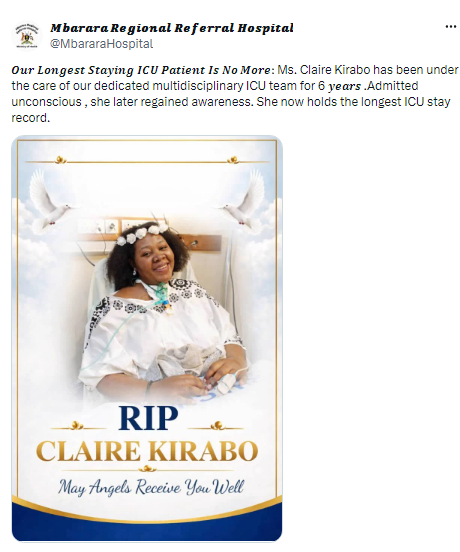
Mbarara Regional Referral Hospital has found itself at the centre of a social media storm after announcing the death of what it described as its “longest staying ICU patient,” a post that many Ugandans branded insensitive while others defended it as recognition of an extraordinary medical achievement.
The hospital posted on its official X account: “Our Longest Staying ICU Patient Is No More: Ms. Claire Kirabo has been under the care of our dedicated multidisciplinary ICU team for 6 years. Admitted unconscious, she later regained awareness. She now holds the longest ICU stay record.”
The announcement immediately triggered heated debate online, with critics accusing the hospital of appearing to celebrate the death of a patient instead of expressing sympathy to her grieving family.
Claire Kirabo reportedly worked at the Resident District Commissioner’s office in Lwengo District before she was admitted to the Intensive Care Unit. The circumstances that led to her prolonged hospitalization remain unclear.
The six-year ICU stay has also sparked questions about the financial burden involved. Reports indicate that ICU services at the hospital cost about Shs600,000, prompting many social media users to wonder how much was spent over the six years she remained under intensive care.
Many users faulted the wording of the hospital’s statement.
Ludwig questioned whether the hospital had confused professional communication with a search for social media engagement, writing that a family was mourning while the hospital appeared to be celebrating a record.
Jackline argued that it was not only the hospital that had invested resources in Claire’s care but also the family, saying it was unfortunate that someone could think the end of such a long and costly journey was something to publicize in that manner.
Grace described the post as “bragging,” while Phiona similarly said the hospital sounded like it was boasting instead of mourning.
Charlotte strongly criticized the hospital, accusing it of indirectly celebrating someone’s death and questioning the judgment behind publishing such a message.
Albert also questioned the motive behind highlighting the record, wondering what exactly was being celebrated when a patient had died after years of treatment.
Nkwasibwe urged people to first understand how unusual a six-year ICU stay is before judging the post, while another Joel took the opposite view, arguing that the hospital should instead celebrate patients recovering quickly rather than remaining in intensive care for years.
Bonny described it as “the worst celebration in history,” arguing that hospitals should celebrate shorter treatment periods and successful recoveries instead of prolonged ICU admissions.
Ronald said the message lacked empathy and questioned the thinking behind the communication.
Zoa criticized the wording, saying describing someone as holding the “longest ICU stay” sounded insensitive because being admitted to intensive care was never an achievement.
Namanya went even further by claiming the patient had made a mistake staying at the hospital, describing the facility as a “death trap.”
Others, however, defended the hospital.
Dr. Oliba Dan Langoya congratulated the hospital’s doctors, nurses and ICU team, saying sustaining a critically ill patient in intensive care for six years was an extraordinary medical accomplishment deserving recognition. He also prayed for Claire’s soul to rest in peace.
Mugisa argued that keeping a patient alive in ICU for six years was itself a milestone because many critically ill patients die within a much shorter period.
Sunday described Claire’s journey from being admitted unconscious to later regaining awareness as a remarkable story of resilience and praised the dedication of the caregivers.
Muleme suggested that most criticism was coming from people without medical backgrounds, while Akandwanaho said the wording might appear controversial to ordinary members of the public but medically represented an important milestone.
Rodrigo believed the backlash stemmed more from the wording than the intention, suggesting the hospital administration could have communicated the achievement more carefully.
Omar praised the specialists for extending Claire’s life by six years despite the severity of her condition, while Nicholas said such a prolonged ICU stay deserved to be documented as a medical case report.
Baraka questioned whether the hospital had sought the family’s consent before turning Claire’s story into a public relations message.
The post has since attracted mixed reactions, with many agreeing that while sustaining a patient in intensive care for six years is an extraordinary medical feat, the language used by the hospital failed to strike the delicate balance between celebrating the dedication of healthcare workers and showing compassion to a family grieving the loss of a loved one. The debate has reignited broader discussions about how health institutions should communicate sensitive matters involving patients and bereaved families in the age of social media.
GOT A HOT STORY? LET US KNOW!
Got breaking news, explosive secrets, or hard evidence?
“When the shepherd sleeps, the wolves rejoice.” This African proverb captures the reality that has, for years, frustrated many Ugandans. Public resources intended to transform communities have too often been undermined by corruption, negligence, abuse of office, and weak accountability. As a patriotic Ugandan, I therefore welcome the renewed commitment by the Ministry of Local Government to strengthen oversight and promote accountability across local governments.
The appointment of new leadership Hon. Balaam Barugahara and Hon Justine Nameere in the Ministry has rekindled hope among citizens who have long demanded that public resources reach the people for whom they are intended. Local governments are the closest arm of government to ordinary Ugandans. They are responsible for delivering essential services such as education, healthcare, roads, sanitation, water, and community development. When these institutions fail, it is the ordinary citizen who bears the greatest burden.
For years, Ugandans have heard countless reports from oversight institutions highlighting challenges such as ghost workers, ghost pupils, abandoned government projects, inflated procurement costs, shoddy road works, and misuse of public funds. Successive reports from the Auditor General and parliamentary oversight committees have repeatedly pointed to weaknesses in financial management and accountability. These findings demonstrate that corruption is not merely an individual problem but a systemic challenge that demands sustained action.
Uganda is not short of laws. The challenge has often been consistent implementation. Our Constitution under National Objective XXVI requires accountability from all public officers. Article 17 places a duty on every citizen to combat corruption and misuse of public property. The Leadership Code Act, the Anti-Corruption Act, 2009, the Public Finance Management Act, 2015, the Local Governments Act, the Public Procurement and Disposal of Public Assets Act, and the Inspectorate of Government Act collectively provide a comprehensive legal framework to promote transparency and punish abuse of office. The question has never been whether laws exist; it has been whether they are applied impartially and consistently.
Recent accountability efforts within local governments should therefore not be viewed as a political spectacle but as an opportunity to restore public confidence. If investigations reveal irregularities involving ghost workers, ghost learners, inflated contracts, diversion of funds, or procurement fraud, those responsible should be subjected to due process regardless of their political affiliation, social status, or region of the country. Justice must not only be done but must also be seen to be done.
As the saying goes, “A fish begins to rot from the head.” If corruption exists within local governments, it is important to appreciate that such practices may involve networks extending beyond individual districts. Accountability should therefore follow the entire chain of responsibility wherever credible evidence leads. Equally, innocent officers should not be condemned merely because investigations are underway. Every person is entitled to due process and the presumption of innocence until proven guilty.
The education sector offers an important example. Every shilling allocated for Universal Primary Education or Universal Secondary Education should ultimately benefit learners. Where audits uncover ghost learners, inflated enrolment figures, absenteeism, or diversion of scholastic resources, those responsible should be held accountable. Similarly, the health sector must ensure that medicines reach health facilities, health workers are present, and public funds improve patient care. Roads financed by taxpayers should serve communities for their intended lifespan rather than deteriorate shortly after construction because of poor workmanship or substandard materials.
Recruitment into public service is another area that deserves close attention. Public employment should be based on merit, competence, and fairness as envisaged under the Constitution and relevant public service regulations. Allegations of bribery, favouritism, or exploitation in recruitment processes, whenever established through lawful investigations, undermine public trust and deny deserving Ugandans equal opportunities.
The anti-corruption campaign should equally avoid regional selectivity. Corruption has no tribe, religion, or region. It is a national challenge requiring a national response. Whether in the Central, Eastern, Northern, Western, or Karamoja sub-regions, public officers should be held to the same standards of accountability. The law should never wear tribal or political colours.
Professional bodies also have a responsibility. Engineers, accountants, lawyers, procurement professionals, auditors, and planners should remember that professional ethics are not ornaments to decorate offices but principles to guide conduct. Protecting wrongdoing in the name of professional solidarity only deepens public mistrust. As another proverb reminds us, “One rotten fruit spoils the basket.”
Citizens equally have a role to play. Fighting corruption cannot be left to government agencies alone. Communities should monitor public projects, attend accountability meetings, demand value for money, report suspected wrongdoing through lawful channels, and support whistle-blowers acting in good faith. Silence in the face of corruption only strengthens those who abuse public trust.
President Yoweri Kaguta Museveni’s call for a “Kisanja of No More Sleep and No More Corruption” will only become meaningful if it translates into measurable improvements in service delivery. Schools should produce better learning outcomes, health centres should provide quality care, roads should last, public funds should reach intended beneficiaries, and public servants should perform their duties diligently.
Where investigations establish negligence, abuse of office, or corruption, disciplinary action and prosecution should follow the law. Routine transfers should never become substitutes for accountability where the evidence warrants stronger action. Equally, officers who perform with integrity deserve recognition and protection.
In conclusion, I commend every honest public servant, investigator, auditor, community leader, journalist, whistle-blower, and citizen who contributes to safeguarding public resources. Building Uganda is a collective responsibility. As the African proverb wisely teaches, “When spider webs unite, they can tie up a lion.” If government institutions, professional bodies, civil society, and ordinary citizens unite in defending integrity, corruption will gradually lose its grip.
Our taxes should build schools not private fortunes; equip hospitals not hidden bank accounts; construct durable roads not monuments to waste. The true measure of patriotism is not found in slogans but in faithful stewardship of the resources entrusted to us.
Long live Uganda, long live H.E Yoweri K.T. Museveni and may integrity, accountability, and service to the people remain the guiding principles of our nation.
Ongadia Robert Phillip – NRM Mobilizer and Coordinator UCAFNET -Jinja
Do you have a story in your community or an opinion to share with us: Email us at Submit an Article
Love may not have worked out the way Nina Roz hoped in the past, but the singer has not lost faith in finding the right person.
While many people become discouraged after failed relationships, Nina Roz says she remains optimistic that the man meant for her is still out there.
That confidence came through during her appearance on Sanyuka TV‘s Weekender, where she opened up about her outlook on love.
I will not stop until I find the one who is truly mine. I will get them here in Uganda. I cannot fail to get him here.
The “Billboard Kipande” hitmaker expressed confidence that she will find love without looking beyond Uganda, insisting that her future partner is closer than many might think.
For now, she remains patient, choosing to hold on to hope as she continues her search for lasting love.
Despite his desire to visit Uganda, Ashton Hall, an American fitness influencer, has revealed that he was unable to do so due to Ebola-related restrictions.
The 30-year-old’s African tour officially kicked off on 28th June 28 and he visited Ghana, Rwanda, and Nigeria in a period of two weeks.
On his list of destinations was Uganda, but he unfortunately could not make it.
While on stream, Ashton Hall revealed that any layover in Uganda would risk him 20 extra days on the continent before he could travel back to the USA.
“If you go through Uganda and have a layover there. You can’t leave Africa they send you back. If I hadn’t landed in Las Vegas, they’d send me back to Africa for 20 days. Because I guess there is an outbreak,” Ashton Hall said.
These are part of the strict guidelines to prevent the Ebola outbreak from making its way to the USA.
Uganda’s bancassurance industry continues to demonstrate remarkable momentum, with banks generating more than UGX 80.8 billion in insurance premiums during the first quarter of 2026 alone. According to the latest industry performance report, Equity Bank Uganda ranked fourth among the country’s 22 licensed bancassurance providers, generating UGX 6.69 billion in Gross Written Premiums (GWP) and capturing an 8.28% market share.
The performance reflects the growing confidence Ugandans have in accessing insurance through trusted financial institutions and highlights the increasingly important role banks are playing in expanding insurance inclusion across the country.
As Uganda’s financial sector continues to evolve, insurance is no longer viewed simply as a product purchased after a loss occurs. Increasingly, it is becoming an essential financial planning tool that protects individuals, families and businesses against unexpected risks while enabling them to recover quickly from life’s uncertainties.
From medical emergencies and accidents to business interruptions, property loss and cyber threats, insurance provides the financial safety net that allows customers to continue pursuing their ambitions with confidence.
One of the biggest drivers behind this shift has been the rapid growth of bancassurance, the distribution of insurance products through banks, which has transformed Uganda’s insurance landscape over the past few years. Rather than requiring customers to visit separate insurance offices, bancassurance enables them to access financial protection through the same trusted institution where they save, invest, borrow and transact.
The latest industry figures illustrate the growing significance of this model: during the first quarter of 2026, Uganda’s banking sector generated UGX 80.81 billion in insurance premiums. Of this, UGX 62.89 billion (78%) came from life insurance, while UGX 17.92 billion (22%) was generated from general insurance.
The figures suggest that more Ugandans are prioritising financial protection for themselves and their families, while businesses increasingly recognise insurance as a critical component of sound risk management.
For Equity Bank Uganda, bancassurance represents far more than an additional banking service. It is a key pillar of the Bank’s broader mission of promoting financial inclusion by helping customers not only grow wealth but also protect it: “At Equity Bank Uganda, we believe that protecting what matters is just as important as creating wealth,” says James Sserumaga, Head of Bancassurance at Equity Bank Uganda. “Insurance enables our customers to manage risks effectively and recover from unexpected setbacks without losing years of progress. Our objective is to make insurance simple, affordable and accessible to every customer.”
Equity Bank’s own performance mirrors the broader industry momentum: during the first quarter of 2026, the Bank generated UGX 6.69 billion in premiums, positioning it among Uganda’s leading bancassurance providers. Notably, 74 percent of the Bank’s premiums, UGX 4.94 billion, came from life insurance products, while UGX 1.75 billion (26 percent) came from general insurance. The performance reflects growing customer demand for solutions that protect incomes, families and long-term financial wellbeing.
Over the past four years, Equity Bank Uganda has steadily expanded its bancassurance offering by making insurance products available through its nationwide branch network, digital banking platforms, relationship managers and the growing Equi-Duuka agency banking network.
This integrated approach is helping remove many of the traditional barriers that have historically limited insurance uptake, including limited access, lack of awareness and the perception that insurance is complex or reserved for high-income earners.
One of the key drivers of this growth has been customer education. For many years, insurance was viewed by some Ugandans as expensive, difficult to understand or only necessary after tragedy struck.
Equity Bank has worked to change this perception by helping customers understand that insurance is an investment in financial resilience rather than an additional expense. Whether a customer is an entrepreneur protecting business assets, a contractor managing project risks, a school safeguarding learners or a family seeking medical protection, the Bank provides tailored insurance solutions designed to meet different needs.
Through Equity Bancassurance, customers can access a comprehensive portfolio that includes Medical Insurance, Life Insurance, Personal Accident Insurance, Motor Insurance, Property Insurance, Burglary Insurance, Fidelity Guarantee Insurance, Machinery Breakdown Insurance, Professional Indemnity Insurance, Contractors All Risk Insurance, Industry All Risk Insurance, Product Liability Insurance, Public Liability Insurance, Business Risk Protection Solutions and EquiShield School Community Cover.
These products help customers mitigate financial losses arising from accidents, theft, equipment failure, professional liabilities, construction risks, workplace incidents, health emergencies and other unforeseen events.
While retail insurance continues to drive premium growth, Equity Bank is also witnessing increasing demand for specialised corporate insurance solutions. As Uganda’s economy becomes more sophisticated, organisations are increasingly seeking comprehensive risk management products covering cyber security, professional indemnity, directors’ and officers’ liability, contractors’ all-risk, property protection, fidelity guarantee, business interruption and medical insurance.
These solutions are becoming increasingly important as businesses strengthen governance, protect investments and improve organisational resilience. According to Sserumaga, the role of banks in insurance distribution extends well beyond selling policies: “Our responsibility is to help customers understand risk and make informed decisions. Insurance should not be viewed as an additional cost but as an investment in stability, business continuity and peace of mind. As customer needs evolve, we must continue working with our insurance partners to develop innovative products that respond to today’s realities while making them available wherever our customers are.”
Equity’s position among Uganda’s leading bancassurance providers reflects a deliberate strategy of integrating insurance into customers’ everyday financial journeys. Rather than treating insurance as a standalone product, the Bank provides protection alongside savings, lending, payments and investment services through multiple customer touchpoints, making it easier for customers to access holistic financial solutions under one roof.
Looking ahead, technology is expected to accelerate the next phase of bancassurance growth.
Digital banking platforms, customer analytics and integrated financial ecosystems are making it easier for banks to offer personalised insurance solutions based on customers’ financial needs and life stages. Increasingly, insurance is no longer viewed as a separate purchase but as an essential part of a customer’s overall financial relationship.
Industry trends also suggest that bancassurance will continue to play a central role in expanding insurance penetration in Uganda by leveraging trusted banking relationships to reach millions of customers who may previously have had limited access to insurance services.
For Equity Bank Uganda, this represents an opportunity to continue deepening financial inclusion while helping customers build greater resilience against life’s uncertainties.
Financial wellbeing is no longer measured solely by the ability to build wealth. It is equally defined by the ability to protect it.
As Uganda’s bancassurance industry continues to grow, Equity Bank Uganda is positioning insurance as an essential pillar of financial inclusion, helping individuals, families, entrepreneurs and businesses manage risk with confidence while making financial protection more accessible through trusted banking relationships.
The Bank’s strong first-quarter performance demonstrates not only the growing demand for insurance but also the increasing confidence customers have in bancassurance as a convenient, affordable and reliable pathway to financial resilience.
By James Sserumaga, Head of Bancassurance, Equity Bank Uganda.
Uganda’s bancassurance industry continues to demonstrate remarkable momentum, with banks generating more than UGX 80.8 billion in insurance premiums during the first quarter of 2026 alone. According to the latest industry performance report, Equity Bank Uganda ranked fourth among the country’s 22 licensed bancassurance providers, generating UGX 6.69 billion in Gross Written Premiums (GWP) and capturing an 8.28% market share.
The performance reflects the growing confidence Ugandans have in accessing insurance through trusted financial institutions and highlights the increasingly important role banks are playing in expanding insurance inclusion across the country.
As Uganda’s financial sector continues to evolve, insurance is no longer viewed simply as a product purchased after a loss occurs. Increasingly, it is becoming an essential financial planning tool that protects individuals, families and businesses against unexpected risks while enabling them to recover quickly from life’s uncertainties.
From medical emergencies and accidents to business interruptions, property loss and cyber threats, insurance provides the financial safety net that allows customers to continue pursuing their ambitions with confidence.
One of the biggest drivers behind this shift has been the rapid growth of bancassurance, the distribution of insurance products through banks, which has transformed Uganda’s insurance landscape over the past few years. Rather than requiring customers to visit separate insurance offices, bancassurance enables them to access financial protection through the same trusted institution where they save, invest, borrow and transact.
The latest industry figures illustrate the growing significance of this model: during the first quarter of 2026, Uganda’s banking sector generated UGX 80.81 billion in insurance premiums. Of this, UGX 62.89 billion (78%) came from life insurance, while UGX 17.92 billion (22%) was generated from general insurance.
The figures suggest that more Ugandans are prioritising financial protection for themselves and their families, while businesses increasingly recognise insurance as a critical component of sound risk management.
For Equity Bank Uganda, bancassurance represents far more than an additional banking service. It is a key pillar of the Bank’s broader mission of promoting financial inclusion by helping customers not only grow wealth but also protect it: “At Equity Bank Uganda, we believe that protecting what matters is just as important as creating wealth,” says James Sserumaga, Head of Bancassurance at Equity Bank Uganda. “Insurance enables our customers to manage risks effectively and recover from unexpected setbacks without losing years of progress. Our objective is to make insurance simple, affordable and accessible to every customer.”
Equity Bank’s own performance mirrors the broader industry momentum: during the first quarter of 2026, the Bank generated UGX 6.69 billion in premiums, positioning it among Uganda’s leading bancassurance providers. Notably, 74 percent of the Bank’s premiums, UGX 4.94 billion, came from life insurance products, while UGX 1.75 billion (26 percent) came from general insurance. The performance reflects growing customer demand for solutions that protect incomes, families and long-term financial wellbeing.
Over the past four years, Equity Bank Uganda has steadily expanded its bancassurance offering by making insurance products available through its nationwide branch network, digital banking platforms, relationship managers and the growing Equi-Duuka agency banking network.
This integrated approach is helping remove many of the traditional barriers that have historically limited insurance uptake, including limited access, lack of awareness and the perception that insurance is complex or reserved for high-income earners.
One of the key drivers of this growth has been customer education. For many years, insurance was viewed by some Ugandans as expensive, difficult to understand or only necessary after tragedy struck.
Equity Bank has worked to change this perception by helping customers understand that insurance is an investment in financial resilience rather than an additional expense. Whether a customer is an entrepreneur protecting business assets, a contractor managing project risks, a school safeguarding learners or a family seeking medical protection, the Bank provides tailored insurance solutions designed to meet different needs.
Through Equity Bancassurance, customers can access a comprehensive portfolio that includes Medical Insurance, Life Insurance, Personal Accident Insurance, Motor Insurance, Property Insurance, Burglary Insurance, Fidelity Guarantee Insurance, Machinery Breakdown Insurance, Professional Indemnity Insurance, Contractors All Risk Insurance, Industry All Risk Insurance, Product Liability Insurance, Public Liability Insurance, Business Risk Protection Solutions and EquiShield School Community Cover.
These products help customers mitigate financial losses arising from accidents, theft, equipment failure, professional liabilities, construction risks, workplace incidents, health emergencies and other unforeseen events.
While retail insurance continues to drive premium growth, Equity Bank is also witnessing increasing demand for specialised corporate insurance solutions. As Uganda’s economy becomes more sophisticated, organisations are increasingly seeking comprehensive risk management products covering cyber security, professional indemnity, directors’ and officers’ liability, contractors’ all-risk, property protection, fidelity guarantee, business interruption and medical insurance.
These solutions are becoming increasingly important as businesses strengthen governance, protect investments and improve organisational resilience. According to Sserumaga, the role of banks in insurance distribution extends well beyond selling policies: “Our responsibility is to help customers understand risk and make informed decisions. Insurance should not be viewed as an additional cost but as an investment in stability, business continuity and peace of mind. As customer needs evolve, we must continue working with our insurance partners to develop innovative products that respond to today’s realities while making them available wherever our customers are.”
Equity’s position among Uganda’s leading bancassurance providers reflects a deliberate strategy of integrating insurance into customers’ everyday financial journeys. Rather than treating insurance as a standalone product, the Bank provides protection alongside savings, lending, payments and investment services through multiple customer touchpoints, making it easier for customers to access holistic financial solutions under one roof.
Looking ahead, technology is expected to accelerate the next phase of bancassurance growth.
Digital banking platforms, customer analytics and integrated financial ecosystems are making it easier for banks to offer personalised insurance solutions based on customers’ financial needs and life stages. Increasingly, insurance is no longer viewed as a separate purchase but as an essential part of a customer’s overall financial relationship.
Industry trends also suggest that bancassurance will continue to play a central role in expanding insurance penetration in Uganda by leveraging trusted banking relationships to reach millions of customers who may previously have had limited access to insurance services.
For Equity Bank Uganda, this represents an opportunity to continue deepening financial inclusion while helping customers build greater resilience against life’s uncertainties.
Financial wellbeing is no longer measured solely by the ability to build wealth. It is equally defined by the ability to protect it.
As Uganda’s bancassurance industry continues to grow, Equity Bank Uganda is positioning insurance as an essential pillar of financial inclusion, helping individuals, families, entrepreneurs and businesses manage risk with confidence while making financial protection more accessible through trusted banking relationships.
The Bank’s strong first-quarter performance demonstrates not only the growing demand for insurance but also the increasing confidence customers have in bancassurance as a convenient, affordable and reliable pathway to financial resilience.
By James Sserumaga, Head of Bancassurance at Equity Bank Uganda.
Related
About UGNEWS24
UGNEWS24 is a Uganda local news service, a product of
SOLAVIA GROUP LIMITED,
Reg. No. 80048169153974.