Blog

  • Moana Live Action Unveils Dwayne Johnson as Maui

    Moana Live Action Unveils Dwayne Johnson as Maui

    Disney’s push into live action remakes continues with “Moana,” and the first preview is already drawing attention.

    The studio revealed Dwayne Johnson as Maui, giving audiences a glimpse of how the animated character will appear in a more realistic setting.

    The design stays close to the original, but the tone feels different.

    The film revisits the story of Moana and her journey across the ocean, a narrative that became a major success when it first released on November 23, 2016.

    As the upcoming Moana live action film nears its July 10, 2026 release, fans remain divided.

    Some welcome the remake, while others question whether the story needed a new version at all.

  • Kyambogo University Opens Applications For 2026/2027 Academic Year

    Kyambogo University Opens Applications For 2026/2027 Academic Year

    All Programmes, Fees, And Minimum Entry Requirements You Need To Know

    Kyambogo University has officially opened online applications for the 2026/2027 Academic Year under the A-Level and Direct Entry Scheme for private sponsorship. If you are a recent A-Level leaver, diploma holder, or degree graduate looking to join one of Uganda’s largest public universities, here is everything you need to know before the deadline closes on Friday, May 15, 2026 at midnight.

    ADVERTISEMENT

    How To Apply

    Applications are submitted exclusively online through the Kyambogo University application portal at https://apply.kyu.ac.ug. After completing the online form, applicants are required to print out a pay-in slip and pay a non-refundable application fee of Shs55,000 for Ugandans and East African nationals, and Shs115,000 for international applicants. Payment is made via bank, through charges linked to the university’s Academic Information Management System (ACMIS).

    Applicants with qualifications from institutions outside Uganda must submit photocopies of equated academic documents from UNEB to the Kyambogo University Admissions Office, Block 2, Room 3, before the closing date.

    For those who encounter difficulties filling in the online form, assistance is available at the Kyambogo University Admissions Office, Block 2, Room 3.

    Minimum Entry Requirements

    To be considered for any Bachelor’s degree programme at Kyambogo, a candidate must hold a Uganda Certificate of Education (UCE) with a minimum of five passes, and at least two Principal Passes in approved Principal Subjects at the same sitting of the Uganda Advanced Certificate of Education (UACE).

    For Diploma programmes, the minimum requirement is a UCE with at least five passes, plus at least one Principal Pass and two Subsidiary Passes in approved Principal Subjects at the same UACE sitting.

    Programmes On Offer

    Kyambogo offers a broad range of programmes across multiple faculties and schools. Below is a summary of what is available by faculty.

    School of Management and Entrepreneurship offers programmes including Bachelor of Business Studies with Education, Bachelor of Business Administration, Bachelor of Science in Accounting and Finance, Bachelor of Administrative and Secretarial Science, Bachelor of Procurement and Logistics Management, Bachelor of Management Science, and Bachelor of Banking and Microfinance. Most require two Principal Passes at A-Level, one of which must be in either Mathematics, Economics, or Entrepreneurship.

    School of Vocational Studies includes Bachelor of Vocational Studies in Home Economics with Education, Bachelor of Science in Human Nutrition and Dietetics, Bachelor of Hotel and Institutional Catering, Bachelor of Fashion and Cosmetology, and several diploma programmes including Diploma in Fashion and Apparel Design, Diploma in Special Needs and Rehabilitation, Bachelor of Community and Social Development, Bachelor of Community Based Rehabilitation, and Diploma in Sign Language Interpreting.

    School of Computing and Information Sciences offers the Bachelor of Information Technology, Bachelor of Library and Information Science, and Bachelor of Information Systems — all requiring two Principal Passes at A-Level in any subjects, with a credit in Mathematics at O-Level being a requirement for some programmes.

    Faculty of Science covers a wide range of programmes including Bachelor of Science Technology in Biology, Chemistry, and Physics combinations, Bachelor of Food Science and Processing Technology, Bachelor of Science in Textile and Clothing Technology, Bachelor of Science in Statistics, Bachelor of Material and Ceramic Technology, Bachelor of Science in Sports and Leisure Management, Bachelor of Environmental Science Technology and Management, and Bachelor of Science with Education in Biological and Physical Sciences. Most science programmes require two Principal Passes, at least one of which must be in Chemistry, Biology, Mathematics, or Physics depending on the programme.

    Faculty of Engineering includes Bachelor of Science in Oil and Gas Engineering, Bachelor of Mechanical and Manufacturing Engineering, Bachelor of Civil Engineering, Bachelor of Engineering in Electronics and Telecommunications, Bachelor of Engineering in Electrical Engineering and Management, Bachelor of Engineering in Automotive Engineering, Bachelor of Industrial Engineering, Bachelor of Mechatronics and Biomedical Engineering, Bachelor of Engineering in Electronic and Electrical Engineering, and Diploma in Refrigeration and Air Conditioning. Engineering programmes generally require two Principal Passes in Mathematics and Physics, with Chemistry or Technical Drawing as supporting subjects.

    School of Built Environment offers Bachelor of Architecture, Bachelor of Science in Surveying and Land Information Systems, Bachelor of Science in Construction and Building Engineering, Bachelor of Science in Property Valuation and Land Management, and Bachelor of Science in Quantity Surveying — all requiring Principal Passes in Mathematics and Physics with Fine Art or Technical Drawing as additional requirements for some.

    Faculty of Social Science includes Bachelor of Economics, Bachelor of Arts in Economics, Bachelor of Demography and Reproductive Health, Bachelor of Development Studies, Bachelor of Public Administration and Resource Governance, Bachelor of Arts in Social Sciences, Bachelor of Social Work, Bachelor of Arts in Security and Diplomatic Studies, and Bachelor of Arts in Economics and Statistics.

    Faculty of Arts and Humanities covers Bachelor of Geography and Earth Observation Systems, Bachelor of Arts in Humanities, Bachelor of Arts in Education, Bachelor of Performing Arts, Bachelor of Cultural Heritage Studies, Bachelor of Archaeology and Heritage Management, Bachelor of Ethics and Human Studies, Diploma in Music, and Bachelor of Fine Art. Most humanities programmes require two Principal Passes at A-Level in any subjects, including Fine Art combinations.

    Faculty of Agriculture offers Bachelor of Vocational Agriculture Education and Landscape Design, and Bachelor of Science in Agriculture — both requiring Principal Passes in Science subjects at A-Level.

    School of Art and Industrial Design includes Bachelor of Industrial Design, Bachelor of Interior and Landscape Design, Bachelor of Textile and Apparel Design, Bachelor of Computer and Graphic Design, Bachelor of Art and Design with Education, Bachelor of Fine Art, and Diploma in Interior Design and Textile Design. Most require two Principal Passes, at least one of which must be in Fine Art.

    School of Education offers Bachelor of Pre-Primary Education and Bachelor of Education Primary — both requiring two Principal Passes in either Arts or Science subjects.

    Important Notes For All Applicants

    The university has issued several warnings applicants must take seriously. Do not pay money to anyone claiming to be an agent of the Academic Registrar — the university has not appointed any agents to act on its behalf or solicit additional fees. Anyone found providing false or misleading information during the application process will face automatic disqualification and may be reported to the relevant authorities including the Courts of Law.

    Kyambogo reserves the right to review admission and fee policies from time to time, and applicants are encouraged to regularly monitor the university website for updates.

    Applicants who scored an overall grade of Y, 7, or Z at O-Level do not qualify for university admission and should not apply. Those wishing to confirm receipt of their application payment should check the portal within 24 hours, and contact the university if the payment status does not reflect as paid.

    For all enquiries, contact the Admissions Office directly at 0414-287343 or 0794-098037, or email bernar@kyu.ac.ug, or visit Kyambogo University Admissions Office, Block 2, Room 3.

    Application Deadline: Friday, May 15, 2026 at Midnight.

  • Baraka vs Kenzo: Fans Battle Over Uganda’s Global Music King

    Baraka vs Kenzo: Fans Battle Over Uganda’s Global Music King

    A heated debate is sweeping through Uganda’s music scene as fans compare the rising success of Joshua Baraka with the established global legacy of Eddy Kenzo.

    The conversation gained traction after a fan pointed out that, despite Baraka’s growing list of international collaborations with stars like Shenseea and Joeboy, he has yet to match Kenzo’s historic 2015 BET Award win for his hit song “Sitya Loss,” a moment that still stands as a major milestone in Uganda’s global music journey.

    Supporters of Baraka, however, argue that the young artiste is carving his own path, pointing to his steady rise, including topping East African Spotify charts and amassing around 1.7 million monthly listeners.

    His hit track “Morocco,” along with street performances in London, has further boosted his international visibility.

    Still, Kenzo’s loyal fan base maintains that his influence goes beyond numbers, crediting him as a trailblazer who opened global doors for Ugandan artistes.

    As Baraka continues to gain ground, industry observers say his recent milestones, including a MOBO Awards nomination and international tours, suggest he could be on course to building a lasting global presence.

    As the debate intensifies, one thing remains clear: Uganda’s music industry is evolving, and a new generation is stepping up to challenge the pioneers who first put the country on the world stage.

  • Ykee Benda: “Biggest Mistake Is Sharing Your Happy Life Online”

    Ykee Benda: “Biggest Mistake Is Sharing Your Happy Life Online”

    Social media has turned everyday life into a public show, with many people sharing everything from their happiest moments to their most private experiences.

    But Ykee Benda is not here for that.

    The Ugandan singer is calling out the culture of oversharing, warning that posting real happiness online often attracts unnecessary attention and pressure from people who do not care about your well-being.

    In a post on X (formerly Twitter), he highlighted the risk of chasing validation from audiences who may not relate to your reality.

    Biggest mistake you can make is bringing your genuinely happy private life to a sad generation to watch just because you want views and validation.

    He then pushed the point further, urging people to protect their peace by staying private and letting others speculate instead of constantly explaining their lives.

    Give them absolutely zero of what’s really happening n see how you live so peacefully, laughing at the conclusions they make of you lol.

    Ykee Benda’s message is now spreading online, with many people agreeing that sharing less could be the easiest way to avoid pressure and protect personal happiness.

  • Ugandan filmmaker Esteri Tebandeke dies at 41 – Sqoop

    Ugandan filmmaker Esteri Tebandeke dies at 41 – Sqoop

    Uganda’s creative industry is in mourning following the death of filmmaker, actress, and visual artist Esteri Tebandeke, who has passed away at the age of 41.

    Tebandeke, known for her role in the international film Queen of Katwe and her appearance as a vixen in Bobi Wine’s hit song Singa, was a multifaceted creative whose influence stretched far beyond the screen.

    Described by colleagues as a storyteller and visionary, Tebandeke built a reputation for her dedication to the craft, both in front of the camera and behind the scenes. Her work reflected a deep commitment to elevating Ugandan film and creating space for new voices in the industry.

    In 2023, she founded the Binti Film Festival, a platform aimed at celebrating and amplifying women in film. The initiative was widely seen as a bold step toward inclusivity in an industry still finding its footing, and it marked just the beginning of a vision she carried with passion.

    Her passing comes after a long and private battle with chronic kidney disease, a condition she had been living with since 2015. Despite her illness, Tebandeke continued to work, contributing to several film projects while quietly enduring her health challenges.

    At one point, she publicly appealed for support, revealing she needed a kidney transplant and significant financial assistance for treatment as her condition worsened.

    Even in the face of illness, those close to her say she remained grounded in hope, faith, and resilience.

    Her death leaves a significant void in Uganda’s film industry, which continues to struggle for recognition despite producing critically acclaimed works.

    Tebandeke is remembered not only for her performances but also for her efforts to uplift others and push the boundaries of Ugandan storytelling.

    She is survived by her husband, Samuel, and her family.

    As tributes continue to pour in, many in the industry are reflecting on her legacy—one defined by creativity, courage, and an unwavering belief in the power of storytelling.

    Don’t want to miss out on any story? For updates on all Sqoop stories, follow this link on Telegram: https://t.me/Sqoop and Whatsapp: https://whatsapp.com/channel

  • UBA Foundation donates books to 600 students, sanitary pads to over 300 girls in Mbale school outreach

    UBA Foundation donates books to 600 students, sanitary pads to over 300 girls in Mbale school outreach

    UBA Uganda, through its Corporate Social Responsibility arm—the UBA Foundation—has strengthened its commitment to supporting young people and education with an outreach visit to Mbale Comprehensive High School.

    A team from the bank, led by Head of Marketing and Corporate Communications Hoziana Niyonsaba Ssemanda, Head of Institutional Banking Charity Ngabirano, and Mbale Branch Manager Ivan Mwima, visited the school to provide both learning materials and personal development support to students.

    As part of the initiative, the Foundation donated literature books to more than 600 students to encourage a stronger reading culture in the Mbale region. In line with Women’s Month activities, the team also distributed sanitary wear to over 300 girls to help them stay in school with dignity and confidence.

    Beyond the donations, the UBA team held a counselling and mentorship session, where they shared practical and inspiring life experiences to motivate students to stay focused on their education and overcome challenges.

    The school’s Head Teacher, Mr Mabonga John Francis, warmly welcomed the visitors and expressed gratitude for the support, praising UBA for its care, generosity, and dedication to the welfare of students.

    Speaking during the visit, Hoziana Niyonsaba Ssemanda said the outreach reflects UBA’s broader mission to empower young people through education and well-rounded support.

    “Our goal is to inspire and equip these young minds with the tools they need to succeed, while also addressing challenges that may hinder their education, especially for the girl child,” she noted.

    Charity Ngabirano also urged students to take their education seriously, remain disciplined, and appreciate the guidance of their teachers and guardians.

    “Education is a gift that shapes your future. Stay committed, respect those who guide you, and remain focused on your dreams,” she advised.

    Students and staff welcomed the initiative with excitement and appreciation, underscoring the value of such engagements.

    The visit further highlights the UBA Foundation’s continued dedication to empowering young people and supporting their future success in Uganda and across Africa.

  • King Saha Says Fans Can Still Enjoy His Music Freely

    King Saha Says Fans Can Still Enjoy His Music Freely

    King Saha has eased growing concerns among fans as copyright debates continue to dominate the music scene.

    Rather than raise alarm, the “Biri Biri” singer struck a relaxed tone, making it clear that listeners should not feel restricted when it comes to his music.

    He explained that the current systems are still not fully operational, meaning fans can continue streaming and enjoying his songs freely.

    At the same time, he signaled that he will communicate any changes if new measures come into effect.

    @king_saha256

    We have no copyright in Uganda👊

    ♬ original sound – king_saha256

  • Kim Kardashian and Lewis Hamilton Linked Again After Tokyo Trip

    Dating rumors around Kim Kardashian and Lewis Hamilton have picked up again following a recent sighting in Tokyo.

    The reality star and the racing icon were seen together, sharing moments that appeared close and friendly. The outing quickly made rounds online as fans tried to read into the situation.

    Kim had traveled with her children, and Hamilton reportedly joined them at some point. This has led many to believe the connection may go beyond a simple friendship.

    Speculation around the two has been building over time, with previous public appearances keeping the story alive.

    So far, neither has confirmed anything, leaving the situation open to interpretation.

  • Nakawa Court Grants Shs500,000 Cash Bail to NUP’s John Mary Ssebuwufu

    Nakawa Court Grants Shs500,000 Cash Bail to NUP’s John Mary Ssebuwufu

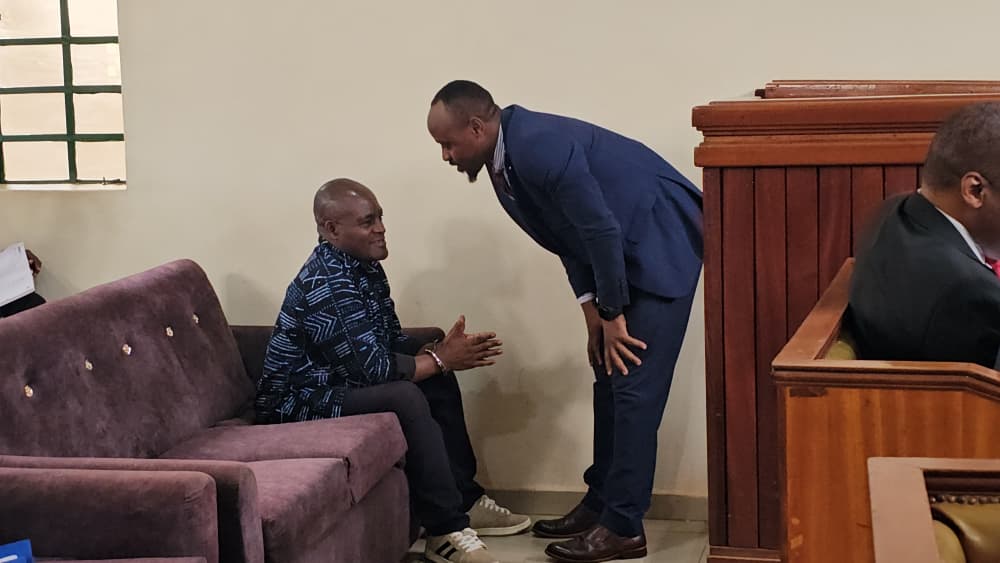
    The Nakawa Magistrates Court has granted cash bail of Shs500,000 to John Mary Ssebuwufu, the Deputy Chairperson of the National Unity Platform Election Management Committee, who is facing charges of incitement to violence.

    Ssebuwufu is charged under Section 79(1) of the Penal Code Act, which criminalizes acts that incite others to commit violence.

    In a detailed ruling delivered at the Nakawa court, the presiding Grade one magistrate Sanula Namboozo  analyzed the legal principles governing bail applications, insisting that although the court retains discretion, the Constitution guarantees every accused person the right to apply for bail and the presumption of innocence until proven guilty.

    The court premised on Article 23(6)(a) and Article 28(3)(a) of the Constitution of Uganda 1995, which guarantee personal liberty and the right of an accused person to apply for bail pending trial.

    During the bail hearing, defence lawyer John Paul Kakande, told court that Ssebuwufu had been detained since 14 January 2026 and allegedly held incommunicado before he was eventually produced before court on 6 February 2026.

    The defence argued that such detention violated constitutional protections relating to personal liberty and the prohibition of torture.

    Counsel quoted the Constitutional Court decision in Besigye vs Attorney General Constitutional Petition No 7 of 2007, where the court maintained that judges should not automatically remand suspects where there is evidence of violations of non-derogable rights.

    The defence also described Ssebuwufu as a responsible public figure with strong community ties.

    Counsel told court that the accused serves as Lord Councillor for Nakawa I Constituency, is Head of Laity at St Andrew Kaggwa Catholic Parish, and is a family man with seven school-going children.

    The defence presented four sureties, all described as responsible individuals with permanent residences and known standing in their communities.

    However, the State Attorney opposed the bail application, arguing that investigations into the case were still ongoing.

    The prosecution also dismissed allegations of illegal detention and urged the court to remand the accused pending completion of inquiries. In the alternative, the State asked the court to impose stringent bail conditions if the application was granted.

    In its ruling, the court noted that bail is anchored in constitutional principles but remains subject to judicial discretion.

    The magistrate referred to earlier constitutional decisions including Uganda v Kizabesigye Constitutional Reference No 20 of 2005 and Foundation for Human Rights Initiative v Attorney General Constitutional Petition No 20 of 2006, which affirm that courts must balance the rights of the accused with the interests of justice.

    The ruling also referenced the Constitution (Bail Guidelines for Courts of Judicature) Practice Directions Legal Notice No. 8 of 2022, which outline the principles that courts should consider when determining bail applications.

    According to the guidelines, courts must assess several factors including: whether the accused has a fixed place of residence, whether the accused has substantial sureties, whether the accused is likely to interfere with witnesses or investigations
    On the issue of residence, the court found that Ssebuwufu had sufficiently demonstrated that he has a known place of residence within the jurisdiction of the court.

    The defence presented a letter of introduction from the LC1 chairperson confirming that the accused resides in Kasana Zone, Kyanja Parish, Nakawa Division in Kampala.

    The court said this information allows authorities to trace the accused if required.

    “With a well-known address in terms of zone, parish, division and district, the applicant’s whereabouts can definitely be traced,” the magistrate noted.

    However, the court raised concerns about the failure by the defence to present the original National Identity Card of the accused.

    The magistrate noted that although a photocopy of the ID had been presented in court, the document had not been uploaded onto the Integrated Case Management Information System (ICMIS), which is now mandatory for official court records.

    The court warned that failure to verify the identity of an accused person could create serious legal concerns.

    “Without identification there is uncertainty about who the person actually is. Verification of the applicant’s identity becomes difficult for the court,” the magistrate said.

    The ruling further observed that lack of proper identification could increase the risk that an accused person might abscond from trial or evade supervision by court authorities.

    However, the court said it would give the accused the benefit of doubt, noting that national identity cards are sensitive personal documents and are usually kept by their owners.

    “In the interest of justice the court shall give the applicant the benefit of doubt and consider him identified in the interim,” the magistrate ruled.

    The court also reviewed the four proposed sureties presented by the defence.

    They included: a biological brother of the accused who operates a hardware business, a civil and electrical engineer who owns an engineering company, an LC1 chairperson and councillor from Nakawa Division
    a businessman dealing in agricultural produce from Mukono District

    Each of the sureties presented letters from their respective LC1 chairpersons and provided national identity cards that were verified in court.

    The magistrate said their relationship with the accused and standing within their communities made them credible guarantors.

    “This fact enhances their commitment to ensuring that the applicant complies with the conditions of bail,” the court noted.

    On the issue of possible interference with witnesses, the court ruled that the prosecution had failed to provide evidence supporting the claim. Since no such evidence was presented, the court dismissed the prosecution’s argument.

    After analyzing the law, evidence and submissions from both sides, the court ruled that the applicant had met the requirements for bail.

    However, the magistrate imposed several conditions.

    Ssebuwufu was ordered to: Pay Shs500,000 cash bail, Present four sureties each bonded at Shs5 million
    Pay Shs10 million if he absconds from court, Submit a copy of his National Identity Card for verification
    Deposit his passport with court until the case is concluded

    The magistrate allowed the bail application and directed that the accused be released once the conditions are fulfilled.

    The case will continue before the Nakawa Magistrate’s Court as investigations into the alleged incitement charges proceed.

  • Thieves Break into Visually Impaired Makerere University Student Room, Steal Laptop & Upkeep Money

    Thieves Break into Visually Impaired Makerere University Student Room, Steal Laptop & Upkeep Money

    A visually impaired student at Makerere University is facing a severe disruption to his academic programme after unknown thieves broke into his room and made off with his laptop and upkeep money amounting to approximately Shs300,000 — losses that have placed his continued studies in serious jeopardy.

    The student, who is pursuing his degree at Uganda’s oldest and most prestigious public university on a government state scholarship, is now appealing to well-wishers, individuals, and organisations for urgent support to enable him to recover and continue his education.

    ADVERTISEMENT

    The break-in, which targeted the student’s room on or near the Makerere University campus, resulted in the loss of two critical assets: his personal laptop and his available upkeep funds. While the monetary value of the stolen items may appear modest in absolute terms, the impact on the student’s daily life and academic functioning is considerable.

    For a student with a visual impairment, a laptop is not a supplementary academic tool — it is the primary interface through which coursework is accessed, assignments are completed, and academic engagement is maintained. Assistive technologies, screen readers, and specialised software that enable visually impaired students to participate fully in university education are all dependent on the availability of a functioning personal computer. The absence of this tool effectively creates a direct and immediate barrier to learning.

    The student’s financial vulnerability is further compounded by the nature of his sponsorship arrangement. As a state scholar, he receives a government stipend of Shs500,000 per semester — a figure that, distributed across the full duration of a semester, provides extremely limited financial flexibility even under normal circumstances.

    The theft of Shs300,000 — representing more than half of his total semester stipend — has effectively eliminated whatever financial cushion he had available for basic subsistence needs including food, transport, and personal upkeep, in addition to depriving him of his primary academic tool.

    The combination of these two losses has placed the student in a position where continuing his studies without external support is not a straightforward proposition.

    The student’s situation draws attention to a wider and often under-examined challenge facing students with disabilities at Ugandan universities. While government scholarships provide a critical entry point for students who would otherwise be unable to access higher education, the financial support attached to these scholarships in many cases does not adequately account for the additional costs associated with disability — including the procurement and maintenance of assistive devices, specialised academic materials, and the general cost of living on or near campus.

    A single adverse event, such as a theft or a medical emergency, can therefore have a disproportionately severe impact on students in this category, given the absence of any meaningful financial buffer.

    Makerere University, like other public universities in Uganda, has structures in place to support students with disabilities. However, the pace at which institutional support can be mobilised in response to individual emergencies often leaves affected students reliant on the goodwill of the wider community while formal processes are engaged.

    An Appeal To The Public

    The student is actively seeking support from well-wishers who are in a position to assist — whether through the provision of a replacement laptop, financial contributions toward his upkeep, or connections to organisations and individuals with the capacity to intervene meaningfully on his behalf.

    His full appeal, in which he speaks directly to the public about his situation and the support he requires, is available for viewing at the following link:

    Members of the public who wish to support the student are encouraged to view the appeal for direct contact information and details on how contributions can be made.

    Beyond the immediate needs of this individual student, his situation presents an opportunity for universities, student welfare organisations, disability rights bodies, and corporate entities with education-focused corporate social responsibility programmes to examine the adequacy of support systems currently available to students with disabilities at Uganda’s public universities.

    The determination required to pursue a university education as a visually impaired student on a minimal government stipend is considerable. That determination deserves to be met with institutional and community support structures robust enough to absorb the kind of disruption that this student is currently experiencing.

    For now, his immediate need is clear. A laptop. Basic upkeep support. And the opportunity to return his full attention to the degree he has worked to earn.

About UGNEWS24

UGNEWS24 is a Uganda local news service, a product of SOLAVIA GROUP LIMITED, Reg. No. 80048169153974.

Registered office

Plot 2335, Buwambo-Katadde-Najjo Road,
Nansana Municipality, Wakiso District, Uganda
P.O. Box 214231, Kampala

© 2026 SOLAVIA GROUP LIMITED. All rights reserved.