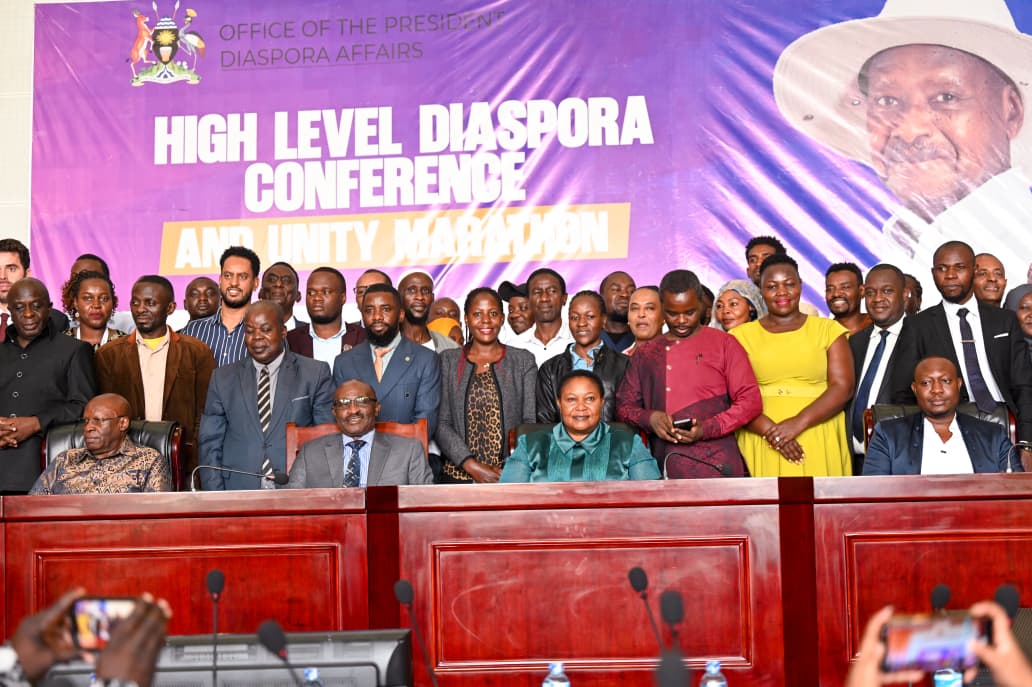
KAMPALA – The Minister for the Presidency, Hon. Babirye Milly Babalanda, has called upon Ugandans in the diaspora to go beyond sending remittances and invest their skills, technology and capital back home to support Uganda’s next phase of economic transformation.
Minister Babalanda made the call today while opening a High-Level Conference for Diaspora and Forced Migrant Communities at the Office of the President Conference Hall in Kampala, held under the theme “Bridging Worlds: Diaspora & Forced Migrants for Shared Prosperity.”
In her address, Babalanda conveyed warm greetings from His Excellency President Yoweri Kaguta Museveni, the First Lady and Minister of Education and Sports, Maama Janet Kataaha Museveni, the Permanent Secretary of the Office of the President, Hajji Yunus Kakande, and the entire staff of the Office of the President.
She said migration is ultimately about people and their search for hope and a better life, noting that the government remains committed to protecting the rights and dignity of every Ugandan, whether at home, abroad or returning home.
The Minister said Uganda’s hospitality is demonstrated by its open-door refugee policy, which has earned the country a global reputation as Africa’s largest refugee-hosting country.
“This demonstrates the character of our people: we know what it means to need a helping hand, and we believe every person deserves dignity,” she said.
Babalanda appealed to forced migrants whose stay in Uganda has not been regularized to work with the relevant authorities to regularize their status in accordance with Ugandan law.
She also cautioned that hospitality comes with responsibility, urging all communities to respect Uganda’s laws, just as Ugandans living abroad are expected to respect the laws of their host countries.
She reaffirmed the government’s commitment to Ugandans in distress abroad, citing recent interventions to rescue and repatriate Ugandans from exploitation and the rehabilitation of thousands of returnees from South Africa at NALI-Kyankwanzi with start-up and resettlement support.
On economic contribution, Minister Babalanda revealed that Ugandans in the diaspora remitted approximately USD 2.8 billion, equivalent to more than Shs 10 trillion, in the twelve months leading up to March 2026, up from USD 1.9 billion recorded the previous year.
While commending this contribution, she challenged the diaspora to think beyond remittances and focus on transferring knowledge, technology, skills, partnerships and investments.
She highlighted the role of the Office of the President in facilitating the Office of the President Diaspora Affairs headed by Ambassador Abbey Walusimbi, Senior Presidential Advisor on Diaspora Affairs, in coordinating with other Ministries, Departments and Agencies to ensure meaningful diaspora participation in the development agenda of President Museveni.
The Senior Presidential Advisor on Diaspora Affairs, Ambassador Abbey Walusimbi, expressed gratitude to the Minister for the Presidency, Hon. Babirye Milly Babalanda, for honouring the invitation to officiate the opening of the conference and for her continued support to the diaspora community.
Ambassador Walusimbi said the conference is about connecting people in practical ways.
“This conference is about connecting them in practical ways. We want the knowledge, networks, skills, and resources of the Ugandan diaspora to open doors for forced migrants and returnees. We also want the resilience and experiences of those who have been displaced or have returned to be recognized and supported,” he said.
The Ambassador said that by the end of the conference, practical outcomes are expected, including a clearer understanding of the real challenges and opportunities faced by Ugandan diaspora communities, returnees, and forced migrants based on lived experience.
Secondly, a short list of practical ideas on concrete ways diaspora networks can support livelihoods, skills transfer, mentorship and reintegration, including linkages with ongoing efforts such as the National Return and Reintegration Framework being advanced by the Ministry of Gender, Labour and Social Development.
Thirdly, stronger coordination among institutions that handle these issues so that the work of the Office of the President Diaspora Affairs, the Ministry of Foreign Affairs, the Ministry of Gender, Labour and Social Development, refugee management bodies, and local governments complement rather than duplicate each other.
“We believe that these outcomes are deliberately modest and achievable. We prefer a few things done well to many ideas that remain on paper,” Walusimbi emphasized.
Ambassador Walusimbi noted that behind every discussion are real Ugandan families: those receiving remittances that support education and household needs, returnees trying to restart livelihoods after difficult experiences abroad, forced migrants seeking stability, and host communities sharing resources and space.
He said Uganda has shown generosity in hosting refugees and has benefited significantly from diaspora contributions, but acknowledged the pressures this places on services, social cohesion, and local economies, whether in Kampala, in refugee-hosting districts, or in regions such as Karamoja.
“When systems work and people support one another, hope grows. When people are left behind or processes are unclear, the whole nation feels the cost,” he said.
He added that the role of the Office of the President Diaspora Affairs is to help bridge these gaps, to convene, to listen, and to support practical collaboration, while fully respecting the mandates of every institution represented.
Ambassador Walusimbi called for focused engagement and asked participants to engage with honesty and a solution-oriented spirit, to share experiences openly, listen with respect, and focus on what can actually be done within Uganda’s institutional framework.
“On behalf of our visionary leader, grandfather and freedom fighter, His Excellency President Yoweri Kaguta Museveni, I thank you once again for being part of this effort,” he said.
“Let us work together to turn dialogue into practical bridges that serve the people of Uganda and strengthen our shared future,” he concluded.
The conference brought together heads of Diplomatic missions, senior government officials, representatives of diaspora and forced migrant communities, and civil society organisations.
Do you have a story in your community or an opinion to share with us: Email us at Submit an Article