Author: admin

  • KIWALA CAROLINE TAHIR: Pearl Sweet; When the Pearl of Africa Finally Bled Sweet Oil

    KIWALA CAROLINE TAHIR: Pearl Sweet; When the Pearl of Africa Finally Bled Sweet Oil

    A Tribute to a Nation’s Journey from Discovery to Destiny

    On a calm Wednesday morning, 3rd September 2026, on the shores of Lake Albert in Kikuube District, where the Kingfisher rig kisses the sky, an old man with a vision stood before Uganda and gave our black gold a name.

    His Excellency Gen. Yoweri Kaguta Museveni looked at the crowd and said: We shall call it PEARL SWEET.

    And just like that, Uganda — the Pearl of Africa — had finally named her own blood.

    For twenty long years, this oil slept beneath the earth of Bunyoro. Discovered in 2006, fought for in boardrooms, delayed by lack of roads, lack of pipelines, lack of belief — but never abandoned. Like a child in the womb, it waited for its time.

    And now its time has come.

    THE POETRY IN THE NAME

    PEARL — Because Winston Churchill called it the Pearl of Africa. A pearl is formed through pressure, through patience, through time.

    SWEET — In petroleum language, sweet means pure. Sulphur as low as 0.16 percent. Easy to refine, high value on world markets. The world craves sweet crude.

    Sweet by chemistry. Sweet by character.

    HOW PEARL SWEET WILL BOOST THE ECONOMY

    This is not just oil. This is economic transformation.

    1. BOOST TO HOUSEHOLD INCOMES: With 1.65 billion barrels recoverable and 230,000 barrels per day at peak, government projections show oil revenue will directly fund Parish Development Model, Emyooga, and wealth creation. The farmer will get more capital, the trader more market.
    2. BOOST TO JOBS AND LOCAL CONTENT: Kingfisher and Tilenga have already employed over 15,000 Ugandans. The refinery in Hoima will create permanent jobs for engineers, welders, drivers, caterers. The $5 billion East African Crude Oil Pipeline from Hoima to Tanga has opened business for Ugandan companies in transport, cement, food supply.
    3. BOOST TO COST OF DOING BUSINESS: President Museveni gave a condition: The Refinery Must Get First Call. That means Uganda will refine its own petrol, diesel, jet fuel. We currently spend $2 billion every year importing fuel. When we refine our own, fuel prices will stabilize, transport costs will drop, and the boda rider will save money. When transport is cheaper, every product in the market becomes cheaper.
    4. BOOST TO UGANDA SHILLING AND FOREIGN EXCHANGE: Currently we pay $12.77 per barrel to export through EACOP, but we will earn over $60 per barrel when we sell Pearl Sweet on the international market as a branded crude like Brent and WTI. That is dollars coming INTO Uganda, not going out. It will strengthen the shilling.
    5. BOOST TO INDUSTRIALIZATION: From Pearl Sweet we will not just get fuel. We will get raw materials for plastics, fertilizers for our farmers, bitumen for our roads, medicine base. One barrel of oil creates six industries. This is how we move from a raw material economy to a modern economy.
    6. BOOST TO INFRASTRUCTURE: Oil money will fund 30 years of roads, Standard Gauge Railway, electricity for factories, schools and health centers — built by our own money, not loans.

    A STORY OF VISION AND PATIENCE

    In 1986, Uganda had tarmac roads but they were broken, potholed and impassable from years of war and neglect. Factories were dead, electricity reached only a few towns, and there was no hope of oil. From a nation that had collapsed, we have rebuilt — and today we name our own crude oil. This is the NRM journey of building a modern economy from the ruins.

    As Minister Musenero said: Pearl Sweet means purity and innocence — that we shall produce this oil without polluting our lakes, without destroying our environment. We shall keep Bunyoro greener than we found it.

    So today, I say:

    Let the farmer know — your PDM money will soon be oil money.

    Let the boda rider know — your fuel will soon be Ugandan fuel.

    Let the young girl know — your lab will soon be built by Pearl Sweet.

    Uganda is no longer just the Pearl of Africa because of scenery.

    Uganda is now the Pearl that produces Sweet.

    God bless Uganda.

    God bless H.E. Gen. Yoweri Kaguta Museveni.

    God bless Pearl Sweet.

    For God and My Country.

    Kiwala Caroline Tahir

    Assistant Resident District Commissioner- Iganga District

    Do you have a story in your community or an opinion to share with us: Email us at Submit an Article

  • Muziki Garage & Beta Hub Restaurant set for September 15 grand opening as Munyonyo welcomes new entertainment hub

    Muziki Garage & Beta Hub Restaurant set for September 15 grand opening as Munyonyo welcomes new entertainment hub

    MUNYONYO, KAMPALA — Munyonyo is set to usher in a new chapter in Kampala’s entertainment scene as Urban Empire prepares to officially open Muziki Garage and Beta Hub Restaurant on September 15, 2026.

    The new entertainment and lifestyle hub is expected to bring together musicians, live bands, comedians, artists, socialites, content creators and entertainment enthusiasts, creating a new platform for Uganda’s vibrant creative community.

    The grand opening is expected to attract a cross-section of Uganda’s entertainment and social scene, with organisers promising a programme featuring live music, comedy and performances.

    The project has attracted support from a number of organisations and brands, including the Ministry of Gender, Labour and Social Development, Aquafina, SM Investments, Land Management Centre, Operation Wealth Creation and the Federation of Uganda Social Media Influencers.

    Kubeera Motors and Kalungi Motors have also supported the upcoming launch.

    The organisers say the initiative is designed not only as an entertainment venue but also as a platform where members of Uganda’s creative industry can connect, showcase their talent and build new opportunities.

    The opening will mark the beginning of a programme expected to make Tuesdays a regular entertainment night, with live bands, music, comedy and other creative performances taking centre stage.

    Speaking about the project, the promoter said the initiative was inspired by a desire to give back to the community after marking a decade in the entertainment and social scene.

    “After celebrating my ten years, it’s high time to give back to the people in Munyonyo. This is for all socialites and the entertainment family in Africa,” he said.

    The event is being organised by Socialite Club, popularly known as the “home of socialites” in Uganda, which has been coordinating preparations for the launch.

    With Munyonyo increasingly emerging as one of Kampala’s major lifestyle and entertainment destinations, the opening of Muziki Garage and Beta Hub Restaurant is expected to add another major attraction to the area’s growing hospitality and nightlife scene.

    Organisers say the September 15 launch will set the tone for a new entertainment experience built around music, comedy, creativity, networking and social culture.

    Muziki Garage and Beta Hub Restaurant will officially open their doors on September 15, 2026.

    Do you have a story in your community or an opinion to share with us: Email us at Submit an Article

  • Uganda rallies diaspora in Korea for investment as trade talks open

    Uganda rallies diaspora in Korea for investment as trade talks open

    SEOUL, South Korea — Uganda has called on its diaspora in the Republic of Korea to invest their capital, skills and technology back home as the two countries prepare to open a major trade and investment meeting aimed at deepening bilateral commercial ties.

    The appeal was made during a diaspora outreach organised by Uganda’s Embassy in Tokyo, which is accredited to Korea, at the 88 Hotel in Seoul on Saturday.

    The engagement was held ahead of the Uganda–Korea Trade and Investment Meeting, scheduled for September 6–10, 2026, in partnership with the Korea International Trade Association (KITA).

    The meeting is intended to strengthen trade and investment cooperation between Uganda and South Korea while opening new opportunities for businesses and investors from both countries.

    The Seoul outreach brought together Ugandan nationals living in Korea, government officials and other stakeholders to discuss the diaspora’s role in national development, investment promotion, trade opportunities and economic diplomacy.

    Uganda’s Ambassador to Korea, resident in Tokyo, H.E. Tophace Kaahwa, urged Ugandans in Korea to support the government’s economic and commercial diplomacy agenda through investment, technology transfer, tourism and capacity building.

    Amb. Kaahwa said the embassy remained committed to serving Ugandans in Korea and encouraged members of the community to maintain close links with Uganda.

    She described Ugandans abroad as “grassroots ambassadors” whose remittances, expertise and networks were critical to national development.

    Kaahwa highlighted opportunities in tourism, mineral development, science and technology and agribusiness, saying increased electricity generation was helping to accelerate Uganda’s economic transformation.

    She also encouraged Ugandans in Korea to register for national identification cards.

    The ambassador said a high-level Ugandan delegation, led by the Second Deputy Prime Minister, had travelled to Korea for the engagements, adding that the Ugandan community’s talents in areas such as football and marathon running could further strengthen relations between the two countries.

    Kiyonga outlines Uganda’s economic ambitions

    Delivering the keynote address, the Second Deputy Prime Minister and head of the Ugandan delegation, Rt. Hon. Dr. Crispus Kiyonga, conveyed greetings from President Yoweri Kaguta Museveni and commended the diaspora for its unity and patriotism.

    Dr. Kiyonga told the gathering that Uganda remained secure and stable and briefed the community on the country’s economic progress.

    He put Uganda’s economy at about US$70 billion and said the government was targeting an economy worth US$500 billion by 2040.

    On infrastructure, Kiyonga said government had invested heavily in road transport to improve mobility and accelerate economic activity. He also noted ongoing efforts to extend the railway network from Nairobi towards Kampala.

    He urged Ugandans in Korea to remain proud ambassadors of Uganda, uphold unity and maintain close contact with the embassy.

    Government moves to strengthen diaspora engagement

    In his presentation, Ambassador Muhindo said government was developing a comprehensive diaspora policy aimed at improving coordination, communication and access to government services.

    He described the policy as a major milestone, saying Ugandans abroad had previously been “scattered and fragmented”.

    Muhindo said consultations on the diaspora policy had largely been completed in North America and Europe and were now being extended to Asia and other regions.

    He urged Ugandans in Korea to participate in the Uganda Diaspora Convention, scheduled for December 18–22, 2026.

    He also encouraged those returning home to share the knowledge and technology acquired in Korea through mentorship and other initiatives.

    The convention, first held in 2024, has helped strengthen links between Ugandans abroad and opportunities at home, he said.

    Diaspora urged to support industrialisation

    Ambassador Henry Mayega, representing the Permanent Secretary of the Ministry of Foreign Affairs, Vincent Waiswa Bagiire, recognised the diaspora’s contribution through remittances, investment and professional expertise.

    He said Ugandans abroad were important stakeholders in advancing the government’s priority areas of agro-industrialisation, tourism, mineral development, and science, technology and innovation.

    Mayega called for greater unity among Ugandans abroad and urged them to participate actively in the country’s industrialisation drive, saying national development should transcend political affiliation.

    The Honorary Consul of Uganda in Busan, Dr. Kim Jin Bo, praised the growing friendship between Uganda and South Korea and encouraged Ugandans to apply the skills and experience gained in Korea to Uganda’s development.

    He described the Ugandan community in Korea as an important bridge between the two governments and peoples.

    654 Ugandans living in Korea

    Earlier, the President of the Ugandans in South Korea Association, Hamza Kyamanywa, welcomed the delegation and said the association was working to build a united and vibrant Ugandan community.

    Kyamanywa said 654 Ugandans were living in South Korea as of July 31, 2026, comprising 407 men and 247 women.

    He said many of them were students, employees and entrepreneurs who remained closely connected to Uganda and continued to contribute to the country both directly and indirectly.

    Kyamanywa, who has lived in Korea for eight years, said he arrived in the country as a student before transitioning into employment and later entrepreneurship.

    During an open session, participants raised concerns and questions around professional development, sports and the welfare of Ugandans married to Korean nationals.

    Some participants also highlighted challenges arising from the absence of a resident Ugandan embassy in Korea, noting that consular services are currently provided through the embassy in Tokyo.

    The Seoul outreach was among a series of diaspora and business engagements organised around the Uganda–Korea Trade and Investment Meeting, which opens on September 6.

    The engagements are expected to provide a platform for Uganda to showcase investment opportunities while strengthening business-to-business and government-to-government cooperation with South Korea.

    Do you have a story in your community or an opinion to share with us: Email us at Submit an Article
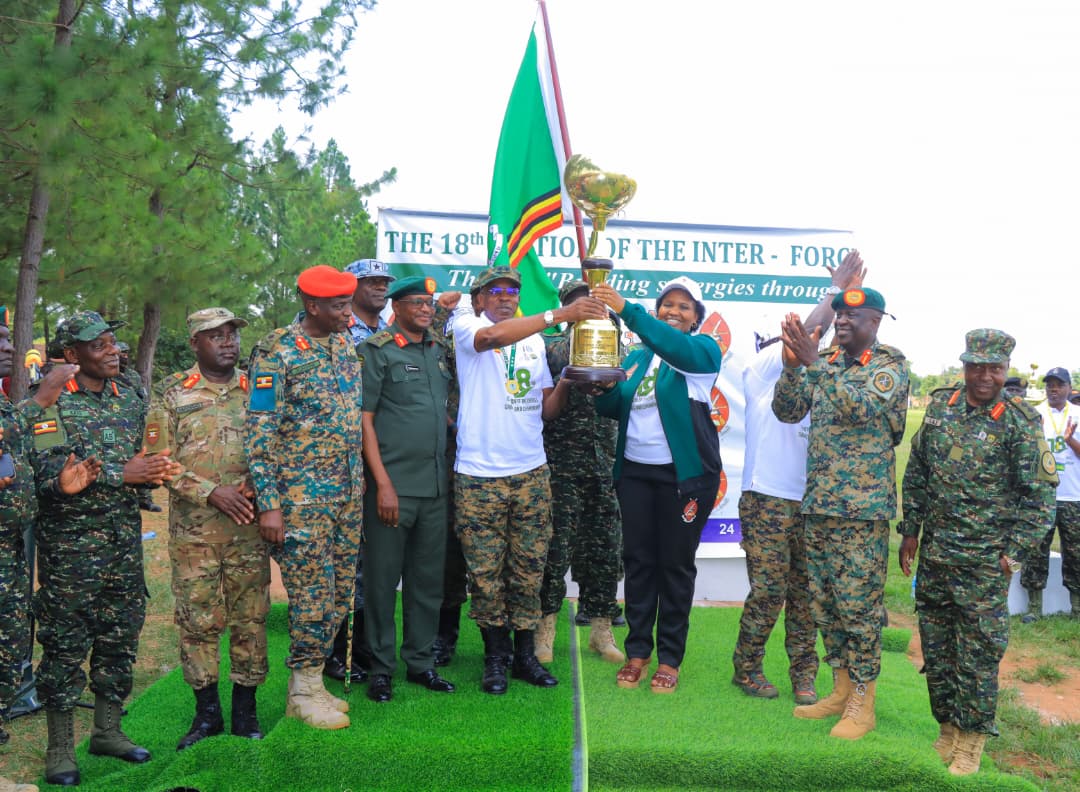
  • UPDF Crowned Overall Champions Of 18th Inter-Forces Games In Gulu

    UPDF Crowned Overall Champions Of 18th Inter-Forces Games In Gulu

    The Uganda People’s Defence Forces (UPDF) have been crowned overall champions of the 18th Edition of the Inter-Forces Games held in Gulu City after securing three decisive gold medals.

    The UPDF edged the Uganda Police Force (UPF), which finished as first runners-up with two gold medals, while the Uganda Prisons Service (UPS) took second runners-up position after securing one gold medal.

    The Uganda Wildlife Authority (UWA) received the Fair Play Trophy after completing the championship without any gold medal.

    The championship brought together four sister security institutions, namely the UPDF, UPF, UPS and UWA, in eight sporting disciplines under the theme, “Building Synergies Through Sports.”

    The disciplines included football, netball, volleyball, athletics, taekwondo, handball, darts and range shooting, with both male and female participants taking part in various categories.

    Speaking at the closing ceremony held at St Joseph’s College Layibi in Gulu City, the Minister of State for Defence and Veteran Affairs (Defence), Hon. Grace Akifeza Ngabirano, commended the participating institutions for demonstrating patriotism, discipline, teamwork and healthy competition throughout the championship.

    She thanked the Chief of Defence Forces (CDF) and the Service Chiefs for supporting the games, noting that the competition had provided an opportunity for the security institutions to showcase talent, resilience and professionalism.

    “You have competed fiercely yet respectfully, proving that while our institutions have different mandates, we remain one family, united by one flag and one mission to protect Uganda and our people,” she said.

    Minister Ngabirano congratulated the UPDF on winning the overall championship and encouraged participants who did not win medals to regard their participation, discipline and teamwork as achievements in themselves.

    “Every athlete who is here is a champion of national unity,” she said.

    Representing the CDF, the Deputy Commander Land Forces, Major General Felix Busizoori, commended participating institutions upon the successful completion of the championship.

    He said the games demonstrated not only the physical abilities of the security forces but also their spirit of teamwork, unity and comradeship.

    Maj Gen Busizoori said the Inter-Forces Games were more than a sporting competition, describing them as an avenue for strengthening partnerships and fostering unity among sister security institutions.

    “These games are not only about competition; their purpose is to promote comradeship, unity and partnership,” he said.

    The Chairperson of the 18th Inter-Forces Games Organising Committee and the UPDF Joint Staff Formal Education, Sports and Culture, Maj Gen Richard Karemire, said the championship brought together 1,017 participants from the four sister security institutions.

    He commended the participants for demonstrating talent, discipline, endurance and teamwork, noting that the competition had strengthened the shared responsibility of the security forces to protect the people and sovereignty of Uganda.

    Maj Gen Karemire thanked the CDF and Service Chiefs for their guidance and support, as well as the technical teams, coaches, referees, commanders and athletes whose dedication contributed to the successful conduct of the championship.

    He also expressed appreciation to the leadership of Gulu City for the warm hospitality extended to the participating teams throughout the games.

    The closing ceremony was attended by senior commanders from the UPDF, UPF, Uganda Prisons Service and UWA, senior and junior officers, men and women in uniform, Gulu City leaders and members of the public.

    The 19th Edition of the Inter-Forces Games will be hosted by the Uganda Prisons Services.

    Do you have a story in your community or an opinion to share with us: Email us at Submit an Article

  • Ruparelia Group Leads Corporate Backing for India Day 2026

    Ruparelia Group Leads Corporate Backing for India Day 2026

    KAMPALA — The Ruparelia Group has thrown its weight behind India Day 2026, emerging among the key corporate sponsors of the annual celebration that brings together Uganda’s Indian community and people from across the country.

    The sponsorship by one of Uganda’s leading business groups underscores the growing role of the private sector in promoting cultural exchange, community engagement and stronger ties between Uganda and India.

    India Day is expected to showcase the richness of Indian culture through music, dance, cuisine, fashion and other cultural performances, while providing a platform for Ugandans and members of the Indian diaspora to interact and celebrate their shared connections.

    For the Ruparelia Group, the partnership further reflects its longstanding links with the Indian community and its wider involvement in Uganda’s social and economic development.

    The Group, founded by businessman Sudhir Ruparelia, has built a diversified business empire with interests in real estate, education, hospitality, financial services and other sectors.

    The celebration comes against the backdrop of steadily expanding Uganda-India relations, with the two countries maintaining strong connections in trade, investment, education, healthcare and people-to-people exchanges.

    India Day also offers businesses an opportunity to strengthen networks and promote partnerships while celebrating the cultural contribution of the Indian community to Uganda.

    Organisers say the event will bring together members of the diplomatic community, business leaders, entrepreneurs, families and cultural enthusiasts for a day of celebration and engagement.

    The Ruparelia Group’s backing is therefore expected to give the event a significant corporate boost while reinforcing the message that cultural diplomacy and business can work hand in hand to deepen relations between communities and nations.

    As preparations gather pace, India Day 2026 is shaping up to be not only a celebration of Indian heritage, but also a reflection of the enduring Uganda-India friendship and the contribution of the Indian community to Uganda’s economic and social fabric.

    Do you have a story in your community or an opinion to share with us: Email us at Submit an Article

  • FR LAZAR ARASU: Why National Progress is Failing the Rural Woman

    FR LAZAR ARASU: Why National Progress is Failing the Rural Woman

    A high number of female Members of Parliament, female university top performers, and women running major corporate enterprises are often cited as proof of women’s empowerment.

    However, these successes are largely confined to urban centers. In rural areas, women continue to endure unthinkable suffering, oppression, and neglect. Rural women are routinely deprived of basic necessities, raised without an education, left unaware of their fundamental rights, subjected to domestic violence, and forced to bear the heavy consequences of men’s actions.

    When asked simple questions like, “How many children do you have?”, many rural women react with shy, awkward smiles. They frequently reveal having six, seven, or even more children. When asked about family planning, many admit they do not practice it because their husbands refuse. One woman frankly remarked, “My husband doesn’t care about the consequences of sex; he just wants it.”

    Another young woman expressed dread at the thought of her husband returning from his job in Kampala: “He only comes home to get me pregnant, then leaves without taking any responsibility for me or our children.”

    Under such oppressive conditions, genuine emancipation remains out of reach.

    The irresponsible sexual behavior of many men stands as the single greatest barrier to rural women’s advancement.

    Marion Birungi, a teacher at a technical school, observes that over 70% of men who work in urban areas while leaving their wives in rural villages engage in extramarital affairs.

    Most rural wives remain unaware of these secret relationships, and those who do know lack the power or social standing to challenge their husbands.

    It is common for men to abandon their families for younger women, leaving their original wives with multiple children to raise alone.

    Furthermore, urban-employed men often feel threatened by wives who become economically independent and self-sufficient, as financial stability undermines traditional male dominance.

    Lacking both literacy and financial independence, these women are left emotionally and economically helpless. They struggle to manage household challenges, guide their children’s behavior, or confront their partners’ actions. When irresponsible men abandon domestic duties, the burden falls entirely on the mother, leaving children vulnerable and perpetuating the cycle of poverty.

    The Impact of Lack of Skills and Education

    * Impared Personal Growth: Education and literacy are essential for financial, emotional, and social maturity. Without them, personal development is severely limited.

    * Resignation to Oppression: Low literacy fosters poor self-esteem, leading many women to accept subjugation as an unchangeable reality.

    * Low Economic Value: Without practical or vocational skills, women cannot command fair value for their hard labor, no matter how hard they work.

    * Political Exploitation: Unscrupulous politicians frequently take advantage of uneducated women with empty promises and “sweet nothings.”

    * Lack of Positive Role Models: News reports occasionally highlight cases of female Members of Parliament falling victim to sexual exploitation by male colleagues. When public leaders face such vulnerability, it leaves ordinary women with few empowering role models.

    * Inability to Access Services: Uneducated women remain unaware of government resources designed for their benefit, including basic healthcare, agricultural support, and micro-loan schemes.
    Key Realities to Consider

    * Academic Disparity: Among the poorest results in the Primary Leaving Examinations (PLE), rural girls consistently rank lowest.

    * Limited Futures: When asked about plans after Primary Seven, the common response is that most girls end up married or pregnant within months.

    * Vulnerability in Informal Work: Girls who turn to petty trading in local centers frequently become targets of exploitation by village men.

    * Poor School Infrastructure: In many rural Universal Primary Education (UPE) schools, not a single student achieves Division I or Division II, with most scoring above 20 aggregates.

    * Age and Social Stigma: Primary 7 leavers in rural areas are often around 16 years old. Returning to complete school alongside significantly younger urban peers causes immense social embarrassment, driving many out of the education system entirely.

    Rev. Fr. Lazar Arasu SDB
    Priest and School Administrator
    [email protected]

    Do you have a story in your community or an opinion to share with us: Email us at Submit an Article

  • Pallaso breaks down concert economics: Why cheap gate tickets don’t mean low profits – Sqoop

    Pallaso breaks down concert economics: Why cheap gate tickets don’t mean low profits – Sqoop

    Ugandan musician Pius Mayanja, popularly known as Pallaso, has challenged the long-held industry belief that charging entry fees of Shs20,000 or Shs30,000 at concert gates automatically spells bad business for artists.

    Speaking on the shifting dynamics of Uganda’s live music industry, the Malamu hitmaker explained that gate collections represent only a fraction of a well-executed event revenue model. According to Pallaso, an artist’s true profitability relies heavily on corporate sponsorships, high-end VIP packages, and personal relationships.

    Pallaso noted that money collected from ordinary gate tickets is rarely pure profit, as it is primarily funneled into operational overheads.

    “Revenue from ordinary ticket sales is often used to cover the costs of staging a concert, including payments to service providers and obligations to the Uganda Revenue Authority (URA),” Pallaso explained.

    Instead of depending solely on general admission, the singer emphasized the financial power of premium table sales targeted at high-net-worth supporters, friends, and corporate allies within an artist’s reach.

    “Your social network is your social net-worth. If a table is Shs5 million and I sell about 10 of them, that’s Shs50 million,” Pallaso shared.

    His insights offer a fresh perspective on the ongoing debate surrounding concert pricing models in Uganda. Entertainment analysts have frequently debated whether low gate charges devalue an artist’s brand. However, Pallaso’s strategy highlights a balanced approach: keeping general entry fees affordable ensures massive crowd turnout, which in turn attracts corporate sponsors and creates a vibrant atmosphere for high-paying VIP guests.


  • ‘Bobi Wine is out of your league”: Weasel warns returned singer Kid Fox over media attacks – Sqoop

    ‘Bobi Wine is out of your league”: Weasel warns returned singer Kid Fox over media attacks – Sqoop

    Veteran musician Douglas Mayanja, popularly known as Weasel Manizo, has cautioned fellow artist Kid Fox following his recent return to Uganda after years abroad, warning him that the local music industry and its power dynamics have vastly evolved.

    Speaking during a recent TikTok live stream, the Goodlyfe Crew artist advised Kid Fox to tread carefully when conducting media interviews. His comments followed recent media appearances where Kid Fox reportedly downplayed and attacked several prominent figures within the local entertainment scene.

    Acknowledging their long-standing relationship, Weasel urged the returning artist to show respect to those who stayed behind and built the industry, noting that the financial and social standing of Ugandan musicians has grown significantly.

    “I love you, Kid Fox, because you are my brother. It’s been a while since you were in Uganda, but things have changed while you were away. People have mansions, people are driving G-Wagons,” Weasel said during the live stream.

    He further emphasized that the industry requires mutual respect rather than hostility.

    “This is a concrete jungle. It’s a good step you came with, but don’t disrespect your brothers,” he added.

    Weasel specifically warned Kid Fox against criticizing Kyadondo East’s former Member of Parliament and National Unity Platform (NUP) leader, Robert Kyagulanyi Ssentamu, better known as Bobi Wine. According to Weasel, the former musician-turned-politician has achieved a status that sets him apart from standard industry feuds.

    “Spare him because he is no longer in our league,” Weasel cautioned.

    Despite his own political affiliation with the ruling party, Weasel noted that political differences should not obscure Bobi Wine’s legacy and influence within the country’s cultural landscape.

    “I am an ardent NRM [National Resistance Movement] person, but he’s in his own league,” Weasel stated, emphasizing the point by adding, “If you don’t know Bobi Wine, you don’t know anyone, not even your mother.”


  • Shakira Shakiraa defends her gym friendship with late King Oyo amid backlash – Sqoop

    Shakira Shakiraa defends her gym friendship with late King Oyo amid backlash – Sqoop

    What began with a malfunctioning gym machine eventually grew into an unlikely friendship between Ugandan musician Shakira Shakiraa and the late King of Tooro, Omukama Oyo Nyimba Kabamba Iguru Rukidi IV—a bond she insists was genuine, despite online skepticism surrounding her claims.

    Following the monarch’s passing, Shakira joined the nation in mourning and spoke publicly about her personal connection to the young ruler. She revealed that the two had been gym buddies and that she had also developed a warm acquaintance with the Queen Mother, Best Kemigisa.

    However, her disclosures quickly ignited debate across social media platforms. While some online commentators questioned the true intimacy of her connection to the King, others accused the singer of leveraging the monarch’s legacy to chase clout and remain in the public eye.

    Pushing back against the criticism, Shakira dismissed claims that her relationship with the late King was a calculated move or a publicity stunt.

    According to the artist, the friendship originated under ordinary circumstances during a workout session when a gym machine she was using stalled. Seeing her struggle, King Oyo stepped in to assist.

    “I was on one of the machines and it refused to work, and he came, he helped me out. From there we started hellos, and then it matured into a friendship,” Shakira recounted.

    She noted that their simple greetings evolved into a familiar rapport as they frequently crossed paths during fitness sessions. She clarified that her statements were intended solely to acknowledge their casual interactions, rather than to imply any deeper relationship.

    Unfazed by accusations that she used the King’s memory to bolster her public profile, Shakira maintained that online trends have never driven her music career or commercial ventures.

    “I am the kind of person that doesn’t care whether I’m trending or not, whether my music is played or not. I focus on my businesses, that’s all,” she stated.

    Reflecting on her comments following the King’s death, Shakira emphasized that she merely shared the memory that meant the most to her—an unscripted connection forged over exercise equipment.

    “When they asked me about him, I shared my experience because that stood out in my friendship with him,” she said.


  • ‘Things have changed’: Weasel cautions Kid Fox against disrespecting Ugandan music icons – Sqoop

    Veteran musician Douglas Mayanja, popularly known as Weasel Manizo, has cautioned fellow artist Kid Fox following his recent return to Uganda after years abroad, warning him that the local music industry and its power dynamics have vastly evolved.

    Speaking during a recent TikTok live stream, the Goodlyfe Crew artist advised Kid Fox to tread carefully when conducting media interviews. His comments followed recent media appearances where Kid Fox reportedly downplayed and attacked several prominent figures within the local entertainment scene.

    Acknowledging their long-standing relationship, Weasel urged the returning artist to show respect to those who stayed behind and built the industry, noting that the financial and social standing of Ugandan musicians has grown significantly.

    “I love you, Kid Fox, because you are my brother. It’s been a while since you were in Uganda, but things have changed while you were away. People have mansions, people are driving G-Wagons,” Weasel said during the live stream.

    He further emphasized that the industry requires mutual respect rather than hostility.

    “This is a concrete jungle. It’s a good step you came with, but don’t disrespect your brothers,” he added.

    Weasel specifically warned Kid Fox against criticizing Kyadondo East’s former Member of Parliament and National Unity Platform (NUP) leader, Robert Kyagulanyi Ssentamu, better known as Bobi Wine. According to Weasel, the former musician-turned-politician has achieved a status that sets him apart from standard industry feuds.

    “Spare him because he is no longer in our league,” Weasel cautioned.

    Despite his own political affiliation with the ruling party, Weasel noted that political differences should not obscure Bobi Wine’s legacy and influence within the country’s cultural landscape.

    “I am an ardent NRM [National Resistance Movement] person, but he’s in his own league,” Weasel stated, emphasizing the point by adding, “If you don’t know Bobi Wine, you don’t know anyone, not even your mother.”


About UGNEWS24

UGNEWS24 is a Uganda local news service, a product of SOLAVIA GROUP LIMITED, Reg. No. 80048169153974.

Registered office

Plot 2335, Buwambo-Katadde-Najjo Road,
Nansana Municipality, Wakiso District, Uganda
P.O. Box 214231, Kampala

© 2026 SOLAVIA GROUP LIMITED. All rights reserved.