The internet has led to connectivity we probably never imagined. Previously, you left a job and that was it. Today, if you leave one, most likely somebody will add you to a WhatsApp group of former employees of Company Z. If you don’t leave the job, you belong already to several WhatsApp groups. The schools you attended also have another WhatsApp group. And of course, another for the particular class say Law Class of 2005. If you attended many schools, you are in several of these.
The neighbours also have another group. Your ancestral village has another one for its Kampala diaspora. The religion you belong to has several others. The one where you live, and another from your ancestral district or diocese.
The gym colleagues have another one. The social clubs you belong to also have others. The list of WhatsApp groups can be endless and sometimes it can be hard to catch up. Some people, perhaps afraid of annoying people if they left, resort to being silent or what Ugandans call akamooli (watching from the sidelines).
However, most of these WhatsApp groups have one thing in common — investments or savings. There is perhaps no WhatsApp group where an investment or savings club hasn’t been mooted. Because everyone wants to save and make some ka-money, the idea usually is supported by many members. And indeed some of these investment or saving clubs have blossomed. Some old students or church associations now have billions in assets under management.
Many people feel that they shouldn’t be left out and go ahead and sign up to many investment or savings clubs. Each of them expects one to pay a set amount of money every month. Failure to pay can be psychologically torturing. Treasurers are cajoling each one of the members to meet their obligations. Meetings spend half the time devising means to ensure everyone is paying and how to discipline those falling short.
I know of somebody who was consistently broke. He was earning a decent monthly salary but he was always stressed and pitiful. I found out that he was belonging to several clubs in Kampala and his ancestral village. They took a significant part of his pay. He was living a miserable life as he tried to meet his obligations with the several investment clubs he belonged to.
Saving and investing is a very good thing but it should be of a certain percentage of one’s earnings. If you save and invest for example 70% of your earnings, you must ensure that you can survive on the remaining 30%. If you are saving 70% of your earnings and then playing dodge ball with your landlord at home, failing to get basics for your family, then it makes no sense. Being super stressed because of saving isn’t probably the right thing to do. The repercussions can be dire.
Many people suffering to meet their saving obligations in clubs as largely a result of subscribing to many clubs. The best way is to identify a club or two which meet your aspirations and concentrate on those than being in so many clubs and failing to meet your obligations. It frustrates everyone including yourself.
Investment and savings clubs however good they are for people and economies, they are very conservative. In order to protect people’s money, they usually invest in assets that are considered safe but sometimes without even regular returns. People can have money in these clubs but they aren’t taking home anything regularly. If a club invests in land or even unit trusts, they have to wait for a long term for either the land to gain value and sell or for the unit trusts to compound significantly to provide a worthy return to the members. Are you willing to wait for that long?
Those that lend money to the members charge very high rates, sometimes as much as 3% per a month. Annually, that is 36%. Just because there isn’t much paperwork, collateral and are swifter than commercial lenders, the interest rates are simply prohibitive given that members are essentially borrowing their own money.
Investment and savings clubs if they want members to make money, they need to lend below annual interest rates of banks. Since they do short term lending, they could do 0.5% a month. People who are borrowing this money, they could then be able to make money with what they have borrowed.
So as your WhatsApp group proposes yet another investment or savings club, be careful before you sign up and see if it makes sense or the ones you belong to are enough.
The writer is a communication and visibility consultant. [email protected]
Do you have a story in your community or an opinion to share with us: Email us at Submit an Article
Last week was filled with grief, not only in Uganda but globally. The demise of the youngest monarch in history attracted immense public attention. The situation became particularly tense at the moment of announcement. In Uganda, for instance, the news first circulated on social media, broken by a prominent blogger.
Like wildfire, within minutes, everyone with a keyboard and a phone started posting with absolute authority, until the traditional media — including newspapers, radio stations and television — eventually took to their own social media pages to announce the passing of King Oyo Nyimba Kabamba Iguru Rukidi IV, the King of Tooro.
Amidst the speculation, official communication was shared by the Kingdom’s Prime Minister, raising some hope and asking the public to pray for the King, stating that he was in a critically frail condition. Surprisingly, many credible media houses continued to report the Omukama’s passing with certainty. This violates media ethics and reporting standards on many fronts.
In this case, the Kingdom of Tooro was the principal authority mandated to communicate the demise of the King. Even if it took them another 24 hours, no media house should have reported the news as fact. A critical review of how media houses reported the Omukama’s demise reveals avoidable lapses driven simply by the pressure to “break the story first” syndrome.
The democratization of the media has created unnecessary competition between traditional media and citizen journalists. This partly explains the lapses. Traditional media has almost been forced to ride on the unfiltered liberty enjoyed by citizen journalists like bloggers. This has seamlessly displaced the role of credible authorities in news gathering and reporting.
For instance, to the best of my knowledge, the first blogger who reported the Omukama’s demise became the prime source for everyone, including some traditional media houses. Even if what he was reporting was true, few appreciate the consequences if what he was reporting had turned out to be false. Because no ethical standards guide such sensitive reporting by bloggers, they can easily fuel public anxiety and distress.
But most importantly, traditional media should do better because, unlike bloggers, it is expected to adhere to professional ethical standards. Traditional media is not barred from reporting speculation, provided a disclaimer is made. Nothing stops a newspaper, radio or TV station from reporting unverified news. However, even where that is the case, efforts must be made to reach the official source for confirmation.
The competition should not be about who breaks the story first, but about who gives the story facts and breadth of coverage. News consumers can tell the difference. That is why a consumer may see a news story on station X and choose to ignore it, waiting to get it from station Y whose credibility they trust.
The need for blogger associations to map and train influential bloggers with huge followings is paramount. This will help prominent bloggers improve their skills in curating news stories before breaking them. They need to be reminded of the basics of reporting standards to avoid the moral and legal implications that may arise from carelessness.
Furthermore, in this era where information is widespread, all entities including Kingdoms need to streamline their communication. Enforcing communication protocols is inevitable; otherwise, if you cannot do so, other people will be forced to communicate — both factual and false — on your behalf. The communication teams of traditional institutions must be on top of their game to counter unofficial communication that may otherwise put the institution in disrepute.
Such teams should also sensitize the public on how to carefully handle all communications associated with traditional leaders. The British monarchy has succeeded in this and I remember vividly, following the passing of the Queen, the official communication from Buckingham Palace succinctly stated that she had “died peacefully.” This precision is not a privilege everyone gets, save for monarchs.
I have argued consistently that the royalty of monarchs is revealed not only in how they live, but also in the respect with which their life or demise should be handled and covered, especially by the media.
The writer, Mr. Badru Walusansa, is a Socio-Political Analyst
Do you have a story in your community or an opinion to share with us: Email us at Submit an Article
IGANGA, Uganda —Following His Excellency President Yoweri Kaguta Museveni’s guidance to the Seventh-day Adventist (SDA) faithful to always observe their National Cleaning Day on the last Sunday of the month, the Minister for the Presidency, MP for Budiope West Constituency and Director for SDA Busoga Women Field, Hon. Babirye Milly Babalanda, today led a massive cleaning exercise in Iganga Municipality.
The nationwide National Cleaning Day was officially held yesterday, Saturday 29th August, as passed by Cabinet. However, the SDA fellowship could not participate yesterday, being their sacred day of worship.
In line with H.E. President Yoweri Kaguta Museveni’s guidance and understanding of the faith, the President guided that the SDA faithful should always consider their National Cleaning Day on the last Sunday of the month – today, Sunday, 30th August.
In her remarks after the cleaning, the Minister conveyed warm greetings from the Office of the President and extended her heartfelt condolences to H.E. President Yoweri Kaguta Museveni, maama Janet Kataha Museveni, and the Kingdom of Tooro upon the demise of His Majesty Omukama Oyo Nyimba Kabamba Iguru Rukidi IV.
She also noted that as per H.E. the President’s directive, His Majesty Omukama Oyo Nyimba Kabamba Iguru Rukidi IV will be accorded an official burial, and flags will fly at half-mast for three days in his honour. The N.O.C is working hand in hand with the leadership of the Ministry of Gender Labour and Social Development, the Kingdom of Tooro, the Royal family, and ministers from Tooro to implement the directive and burial arrangements be communicated in due course.
The minister, who has been at the forefront of implementing the President’s guidance to the SDA Church, said the arrangement demonstrates the NRM government’s respect for freedom of worship, a freedom that was restored and is protected under the leadership of H.E. President Yoweri Kaguta Museveni.
She thanked H.E. the President and Cabinet for passing the National Cleaning Day initiative, noting that cleanliness is directly linked to good health, community transformation and national development.
She commended the leadership and residents of Iganga for embracing the exercise with enthusiasm and unity.
Minister Babalanda reiterated H.E. the President’s two key assignments for this term: eradicating poverty and fighting corruption. She directed the RDC Iganga District to work together with the State House Anti-Corruption Unit and other law enforcement agencies to arrest all land grabbers in the district.
The minister urged all Ugandans to make cleaning a routine responsibility, saying a clean environment is the first step in the fight against poverty and disease.
The Bishop of SDA Busoga Field, Pastor Jimmy Kajura, expressed his gratitude to His Excellency President Yoweri Kaguta Museveni and the NRM Government for answering to their call as SDA faithful to permit them to carry out their cleaning exercise on the last Sunday of the month rather than Saturday, which is their day of worship.
The cleaning exercise brought together staff from Uganda aids Commission, the NRM Chairperson, Iganga District, Hajji Walubi Abubaker; Chairperson LCV, Iganga District, Swabiru Isabirye Kalulu; Chairperson LCV, Kaliro District, Kagoda Elijjah; community leaders and residents of Iganga Municipality in cleaning the town, sweeping streets, collecting garbage and opening drainage channels.
Do you have a story in your community or an opinion to share with us: Email us at Submit an Article
KYANAMUKAKA, MASAKA — The Personal Secretary to former Vice President Edward Kiwanuka Ssekandi joined Kyanamukaka residents to launch the government’s National Cleaning Day policy, transforming a national mandate into a vibrant, community-led movement.
Mr. Mutebi swept public spaces, cleared waste, and urged households to integrate hygiene into their daily routines alongside Masaka District Resident District Commissioner (RDC) Billy Mulidwa, Kyanamukaka Town Council Mayor Zainab Nakidde, and local leaders.
Approved by Cabinet under President Yoweri Museveni on August 11, 2025, and officially launched by Vice President Jessica Alupo on July 25, 2026, the policy reserves the last Saturday of every month for public sanitation. Communities nationwide are expected to clean homes, markets, schools, health facilities, and drainage channels.
For Mr. Mutebi, the policy’s true test is civic ownership.
“I am happy to see the Masaka District RDC joining us,” Mutebi said. “Maintaining clean surroundings is not the responsibility of government officials alone. Citizens play a direct role in preventing disease and protecting their communities. I hope next month we perform the exact same exercise.”
He stressed that while security and administrative figures were present, residents organized and worked voluntarily. “The people worked communally without needing security guidance,” he noted, emphasizing community participation over legal enforcement.
Focusing on Household Hygiene
RDC Billy Mulidwa commended the turnout, calling the initiative a turning point for civic health.
“Today marks a new chapter in maintaining cleanliness, starting from our homes,” Mulidwa stated. He advised residents to prioritize latrine sanitation and safe drinking water, noting that proactive home hygiene shields families from avoidable medical expenses.
Mayor Zainab Nakidde reiterated the importance of domestic sanitation, highlighting that clean public spaces cannot compensate for unsanitary home environments.
“Our water containers must remain clean, and drinking water must be thoroughly boiled,” Nakidde urged, pointing out that children remain the most vulnerable to waterborne illnesses.
Beyond the Monthly Clean-Up
The Kyanamukaka exercise highlights the broader challenge of long-term sustainability. While monthly campaigns clear visible waste and unblock drainage channels, lasting success relies on daily behavioral change.
Government guidelines explicitly note that National Cleaning Day is meant to reinforce—not replace—daily personal hygiene. The campaign’s impact will ultimately be judged by post-event habits: whether businesses maintain tidy premises, drainage systems remain clear, latrines are sustained, and local water sources stay protected.
The initiative also tests local government leadership, requiring officials to bridge national directives with grassroots realities. Mr. Mutebi reiterated that communities should not wait for visiting dignitaries to keep their neighborhoods clean.
As the exercise concluded, public spaces across Kyanamukaka were visibly transformed. However, as Mr. Mutebi emphasized, the fundamental goal remains cultural: ensuring sanitation does not end when the brooms are put away. Cleanliness, he reminded residents, cannot wait for the next official cleaning day.
Do you have a story in your community or an opinion to share with us: Email us at Submit an Article
KAMPALA — In a black office chair at Union Transport Alliance’s Luthen Towers headquarters, Fred Ssenoga sits surrounded by the very products that define his organization’s rapid expansion.
The conversation moves quickly from transport to housing, consumer products, micro-financing, and digital payments. But it ultimately centers on a pivotal question for investors: What happens when one of Uganda’s largest organized transport networks evolves into a comprehensive digital commercial ecosystem?
“It is time to develop the economy,” Ssenoga explains. “We have a complete cycle, and we are digitalizing our system to connect transport workers, families, and businesses.”
That vision is already operational. Union Transport Alliance—formalized in March 2026 after expanding from the United Boda-Boda Riders Cooperative Union to include taxis, buses, and trucks—launched Union Online Duuka, a digital marketplace powered by fintech provider RukaPay. The platform integrates e-commerce, product financing, and last-mile delivery into a single interface.
+-----------------------------------------------------------------------+
|                   THE UNION COMMERCIAL ECOSYSTEM                      |
+-----------------------------------------------------------------------+
|  [Mobility & Fleet]     --> Boda-bodas, Taxis, Buses, Electric Bikes  |
|  [Consumer Goods]       --> Union Oil, Union Water, Smartphones, Pads |
|  [Digital Integration]  --> RukaPay (*289*8*9#), Union Online Duuka  |
|  [Financial Services]   --> School-Fees, Wetaase & Stockist Loans    |
|  [Community Development]--> Union Village Housing Initiatives         |
+-----------------------------------------------------------------------+
From Transport to Economic Infrastructure
Ssenoga’s model hinges on converting everyday transport routines into multi-layered economic activity. A motorcycle rider who once earned income solely by carrying passengers now becomes a delivery agent, a consumer, and a merchant touchpoint.
Through Union Online Duuka, customers shop for proprietary products—such as Union Oil, Union Water, smartphones, and electric bike financing—alongside inventory from accredited stockists. RukaPay provides the transactional backbone via USSD (*289*8*9#), mobile apps, and QR merchant channels, enabling instant digital payments and credit access for school fees, stock funding, and personal loans.
Beyond digital commerce, the group’s Union Village project offers informal-sector operators an incremental deposit-to-ownership model for housing, beginning with land developments in Busunju.
The Investment Case and Execution Test
For institutional investors, the Union proposition shifts the focus from single-product sales to network effects and customer lifetime value across five key pillars:
Scale: Direct integration with organized transport associations nationwide.
Distribution: Built-in fleet coverage for immediate last-mile delivery.
Financial Services: High-frequency transaction flow managed via RukaPay.
Diversification: Revenue streams spanning mobility, consumer goods, loans, and real estate.
Data Visibility: Transformation of cash-based informal trades into traceable digital commerce.
The ultimate challenge, however, lies in operational execution. Connecting disparate industries—fintech, logistics, retail, and real estate—requires seamless software integration, robust fraud controls, and strict credit risk management for micro-loans.
If Union can maintain network reliability while scaling, it offers a blueprint for formalizing East Africa’s informal transport sector. Sitting at Luthen Towers, Ssenoga remains focused on that digital horizon. The objective is no longer just moving people across Uganda, but powering the commerce behind every journey.
Do you have a story in your community or an opinion to share with us: Email us at Submit an Article
MTN MoMo Uganda and SchoolPay have celebrated ten years of partnership and innovation that have transformed the way parents pay school fees and schools manage collections across Uganda.
Over the past decade, SchoolPay, the digital education payments and school management platform developed by Fincom Technologies, has become MTN MoMo’s leading partner in digitising school fee collections. Today, the platform processes approximately 95% of all school fees payments made through MTN MoMo, making it a key driver of digital payments within Uganda’s education sector.
The partnership has made it possible for parents to conveniently pay school fees anytime and from anywhere using MTN MoMo, while enabling schools to benefit from instant payment notifications, automated reconciliation, improved record keeping and greater financial accountability.
Speaking during the anniversary celebrations on Thursday, Phrase Lubega, Managing Director of MTN MoMo Uganda Ltd, said the partnership demonstrates the power of collaboration in using technology to solve everyday challenges.
“By bringing together SchoolPay’s expertise in education technology and MTN MoMo’s extensive financial services ecosystem, we have created a solution that schools and parents can depend on every day. Over the past decade, this partnership has enabled millions of convenient school fees payments while helping schools improve efficiency, accountability and financial management.”
The MTN MoMo MD, Phrase Lubega (5L) receives a Commemorative plaque from Fincom Technolgies’ CEO, Charity Atukwatsa Mutagamba (5R)
To mark the ten-year milestone, MTN MoMo handed over a brand-new branded van to SchoolPay as a gift and symbol of appreciation for the decade-long partnership.
The vehicle will support SchoolPay’s field operations and ease the movement of its teams as they engage and onboard more schools across Uganda, helping to expand the reach of digital education payments.
Charity Atukwatsa Mutagamba, Chief Executive Officer of Fincom Technologies, the company behind SchoolPay, welcomed the recognition and said the partnership with MTN MoMo has been instrumental in expanding access to secure and convenient digital payments.
“We are deeply grateful to MTN MoMo for this generous gift and for the confidence it demonstrates in our partnership. The van will greatly support our team as we move across the country to engage and onboard more schools. It will help us get closer to the institutions and communities we serve as we continue our mission of making education payments simpler, more transparent and more efficient.”
As both organisations look to the future, MTN MoMo and SchoolPay reaffirmed their commitment to deepening collaboration, driving innovation and expanding access to convenient, secure and accountable digital education payments for more Ugandan families and institutions.
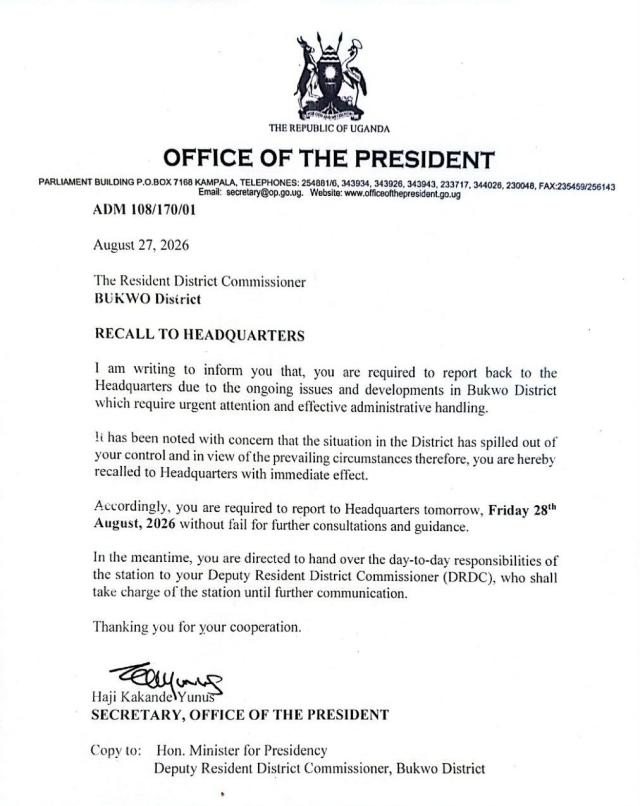
The Resident District Commissioner (RDC) of Bukwo District, George Owany, has been recalled to the Office of the President with immediate effect.
The action comes amid allegations that he was soliciting 109 million Shillings from SACCO leaders.
There are also concerns over the manner in which some government projects in the district were being handled.
According to a letter dated August 27, 2026, and signed by Haji Kakande Yunus, Secretary in the Office of the President, Owany has been directed to report to the President’s Office on Friday, August 28, 2026, for further consultations and guidance.
The letter says ongoing issues and developments in Bukwo District require urgent administrative attention, adding that the situation had “spilled out of your control.”
Owany has also been directed to hand over the day-to-day responsibilities of the RDC’s office to the Deputy Resident District Commissioner, who will take charge until further communication from the Office of the President.
The recall comes hours after Owany was ordered to step aside and arrested over allegations of soliciting money from SACCO leaders in the district.
Owany was arrested on Thursday on the orders of the Minister of Local Government, Balaam Barugahara Ateenyi, and handed over to the State House Anti-Corruption Unit for investigations.
Barugahara accused the RDC of allegedly conspiring with some SACCO leaders to solicit one million Shillings from each of the 109 SACCOs in Bukwo District, amounting to 109 million Shillings.
The Minister said Owany must account for and show the 109 million Shillings allegedly solicited from the SACCOs as part of the investigations.
Barugahara also directed Owany to hand over his phone to the State House Anti-Corruption Unit to facilitate investigations before instructing the unit to detain him.
According to the Minister, RDCs are appointed by the President to monitor government programmes and ensure accountability and should therefore not be associated with allegations of corruption or abuse of office.
“I am appointed by the President, and equally you. So sparing you as an RDC is unfair to the people of Bukwo and Uganda service,”
Barugahara said before instructing the State House Anti-Corruption Unit to detain Owany.
Apart from the SACCO allegations, Owany has also come under scrutiny over his alleged involvement in the commissioning of government projects without the consent of the district council.
Local concerns raised against the RDC allege that some projects were commissioned without seeking the necessary approval of the council and without requesting or scrutinising Bills of Quantities (BOQs) before the works were undertaken or commissioned.
The allegations have raised questions over adherence to public procurement, planning and accountability procedures in the implementation of government projects in the district.
Those raising the concerns say project specifications and costs should be properly established through Bills of Quantities and that relevant local government structures should be involved in project planning and oversight.
However, the allegations are yet to be independently established, and the ongoing investigations are expected to determine whether any laws, regulations or administrative procedures were breached.
Fred Mutai, a former councillor in Bukwo Town Council, accused the RDC of being linked to several activities he described as “shadow works” in the district.
Mutai told the Minister that residents and local leaders had raised concerns about the conduct of the RDC, alleging that some activities linked to his office were not transparent.
“The RDC is connected to a lot of shadow work in Bukwo. We have raised these concerns because some of the activities are not clear to the people. We want the authorities to investigate and establish the truth,” Mutai said.
The latest developments come as the government intensifies efforts to expose corruption and alleged misuse of public office in local governments.
The Office of the President copied the recall letter to the Minister for the Presidency and the Deputy Resident District Commissioner of Bukwo District.
Earlier on Thursday, August 27, Barugahara ordered the arrest of a police officer in Bukwo District over allegations of defiling and marrying a 13-year-old girl.
The Minister said the officer, whose duty is to protect citizens and enforce the law, should instead face investigation over the allegations.
The developments have placed Bukwo District administration under increased scrutiny, with central government authorities now investigating allegations involving the conduct of senior officials, management of public projects and alleged solicitation of money from SACCO leaders.
Owany was expected to report to the Office of the President on Friday, August 28, for further consultations and guidance, while the Deputy RDC takes over the day-to-day running of the office until further notice.
GOT A HOT STORY? LET US KNOW!
Got breaking news, explosive secrets, or hard evidence?
In the middle of 2014, Omukama Oyo Nyimba Kabamba Iguru Rukidi IV of Tooro Kingdom announced that he would fast in protest against what he described as the division of his ancestral territory.
The trigger was the formal recognition of two new cultural institutions of Obusinga Bwa Rwenzururu in Kasese and Obudhingiya Bwa Bwamba in Bundibugyo. Both areas had historically fallen under Tooro before the abolition of kingdoms in 1967.
President Museveni, who had been one of King Oyo’s official guardians since 1995, attended the installation of Bamba King Maj. Martin Kamya, a move King Oyo viewed as a desecration of his kingdom. To the king and many of his subjects, the central government’s decision amounted to carving up Tooro’s traditional boundaries.
Kingdom officials made preparations for an intentional, clear repsonse. Then Premier Dr Stephen Kaliba stated that King Oyo would fast to express displeasure at the creation of the new institutions without consultation and over the long delay in returning kingdom assets seized decades earlier.
In June 2014 the plan was announced. A month later, on 14 July, the king formally began a six-day fast at Karuziika Palace in Fort Portal. He invited his subjects and religious leaders to join him, declaring that “a king does not fast alone.”
URN reported that the monarch spent his days in prayer, intercession and listening to testimonies, breaking the fast only in the evening with a simple meal shared with those who had joined him. Religious leaders from different denominations visited the palace to show support.
President Yoweri Museveni’s reaction was blunt and widely reported. Commenting on the planned fast, the President remarked that the exercise would help King Oyo lose weight and remain fit.
“If my son has decided to fast, I don’t mind, let him fast it will help him shape up and be healthy,” the president told journalists at his Rwakitura home.
The comments triggered anger in Fort Portal. Loyalists demonstrated in the streets. Police used teargas and arrested at least four people. Tooro Kingdom officials demanded an apology, arguing that the President’s words undermined the institution.
The fast ended after six days. The new cultural institutions remained in place. The demand for the return of kingdom assets continued, leading years later to a 2019 Memorandum of Understanding between King Oyo and President Museveni. Progress on the assets has been slow, with verification exercises and further discussions continuing into the 2020s.
The 2014 episode remains one of the most public moments of tension between the Tooro throne and the central government during King Oyo’s long reign.
Despite the sharp exchange that year, the personal relationship between the President and the king, rooted in Museveni’s role as guardian, endured. The fasting episode, however, is still remembered in Tooro as the moment a young monarch chose prayer and self-denial to defend what he regarded as the integrity of his kingdom’s borders.
GOT A HOT STORY? LET US KNOW!
Got breaking news, explosive secrets, or hard evidence?
The Court of Appeal has halted execution of a High Court decree requiring Casements (Africa) Limited and businessman Abid Alam to pay Chinese glass manufacturer Weihai Rongsheng Glasswork Co. Limited more than US$338,000 (about Shs1.27 billion), pending determination of their intended appeal.
The stay was granted on August 28, 2026, by Court of Appeal Justice Florence Nakachwa, sitting as a single Justice, after the applicants challenged a High Court decision that dismissed their attempt to set aside a default judgment entered against them. The applicants had asked the Court of Appeal to stop all execution proceedings arising from High Court Civil Suit No. 0638 of 2025, arguing that enforcement of the decree would cause them substantial and irreparable loss and could render their intended appeal nugatory.
The dispute arose from three contracts signed in June 2022 under which Weihai Rongsheng Glasswork was to supply Casements (Africa) Limited with 40 crates of clear glass, 140 crates of tinted glass and 30 crates of laminated glass at a total cost of US$338,800.52. According to the Chinese company, the glass was shipped and received by Casements at its premises in Kampala Industrial Area, but payment was not made within the agreed 120-day period.
The company subsequently sued for recovery of the outstanding amount and obtained judgment in its favour. Casements and Alam, however, argued that they were denied an opportunity to defend the case because of mistakes and failures by their former lawyers. They told the Court that after being served with court documents in July 2025, they immediately instructed Karungi & Partners Advocates to file an application seeking leave to appear and defend the claim.
The lawyers filed Miscellaneous Application No. 1618 of 2025, which came before the High Court on August 20, 2025, and was later scheduled for hearing on August 25. The applicants said their former lawyers failed to attend the August 25 hearing and did not inform them about what had happened. The application was consequently dismissed, paving the way for the default judgment against them.
The applicants later instructed Muwema & Co. Advocates to seek the setting aside of the default judgment, arguing that they had acted diligently by instructing lawyers and should not be punished for the mistakes of their former advocates. The High Court dismissed that application in January 2026, prompting the intended appeal.
Weihai Rongsheng opposed the stay application, arguing that Casements and Alam had repeatedly acknowledged the debt and entered into payment arrangements which they failed to honour. The Chinese company also argued that the intended appeal lacked merit and that the applicants had failed to demonstrate that enforcement of the monetary decree would cause irreparable loss.
Weihai Rongsheng told the Court that it had already commenced execution proceedings, including seeking attachment of Alam’s shares in Casements (Africa) Limited, garnishee orders against the company’s bank accounts and the arrest and committal of Alam to civil prison. Justice Nakachwa, however, found that the applicants had satisfied the legal requirements for a stay of execution.
The judge noted that at the stay stage, an applicant is not required to prove that the intended appeal will succeed, but only that it raises reasonable and arguable questions. She found that the applicants had raised triable issues, including whether the dismissal of their application resulted from mistakes by their former lawyers or their own dilatory conduct, and whether the default judgment had been properly entered under the law.
Justice Nakachwa also found that the applicants had demonstrated a risk of substantial and irreparable harm, particularly because the execution proceedings could result in Alam’s arrest and imprisonment. She held that imprisonment could cause psychological and mental harm that might not easily be reversed even if the applicants ultimately succeeded in their appeal.
The judge said the balance of convenience therefore favoured protecting Alam’s personal liberty while the intended appeal is pursued. The Court also found that the applicants had acted without unreasonable delay, having filed the Court of Appeal application shortly after the High Court rejected their earlier application for a stay. Justice Nakachwa consequently ordered a stay of execution of the judgment and decree in High Court Civil Suit No. 0638 of 2025 pending determination of the applicants’ intended appeal.
The costs of the Court of Appeal application will abide by the outcome of the intended appeal.
GOT A HOT STORY? LET US KNOW!
Got breaking news, explosive secrets, or hard evidence?
Bududa District leaders and the Uganda Wildlife Authority (UWA) have failed to reach consensus on key concerns surrounding ongoing enforcement operations in and around Mt. Elgon National Park, with disagreements persisting over crop destruction, boundary demarcation and the fate of residents living inside the protected area.
The disagreement emerged during a stakeholders’ meeting held at Bududa District Council Hall on Friday, following UWA operations in Bushiyi, Bundesi, Bukalasi and Bubiita sub-counties. UWA officials have been enforcing the park boundary and destroying crops cultivated in areas they say fall within the protected area.
Some residents living inside the park have also reportedly been given a one-week ultimatum to vacate. The enforcement has raised concern among local leaders and communities, particularly over the destruction of crops and the welfare of households expected to leave the area.
Tensions intensified following an incident in Natunga Village, Namirumba Parish, Bushiyi Sub-county, where residents Simeo Benecto, Florence Namee and Veronica Jewa were reportedly shot and injured during an encounter with UWA personnel. The three are receiving treatment in Mbale.
They reportedly sustained the injuries after questioning the destruction of their crops and objecting to orders to leave their homes within one week. In another incident, residents from Bubiita and Bukalasi sub-counties reportedly stormed the offices of the Resident District Commissioner and district chairperson carrying coffee, banana stems and other crops, asking leaders to intervene before the destruction of their gardens left their households facing hunger.
During Friday’s meeting, community representatives called on UWA and Government to take responsibility for crops destroyed during the enforcement exercise, saying farmers had suffered significant losses and should be considered for compensation. More than 40 gardens belonging to over 40 households have reportedly been destroyed.
The affected crops include coffee, bananas, onions, maize and cassava. Farmers also raised concern over how they will repay Parish Development Model (PDM) funds they borrowed and invested in agriculture after their crops were destroyed. The enforcement operation was still ongoing at the time of filing this report.
UWA officials told the meeting that approximately 1,500 acres of land had been encroached on by people living or cultivating land in areas falling inside Mt. Elgon National Park. Bududa District Chairperson Geoffrey Natubu said the concerns surrounding Mt. Elgon National Park require extensive consultations involving national leaders because they affect communities in several districts surrounding the mountain.
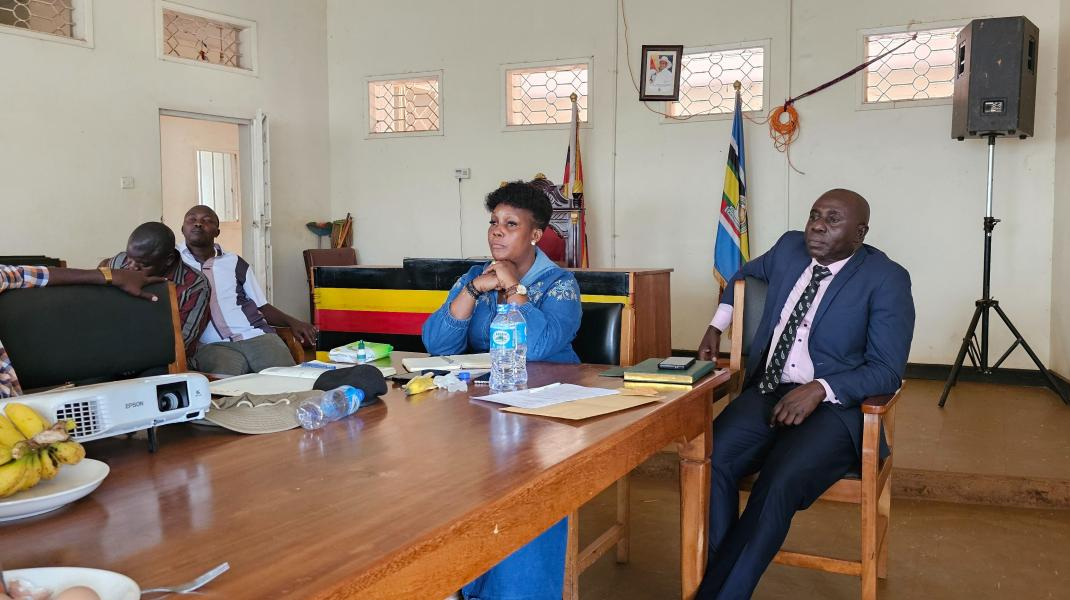
Bududa officials in the meeting
Natubu said some communities had occupied the area for generations and called for a coordinated Government approach to address their concerns. He urged Members of Parliament from affected areas and the wider Bugisu region to join future engagements so they can participate in discussions concerning communities they represent. Natubu cautioned against leaving local governments to handle major interventions such as relocation without clear guidance and involvement from the national Government.
He called for continued dialogue among UWA, local leaders and communities to prevent further tension. Mukhwana Wekhoola Koloto, the National Resistance Movement chairperson in Bududa, said leaders understood the importance of protecting the forest and were willing to sensitise people living inside the park to vacate. However, he questioned where the affected residents would go, particularly after their food crops had been destroyed.
Mukhwana also questioned whether the sensitisation exercise had been brought to the attention of MPs representing the affected communities. He said MPs should be involved because they represent the affected people at the national level. Bududa Resident District Commissioner Juliet Solome Namara called for peaceful and coordinated engagement between Government agencies and communities.
Namara said residents had raised concerns over crop destruction and restrictions on activities within the protected area, which she said should be addressed through dialogue while ensuring communities understand the Government’s position and have an opportunity to present their grievances.
She urged UWA, district leaders and security agencies to provide communities with clear and consistent information and cautioned against approaches that could create unnecessary tension between residents and enforcement personnel. Bududa District Internal Security Officer Denis Elyebu said leaders could not stop sensitising residents to leave the forest, but the challenge was that UWA had not provided a clear boundary linking the protected area to community land.
Elyebu said he visited Bushiyi and found that, apart from eucalyptus trees, there was inadequate physical demarcation to guide residents and enforcement teams. He asked UWA to provide each sub-county with geographical coordinates so that communities and local leaders are not caught off guard during enforcement operations.
Bududa Chief Administrative Officer Max Martin Mukula cautioned against rushing into enforcement or relocation measures without adequate planning. Mukula said the consequences of Government actions, particularly for households that may be required to leave areas confirmed to be within the protected area, must be carefully considered.
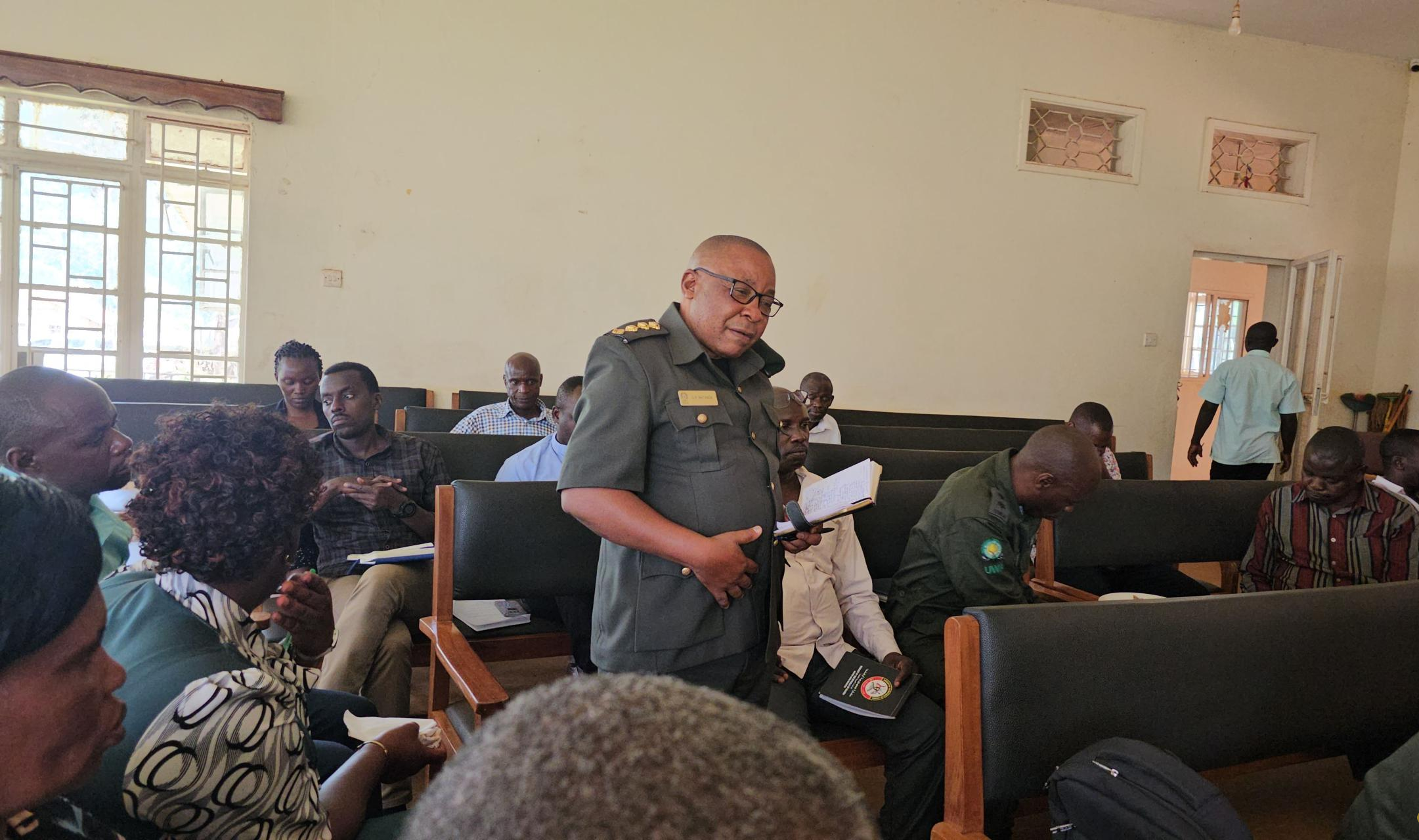
UWA Administrator Matanda addressing the officials
He said any relocation or eviction process should follow applicable legal and administrative procedures while taking into account the welfare of affected communities. The CAO also called for accurate information on affected households, crops, homes and livelihoods to support Government planning and decision-making.
Godfrey Matanda, the UWA administrator, explained the Authority’s mandate to protect and manage the protected area. Matanda said Mt. Elgon was gazetted as a national park in 1993 after previously being managed as a Central Forest Reserve. He said the park boundary is established using geographical coordinates and that the legally established boundary has not changed, although population growth and encroachment have created challenges in some areas.
Matanda said some boundary pillars had reportedly been removed, displaced or shifted, making it necessary for stakeholders to work together to verify and clearly identify the boundary on the ground. He said UWA remained committed to working with district and local leaders to address concerns arising around the park.
The meeting also focused on concerns over different references to the Mt. Elgon park boundary, including those associated with 1993, 2005 and 2017. District and security officials called for accurate geographical coordinates and clear, visible boundary markers to help communities, enforcement personnel and local authorities identify the extent of the protected area.
Stakeholders said clear boundary information would help reduce misunderstandings and potential conflicts between communities and conservation authorities. They also called for verification of allegations that some boundary pillars had been removed or shifted and for the findings to be clearly communicated to affected communities.
The meeting also considered the fate of people who may be required to leave areas confirmed to be within the national park. District leaders said residents required to leave protected areas who have no alternative place to stay should be considered for resettlement through the appropriate Government structures.
They said the matter requires engagement with relevant national Government institutions to establish a clear and coordinated approach. Stakeholders emphasised that any resettlement process should be properly planned and communicated to affected communities.
The stakeholders also discussed allegations of misconduct, possible collusion and selective targeting involving some enforcement personnel and community members. Participants called for such allegations to be investigated and appropriate action taken where wrongdoing is established. At the same time, communities were urged to comply with the law and avoid activities that contribute to encroachment or undermine conservation efforts, including illegal cultivation and interference with boundary markers.
UWA also encouraged communities to explore conservation and tourism opportunities around Mt. Elgon, which could contribute to local livelihoods. Stakeholders agreed that Members of Parliament from affected areas should participate in subsequent engagements. District leaders said MPs should participate as a team in planned sensitisation and community engagement exercises rather than leaving the responsibility to the district chairperson and sub-county leaders alone.
Their involvement is expected to provide a platform for national leaders to participate in discussions on community concerns and contribute to issues requiring national-level intervention, particularly resettlement and other major Government measures.
The meeting ended with a commitment to continue consultations among UWA, district authorities, security agencies, MPs and communities despite the lack of consensus on some of the key concerns. District leaders pledged to pursue a peaceful, lawful and coordinated approach to managing Mt. Elgon National Park while seeking solutions to concerns raised by surrounding communities.
GOT A HOT STORY? LET US KNOW!
Got breaking news, explosive secrets, or hard evidence?