Author: admin

  • WATER CRISIS LOOMS! NWSC Begs Shs650bn To Save 50 Towns From Shortages

    WATER CRISIS LOOMS! NWSC Begs Shs650bn To Save 50 Towns From Shortages

    By Evans Najuna

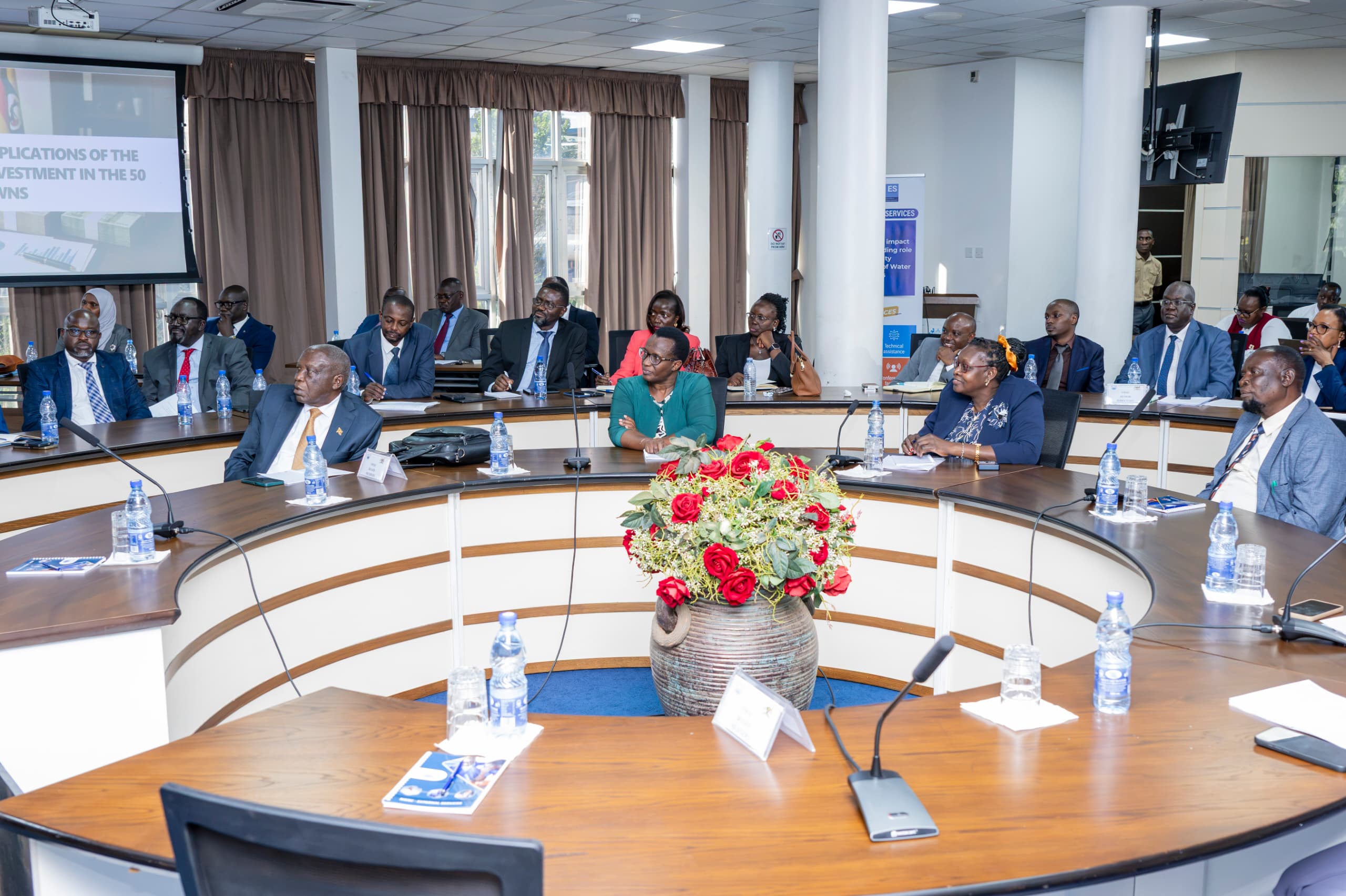
    KAMPALA: The National Water and Sewerage Corporation (NWSC) has put government on the spot, seeking a whopping Shs650 billion to boost water production and supply in 50 towns across the country as its existing systems come under increasing pressure.

    Under the proposed financing arrangement, government would provide Shs500 billion as a concessionary loan at an annual interest rate of 2%, with a two-year grace period and a 20-year repayment window.

    NWSC says it would service the loan from its own revenues, while another Shs150 billion would be provided as a revenue grant.

    The funds would be released in five equal annual tranches of Shs130 billion during the 2027/28 to 2031/32 financial years.

    The cash request received a major boost after the new Minister of Water and Environment, Gen. Kahinda Otafiire, pledged government backing for the ambitious expansion programme.

    Otafiire made the commitment during his maiden visit to NWSC’s International Resource Centre in Bugolobi since taking charge of the ministry in May

    Otafiire made the commitment on Thursday, August 28 during his maiden visit to NWSC’s International Resource Centre in Bugolobi since taking charge of the ministry in May.

    He told NWSC management and staff that providing clean and reliable water to Ugandans was a national duty that could not be left to technocrats alone.

    The minister challenged the corporation to abandon short-term planning and think at least 20 years ahead if it is to keep pace with the country’s growing population and demand for water.

    While commending NWSC’s leadership as capable managers, Otafiire warned that many African institutions collapse not because they lack intelligent people, but because of poor management and execution.

    “In Africa we have intelligent people with poor management skills,” Otafiire said.

    He urged NWSC to motivate and retain workers with specialised skills, saying the corporation could not afford to lose valuable expertise.

    Otafiire also promised government support for NWSC to establish local assembly plants for critical water-sector materials, including pipes and meters.

    He argued that global conflicts and disruptions in international supply chains had made self-reliance increasingly urgent.

    The minister also weighed in on whistle-blower complaints against NWSC, saying legitimate grievances should be investigated and addressed.

    NWSC Managing Director Dr Silver Mugisha presented the 50 Towns Water Supply Improvement Project, saying it was designed to address increasing pressure on the corporation’s water systems

    He likened criticism to dust raised by a moving vehicle, arguing that an institution that is active and moving will inevitably attract scrutiny.

    Otafiire urged NWSC management to treat opposition as a “mirror” that can expose weaknesses and help the corporation improve rather than viewing critics as enemies.

    He praised NWSC as evidence that government-owned institutions can perform, recalling that the corporation had once been lined up for privatisation.

    NWSC Managing Director Dr Silver Mugisha presented the 50 Towns Water Supply Improvement Project, saying it was designed to address increasing pressure on the corporation’s water systems.

    Mugisha said the project followed a request by Otafiire for NWSC to develop a strategy for improving water supply in the selected towns.

    The NWSC board has since reviewed and approved the concept, with amendments, and will forward it to the ministry before implementation.

    Otafiire made the commitment during his maiden visit to NWSC’s International Resource Centre in Bugolobi since taking charge of the ministry in May

    According to Mugisha, NWSC’s average capacity utilisation has reached 85%, a level at which customers increasingly begin experiencing water shortages.

    The proposed Shs650 billion investment will finance water production systems, electro-mechanical equipment, transmission mains, storage reservoirs, distribution networks and water-quality monitoring.

    The 50 towns are spread across the corporation’s four regions, with 14 towns in the Central Region allocated Shs202 billion, 14 towns in the Eastern Region receiving Shs178 billion, eight towns in the Northern Region getting Shs90 billion and 14 towns in the Western and South-Western regions sharing Shs180 billion.

    Individual allocations will range from Shs10 billion to Shs30 billion, depending on the size and requirements of each water system.

    Mugisha revealed that NWSC currently faces an investment financing gap of about Shs1.436 trillion, underscoring the scale of resources required to keep up with its rapid expansion.

    He said the corporation had grown from just 23 towns in 2013 to 293 towns as of June 30, 2026.

    The utility now serves more than 22 million people, while customer connections have risen from about 300,000 to more than one million.

    Turnover has also jumped from Shs120 billion to Shs680 billion, while the corporation’s assets have grown from Shs580 billion to about Shs5 trillion.

    Mugisha attributed the growth to efforts to reduce the cost of doing business and the development of in-house systems and expertise.

    He appealed to Otafiire to ensure public institutions are not forced to adopt expensive external systems where local expertise is already available.

    In a separate presentation, Johnson Amayo said NWSC’s pipeline network had expanded to approximately 24,000 kilometres, while customer satisfaction stood at 82%.

    He highlighted the Katosi water treatment plant, whose capacity has been increased to 240 million litres.

    Amayo said talks were underway with the Ministry of Finance for an additional 80 million euros to expand water intake and evacuation capacity.

    Otafiire made the commitment during his maiden visit to NWSC’s International Resource Centre in Bugolobi since taking charge of the ministry in May

    He also pointed to the Service Coverage Acceleration Project, under which about Shs30 billion annually is being channelled towards ensuring every village has access to a water point.

    Beyond the Shs650 billion financing request, Mugisha asked the minister to support the solarisation of NWSC’s power systems to reduce the corporation’s energy costs.

    He also called for government support towards local production of materials currently imported by NWSC, including soda ash, polymers, meters and generators.

    NWSC Board Chairman Prof. Henry Alinaitwe pledged continued strategic guidance, oversight and support to the corporation.

    On the whistle-blower allegations, Alinaitwe said the board had commissioned an audit and that findings so far indicated that some NWSC initiatives, including its insurance company, were helping the corporation save money.

    Representing the Permanent Secretary at the Ministry of Water and Environment, John Mary Vianne Twinomujuni pledged the ministry’s support, describing NWSC as one of its best-performing institutions.

    He said the ministry would guide the corporation through the necessary processes to ensure the 50 Towns Water Supply Improvement Project is implemented in accordance with government requirements.


    GOT A HOT STORY? LET US KNOW!

    Got breaking news, explosive secrets, or hard evidence?

    Email us: redpeppertips@gmail.com

    We accept tips, documents, videos, photos, and recordings—the more evidence you have, the better.

    CONFIDENTIALITY IS OUR TOP PRIORITY. SOURCES ARE ALWAYS PROTECTED!

    About Post Author

  • The IT Grad hacking Kampala’s night life – Sqoop

    The IT Grad hacking Kampala’s night life – Sqoop

    To understand Kampala’s evolving nightlife, look no further than Aaron Elwanu, better known on the decks as Dread Lazer. At just 25, the Information Systems Technology graduand from Makerere University is living proof of what happens when raw technical focus meets an unapologetic desire to turn the crowd upside down.

    His stage name tell a story of its own. The “Dread” part pays homage to reggae music, his deepest musical love. Then the “Lazer” represents what he aims to deliver behind the decks with sets that are sharp, focused and fun as well.

    It’s a fitting description for a young man who, off-stage, is something of a paradox. “I’m an introvert. “I really like to be indoors,” Aaron admits. It’s this quiet, introspective side that makes his transformation on stage so much more enjoyable as the reserved student becomes a force of nature the moment the music starts.

    “The party is a place to let your worries disappear and just relax. Even though the music for that mood changes every time, my goal is to keep you completely in the moment,” Dread Lazer says.

    His journey began in 2012 inside a local gaming station, experimenting with VirtualDJ, PCDJ, and desktop software between rounds of PlayStation 2. Growing up near the Kenyan border, he soaked in the soundscape cutting across Uganda and Kenya, drawing heavy inspiration from the legendary Supremacy Sounds mixmasters.

    The defining moment arrived in 2022 when he landed his first paid gig at his Senior Six prom for Seeta High in a move that saw him miss his own prom festivities to pursue his true passion. That break eventually led to 5 PM to 7 PM sets at the former Kampala favourite, Kenji’s, alongside DJ Bugy and DJ Kuzzi, before graduating to late-night Saturday slots at Kenji’s and Cielo Lounge. He simultaneously built a following across high school and university circuits, rocking crowds at Seeta High, Uganda Martyrs Namugongo, Nabisunsa, and St. Joseph’s Nagalama.

    When Kenji’s closed and other gigs slowed during the post-lockdown period, Dread Lazer adapted. He invested his savings into equipment and turned to TikTok during the university recess, dropping mixes and mashups that racked up serious numbers online. That momentum caught NRG Radio’s attention, and after a competitive month-long audition alongside talents like Eyo Marcus and DJ Cross, he earned his spot as a full-time national radio DJ and influencer.

    Balancing a demanding Information Systems degree at Makerere while building a DJ career took discipline. While his parents were initially hesitant and concerned the decks would distract from his academics, their perspective shifted completely as they saw his dedication pay off into a viable, professional path.

    What sets a Dread Lazer set apart isn’t just his custom DJ drops or signature mashups; it’s his calculating approach to the room. Before touching a single fader, he observes the crowd and the preceding DJ, analyzing the energy to craft seamless transitions. While he leans toward Afrohouse and the infectious energy of three-step, he refuses to be boxed into a single genre or simply ride the prevailing Amapiano wave.

    His ability to read the room and ignite massive audiences made him a standout highlight across the Smirnoff Fiestas circuit and the MUBS Cultural Gala, where his sets turned main events into full-blown after-parties. Now, Smirnoff is proud to back his vision for a party built on the same spirit of self-expression and genuine connection that defines the brand.

    Despite facing early industry hurdles from moments of self-doubt to gig negotiations where others sought to undervalue his work, Dread Lazer remains focused on his ultimate destination to take his sound to the international stage.

    As he prepares for his upcoming showcase at Kati Kati on September 4th, Dread Lazer invites partygoers to drop their stress at the door and step into the vibe.

    It’s a celebration of keeping it real and as Dread Lazer puts it, “finding a space where the music is loud, the vibe is immaculate, and the connection is everything.”

    With a sound that evolves with every venue he plays and an ambition that extends far beyond local borders, Dread Lazer invites you to his Turnup as he looks to prove that sometimes the most powerful voices in the club belong to the people who speak the quietest off-stage.

    Don’t want to miss out on any story? For updates on all Sqoop stories, follow this link on Telegram: https://t.me/Sqoop

  • MBARARA: Alcohol, Betting Crackdown Looms, City Council Set To Pass New Ordinance

    MBARARA: Alcohol, Betting Crackdown Looms, City Council Set To Pass New Ordinance

    By Amos Tayebwa
    MBARARA

    Mbarara City Council is set to tighten the screws on alcohol consumption and gambling activities, with leaders warning bar patrons, betting enthusiasts and operators to prepare for new restrictions.

    The City Council has scheduled September 2, 2026, for a council meeting at which a proposed by-law regulating alcohol consumption, bars, gambling and sports betting within Mbarara City and its urban centres will be considered.

    The move follows guidance from the Minister of Local Government, Balam Barugahara, who recently called for bars in urban centres across the country to be prohibited from opening before 3:00pm.

    Barugahara later tasked local governments, including cities and districts, to sit through their respective councils, with the assistance of Resident City Commissioners (RCCs) and Resident District Commissioners (RDCs), to formulate ordinances regulating bars and gambling or betting centres.

    Under the arrangement, individual local councils will determine the opening and closing hours for bars and other related businesses, alongside other guidelines contained in the proposed policies or by-laws.

    Mbarara City Council Speaker Bony Tashobya Karutsya confirmed that council will meet on September 2 to deliberate on a by-law seeking to regulate alcohol consumption, bars, gambling and sports betting across Mbarara City.

    He said the council has three ordinances lined up for consideration, including the regulation of alcohol and sports betting, parking of motor vehicles, and the loading and offloading of taxis and buses at taxi and bus parks.

    The Speaker urged other city and district councils to follow suit and embrace the Minister’s guidance on regulating alcohol and betting activities.

    Meanwhile, Gerald Tukamuhebwa, the Deputy RCC in charge of Mbarara City South Division, said security is ready to enforce whatever regulations are approved by the City Council.

    A montage of Gerald Tukamuhebwa, Deputy RCC Mbarara City South (L) and Ronald Taremwa, the Mbarara City Deputy Mayor

    “Once the City Council comes up with a by-law on alcohol and gambling regulation, as security and different stakeholders, we shall be there to assist them in implementation. As far as I know we are there to ensure all things are done in the right way and the right procedure, and to make sure that the guidelines and the by-laws that are put in place are adhered to and ensure that we have got trade order within our City. We shall work hand in hand with the local councils to ensure that we have kept law and order,” Tukamuhebwa said.

    He also appealed to alcohol consumers to use the morning hours productively by engaging in work before heading to bars and malwa joints later in the day.

    He urged those who drink to do so responsibly.

    Mbarara City Deputy Mayor Ronald Taremwa said the City has already embarked on preparations for an ordinance regulating alcohol and betting activities following the Minister’s guidance.

    Taremwa said the process will involve consultations in which councillors will be required to return to their respective areas and seek views from bar owners, bar attendants, consumers, parents, games and betting house operators.

    He said the majority of people in Mbarara have welcomed the Minister’s proposal and are prepared to support it, although some sections of the population have opposed the idea.

    According to Taremwa, some of those opposed argue that the policy infringes on their economic rights because their businesses could be affected, while others maintain that they have a right to drink whenever they want as long as they can afford it.

    “As a City here, through consultations we shall come up with appropriate time that we can put in our ordinance as the time within which one is supposed to open the bar or engage in those alcoholic activities. We shall also come up with sanctions or offences, if you do this that contravenes with this ordinance then you are supposed to face the law and be charged with these offences,” Taremwa said.

    The proposed restrictions have already triggered changes among some bar operators in Mbarara.

    Since the Minister issued the guidelines, some bars reportedly panicked and started opening at 3:00pm, while others have continued waiting for the City Council’s final decision on the implementation of the new regulations.

    With the September 2 council sitting now looming, bar owners, alcohol consumers and gambling operators are waiting to see how far Mbarara City will go in enforcing the proposed crackdown.


    GOT A HOT STORY? LET US KNOW!

    Got breaking news, explosive secrets, or hard evidence?

    Email us: redpeppertips@gmail.com

    We accept tips, documents, videos, photos, and recordings—the more evidence you have, the better.

    CONFIDENTIALITY IS OUR TOP PRIORITY. SOURCES ARE ALWAYS PROTECTED!

    About Post Author

  • DIGITAL POWER! MTN Arms 503 Youths With Digital Skills For Jobs, Business Growth

    DIGITAL POWER! MTN Arms 503 Youths With Digital Skills For Jobs, Business Growth

    MTN Uganda has graduated 503 young people from its ACE digital-skilling programme, adding to efforts to build a workforce capable of supporting businesses and jobs as the country seeks to accelerate economic growth through technology.

    The latest cohort brings the number of people who have completed the programme to more than 1,190, who consist of people with disabilities and refugees.

    The graduates were trained through a hybrid learning model in computer and online essentials, digital marketing, e-commerce, cybersecurity and artificial intelligence. They are eligible to progress to the ACE Career & Enterprise track, which provides advanced digital and entrepreneurship training aligned with MTN’s Ambition 2030 strategy.

    George William Egaddu, Chairperson of the Board of Trustees of MTN Foundation, said the MTN ACE programme was designed to help young people turn access to technology into economic opportunities.

    “At MTN Foundation, we believe that investing in young people is an investment in Uganda’s future. Digital access creates the opportunity, but it is skills that enable people to turn that access into livelihoods, businesses and solutions,” Egadu said.

    MTN Foundation Trustee Chairperson George William Egaddu speaks to MTN ACE graduands during their graduation ceremony at the National ICT Hub in Nakawa on Aug. 28.

    Uganda is targeting a tenfold expansion of its economy to $500 billion by 2040, with ICT, science, technology and innovation identified among the drivers of economic transformation under the Fourth National Development Plan.

    The country’s demographics add urgency to the skills push. Three-quarters of Uganda’s population are below the age of 30, creating pressure to expand employment opportunities while giving the economy a large pool of potential workers and entrepreneurs.

    “The opportunity before us is to ensure that our young population is equipped not only to participate in the digital economy, but also to shape it,” said Amos Mpungu, assistant commisioner, who represented permanent secretary, Dr. Aminah Zawedde, in the Ministry of ICT and National Guidance.

    Mpungu said programmes such as ACE complemented government efforts to build a digitally empowered society in which young people can use technology to develop businesses, create jobs and address local challenges.

    MTN Uganda said expanding connectivity would have limited economic impact without the skills required to use digital services productively.

    Ministry of ICT and National Guidance Assistant Commissioner Amos Mpungu speaks to MTN ACE graduands during their graduation ceremony at the National ICT Hub in Nakawa on Aug. 28.

    The MTN Foundation receives 1% of MTN Uganda’s net profit for social investment and focuses on economic empowerment, education, health and humanitarian response.

    In 2025, the Foundation invested more than Shs 5.1 billion in various programmes impacting more than  60,000 people across Uganda.

    An independent assessment of Foundation economic empowerment projects implemented between 2022 and 2024 found that 88% of youth participants secured employment after training, while 93% reported improved business performance. More than 22 startups were supported.

    The ACE programme now gives the latest graduates a pathway into more advanced digital and entrepreneurship training, with the focus shifting from acquiring basic skills to applying them in jobs, businesses and new ventures.


    GOT A HOT STORY? LET US KNOW!

    Got breaking news, explosive secrets, or hard evidence?

    Email us: redpeppertips@gmail.com

    We accept tips, documents, videos, photos, and recordings—the more evidence you have, the better.

    CONFIDENTIALITY IS OUR TOP PRIORITY. SOURCES ARE ALWAYS PROTECTED!

    About Post Author

  • FINANCE POWER! Housing Finance Bank Unveils Key Catalyst to Uganda’s Growth at REDI Conference

    FINANCE POWER! Housing Finance Bank Unveils Key Catalyst to Uganda’s Growth at REDI Conference

    Uganda’s ambition to grow its economy from approximately USD 50 billion to USD 500 billion by 2040 will depend on how effectively capital is channeled into the businesses, housing and infrastructure that drive economic activity. This was a key theme at the REDi Mbarara 2026 – Ankole Real Estate & Infrastructure Conference organized by Knight Frank Uganda, where Housing Finance Bank highlighted the role of finance in unlocking investment and supporting the country’s next phase of growth.

    The conference brought together investors, developers, policymakers, financial institutions and industry leaders to examine opportunities shaping Western Uganda, particularly in real estate, infrastructure and regional investment.

    Representing Housing Finance Bank, Joel Matsiko, Ag. Head of Business and Institutional Banking, said that Uganda’s Tenfold Growth Strategy (ATMS) presents a significant opportunity for financial institutions to direct capital towards productive sectors.

    “If we are going to achieve the scale of growth envisaged under the Tenfold Growth Strategy, we have to ensure that capital is reaching the sectors that create economic value. That means financing businesses to grow, supporting housing development and investing in the infrastructure that allows economies to expand,” said Matsiko.

    Mbarara and the wider Ankole region are increasingly important centres of economic activity, with opportunities across commercial enterprise, agriculture, real estate and infrastructure. Unlocking this potential will require investment alongside the financing and infrastructure needed to support sustainable growth.

    For Housing Finance Bank, this means providing financial solutions across the economic ecosystem, supporting businesses and institutions while expanding access to housing finance, financial inclusion and digital financial services.

    The conference also explored how regional economies can attract and effectively deploy investment. Joseph Enyimu, Commissioner for Economic Development Policy & Research at the Ministry of Finance, Planning and Economic Development, spoke on Financing Regional Growth, while Nelson Tugume of Inspire Africa highlighted emerging investment opportunities in Ntungamo, including the development of Uganda’s “Coffee City.”

    Matsiko noted that stronger collaboration between government, investors, developers and financial institutions will be essential to converting regional opportunities into sustainable economic activity.

    “There is a significant opportunity in bringing together government, investors, developers and financial institutions around viable projects and enterprises. As a Bank, our role is to provide the financial solutions that help turn these opportunities into sustainable economic activity,” he said.

    For Housing Finance Bank, participation in REDi Mbarara reflects its commitment to supporting the financial ecosystem needed to drive growth across Uganda’s regions.

    As Uganda pursues its ambitious growth agenda, ensuring that capital reaches the businesses, homes and infrastructure that power regional economies will remain critical to turning that ambition into reality.

    About Post Author

  • Robert Mutungi flies in The Ben for wife Olivia’s lavish birthday surprise – Sqoop

    Robert Mutungi flies in The Ben for wife Olivia’s lavish birthday surprise – Sqoop

    Businessman Robert Mutungi, popularly known as a silent moneybag, has once again shown that when it comes to his wife, Olivia Ventures, he is willing to go all out, reportedly spending more than $150,000 on her exclusive birthday celebration.

    In a surprise that caught many guests off guard, Mutungi flew in Rwandan star The Ben to headline a private birthday celebration for his wife.

    The intimate but lavish party brought together about 30 guests, including celebrities such as Sheila Gashumba and comedian Alex Muhangi, with Mutungi keeping the guest list deliberately small.

    The Ben’s appearance was one of the evening’s biggest surprises, with the Rwandan singer taking the celebrations to another level with his performance.

    Mutungi also assembled a strong line-up of Ugandan musicians to entertain his wife and guests, including Rema Namakula, Fik Fameica, Elijah Kitaka, Winnie Nwagi, Ykee Benda, Kalifah Aganaga, Rickman, Mun G, Anknown, Dax Vibez and Liam Voice.

    The celebration adds another chapter to Mutungi and Olivia’s relationship, with the businessman previously making headlines with his grand gestures towards his wife.

    The couple got engaged last year at the exclusive Lemala Wildwaters in Jinja during an intimate ceremony attended by close friends and family.

    Sources close to the celebrations claim Mutungi spent more than $150,000 to fly in The Ben and organise the birthday experience, although the figure could not independently be verified.

    For a celebration that brought together some of Uganda’s biggest entertainment names and one of Rwanda’s leading stars, Mutungi appeared determined to make sure Olivia’s birthday was one she would not forget anytime soon.

    Don’t want to miss out on any story? For updates on all Sqoop stories, follow this link on Telegram: https://t.me/Sqoop

  • UBOS BOSS SOUNDS TEAMWORK ALARM! Staff Warned Over Trust, Discipline, Accountability

    UBOS BOSS SOUNDS TEAMWORK ALARM! Staff Warned Over Trust, Discipline, Accountability

    By Evans Najuna

    KAMPALA – Uganda Bureau of Statistics (UBOS) Executive Director and Chief Statistician, Dr. Chris N. Mukiza, has sounded the alarm over teamwork, discipline and accountability at the statistics body, warning staff that failure to uphold institutional values could attract sanctions.

    Mukiza issued the warning during a five-day UBOS staff retreat aimed at strengthening teamwork, professional integrity, discipline and a shared sense of purpose among employees.

    Opening the retreat, Mukiza reminded staff that they are custodians of the Bureau’s vision, mission and core values, challenging them to lead by example in the execution of their duties.

    “You are the bearer of the vision, mission and core values of the Bureau, you must, therefore, be the champion and lead by example,” Mukiza said.

    The UBOS boss urged staff to embrace professionalism, integrity, trust and commitment, stressing that the success of the institution depends not only on individual performance but also on how effectively employees work together.

    He called for greater support among staff and a renewed focus on the wider objectives of the Bureau to ensure efficiency throughout the statistical production chain.

    Mukiza also challenged employees to guard against what he described as the five dysfunctions of a team – absence of trust, fear of conflict, lack of commitment, avoidance of accountability and lack of results.

    He warned staff against conduct that goes against UBOS standards, saying those found engaging in such practices risk disciplinary action in accordance with the institution’s Human Resource Manual.

    The Executive Director particularly encouraged staff not to fear constructive conflict, saying differences in opinion should not be allowed to destroy teams but should instead provide an opportunity for deeper reflection, better decisions and improved problem-solving.

    According to Mukiza, healthy disagreement can strengthen working relationships when handled professionally and when the interests of the institution remain the priority.

    He challenged staff to use the retreat to better understand themselves, their colleagues and their individual responsibilities while finding more effective ways of supporting one another in delivering the Bureau’s mandate.

    Closing the retreat, Deputy Executive Director Dr. Vincent F. Ssenono urged staff to move beyond discussions and put the lessons from the engagement into practice at their respective workstations.

    Ssenono called for stronger trust, collaboration and teamwork, saying the retreat had given staff an opportunity to reflect on both their individual and collective responsibilities.

    He also urged employees to appreciate the contribution of different departments and identify practical ways of working together to advance UBOS’ mandate.

    Ssenono said the lessons and commitments generated during the retreat should become a driver for improved performance and better delivery of the Bureau’s mandate.

    The team-building retreat brought together staff from the Office of the Executive Director, including the Risk Management and Compliance Department, Public and Media Relations, and Professional Services.


    GOT A HOT STORY? LET US KNOW!

    Got breaking news, explosive secrets, or hard evidence?

    Email us: redpeppertips@gmail.com

    We accept tips, documents, videos, photos, and recordings—the more evidence you have, the better.

    CONFIDENTIALITY IS OUR TOP PRIORITY. SOURCES ARE ALWAYS PROTECTED!

    About Post Author

  • From the village to the district: How LC1 councils could change Uganda’s fight against corruption

    From the village to the district: How LC1 councils could change Uganda’s fight against corruption

    KAMPALA. The Permanent Secretary in the Ministry of Local Government, Mr Ben Kumumanya, has spent more than three decades inside Uganda’s decentralisation experiment—a system formally launched in 1992 to transfer decision-making and responsibilities closer to citizens.

    Now, following the election of village Local Council I (LC1) chairpersons, the same grassroots architecture could provide Uganda with a powerful new layer in the fight against corruption in local government.

    The Electoral Commission, led by Justice Simon Mugenyi Byabakama, conducted the 2026 LC1 elections across 71,214 villages, with polling successfully completed in 70,079 villages—98.4 per cent of the targeted villages.

    The significance of the elections, however, goes beyond restoring elected leadership.

    It is about restoring citizens’ ability to know what is happening in their villages, identify problems early and demand answers from institutions responsible for delivering public services.

    From managing community information and monitoring public programmes to tracking service delivery and reporting suspected abuse of public resources, the new LC1 councils are positioned at the point where corruption is often easiest to detect—where government meets the citizen.

    For Mr Kumumanya, that is at the heart of decentralisation.

    The Ministry has described LC1 and LC2 leadership as the “bedrock” of Uganda’s decentralised governance system, arguing that these structures bring leadership and decision-making closer to citizens and enable communities to identify priorities, monitor public services and hold leaders accountable.

    The 1992 idea meets the 2026 village

    Uganda’s decentralisation reform dates back to 1992, when Government embarked on a far-reaching transfer of responsibilities to local governments.

    The reform was built around a simple proposition: government becomes more responsive when decisions are taken closer to the people affected by them.

    More than three decades later, that proposition is facing another test.

    The country now has 71,214 villages, according to the Electoral Commission’s 2026 election preparations.

    Each village represents a community with households, public services, government programmes, land, roads, water sources, schools and economic activities.

    And each now has elected grassroots leadership.

    This creates the potential for an accountability network stretching from the village to the parish, sub-county, town council, municipality, district and ultimately the central government.

    The question is whether Uganda can make that network work.

    The Constitution gives citizens the mandate

    The anti-corruption argument for LC1 councils is not simply political. It has a constitutional foundation.

    Article 176 of the Constitution provides that decentralisation shall apply at all levels of local government to ensure “people’s participation and democratic control in decision making.”

    It also requires local governments to oversee the performance of government employees providing services in their areas and to monitor the provision of government services and implementation of projects.

    That provision is important.

    It means decentralisation was never intended merely to create more administrative offices. It was designed to establish a governance system in which citizens participate and local institutions monitor what happens around them.

    The Constitution further provides that all public offices are held in trust for the people and that persons in positions of leadership and responsibility are answerable to the people.

    It also requires lawful measures to expose, combat and eradicate corruption and abuse or misuse of power by people holding political and public offices.

    For the new LC1 councils, this creates both an opportunity and a responsibility.

    From the village register to accountability

    One of the less celebrated but important functions of grassroots governance is knowing who lives in a community.

    The Electoral Commission undertook verification of residents and compilation of the Village Residents’ Register in all 71,214 villages ahead of the 2026 elections.

    Such community-level information can be valuable when Government is identifying beneficiaries, tracing residents, resolving administrative questions or establishing who was present when an incident occurred.

    But this should not be confused with giving LC1 chairpersons authority to adjudicate land ownership or independently investigate criminal cases.

    For example, where there is a dispute over the sale or occupation of land, village leaders may possess useful information about the parties, their residence and community circumstances. However, ownership and registration remain matters governed by the relevant land laws and competent authorities.

    That distinction matters.

    The LC1 council is a first point of community information—not a substitute for courts, land offices, auditors, police or anti-corruption agencies.

    When corruption begins with a small transaction

    Corruption does not always announce itself through a multimillion-shilling scandal.

    It can begin with a small demand for money.

    A person may be asked to pay before accessing a government service. A beneficiary may be told to surrender part of a programme allocation. A public official may manipulate a list of beneficiaries. A community may be told that a project has been completed when residents can see that it has not.

    The person most likely to know something is wrong may be the person living next door.

    That is where the LC1 council becomes important.

    A resident can raise a complaint. The council can document and channel it. The sub-county or district can investigate administratively where appropriate, while auditors, inspectors, the Inspectorate of Government, police or other competent institutions can take action within their mandates.

    The village therefore becomes the first warning point, rather than the final court of accountability.

    Kumumanya’s warning to local leaders

    Mr Kumumanya has recently reminded local government trainers that public office carries personal responsibility.

    Citing Article 164 of the Constitution, he told trainers that leaders who misuse public resources or cause financial loss through actions contrary to established instructions can be held personally accountable and required to make good the loss, even after leaving office.

    The warning is significant for the new councils.

    It reinforces the principle that leadership is not merely an opportunity to exercise authority. It is a fiduciary responsibility.

    Public resources are held in trust, and public office carries consequences.

    That message is consistent with the Ministry’s wider anti-corruption drive.

    The Ministry’s reform agenda

    The Ministry of Local Government has increasingly placed integrity, transparency and institutional reform at the centre of its local-government agenda.

    In March 2026, Mr Kumumanya engaged District and City Service Commissions on strengthening integrity and addressing administrative weaknesses.

    He told the commissions:

    “Service Commissions must remain firm and independent in executing their mandate. Any form of interference or corruption should be reported immediately.”

    The Ministry has also been working with oversight institutions to strengthen accountability in recruitment and human-resource management.

    This is important because corruption in local government can begin before an officer even occupies a public office.

    If jobs are bought, the public ultimately pays.

    Mr Kumumanya has therefore linked merit-based recruitment, institutional independence and anti-corruption enforcement.

    The Ministry has also announced reforms to strengthen the legal and administrative framework governing local governments, including ongoing discussions around amendments to the Local Government Act.

    Councils must also be scrutinised

    The argument is also supported by the public-accountability perspective.

    During a Media Challenge Initiative training in June, Mr Leonard Imanishimwe, a lecturer in Public Accountability, argued that corruption can be confronted through stronger scrutiny and accountability of councils by authorities responsible for supervising local government.

    His argument places the LC1 council within a broader chain of accountability.

    The council itself must be accountable.

    The sub-county must supervise. The district must inspect. The Ministry must coordinate, monitor and guide. Oversight institutions must investigate where necessary, while political leadership must ensure that the system does not tolerate impunity.

    This is important because decentralisation without accountability can simply decentralise the opportunity for abuse.

    The PDM and grassroots test

    The Parish Development Model (PDM) provides one of the clearest tests of whether grassroots accountability can work.

    Government has committed significant resources to parish-level economic transformation.

    Mr Kumumanya has specifically instructed trainers to ensure that councils understand their role in mobilising communities, providing oversight and ensuring that programmes such as PDM and Emyooga deliver tangible benefits.

    At village level, the new councils can help citizens ask basic but important questions:

    Who qualifies?

    What is the programme supposed to provide?

    Who has received support?

    Were beneficiaries asked for money?

    What happened to those who were left out?

    Where should complaints be reported?

    These questions may appear simple, but they are powerful.

    They can transform citizens from passive recipients into informed participants in government programmes.

    The danger: turning every disagreement into corruption

    There is, however, a line the new LC1 councils must not cross.

    They should not become village courts of public accusation.

    Political rivalry should not be confused with corruption. A disagreement should not automatically become a criminal allegation, and suspicion should not be presented as proof.

    The proper approach should be:

    Listen.

    Document.

    Verify.

    Report.

    Follow up.

    That approach protects both the citizen and the public servant.

    It also ensures that allegations reach institutions with the legal mandate to investigate and determine responsibility.

    The Ministry’s current anti-corruption operations demonstrate this principle. During recent inspections, allegations and concerns raised by citizens have been documented and referred to relevant institutions, with the Ministry emphasising due process for anyone implicated.

    Why the village can make a difference

    The LC1 council has something larger institutions cannot easily manufacture:

    Proximity.

    The chairperson lives among the residents.

    Councillors know the community.

    Residents know the projects.

    They know the beneficiaries.

    They know whether a facility is functioning, whether a road exists and whether a water source works.

    They also know when something does not look right.

    This does not make them investigators.

    It makes them eyes and ears of participatory governance.

    If that information is responsibly channelled through the appropriate administrative and legal structures, it can help authorities act before small abuses become large losses.

    From elections to an accountability culture

    The 2026 LC1 elections should therefore not be judged simply by the number of chairpersons elected.

    They should be judged by what happens after the election.

    Do citizens attend community meetings?

    Do councils explain government programmes?

    Do leaders monitor service delivery?

    Do they protect public property?

    Do they report suspected corruption?

    Do technical officers respond to legitimate complaints?

    Do higher authorities act on credible information?

    And, most importantly, do citizens begin to believe that speaking about corruption can produce results?

    That is the deeper test.

    The Kumumanya challenge

    For Mr Kumumanya, the restoration of elected grassroots leadership provides an opportunity to reconnect the original philosophy of decentralisation with modern accountability.

    The idea born in 1992 was that citizens should have a greater role in shaping the affairs of their communities.

    The challenge in 2026 is to make that participation meaningful.

    A council that merely meets has not necessarily strengthened democracy.

    A council that helps citizens understand government programmes, monitors services, safeguards public property and reports credible concerns has.

    The difference is accountability.

    And accountability is where the anti-corruption battle becomes real.

    The final test is the citizen

    Uganda does not lack institutions responsible for fighting corruption.

    It has the Inspectorate of Government, the Auditor General, police, courts, internal auditors, procurement structures, District and City Service Commissions and the Ministry of Local Government.

    The challenge is connecting these institutions to the citizen who first sees something going wrong.

    The new LC1 councils could provide that connection.

    They could become the point where a citizen’s observation becomes a documented complaint; where a community concern becomes an administrative inquiry; and where a genuine case is escalated to an institution with the power to investigate.

    That is the real promise of the 2026 LC1 elections.

    Not simply that Uganda has restored elected village-level leadership across 71,214 villages, but that it has rebuilt a vast network through which citizens can participate in governance and demand accountability.

    The fight against corruption will not be won by circulars alone.

    It will not be won by inspections alone.

    It will not be won by arrests alone.

    It will be won when laws, institutions, leaders and citizens work together.

    And that is why the village matters.

    Because corruption may be committed in an office somewhere up the administrative chain, but its consequences are eventually felt by people at the bottom.

    The new LC1 councils now have an opportunity to reverse that journey:

    From the village to the district.

    From the district to the Ministry.

    From information to scrutiny.

    From scrutiny to accountability.

    And, ultimately, from decentralisation as an administrative idea to decentralisation as a living system in which citizens can ask the most important question in public service:

    “Where did our money go—and what did we get for it?”

    Do you have a story in your community or an opinion to share with us: Email us at Submit an Article

  • From survival to scale: How Dr Ruth Biyinzika is turning Uganda’s women entrepreneurs into engines of growth

    From survival to scale: How Dr Ruth Biyinzika is turning Uganda’s women entrepreneurs into engines of growth

    KAMPALA. On the face of it, Dr Ruth Biyinzika Kasolo is living a dream many African women would celebrate.

    Watch her at work and it is difficult to miss the intensity with which she approaches the question of women’s economic empowerment. She speaks with the conviction of someone who understands that behind every statistic on women in business is a real woman—often balancing family responsibilities, limited capital, uncertain markets and the daily pressure to keep a business alive.

    For Dr Biyinzika, however, the work is not simply about celebrating women for entering business.

    It is about asking a harder question: What happens when a woman who has spent years running a survival enterprise is finally given the tools, skills, finance and market access to grow?

    That question sits at the heart of Uganda’s Generating Growth Opportunities and Productivity for Women Enterprises (GROW) Project, where Dr Biyinzika serves as project coordinator.

    “We want women to think beyond survival businesses and identify enterprises that can grow into sustainable sources of income,” she has said.

    The statement captures the difference between being economically active and becoming economically productive.

    A woman selling tomatoes by the roadside is economically active.

    But a woman who can expand that business, keep proper records, access suitable finance, employ another person, reach larger markets and generate sustained income is building an enterprise.

    GROW is designed to help more women make that difficult transition—from survival to scale.

    How GROW began

    GROW was conceived as a national response to some of the structural barriers preventing Ugandan women-owned businesses from moving beyond micro-enterprises.

    The World Bank approved the US$217 million project in 2022, but implementation did not begin that year. The project became effective on January 20, 2023, an important distinction when assessing its implementation timeline.

    The Government of Uganda, through the Ministry of Gender, Labour and Social Development, implements the project in partnership with the Private Sector Foundation Uganda.

    Its development objective is to increase women’s access to entrepreneurial services that enable them to move their enterprises from micro to small and from small to medium businesses.

    The programme was therefore never designed as simply another credit scheme.

    It brings together enterprise-development services, finance, productive infrastructure, skills, business networks and market opportunities.

    The World Bank’s approach recognises that women-owned businesses often face several constraints simultaneously, including limited access to finance, inadequate business-development services, gaps in technical and digital skills, weak market linkages and infrastructure challenges.

    That design reflects a reality Dr Biyinzika repeatedly emphasises: capital without capability may not produce growth.

    Giving an entrepreneur money without giving her the capacity to manage it can simply make a small problem bigger.

    The real question is whether finance can become productive capital.

    The woman behind the programme

    Dr Biyinzika’s professional background helps explain why she approaches GROW as an enterprise-development programme rather than simply a lending operation.

    Her work has spanned skills development, governance, private-sector development and women’s economic empowerment, bringing her into contact with institutions that influence how women access markets, finance and economic opportunities.

    At GROW, she operates at the intersection of government, financial institutions, development partners and women entrepreneurs.

    Her role is consequently less about simply handing women opportunities and more about creating the conditions under which they can use those opportunities productively.

    That distinction matters.

    For a woman entrepreneur, a loan may buy stock.

    Business training can teach her how to manage that stock.

    A market linkage can give her customers.

    A productive facility can increase her capacity.

    And appropriate financial services can provide the next investment.

    The ambition is to connect these pieces so that one intervention reinforces another.

    The financing question

    The demand for GROW financing has exposed the scale of the financing gap confronting women-owned enterprises.

    Parliament reported in March 2025 that six participating banking institutions had been allocated Shs50.1 billion for the first year of the project. The institutions included Centenary Bank, Finance Trust Bank, PostBank Uganda, DFCU Bank, Equity Bank Uganda and Stanbic Bank Uganda.

    But Dr Biyinzika has consistently cautioned against treating access to money as the end of the story.

    In February 2025, while discussing GROW’s impact in Kampala, she explained that the programme was intended to support women seeking to upgrade from micro to small businesses and from small to medium enterprises, rather than simply financing very small activities with little prospect of expansion.

    The distinction is crucial.

    GROW is attempting to identify businesses with growth potential and provide the support required to turn that potential into measurable economic value.

    In other words, the question is not merely: How many women received money?

    It is: What did the money help them build?

    When a loan becomes an enterprise

    The true measure of GROW therefore begins after the money reaches a woman’s hands.

    Can she increase production?

    Can she acquire machinery?

    Can she employ another worker?

    Can she enter a larger market?

    Can she maintain proper financial records?

    Can she repay the facility and eventually graduate into mainstream commercial finance?

    These are the questions that will determine whether GROW produces lasting economic transformation.

    The Ministry of Gender’s statistics show that by 2024, 24,753 women entrepreneurs had been reached through various GROW services, including community mobilisation, mindset change, sector-specific training and access to finance.

    The numbers provide scale.

    But the stories behind those numbers provide meaning.

    Development is ultimately not experienced in spreadsheets. It is experienced in the life of a woman whose business moves from uncertainty to stability, from stability to expansion and, eventually, from expansion to employment creation.

    Women are not one market

    This is where Dr Biyinzika’s recent engagement with financial institutions becomes particularly significant.

    At the closing of the Women’s Market in Kampala on August 29, 2026, she challenged financial institutions to move beyond strategies and commitments and use data to develop products suited to the different realities of women-owned businesses.

    Her argument was straightforward: women are not one market.

    A small retailer may need short-term working capital.

    A manufacturer may need equipment financing.

    An established enterprise may require longer-term investment capital to enter new markets.

    Treating all these entrepreneurs as though they have identical needs risks producing financial products that look impressive on paper but fail to address the problems businesses actually face.

    “Bank of Uganda are telling the leadership that they are data-centric, and by March next year we shall be registered in many of these processes, and we want to talk in figures,” Dr Biyinzika said.

    Her call for data changes the conversation.

    It asks financial institutions not simply how many women they have served, but which women they have served, with what products, for which businesses and with what results.

    That is a more demanding measure of financial inclusion.

    From strategy to the women’s market

    The Women’s Market initiative has introduced the Women’s Market Playbook, developed with the Financial Alliance for Women.

    The framework encourages financial institutions to understand women as a diverse customer and enterprise market rather than applying a one-size-fits-all model.

    The questions are practical:

    Who are the women customers?

    What businesses do they operate?

    What type of finance do they need?

    What prevents them from accessing it?

    And what happens after they receive financial services?

    Dr Biyinzika’s answer is that institutions need reliable data to answer these questions.

    The goal is to move from policy statements about supporting women to actual financial products capable of helping women-owned businesses grow.

    It is the difference between saying “women matter to our bank” and designing a financial product that proves they do.

    Recognising the financial sector

    At the Kampala event, Dr Biyinzika recognised 55 stakeholders from financial institutions for supporting the women’s market agenda.

    Among the institutions recognised were Centenary Bank, Vision Bank, Finance Trust Bank, FINCA, Housing Finance Bank, Opportunity Bank, Ecobank, Citi Bank, Stanbic Bank and UGAFODE.

    She also appreciated the support of the Bank of Uganda, the Ministry of Gender, Labour and Social Development, the Ministry of Finance, Planning and Economic Development and the World Bank.

    “I would like to thank the Bank of Uganda for telling the leadership that they are data-centric, and whatever we are doing is because of their support,” she said, while also thanking the ministries and the World Bank for supporting GROW.

    She singled out Serena Cavicchi, the World Bank’s Senior Social Development Specialist and Task Team Lead for Uganda’s GROW Project, for her contribution.

    “We want to thank the World Bank for the GROW Project, and we’ve always got 100 per cent support from Serena,” Dr Biyinzika said.

    The recognition was more than ceremonial.

    It underscored the fact that women’s economic empowerment cannot be delivered by government alone.

    Government can create policy.

    Development partners can provide resources and technical support.

    GROW can organise interventions.

    But banks and other financial institutions ultimately determine whether women can access financial products that match the businesses they are trying to build.

    The hidden barriers

    For many women, however, the barriers extend beyond money.

    They may lack formal business records.

    They may have limited digital skills.

    They may struggle to provide conventional collateral.

    They may operate from informal premises.

    They may have childcare responsibilities that limit their participation in training.

    They may produce quality products but lack reliable access to markets.

    This explains why GROW uses a “wrap-around” approach rather than relying solely on loans.

    The project combines business-development services, skills, infrastructure and market linkages with finance.

    It acknowledges that a woman’s economic life cannot be neatly divided into separate boxes labelled finance, family, skills, markets and infrastructure.

    These realities interact.

    A lack of digital skills can restrict access to markets.

    Poor records can make it difficult to obtain finance.

    Limited infrastructure can constrain production.

    Weak market access can make a profitable loan difficult to repay.

    Solving one constraint while leaving the others untouched may therefore produce only partial results.

    The rural woman

    The ultimate test will also be whether the programme reaches women beyond Uganda’s major commercial centres.

    The rural entrepreneur may be running a viable poultry, agricultural-processing, tailoring or retail business while remaining far from formal financial institutions.

    For such a woman, financial inclusion means more than owning a bank account.

    It means accessing the right capital at the right time and on terms that allow her business to remain productive.

    It means knowing where to obtain technical assistance.

    It means having a market for what she produces.

    And it means having financial institutions that understand the realities of her business rather than measuring her against assumptions designed for a different kind of customer.

    That is why Dr Biyinzika’s insistence on data matters.

    If institutions understand where women entrepreneurs are located, what they produce, how much they borrow, what they invest in and what prevents their businesses from growing, they can design better interventions.

    Data, in this sense, becomes more than a reporting tool.

    It becomes a development instrument.

    The curriculum connection

    Dr Biyinzika’s vision extends beyond women entrepreneurs.

    At the recent National Curriculum Development Forum, she challenged stakeholders to examine whether Uganda’s education system is producing people capable of creating opportunities rather than simply waiting for them.

    Her message connects education to productivity.

    A young person needs skills.

    An entrepreneur needs skills.

    A woman seeking to grow a business needs skills.

    And a country seeking transformation needs citizens capable of turning knowledge into production.

    This is where her work on curriculum and women’s empowerment converge.

    Both ask the same fundamental question:

    What can a Ugandan do with the opportunity placed before them?

    Education may provide knowledge, but knowledge becomes economically meaningful when it is converted into skills, innovation, enterprise and production.

    That is the bridge between learning and livelihood.

    The patriotism dimension

    For Dr Biyinzika, the answer is also tied to citizenship.

    She has called for a renewal of patriotism among Ugandans, arguing that development requires citizens who see their skills and enterprises as instruments for contributing to the country.

    “We need to re-ignite patriotism among our people,” she said at the curriculum forum.

    The statement gives economic empowerment a wider meaning.

    A woman who grows her business and employs another person creates an opportunity.

    A business that buys from local farmers strengthens a value chain.

    An enterprise that formalises and pays taxes contributes to public revenue.

    A graduate who creates an enterprise instead of waiting indefinitely for employment contributes to productivity.

    In this sense, empowerment is not simply about what Government gives women.

    It is about what women can build with what they receive.

    That is where the language of empowerment meets the language of national development.

    The numbers must eventually speak

    Dr Biyinzika’s most recent message to financial institutions therefore provides perhaps the clearest benchmark for GROW’s next phase.

    “We want to talk in figures,” she said.

    Those figures should eventually reveal whether women are receiving appropriate financing, whether businesses are expanding, whether incomes are rising and whether enterprises are creating employment.

    The question must move from access to impact.

    From the number of women reached to the number of businesses transformed.

    From the amount of money disbursed to the value created.

    From the number of loans issued to the number of enterprises that survive, grow and employ others.

    From participation to productivity.

    From intervention to measurable transformation.

    That is where GROW’s real report card will eventually be written.

    From survival to scale

    Ugandan women have never waited for perfect conditions before trying to earn a living.

    They have built businesses from markets, homes, farms, workshops and roadside stalls.

    They have turned modest capital into household income and, in many cases, household income into businesses that support entire families.

    GROW’s challenge is to help some of those enterprises cross the difficult bridge from survival to scale.

    That means capital that is appropriate.

    Skills that are practical.

    Markets that are accessible.

    Infrastructure that works.

    Financial institutions that understand women customers.

    And data that shows what is actually changing.

    Dr Biyinzika’s vision brings these elements into one picture.

    At the beginning is the woman with an idea or an existing business.

    In the middle is the support system—finance, skills, markets, infrastructure and institutions.

    At the other end is the outcome: a stronger enterprise, higher income, employment and greater economic resilience.

    That is why the story of GROW cannot end with a loan.

    Its success will be found in the woman who moves from a small stall to a shop; from a shop to a company; from working alone to employing others; from surviving from one day to the next to planning for the next generation.

    And perhaps this is the deepest meaning of Dr Biyinzika’s call to women to “think beyond survival businesses.”

    She is asking them not merely to enter Uganda’s economy, but to help shape it.

    For when a woman’s enterprise grows, the impact does not stop at her doorstep.

    It travels through her employees, suppliers, customers, family and community.

    One enterprise can create several livelihoods.

    Several livelihoods can strengthen a household.

    Stronger households can strengthen communities.

    And stronger communities contribute to a more productive economy.

    That is when a women’s empowerment programme stops being merely a project.

    It becomes an economic story.

    And that is the story GROW is now being asked to write.

    Do you have a story in your community or an opinion to share with us: Email us at Submit an Article

  • 9th PAP Global Awards: Late Rajiv Ruparelia Posthumously Honoured with Humanitarian Achievement Award

    9th PAP Global Awards: Late Rajiv Ruparelia Posthumously Honoured with Humanitarian Achievement Award

    KAMPALA — Delegates, diplomats, cultural leaders, and Pan-African advocates gathered at the Speke Resort Munyonyo for the 9th Pan-African Pyramid (PAP) Global Awards, an annual event dedicated to recognizing outstanding contributions to Africa’s socio-economic transformation, unity, and development.

    Organised by the Pan-African Pyramid—an organization committed to advancing Pan-Africanism, patriotism, and intellectual engagement—the ceremony serves as a key platform for celebrating continental excellence and fostering dialogue on Africa’s future.

    Posthumous Honour for Rajiv Ruparelia

    A central highlight of the ceremony was the posthumous recognition of the late Rajiv Ruparelia, who was awarded the prestigious Humanitarian Achievement Award.

    Rajiv was eulogised for stepping outside the comfort of his family background to build independent commercial ventures that generated thousands of jobs and accelerated economic growth across Uganda. The Ruparelia Group currently employs up to 10,000 people, with employment capacity projected to expand further as major ongoing development projects near completion.

    Dr. Sudhir Ruparelia, Chairman of the Ruparelia Group, attended the ceremony alongside family members to receive the honor on behalf of his late son. During the ceremony, attendees also eulogised King Oyo of Tooro, recalling his ties to the family’s educational ventures as a former student of Kampala International School Uganda.

    High-Profile Delegates and Keynote Addresses

    The gathering brought together several prominent figures driving intellectual and social discourse on the continent:

    • Bishop Joshua Maponga: The Zimbabwean-born public speaker, author, philosopher, and social entrepreneur was among the distinguished guests. Known for advocating an authentic, self-sustaining Africa, Maponga urged Africans to build systems anchored in traditional values and collective responsibility.
    • Ayo Kimathi: The US-based Pan-Africanist delivered a scheduled message addressing modern socio-economic challenges, calling on African societies to resist contemporary forms of external dependency.

    The 9th PAP Global Awards reaffirmed the organization’s mission to highlight leadership that creates a lasting local footprint while contributing to a unified, self-reliant Africa.

    Do you have a story in your community or an opinion to share with us: Email us at Submit an Article
About UGNEWS24

UGNEWS24 is a Uganda local news service, a product of SOLAVIA GROUP LIMITED, Reg. No. 80048169153974.

Registered office

Plot 2335, Buwambo-Katadde-Najjo Road,
Nansana Municipality, Wakiso District, Uganda
P.O. Box 214231, Kampala

© 2026 SOLAVIA GROUP LIMITED. All rights reserved.