Club Guvnor has announced international soca star Kevin Lyttle as the headline performer for the Serendipity Street Party Summer Splash Edition, set for 13 September 2026 at Guvnor Streetside in Kampala.
Lyttle, best known for his global hit “Turn Me On”, will be in Kampala for an outdoor celebration that organisers say will combine Caribbean sounds, street-party energy and Kampala’s nightlife culture.
The multi-platinum singer is expected to bring his signature soca and dancehall sound, smooth vocals and energetic stage performance to the event. Fans will also get the opportunity to enjoy some of his biggest hits and songs that helped define the international soca and dancehall scene.
The Summer Splash Edition is designed to offer a different kind of nightlife experience, with the event beginning as a daytime street carnival before transitioning into a high-energy party into the night.
Organisers say the event will feature performances and DJ sets from local entertainers alongside Lyttle, as well as vibrant street-party entertainment and premium production.
The organisers are positioning the Serendipity Street Party as one of Kampala’s major social events of the season, bringing together music, fashion, food, drinks and outdoor entertainment in one setting.
Online tickets are priced at Shs70,000 through Quicket, while tickets at the gate will cost Shs150,000. Tables are available at Shs2 million.
Gates will open early to allow guests to enjoy the daytime carnival atmosphere before the main performances begin.
For table bookings and exclusive reservations, patrons can contact Club Guvnor management on 0772183867 or 0704758125.
The Johnnie Walker Uganda Open Golf Championship returns this Friday, August 21, with the Seniors Open at Uganda Golf Club, where some of the most experienced golfers will compete over 36 holes.
The event follows the Johnnie Walker Uganda Ladies Open at the same venue, won by Tanzania’s Hawa Wanyeche.
For many, the Seniors Open is another chance to compete for honours in a championship they have featured in over the years.
Among the leading names in the men’s field is defending champion David Plenderleith, who will tee off at 10:10am alongside William Mutyaba and Shashi Mwinyi.
Plenderleith won last year’s championship at Lugazi Hills Golf and Country Club after posting rounds of 83 and 84 for a gross total of 167, finishing three strokes ahead of Kenya’s John Muchiri. This year, he returns with plenty of competitive golf behind him, having played regularly in club rounds and tournaments, particularly at his home club, Lake Victoria Serena Golf Resort and Spa in Kigo.
Muchiri, who won the championship in 2021 and 2022, returns this year hoping to reclaim the title, while 2024 champion Stephen Katwiremu, Onyango Matata and Chris Mutegyeki are also expected to challenge for the men’s crown.
They are regular competitors in previous Opens and have featured on the podium in several events this year.
The women’s competition will be led by defending champion Catherine Pavie of Jinja Club. Pavie won last year’s female cluster with a gross score of 192, beating Katy Kabenge by two strokes.
Pavie will tee off at 9:30am alongside Eldad Mwangusya and Michael Cleave, while Kabenge will be among the golfers looking to challenge for the title.
Edrae Kagombe, Jeninah Nasimolo and Grace Obua are also expected to be in contention.
For the golfers taking part, the Seniors Open is another opportunity to compete, but it also reflects the longevity of their involvement in the sport.
Johnnie Walker East Africa Brand Manager Christine Kyokunda said the seniors’ continued participation is a fitting reflection of the brand’s “Keep Walking” philosophy.
“The seniors opened the way for us. Seeing them continue to walk the greens after so many years of playing the game is inspiring. They have given so much to golf, and their continued passion shows that the journey does not stop. It is about keeping going, challenging yourself and inspiring the next generation,” Kyokunda said. The event will conclude with an Afro-themed 19th Hole experience on Saturday, featuring live entertainment from songstress Winnie Nwagi and other acts.
With less than 24 hours to Vinka’s maiden concert, preparations for the highly anticipated show at Cricket Oval are complete, with organisers urging fans to arrive early for what promises to be a memorable night.
Vinka, together with event organisers Swangz Avenue, addressed the media at Cricket Oval and said the concert will bring her music catalogue to life through a major live production featuring energetic performances and several surprises.
The show, dubbed Live and Loud, will celebrate Vinka’s journey from a dancer to one of Uganda’s leading female musicians, whose party hits have become a fixture on the country’s entertainment scene.
“This long-awaited concert is a celebration of Vinka’s humble beginnings as a dancer to a music powerhouse whose party anthems have dominated the Ugandan sound waves,” said Julius Kyazze, the CEO of Swangz Avenue.
Vinka said the concert is also an opportunity to appreciate the fans who have supported her career from the beginning.
“This concert is a tribute to everyone who has danced, sung and stood by my side since day one,” she said.
The event is backed by Uganda Waragi and Bell Lager as the official spirit and beer sponsors, respectively.
Roy Tumwizere, Brand Manager for Core Mainstream Spirits at Uganda Breweries Limited (UBL), said Uganda Waragi was proud to be part of the milestone.
“Vinka’s music is the definition of Ugandan spirit—lively, bold and undeniably loud. As the spirit that binds us, we are thrilled to celebrate this milestone with her. Expect an unmatched Uganda Waragi experience with Vinka come Friday,” he said.
(Middle) Roy Tumwizere the Core Mainstream Brand Manager at UBL addressing the media at the Vinka Live & Loud press conference at Cricket Oval.
Bell Lager, which joined the concert as a beer sponsor last month, said its support is aimed at giving fans a complete celebration experience.
Lillian Kansiime, Brand Manager for Bell Lager, said Vinka’s journey reflects the brand’s values of home-grown talent and excellence.
“Bell Lager has always stood for enjoyment and celebration. Vinka’s journey mirrors our own story of home-grown pride and excellence. We’re proud to raise a Bell with her fans this Friday and toast to a night Kampala will remember,” she said.
Fans attending the concert will have access to cocktail bars serving signature Uganda Waragi cocktails, beer offers and other experiences throughout the night.
The organisers have also prepared photo booths, DJ sets and surprise performances as part of the entertainment programme.
With the stage set and preparations complete, fans have been encouraged to arrive early to enjoy the pre-show activities and experience the full Live and Loud festival atmosphere.
KAMPALA — African Centre for Media Excellence (ACME) founder Dr Peter Mwesige is returning to the classroom at Makerere University, nearly two decades after leaving the institution to pursue a career in journalism, media leadership and development.
Mwesige was on Wednesday, August 19, appointed a lecturer in the Department of Journalism and Communication by the Makerere University Appointments Board.
His return comes at a significant time for ACME, the media development organisation he co-founded in 2009, which was suspended by Uganda’s National Bureau for NGOs in January 2026.
The NGO regulator accused ACME of engaging in activities it considered “prejudicial to the security and the laws of Uganda”, resulting in the suspension of the organisation’s training programmes and public-interest projects.
Mwesige, however, is now heading back to an institution where he previously taught until 2007, bringing with him nearly two decades of experience gathered across journalism practice, media management, research, training, policy and media development.
The Department of Journalism and Communication has welcomed his return, saying his experience will strengthen teaching, research and professional links between Makerere and the wider journalism industry.
Department head Dr Aisha Nakiwala Ssembatya described the appointment as exciting, saying Mwesige was not simply returning as a former colleague but as an experienced professional carrying new knowledge and perspectives.
“The news of his return is definitely a delight for all of us,” Nakiwala said, adding that his years away from the university had given him valuable experience that could now benefit both staff and students.
Mwesige left Makerere in 2007 after taking up a position as head of training at Nation Media Group in Kenya.
Two years later, he teamed up with colleagues to establish ACME, where he eventually served as executive director until 2022.
He was succeeded at ACME by Dr George Lugalambi, who had himself taken over from Mwesige as head of the Department of Mass Communication at Makerere in 2007.
Nakiwala said Mwesige’s experience in civil society and journalism leadership would complement the department’s existing work, particularly in training, graduate research and professional engagement.
Mwesige says his connection to journalism education and Makerere never disappeared, despite spending almost 20 years away from the university.
He said much of his work since leaving Makerere had remained connected to the university’s traditional mandates of teaching, research and public engagement.
But he believes his return comes at a particularly important moment for journalism.
Digital technology has dramatically changed how news is produced, distributed and consumed, while traditional media business models continue to face pressure.
At the same time, journalists and media organisations are grappling with declining public trust, misinformation, artificial intelligence, digital rights and the survival of quality journalism.
Mwesige said his years working at the intersection of journalism, media development, research and policy had given him an opportunity to understand these challenges from several angles.
He said he now wants to bring that experience back into the lecture room and help prepare a new generation of journalists for a media environment vastly different from the one he left behind.
Mwesige returns to Makerere with a career that has taken him through some of Uganda’s biggest newsrooms and media organisations.
He previously served as Executive Editor of Monitor Publications, which publishes the Daily Monitor, News Editor of the New Vision and editor of The Crusader.
He later became deeply involved in media development, training and research through ACME and other regional initiatives.
More recently, he has been serving as Chief of Party for the Your Rights Activity project implemented by the Collaboration on International ICT Policy for East and Southern Africa (CIPESA).
The project had been funded by the United States Agency for International Development before the programme was gutted following the change in US administration under President Donald Trump in 2025.
Reflecting on his return, Mwesige said the past two decades had broadened his understanding of journalism far beyond what he knew when he left Makerere.
He said his experience had covered newsrooms, media management and leadership, media development, research, training, regional programmes and engagement with journalists, editors, policymakers, researchers and civil society actors across Africa.
One of the key lessons he said he was bringing back was the need for journalism education to remain connected to the realities of the profession.
Universities, he argued, must preserve the critical and intellectual foundations of journalism education while ensuring students understand the rapidly changing technological, economic and professional environment awaiting them.
Mwesige also said he hoped to contribute beyond classroom teaching.
He wants to be involved in graduate supervision, research, mentoring young academics and students, while strengthening the relationship between Makerere, news organisations, policymakers and other stakeholders shaping the future of journalism.
His appointment was part of a wider batch of 89 teaching and non-teaching appointments approved by Makerere on Wednesday.
According to a statement signed by Chief Human Resource Officer Deus Tayari Mujuni, the appointments comprised 42 new appointments, one leadership appointment, 12 post-retirement appointments, 17 ordinary appointments and 17 honorary appointments.
Of the 42 new appointments, 10 were teaching positions, while the remainder were non-teaching.
All 12 post-retirement appointments were for teaching staff at professor and associate professor level.
The university also made 17 honorary appointments, which were largely in the pure sciences, including psychiatry, ophthalmology, and paediatrics and child health.
Under Makerere’s Human Resource Manual, honorary appointments are reserved for people with distinguished academic and professional records and do not attract remuneration.
For Mwesige, however, the new appointment marks a return to familiar territory—with the veteran journalist now stepping back into the classroom armed with almost two decades of experience in a rapidly transformed media industry.
GOT A HOT STORY? LET US KNOW!
Got breaking news, explosive secrets, or hard evidence?
Speke Resort Munyonyo has introduced an ongoing weekend staycation offer designed to give families, friends and individual travellers an opportunity to enjoy a relaxing lakeside getaway at discounted rates.
The weekend packages combine accommodation, full-board meals and selected leisure activities, allowing guests to spend their entire weekend at the resort without having to organise separate meals or entertainment.
A single Deluxe Room costs $120 (about Shs444,883) per night, while a double Deluxe Room is priced at $149 (about Shs552,397) per night.
The rates are inclusive of taxes and cover breakfast, lunch and dinner throughout the stay.
Guests can also enjoy a range of leisure activities as part of the weekend experience. These include boat rides on Lake Victoria, while children can take part in pony rides at the resort’s equestrian centre.
The resort is also offering a special Sunday dining experience, with its Flight Skewers Combo Platters available at Shs55,000.
Under the offer, diners can create their own platter by selecting four items from chicken, beef, goat, fish, paneer and exotic vegetables. The platter also comes with a beer.
Located on the shores of Lake Victoria in Munyonyo, Kampala, Speke Resort Munyonyo is a five-star lakeside resort owned by businessman Sudhir Ruparelia.
The resort is known for hosting major international conferences, summits and high-profile events. It has 477 rooms and suites, several restaurants and dining facilities, a large convention centre, an Olympic-size swimming pool and an equestrian centre.
The weekend staycation offer provides guests with an opportunity to combine accommodation, dining and leisure activities in one lakeside experience.
Family business leaders have been urged to build structures that preserve wealth, manage risk and prepare the next generation to sustain the enterprises they inherit.
The call was made on Wednesday, August 19, 2026, during the third annual Enjovu Family Business Breakfast, held at Protea Hotel Kampala under the theme; ‘Roots & Returns: Built to Last.’
The event, organised by Enjovu Family Business, in partnership with I&M Bank, brought together family business owners, financial experts, lawyers and other stakeholders, to discuss succession, investment, governance, diversification and long-term wealth creation.
The panel discussion featured Owek. Robert Waggwa Nsibirwa, the Second Deputy Katikkiro and Minister of Finance, Investment, Planning and Economic Development in the Buganda Kingdom, Counsel Sophia Nampija, Partner at KATS Advocates, Edward Gibson Nangono, Chief Business Officer at I&M Bank Uganda Limited and Kenneth Makanga, Managing Partner at BDO East Africa. The discussion was moderated by Dr Irene Esther Mutuzo Sevume, Team Lead at Enjovu eLearning.
Owek. Robert Waggwa Nsibirwa, Second Deputy Katikkiro and Minister of Finance, Investment, Planning and Economic Development in the Buganda Kingdom, addressing the Breakfast Meeting.
Owek. Nsibirwa emphasized that family businesses must think beyond wealth creation and focus on ensuring that accumulated wealth continues generating value across generations.
“Our roots are land, family, faith and reputation. Our returns are when we are able to compound them,” he said, urging business owners to recognise that a successful enterprise can easily lose its value without deliberate succession and wealth-preservation structures.
He also pointed to Uganda’s growing population, strategic location within Great Lakes region and emerging opportunities in sectors such as oil and gas as reasons for entrepreneurs to adopt a more ambitious outlook.
However, he cautioned that opportunity must be matched with preparation, especially as businesses navigate regulatory, market and international risks.
He further encouraged families to avoid concentrating their wealth in a single enterprise and instead diversify into investments they understand. “Let’s invest in what we understand,” he said, emphasizing the importance of research and professional advice when making investment decisions.
Former Minister of Finance, Hon. Maria Kiwanuka, was among the guests at the event.
He noted that diversification should be viewed as a wealth-protection strategy rather than a sign of diminished confidence in the family business, particularly as different generations often have varying perspectives on wealth management.
He also underscored the importance of protecting existing wealth through mechanisms such as insurance, wills and appropriate governance structures before pursuing further growth.
On the other hand, Counsel Nampija urged business owners to address legal and tax planning early rather than waiting for disputes, death or incapacity to expose weaknesses in their arrangements.
Counsel Sophia Nampija, Partner at KATS Advocates, sharing insights on key legal considerations affecting businesses.
She encouraged families to assess whether assets are held personally or through appropriate corporate structures and consider mechanisms such as trusts where they can support effective management and distribution of family wealth.
Mr. Kenneth Makanga highlighted the importance of liquidity, noting that even wealthy families can face challenges when immediate access to cash is required. The COVID-19 pandemic, he said, demonstrated why families should maintain investments that can provide liquidity when circumstances change.
Kenneth Makanga, Managing Partner at BDO East Africa, speaking during the panel session.
“You can project and plan very well, but circumstances can happen,” Makanga said, encouraging families to diversify into investments that offer both returns and flexibility.
For I&M Bank Uganda Limited, the discussions reflected the evolving financial needs of family enterprises as they transition from business operations to broader wealth creation and preservation strategies.
According to Mr. Edward Gibson Nangono, the bank is expanding its support for family-owned enterprises beyond traditional business banking.
Edward Gibson Nangono, Chief Business Officer at I&M Bank, delivering his remarks moments before the panel session.
“At I&M Bank, we have solutions that respond to the evolving needs of family businesses. I&M Capital provides wealth management and investment solutions to help families diversify and preserve wealth, while I&M Burbidge Capital supports family-led businesses in accessing strategic equity partners to unlock growth,” Nangono said.
Annette Nakiyaga, Head of Marketing and Corporate Communications at I&M Bank Uganda Limited, said the partnership with Enjovu provides an important platform for addressing the factors that determine whether family businesses survive beyond one generation.
L-R: I&M Bank’s Executive Director and Chief Operations Officer, Sam Ntulume; Head of Marketing and Corporate Communications, Annette Nakiyaga; and Chief Business Officer, Edward Gibson Nangono, listen in at the Breakfast Meeting.
“Family businesses are not only about the enterprises we build today, but also the people, values and wealth structures we leave behind for future generations. At I&M Bank Uganda Limited, we begin by understanding the unique needs of every customer, including family businesses, enabling us to provide tailored financial solutions that support their long-term aspirations.”
Elizabeth Kibuuka, Founder of Enjovu Family Business, noted that some Ugandan enterprises are already in their third generation, demonstrating that longevity is achievable when families intentionally prepare for transition and succession.
Elizabeth Kibuuka, Founder of Enjovu Family Business, speaking at the Breakfast Meeting.
According to research, family businesses drive Uganda’s economy, accounting for more than 60% of enterprises and contributing over 70% to the GDP. However, fewer than 10% survive beyond the founding entrepreneur, highlighting the importance of deliberate succession and governance planning.
Uganda’s education sector is mourning the death of Dr Henry Stanley Okia, the longtime principal of Hillside Schools Naalya, who died on Thursday morning after suffering a sudden heart attack.
Okia reportedly experienced the medical emergency on Wednesday and, despite the sudden attack, drove himself to hospital seeking treatment. His condition later deteriorated and he passed away on Thursday morning.
His death has sent shockwaves through the education fraternity, with colleagues, former pupils and parents remembering him as a committed educationist, mentor and school leader.
A family announcement issued on Thursday described Okia as a dedicated leader, mentor and inspiration to many, whose life was defined by wisdom, integrity and service.
Okia’s death brings to an end a remarkable education career spanning more than four decades, during which he rose from a classroom teacher to become a school administrator, education researcher and holder of a doctorate in education.
His journey in education began at Namutamba Primary Teachers’ College in Mityana, where he started teacher training in 1980 before qualifying as a Grade Two teacher in 1984.
His first teaching posting took him to Narambhai Road Primary School in Jinja, where he taught several subjects, including English, Mathematics, Social Studies and Religious Education.
He later moved to Nakasero Primary School in 1988, continuing to build his reputation as a dedicated classroom teacher.
In 1997, Okia made the transition into private education when he became head teacher of Lakeside Academy Primary School in Entebbe.
He later played a role in establishing Entebbe Junior School before joining Hillside Schools Naalya, where he would spend more than two decades.
By 2024, Okia had served as principal of Hillside Schools Naalya for approximately 23 years, making him one of the institution’s longest-serving and most recognisable leaders.
Despite rising through the ranks into senior management, Okia never completely left the classroom behind.
He remained particularly interested in teaching Primary Seven pupils and frequently emphasised the importance of teachers treating education as a vocation rather than simply a job.
In a 2024 media interview, Okia described teaching as a calling and said one of the greatest rewards for an educator was watching former pupils grow into successful adults.
His passion for education also saw him return to the lecture room as a student.
Okia pursued advanced studies while continuing with his demanding career and eventually obtained a Doctor of Philosophy in Education from Kyambogo University, graduating in December 2023.
His doctoral research focused on support supervision and teacher performance in government-aided primary schools in the Teso Sub-region, examining the relationship between teacher supervision and performance.
Beyond school administration and research, Okia also contributed to educational literature.
He authored learning materials, including a Social Studies revision workbook for primary school pupils, and published research examining teacher supervision and professional development.
Even in the final months of his life, Okia remained actively involved in education programmes.
In July 2026, he addressed teachers at an education initiative in Gogonyo, where he encouraged educators to embrace the national curriculum, technology and early identification of pupils struggling with learning.
His career therefore spanned a remarkable period of transformation in Uganda’s education system—from the traditional chalk-and-blackboard classroom of the early 1980s to an era increasingly dominated by technology, digital learning and changing curricula.
For generations of pupils, teachers and parents who interacted with him, Okia was more than a school administrator. He was a teacher, mentor and education advocate who remained deeply connected to the classroom until his final years.
His sudden death has left the Hillside Schools community and the wider education fraternity mourning the loss of a veteran educationist whose career was built around teaching and service.
Burial arrangements are expected to be communicated by the family and Hillside Schools management.
GOT A HOT STORY? LET US KNOW!
Got breaking news, explosive secrets, or hard evidence?
KAMPALA — Police are investigating a horrific attack on five children in Kalungu Bunga, Ggaba Parish, where two siblings were killed and three others seriously injured in an early-morning stabbing incident.
The children’s 43-year-old mother, Dorothy Namayo, a Kenyan national, was also found injured at the scene and remains admitted at Mulago National Referral Hospital under police guard.
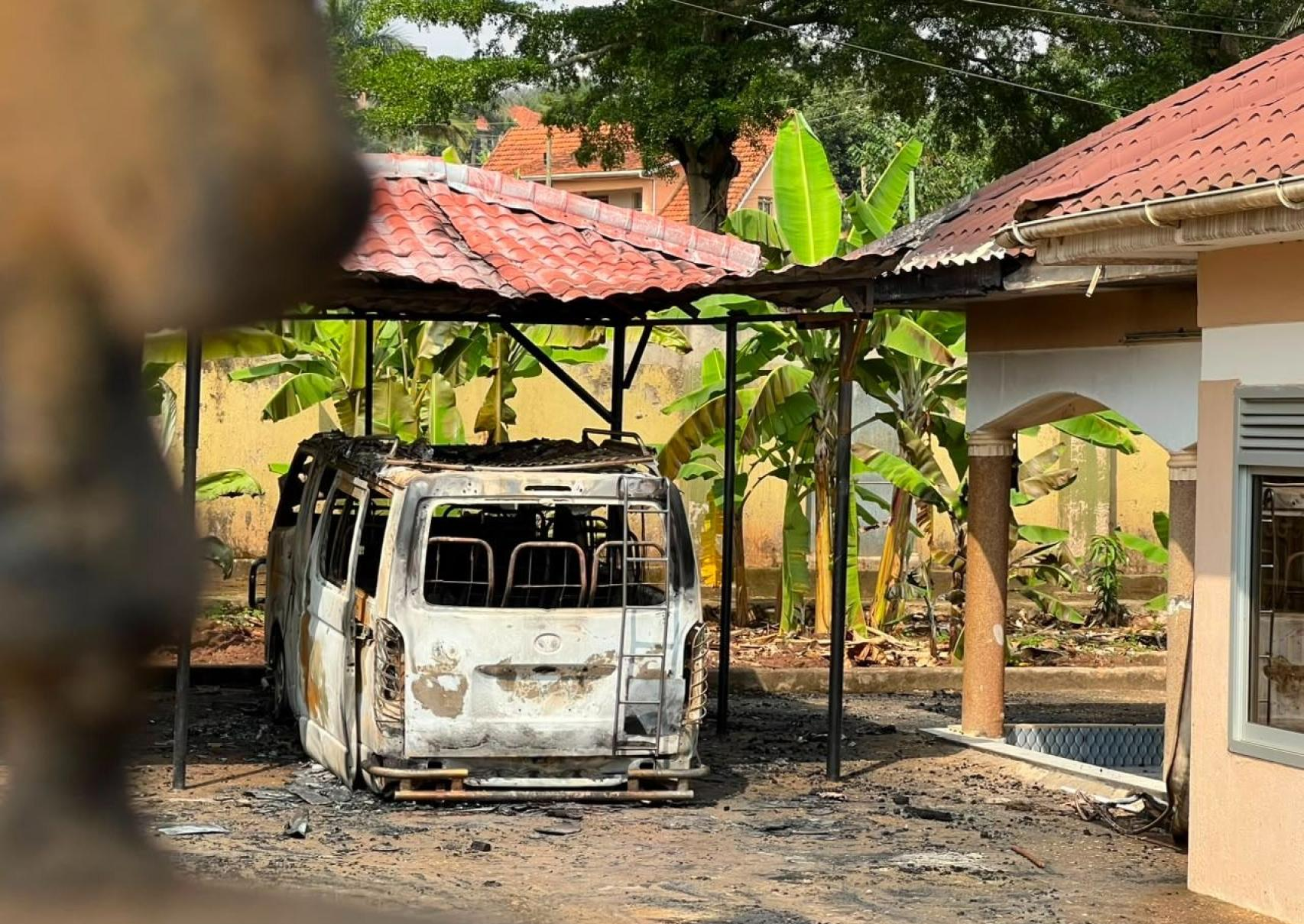
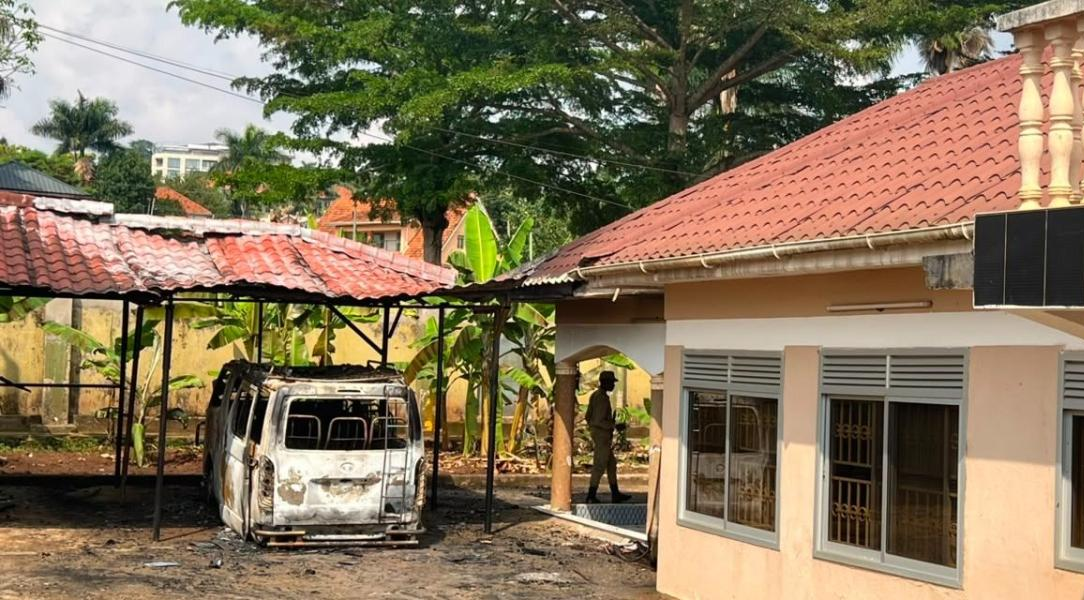
Detectives are yet to establish what triggered the attack, who started a fire that destroyed a Toyota Hiace parked at the family home, or whether the stabbing and fire were connected.
The shocking incident happened in the early hours of Thursday, just months after another deadly attack on children in Ggaba Parish in which four children were stabbed to death at the Ggaba Early Childhood Development Program daycare centre.
According to preliminary information gathered by police, the alarm was raised at about 4:00am after a housemaid was awakened by an alarm and cries for help coming from the main house.
When she went to investigate, she reportedly found several children with severe stab wounds.
Namayo was also found injured and was rushed to hospital, where she remains under police guard as detectives piece together what happened.
The attack sparked panic among neighbours, some of whom reportedly climbed over the perimeter wall after struggling to gain access to the house.
Mary Mubiru, the chairperson of Kalungu Bunga Village, said she was initially alerted by a neighbour who told her that a vehicle at the home was on fire.
Before she reached the scene, however, Mubiru said the children’s father contacted her and asked her to intervene, alleging that his wife was attacking the children.
“I rushed there and found people trying to enter the house,” Mubiru said.
According to Mubiru, rescuers eventually gained access and were confronted with a horrific scene.
The burnt vehicle in the compound
One of the older children was already dead, while others were found seriously injured and crying for help.
Peter Waburokho, a neighbour who was among the first residents to enter the compound, said he arrived at about 5:00am after noticing the fire.
He described the situation inside the house as chaotic, with injured children crying for help.
Waburokho further said one of the injured children told rescuers that their mother was responsible for the attack.
Police, however, have not independently established that account and are treating it as part of the witness evidence being examined.
Investigators are also looking into reports of a disagreement involving members of the family on Wednesday, hours before the attack.
Waburokho said he had heard about the disagreement and that the children’s father was away when the incident occurred.
However, that account is not universally supported by residents.
Mubiru said she had never received complaints of domestic violence involving the family, while Ssebandeke Atanansi, who says he has lived in the area for about 15 years, described the household as generally calm.
Ssebandeke said he had never witnessed the couple fighting and urged people experiencing domestic disagreements to seek help before conflicts escalate.
The conflicting accounts have now become part of the questions facing detectives as they reconstruct what happened in the hours leading up to the killings.
The House where the incident occurred
Police Fire Prevention and Rescue Services responded to the scene and extinguished the fire that destroyed the Toyota Hiace.
Investigators recovered a five-litre jerrycan, which they suspect may have contained petrol, together with other exhibits from the scene.
The items are expected to undergo forensic examination to establish what they contained and whether the fire was deliberately started.
Homicide detectives, Scene of Crime Officers and fire investigators have since examined the house, documented the scene and collected evidence.
Police have also recorded statements from the person who first reported the incident and several witnesses.
Luke Owoyesigyire, the Deputy Kampala Metropolitan Police spokesperson, said investigators were working to establish the circumstances surrounding the deaths, injuries and fire, as well as the motive behind the attack.
Namayo remains hospitalised under police guard, and detectives are expected to obtain her account once her medical condition allows.
The tragedy has sent fresh shockwaves through Ggaba Parish, which is still grappling with memories of another deadly attack on children.
On April 2, four children—three boys and a girl—were stabbed to death at the Ggaba Early Childhood Development Program daycare centre in Makindye Division.
Police arrested 34-year-old Christopher Okello Onyum at the scene in connection with those killings, and the case was subsequently taken to court.
Police have not linked the two incidents, but their occurrence within the same area and only months apart has left residents deeply concerned about the safety of children.
For now, detectives are focusing on the physical evidence recovered from the house, witness accounts, the circumstances surrounding the vehicle fire and, crucially, the statement expected from the injured mother.
The investigation is expected to shed light on what happened inside the family home before the desperate cries for help alerted neighbours at dawn.
GOT A HOT STORY? LET US KNOW!
Got breaking news, explosive secrets, or hard evidence?
When we hear the words Red Sea, what comes to mind?
For many of us, it is war, missiles, ships being attacked, military operations and geopolitical tensions, and for good reason. The Red Sea and the Bab El-Mandeb Strait have once again become areas of serious security concern. Just this week, a cargo vessel was attacked in the Bab El-Mandeb, with crew members losing their lives. Shipping through the route has also dropped sharply as companies try to avoid the growing risks. But perhaps we are looking at the Red Sea from only one side. What if we stopped asking only, “How do we secure the Red Sea?” What if we also asked: “How do we develop the Red Sea?”
The Red Sea is more than a place where conflicts meet. It is a natural connection between Africa and the Arab world. On one side are countries such as Egypt, Sudan, Eritrea, Djibouti and Somalia. On the other are Saudi Arabia and Yemen. Through the Bab El-Mandeb, it connects the Red Sea to the Gulf of Aden and the wider Indian Ocean. In other words, this is not just a body of water separating two regions. It is a corridor connecting two worlds. And corridors are not only built for armies. They are built for people, trade, investment, ideas and opportunities.
What if we looked at it all differently?
The Red Sea is already one of the world’s important trade routes. It connects markets and allows goods to move between Africa, the Middle East, Asia and Europe. But insecurity is increasingly dominating the conversation. We talk about naval forces, attacks on ships, blockades, military alliances, who controls which port or which strategic route. These conversations are important. A dangerous Red Sea affects everyone. When ships avoid the route, transportation becomes more expensive, supply chains are disrupted and countries that depend heavily on imports can feel the consequences.
But security cannot be the end of the conversation. What happens after the guns fall silent? Who builds the ports, creates the businesses, develops the surrounding communities, gets the jobs, invests in young people, makes sure that the people living around this strategic corridor actually benefit from its importance? This is where we need to start thinking differently.
The Red Sea could be a development corridor
Imagine a Red Sea region where the conversation is not only about protecting ships, but also about creating opportunities. A region where ports become centers of trade and employment, young people are trained in logistics, shipping, technology and maritime services, agriculture and food systems are strengthened, renewable energy is developed, fisheries become sustainable businesses rather than neglected resources, infrastructure connects communities to markets, African and Arab businesses can work together, investment creates jobs instead of simply creating strategic influence.
This is not an impossible idea. The World Bank’s current work in the region already points toward this kind of thinking. Its development agenda is increasingly focused on jobs, food security, water, infrastructure, private-sector growth and regional economic integration. In the Horn of Africa, the Bank has supported economic-corridor projects linking infrastructure and regional trade, including the Djibouti Regional Economic Corridor. The Bank’s 2026 work on food security in the Middle East and North Africa also connects food systems directly with job creation and economic resilience. So perhaps the question is not whether the Red Sea can become a development corridor, The question is whether we have the imagination and political will to make it one?
And this is where Africa and the Arab world come in
For too long, discussions about Africa and the Arab world can sometimes feel like discussions between governments, diplomats and institutions. But the Red Sea presents an opportunity to make that relationship more practical.
Africa and the Arab world already share geography, history, culture, trade and common challenges. Why not build on that? Why shouldn’t African and Arab countries develop a shared agenda for the Red Sea?
An agenda that focuses on peace, trade, investment, climate resilience, food security, maritime development and jobs. This would not mean ignoring security. In fact, development can strengthen security. A young person with skills, employment and a future to look forward to has something to protect. A community that benefits from trade and investment has a greater stake in peace. A region connected by legitimate economic opportunities has more to gain from stability than conflict. Security and development should therefore not be treated as competing priorities. They should work together.
Africa and the Arab world have some of the world’s youngest populations. Yet when major geopolitical questions are discussed, young people are often brought into the conversation after the decisions have already been made.But young people should not simply be the beneficiaries of development. They should help design it.
The question before Africa and the Arab world is therefore not only how to secure the Red Sea.
It is whether we can turn it into a corridor of shared prosperity. And perhaps, for the young people of Africa and the Arab world, that is the future worth fighting for.
The author works with the Liaison and Partnerships Department at the Afro-Arab Youth Council
Do you have a story in your community or an opinion to share with us: Email us at Submit an Article
Media personality, comedian and events emcee Collins Bareija, popularly known as Emeka, is working to recover his YouTube channel after hackers gained access to his Gmail account and took control of the platform.
Emeka revealed the incident on Thursday, saying the attackers had deleted videos from his channel, The Romantic Mukiga, which has been home to his relationship podcast, Tie the Knot.
“Today afternoon, someone hacked into my @gmail and took control of my @YouTube Channel and deleted my videos,” Emeka wrote on X.
He later assured his followers that efforts were underway to regain control of the account and prevent further damage.
“We’re doing our best to secure it. Admin,” he added.
Good evening.
Today afternoon, someone hacked into my @gmail and took control of my @YouTube Channel and deleted my videos.
The channel has built its identity around Tie the Knot, a podcast in which couples open up about their relationships, sharing their experiences, challenges and stories with audiences.
https://www.youtube.com/@theromanticmukiga
The hacking incident comes at an inconvenient time for Emeka, who was scheduled to premiere another episode of the podcast on August 20.
It remains unclear whether the scheduled episode will go ahead as planned as he and his team work to restore access to the channel.
The incident has also left Emeka’s existing content at risk, with the hackers reportedly deleting videos after gaining control of the account.
For now, the comedian and content creator is focused on securing his accounts and recovering the channel, while his followers wait to see whether the deleted content can be restored.
The incident highlights the growing vulnerability of content creators whose careers and audiences increasingly depend on digital platforms, where losing access to a single account can mean losing years of work and content.
Don’t want to miss out on any story? For updates on all Sqoop stories, follow this link on Telegram: https://t.me/Sqoop
About UGNEWS24
UGNEWS24 is a Uganda local news service, a product of
SOLAVIA GROUP LIMITED,
Reg. No. 80048169153974.