Media personality, comedian and events emcee Collins Bareija, popularly known as Emeka, is working to recover his YouTube channel after hackers gained access to his Gmail account and took control of the platform.
Emeka revealed the incident on Thursday, saying the attackers had deleted videos from his channel, The Romantic Mukiga, which has been home to his relationship podcast, Tie the Knot.
“Today afternoon, someone hacked into my @gmail and took control of my @YouTube Channel and deleted my videos,” Emeka wrote on X.
He later assured his followers that efforts were underway to regain control of the account and prevent further damage.
“We’re doing our best to secure it. Admin,” he added.
Good evening.
Today afternoon, someone hacked into my @gmail and took control of my @YouTube Channel and deleted my videos.
The channel has built its identity around Tie the Knot, a podcast in which couples open up about their relationships, sharing their experiences, challenges and stories with audiences.
https://www.youtube.com/@theromanticmukiga
The hacking incident comes at an inconvenient time for Emeka, who was scheduled to premiere another episode of the podcast on August 20.
It remains unclear whether the scheduled episode will go ahead as planned as he and his team work to restore access to the channel.
The incident has also left Emeka’s existing content at risk, with the hackers reportedly deleting videos after gaining control of the account.
For now, the comedian and content creator is focused on securing his accounts and recovering the channel, while his followers wait to see whether the deleted content can be restored.
The incident highlights the growing vulnerability of content creators whose careers and audiences increasingly depend on digital platforms, where losing access to a single account can mean losing years of work and content.
Don’t want to miss out on any story? For updates on all Sqoop stories, follow this link on Telegram: https://t.me/Sqoop
When the corrupt hide behind the law to confuse the common man, they weaponize technicalities, bribes, and endless court delays to shield themselves from accountability. This is precisely why the ongoing anti‑corruption campaign spearheaded by Minister Balaam and Ms. Nameere has struck such a chord with ordinary Ugandans. By exposing suspects of graft publicly and ordering interdictions, they have chosen a method that is both direct and easily understood by the citizenry. It is a language the common man can grasp: when someone steals from the public purse, they are named, shamed, and stopped from continuing in office while investigations proceed.
Predictably, critics have emerged. Some politicians, lawyers, and commentators—including figures like Norbert Mao, Abdu Katuntu, and sections of the Uganda Law Society—have questioned the approach, arguing that it undermines due process. Yet this criticism rings hollow when weighed against the reality of Uganda’s corruption crisis. According to the Inspectorate of Government’s 2021 report, Uganda loses approximately UGX 20 trillion annually to corruption and misuse of public funds. That staggering figure represents hospitals without medicine, schools without desks, and roads left in ruin. To fault ministers for taking bold steps against such hemorrhage is not only ridiculous but borders on treason against the nation’s future.
For decades, public officials stole with impunity, confident that they could bend the law with bribes and connections. The ordinary citizen bore the brunt—parents taxed twice as they paid school fees in “free” USE schools, patients forced to buy drugs in public hospitals, farmers unable to transport produce because road funds were siphoned off. The courage of Balaam and Nameere to call out suspects publicly is a fulfillment of President Museveni’s repeated call for an enhanced fight against corruption. In his 2024 State of the Nation Address, the President warned: “Corruption is a cancer. We shall not allow it to eat the future of our children.”
Recent cases illustrate the effectiveness of exposure. During Balaam’s countrywide tour, he revealed shocking practices in schools where headteachers were charging illegal fees despite government funding. Parents cheered his candor, with one mother in Lira telling reporters: “At last someone is speaking for us. We pay taxes, why should we pay again for what is supposed to be free?” Similarly, Nameere’s campaign has unearthed ghost workers in local governments, with payrolls bloated by names of people long dead or nonexistent. These revelations have sparked public outrage and renewed confidence that the government is serious about cleaning house.
The public reaction has been overwhelmingly supportive. Social media platforms have been flooded with praise for the ministers’ courage, with hashtags like #ExposeCorruption and #InterdictThemAll trending. Citizens argue that naming suspects is the only way to break the culture of secrecy that has protected thieves for years. As one boda‑boda rider in Masaka put it: “We don’t understand court procedures, but when we hear that someone has been interdicted, we know government is serious.”
Those who fault the approach forget that corruption thrives in darkness. Exposure is sunlight—it disinfects. Interdiction prevents suspects from continuing to abuse office while investigations are ongoing. This is not mob justice; it is a practical safeguard. The alternative is to allow suspects to remain in office, tamper with evidence, intimidate witnesses, and continue stealing. That is the real injustice.
The hemorrhage of public funds has reached crisis levels. With UGX 20 trillion lost annually, Uganda cannot afford half‑measures. Every shilling stolen is a classroom denied, a health center unfunded, a road left undone. The ministers’ campaign is not perfect, but it is believable, relatable, and effective in rallying the public behind the anti‑corruption fight. To undermine it is to side with the thieves.
Public office bearers must take heed. The era of impunity is ending. The government is committed to smoking out thieves wherever they hide—whether in ministries, districts, or parastatals. Exposure will be relentless, interdictions swift, and prosecutions inevitable. Those who imagine they can bend the law with bribes should remember that the tide has turned. The people are watching, the President has spoken, and courageous ministers are acting.
Ugandans must rally behind this initiative. Supporting Balaam and Nameere is not about personalities; it is about protecting the nation’s future. Corruption is theft from every citizen. It robs children of education, patients of medicine, and farmers of markets. To fault those fighting it is to betray the nation. The time for excuses is over. The time for courage is now.
Let every public servant be warned: desist from stealing public funds. The government is determined to smoke you out, expose you, and interdict you. No hiding place will remain. And let every citizen stand firm in support of this campaign, for it is the clearest sign yet that Uganda is serious about defeating corruption.
The author is the Deputy Resident City Commissioner for Nakawa Division.
Do you have a story in your community or an opinion to share with us: Email us at Submit an Article
Stanbic Bank Uganda has expanded access to unsecured loans under a revamped ‘Oli inCharge’ campaign, positioning the initiative to support families preparing for the third school term, entrepreneurs seeking business capital, and farmers investing in production as the country enters the final quarter of the year.
This initiative comes as Stanbic Bank celebrates 35 years of operations in Uganda, during which it has increasingly positioned itself around financial inclusion, enterprise development, digital banking, and economic transformation.
The enhanced campaign aims to make borrowing faster, simpler, and more inclusive, while increasing use of the bank’s digital lending channels to improve customer convenience and financial access.
Speaking at the campaign relaunch in Kampala, Sylvia Atuhairwe, Head of Distribution at Stanbic Bank Uganda, said the initiative reflects the bank’s commitment to helping Ugandans take control of their financial futures through accessible and affordable financing solutions.
“Today is not just about relaunching a campaign. It is a reaffirmation of Stanbic Bank’s commitment to being a trusted partner in our customers’ financial journeys. Behind every loan application is a parent preparing for a school term, a business owner seeking to expand, a farmer investing in production, or a family planning for the future,” Atuhairwe said.
She said the campaign aligns with Stanbic’s purpose of “Uganda is our home, we drive her growth,” by bridging the gap between aspiration and action through timely financial support.
Under the revamped campaign, salaried customers can access unsecured loans of up to UGX 350 million, repayable over 120 months, while non-salaried customers, including farmers and entrepreneurs, can access unsecured financing of up to UGX 250 million.
Atuhairwe said the bank is deliberately simplifying access to credit at a time when many households face increased financial pressure from school fees, business expansion needs, and agricultural investment.
She also encouraged parents to use Stanbic’s digital channels for school fees and other essential payments.
“As we prepare for the third school term, we encourage parents to choose Stanbic’s digital channels for school fees and other important payments. Through our mobile app, USSD platform, internet banking, and agency network, customers can make payments quickly, securely, and conveniently without the stress of carrying cash or spending hours in queues,” she said.
Yvone Namutosi, Head of Digital and E-Commerce at Stanbic Bank Uganda, said customers can now apply for and receive loan decisions through the Stanbic Mobile App and USSD platform in as little as two minutes, eliminating paperwork and reducing the need for branch visits.
“At Stanbic, we are reimagining how customers access credit. Through our digital platforms, customers can apply for a loan from wherever they are and receive a response in as little as two minutes. The process is quick, secure, and designed around the customer,” Namutosi said.
She said digital banking allows customers to manage their finances at their convenience while reducing transaction costs, adding that customers accessing Instant Cash loans of up to UGX 5 million through Stanbic Mobile Banking will benefit from interest-free access under the campaign terms, making short-term borrowing more affordable.
The bank is also encouraging digital loan disbursements by offering waivers on selected transactions to promote innovation, convenience, and financial inclusion.
The campaign integrates insurance protection as part of responsible borrowing, where Dogo Singh, the Insurance Manager at Stanbic Bank Uganda, said financial growth and financial protection should go hand in hand, particularly for customers acquiring assets, expanding businesses, or taking on new financial commitments.
“A loan can help you acquire an asset, invest in a business, or achieve an important personal goal, but insurance helps ensure that those achievements are protected. True financial control is not only about accessing money; it is also about protecting your future and the people who depend on you,” Singh said.
Do you have a story in your community or an opinion to share with us: Email us at Submit an Article
Socialite Bad Black has opened up about the pressure mature women face to maintain their looks and keep pace with younger juicy babes, admitting that she is not ready to surrender her place in the spotlight.
Speaking during an interview on Galaxy FM, Bad Black, who is in her mid-30s, acknowledged that age is beginning to catch up with her but said she remains determined to compete in a space increasingly dominated by women in their 20s.
“Age is catching up, but we are competing with young children. I won’t accept to grow old. We are now competing with girls who are 20. We need to show them that we can be in their space,” she said.
Bad Black revealed that some of the recent changes to her body have been part of her efforts to keep up with current beauty trends and remain competitive with younger babe.
The outspoken socialite, who is currently on a media tour promoting her upcoming Beyond The Scars event next month, also linked some of the pressure to her relationship.
According to Bad Black, her partner is younger than her, something she says motivates her to maintain her appearance and avoid giving younger women an opportunity to attract his attention.
She also spoke candidly about the physical challenges she has experienced following recent medical procedures.
“Life hasn’t been easy for the previous one month since I was under medical procedures, but now I’m remaining with two weeks to be able to sit properly,” she revealed.
Despite the discomfort and recovery process, Bad Black remains determined to maintain her image and presence in the entertainment and social scene.
Enock Mugabi aka iWitness is a Journalist, Seasoned Writer and Music Analyst with a passion for sports. Connect with him on social media using the links below in bio.
Breaking through as an artist in Uganda is a battlefield. Some artists spend years in a studio waiting for a break. Others drop one viral track, get three months of fame, then disappear. Vinka took neither road. She arrived with a massive debut and never slowed down. That kind of staying power is rare in Kampala’s music scene. It’s also exactly the spirit Bell Lager built its 75-year story on. Two Ugandan originals who are a part of Uganda’s Very Own story.
Since her first release, Vinka has delivered one hit after another. Malaika. Chips Na Ketchup. Bailando. All Over You. Her voice carries a signature power and her stage presence is impossible to ignore. She built a space in the industry that belongs entirely to her. Bell Lager has been there through most of it, cold glass in hand at every celebration.
Long before her face was on billboards across Kampala, Vinka worked behind the scenes as a talent manager at Swangz Avenue. The agency was looking to sign a new female artist. During a recent casual studio conversation on the Ugandan Boy podcast, Vinka revealed how someone once turned to her and asked the question that changed everything.
Why not you?
“The desire was always there,” Vinka recalls. “I was a top performer in high school. But stepping out from talent management meant putting myself on the line. On stage, every choice becomes personal.”
The leap was as bold as it sounds. Her early tracks got people arguing rather than cheering. Critics called her voice raspy and heavy. Some said she ‘sounded like a man.’
Vinka didn’t shrink from it. She leaned in. “I turned their harshness into curiosity,” she says. “People were talking because I sounded different. I decided I was never going to change my tone to make anyone comfortable. Staying true to my sound is what set me apart.” That refusal to compromise became her edge, and it’s the same self-belief that carried her from those early arguments into a career built to last.
A lasting career in Uganda takes more than hit singles. It takes an instinct for how Ugandans actually unwind, and that’s where Vinka’s story and Bell’s meet.
Bell Lager just marked 75 years as part of everyday Ugandan life. Its Uganda’s Very Own campaign spotlights people who stay true to where they come from and build something lasting from it. Vinka fits that description as naturally as anyone. She’s Uganda’s very own artist. Bell is Uganda’s very own beer. Put the two together and the fit needs no explaining.
Ugandan celebration shows up everywhere. Weekend plot sessions. Roadside meat spots. A neighbouring kafunda. Wedding receptions. Packed nightclubs. For Vinka, partnering with a brand that has sat on Ugandan tables across generations felt less like a business deal and more like coming home.
The connection showed up clearly when Vinka and Uganda Breweries Limited (UBL) worked on ‘Red Card’. The track was meant as a drunk-driving campaign. Vinka turned it into a club hit instead. Ugandans were dancing to it in packed venues before they even realised the message underneath. It worked because it never felt like a lecture, it felt like an authentic Ugandan track for an authentic Ugandan night. Real culture first, message second.
Vinka’s own transformation runs on the same logic. Moving from managing talent to standing alone in front of tens of thousands of people changes how you see everything. “Working behind the scenes taught me the work ethic to build a career,” she says. “Becoming the artist taught me courage. It taught me to trust my own instincts when everyone else doubted me.”
That evolution, from the girl behind the glass to the woman commanding the stage, now leads to her biggest milestone yet: The Live & Loud Concert as she headlines Lugogo Cricket Oval this August.
Lugogo is the ultimate test for any Ugandan act. For Vinka, filling that arena is proof of a decade spent trusting her own voice. Her advice to young creators trying to break through in Kampala stays true to that same philosophy. “You have to believe in your purpose before anyone else validates it. Respect the craft and stay disciplined every day,” she concluded.
As Uganda’s creative industry waits to see how the government will honour the late theatre icon Alex Mukulu, Uganda Communications Commission executive director Nyombi Thembo believes the industry should not simply wait for recognition from above. It should also learn to honour its own.
Speaking about Mukulu’s immense contribution to Ugandan theatre, Nyombi said the passing of one of the country’s most celebrated playwrights, actors and directors should force the creative fraternity to look inward, not only at how it celebrates its legends, but also at what has happened to the standards Mukulu represented.
“Today, as we wait for the government, we should make our associations and honour ourselves with medals,” Nyombi said.
Drawing a comparison with the Oscars, Nyombi argued that recognition of artistic excellence does not always have to come from the government.
“The medals given at the Oscars don’t belong to the American government,” he said, suggesting that Uganda’s creative bodies can also build their own culture of recognising excellence and preserving the legacies of those who have shaped the industry.
For Nyombi, however, honouring Mukulu should go beyond medals, ceremonies and glowing tributes.
The real tribute, he argued, would be a return to the discipline and excellence that defined the late theatre maestro’s work.
“Alex transformed Ugandan theatre and has contributed a lot to the industry. And if we are to transform his passing, we should bring back perfection,” Nyombi said.
In his view, theatre has increasingly drifted away from the painstaking preparation, structure and attention to detail that once defined the art. While improvisation has its place, Nyombi warned that it should never become a substitute for excellence.
“Improvisation is good, but it should be secondary. Let us go back to perfection. We miss perfection,” he said.
And in Alex Mukulu, Nyombi said, Uganda had one of the finest champions of that standard.
“Alex Mukulu has been the leader of perfection.”
His remarks touched on a wider conversation about the state of theatre, with Nyombi arguing that the growing dependence on improvisation has, in part, contributed to audiences walking away from the art form.
“We are saying people have abandoned theatre because improvisation has overtaken perfection,” he said.
For an industry now mourning one of its most influential voices, Nyombi’s call was both a tribute and a challenge: let Mukulu’s death not only be marked with medals, official funerals and emotional speeches, but with a revival of the excellence he spent his life demanding.
Because, as Nyombi put it, “Art is known for perfection.”
Perhaps that is the legacy Mukulu would have wanted most, not simply to be remembered as a theatre giant, but to see the theatre he helped transform return to the perfection he embodied.
Don’t want to miss out on any story? For updates on all Sqoop stories, follow this link on Telegram: https://t.me/Sqoop
Police have opened investigations into a suspected murder, attempted murder and arson incident in which two children were killed and three others seriously injured at Kalungu Bunga, Ggaba Parish, in Kampala’s Makindye Division.
The incident occurred at about 4:00am on 20 August 2026.
According to Kampala Metropolitan Police South, the incident came to light after a housemaid was awakened by an alarm and cries for help coming from the main house. When she went to check, she found several children with severe injuries and raised an alarm.
Police said 14-year-old Khadija Daizy was found dead in her bedroom after sustaining multiple stab wounds.
Another victim, seven-year-old Hawa Dalena, was rushed to Nsambya Hospital but later died while receiving treatment.
Three other children, aged 13, eight and five, survived the attack and were taken to hospital for medical attention.
Police have identified the alleged suspect as Namayo Dorothy, 43, a Kenyan national and mother of the victims. She was also found injured and is currently admitted to Mulago National Referral Hospital under police guard.
During the incident, a Toyota Hiace vehicle parked at the premises was also set on fire and completely burnt. Police Fire Prevention and Rescue Services responded and extinguished the blaze.
A jerrycan suspected to have contained petrol was recovered from the scene and taken as an exhibit.
Police said a team of homicide detectives, Scene of Crime Officers and fire and rescue personnel visited the scene, where they examined and documented the area and recovered exhibits for forensic analysis.
The bodies of Khadija and Hawa were taken to Mulago City Mortuary for postmortem examinations.
The case was registered at Kabalagala Police Station, and investigations are ongoing to establish the exact circumstances surrounding the incident and the motive behind the attack.
Police have recorded statements from the person who reported the incident and other relevant witnesses. The suspect remains under police guard at the hospital as investigations continue.
Controversial socialite Bad Black, has opened up about her spiritual journey, revealing that she has visited traditional shrines on several occasions and has, at times, practiced witchcraft.
The outspoken socialite made the revelation during an interview Galaxy TV’s Rewind Team after being asked whether she had ever bewitched someone.
Bad Black answered without hesitation, saying she was familiar with traditional practices and had visited shrines numerous times. She even claimed to know how to use Emindi, a traditional tobacco pipe.
“Yes, very much,” she said. “I have entered a traditional shrine, and it’s not once or twice. I do it often. Even our clan’s traditional ghosts sit on my head.”
According to Bad Black, her visits to traditional healers are largely driven by personal and family concerns. She said she sometimes seeks traditional intervention when she wants things to work in her favour, particularly when it comes to the happiness and wellbeing of her children and household.
“Most of the time, I’m a deal breaker, and since I’m soft-hearted, I always want my stuff to go through smoothly, make my children happy and make sure me and my family household are happy,” she explained.
However, Bad Black suggested that her use of traditional practices is not limited to solving personal problems. She claimed that she can also turn to witchcraft when she feels someone has mistreated or oppressed her.
“When you oppress me, I can deal with you, and witchcraft works,” she said.
A Spiritual Journey That Has Taken Different Turns
Bad Black also spoke about her relationship with religion, revealing that her spiritual beliefs have changed significantly over the years.
She said she studied the Quran and later became Born Again while serving a prison sentence. However, she explained that her faith has evolved depending on what she believes is working for her at a particular point in her life.
“It also works, but depending on the season,” she said. “I studied the Quran and got Born Again during my term in prison, but it depends on where I get success. The more I have grown, I’m becoming a pagan.”
The socialite further disclosed that she stopped attending church in December 2024. She said she now prefers consulting her ancestors before turning to biblical teachings.
“I have a whole generation behind me. I don’t believe in cursing generational demons through prayers. I seek the guidance of my forefathers before I talk about Jacob in the Bible,” she stated.
Despite describing herself as increasingly drawn to traditional spirituality, Bad Black insisted that she remains a believer.
She acknowledged, however, that her spiritual choices can sometimes depend on her mood and circumstances.
“I’m a believer, but it depends on my moods. I’m a believer, but sometimes one needs to seek their consultancy,” she said.
Her remarks have once again put the spotlight on Bad Black’s unconventional approach to spirituality, as she describes a personal journey that has moved between Islam, Christianity and traditional African beliefs.
Enock Mugabi aka iWitness is a Journalist, Seasoned Writer and Music Analyst with a passion for sports. Connect with him on social media using the links below in bio.
The Minister for the Presidency, Milly Babalanda, has warned Resident District Commissioners (RDCs), Resident City Commissioners (RCCs) and their deputies against being distracted by rumours of reshuffles, urging them to focus on delivering government programmes.
Babalanda says appointments under the Office of the President are based on merit and that officials who perform well should not panic over speculation about transfers or reappointments.
She was speaking on Wednesday during a capacity-building training for RDCs, RCCs, their deputies and assistants in Jinja City.
Babalanda said the officials are regularly assessed by their supervisors, who guide their performance and suitability for continued deployment.
She said some officials have instead become preoccupied with rumours and, in some cases, disrespect their supervisors, creating unnecessary anxiety over their positions.
“Do not concentrate on speculation about appointments, reshuffles and transfers, which are beyond your control, but instead concentrate on improving service delivery, which is the very reason for your appointment,” Babalanda said.
She, however, warned that officials who fail to perform should not expect to retain their positions.
“Those who fail to perform should not expect to retain offices,” she said.
Babalanda challenged RDCs and RCCs to spend more time monitoring government projects in the field and ensuring that public programmes translate into tangible benefits for citizens.
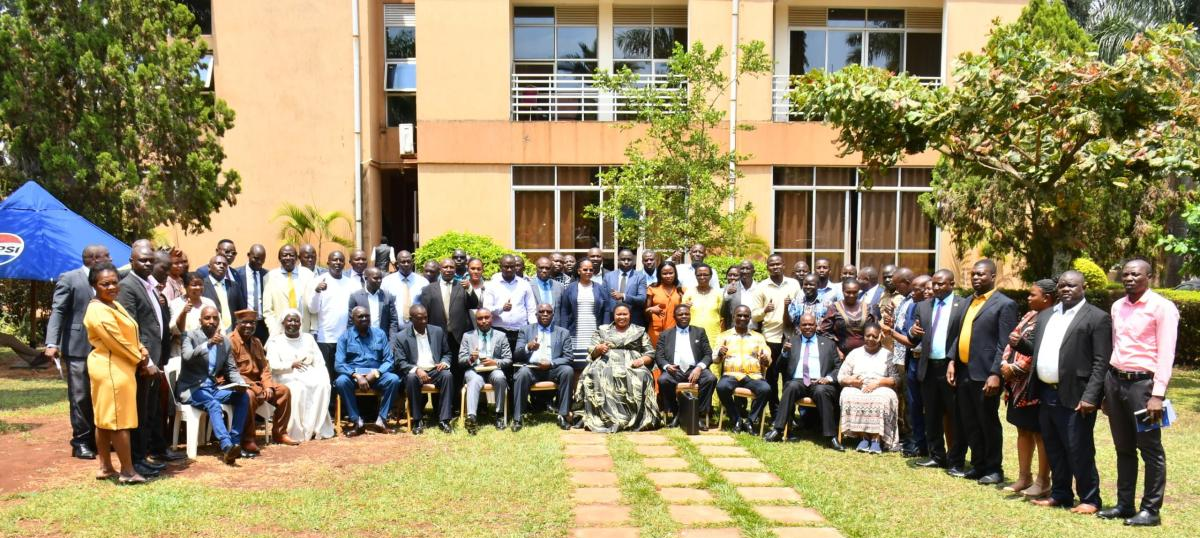
The minister for presidency, Hon. Babirye Milly Babalanda(M) shares photo moment with resident district commissioners-RDCs, their deputies and assistants in Jinja city
“The responsibility before you, therefore, is much greater than occupying offices or attending meetings, but rather monitoring government projects extensively. It is about being in the field, understanding what is happening, identifying problems, protecting government interests, and ensuring that public programs have resulted in tangible results for the benefit of the people,” she said.
She said government officials must ensure that their presence is felt through improved livelihoods rather than official statements.
“Make sure that the government’s presence is not only felt through official statements, but rather through the direct impact it can have on individual lives. The people of Uganda expect results and not endless talk. Let us focus on improving the livelihoods of our people through poverty eradication programs like Parish Development Model (PDM), Emyooga, four-acre model, among others,” Babalanda said.
Babalanda also cautioned the officials against being drawn into partisan political debates and responding to statements made by political actors.
She urged them to remain focused on their administrative responsibilities and service delivery.
“Recognize the political environment in which we operate and desist from entertaining political commentary and rumours geared at destroying you. Don’t spend time responding to statements made by political actors, but instead concentrate on your work,” she said.
She also asked RDCs and RCCs to play an active role in fighting corruption in their areas of deployment, saying the effort would help protect public resources and improve service delivery.
However, Babalanda cautioned them against using anti-corruption investigations to settle personal disputes.
She said allegations of corruption should be supported by evidence and suspects given a fair hearing before prosecution.
The officials attending the training said the engagement had helped them identify areas where they could strengthen coordination and service delivery.
Ahmed Katerega, the Jinja District RDC, said the training had provided timely guidance and would help them improve their service delivery mechanisms.
Katerega said they plan to establish working teams bringing together technocrats and political leaders to improve the implementation and popularisation of government development programmes.
Rodgers Ntogona, the Assistant RDC of Luuka District, said the training had also strengthened teamwork among government officials.
Ntogona said he attends to about six people seeking guidance on how to benefit from government programmes each day.
He said the knowledge acquired during the training would be shared with other technocrats to strengthen the chain of service delivery from government offices to communities.
GOT A HOT STORY? LET US KNOW!
Got breaking news, explosive secrets, or hard evidence?
News anchor and journalist Canary Mugume has shared his thoughts on why former lovers continue to follow each other on social media even after ending their relationships.
Speaking on a podcast, Canary was asked why ex-partners in Kampala often remain connected on social media. He suggested that, in some cases, the continued connection could be a sign of “unfinished business.”
According to Canary, some people end relationships on bad terms but continue following each other because they still hope something might happen between them, including the possibility of getting back together. He also believes others do it to keep tabs on their former partners and compare how they are doing after the breakup.
They ended perhaps on a bad note and feel like something needs to happen for them to maybe get back together but also want to prove a point, am I doing better than them.
He added that some people use social media to show their exes that they have moved on and are now doing better without them, a behaviour he described as “nonsensical.”
Canary, however, noted that following an ex does not necessarily mean there are still feelings involved. He warned that constantly seeing an ex’s posts can sometimes be emotionally triggering and may even affect a person’s current relationship.
I don’t know if it’s right or wrong because it doesn’t necessarily mean anything to follow your ex on social media; however, it could be triggering. You could see posts that are triggering and could take you back and could affect your current relationship.
For Canary, the best approach after a relationship ends is to truly move forward rather than remain emotionally attached through social media.
“I feel like if you’ve moved on, you should move on,” he concluded.