The entertainment and media fraternity has been dealt a major blow following the untimely passing of veteran actor and playwright Alex Mukulu.
Mukulu breathed his last this afternoon at the age of 72. The cause of his death has not yet been disclosed, leaving many fans, colleagues, and members of the entertainment industry in shock.
Details surrounding his passing remain scanty, and the family is yet to communicate further information regarding his death and funeral arrangements.
Fans, friends, fellow entertainers, and well-wishers have since flooded social media with condolence messages, extending their sympathies to the bereaved family and praying for strength during this difficult moment.
Alex Mukulu will be remembered for his remarkable contribution to Uganda’s theatre and entertainment industry, as well as his strict and uncompromising character, particularly during talent search competitions.
He became widely known for his role as a tough judge on Yolese Ekitone, a talent search programme that aired on Bukedde TV.
His distinctive judging style and high standards left a lasting impression on many viewers and aspiring performers.
Mukulu was known for his sharp assessments of emerging acts, especially when their performances fell short of the standards he expected.
His stern personality and memorable approach made him one of the most recognizable figures in Uganda’s talent and theatre circles.
His legacy will undoubtedly live on through the many artists and performers he influenced throughout his career.
May his soul rest in eternal peace.
Uganda's creative arts fraternity is mourning the demise of veteran dramatist and composer Alex Mukulu, who passed away at the age of 72. MHSRP 🕊️ pic.twitter.com/NPhz3QBh4M
The High Court in Kampala has found Senior Accountant Dr Francis Onebe and his former employee, private security guard Bonny Oriekot, with a case to answer. Onebe is accused of the alleged murder of his wife, Immaculate Mary Asio.
The Criminal Division Judge, Professor Justice Andrew Khaukha, found Onebe and his co-accused with a case to answer on Friday after the prosecution closed its case with evidence against them from 17 witnesses in the trial.
Khaukha said the court had examined the evidence presented by the prosecution and found sufficient grounds requiring the two accused persons to defend themselves against the murder charge, and that a prima facie case had been established against them.
The judge said the prosecution alleges that between January and September 2021, at Mawanga Zone, Munyonyo, in Makindye Division, Kampala District, Onebe, Oriekot and others still at large, with malice aforethought, unlawfully caused the death of Asio Mary Immaculate.
The two accused persons denied the allegations and pleaded not guilty to the murder charge; hence the presentation of the said 17 Prosecution witnesses.
But the Judge said he will prepare a detailed written ruling explaining the court’s assessment of the evidence, which would be made available to the parties.
The judge noted that he took over the case from Justice Michael Elubu after the prosecution had called 12 witnesses, and that all the prosecution witnesses had been subjected to cross-examination by the defence lawyers.
The prosecution was led by Chief State Attorney Joseph Kyomuhendo and State Attorney Sharifah Nalwanga.
The case stems from the disappearance of Asio on January 6, 2021. Her husband, Onebe, reported a suspected kidnapping at Kabalagala Police Station after she went missing.
However, on September 7, 2021, nearly nine months after her disappearance, investigators discovered a decomposing body in a septic tank at the couple’s matrimonial home in Mawanga, Munyonyo.
The discovery triggered a murder investigation, leading to the arrest and prosecution of Onebe and Oriekot.
The 67-year-old Onebe and Oriekot, who was employed as a private security guard with Pentagon Security Company, were later arraigned before the Makindye Magistrates Court and charged with murder before being committed to the High Court for trial.
They have been on remand at Murchison Bay Prison pending the conclusion of the case since 2021, after Onebe was denied bail by the High Court. Following today’s ruling, the prosecution asked the court to direct the defence to disclose its evidence and witnesses ahead of the next phase of the trial.
State Attorney Sharifah Nalwanga referred to Section 76 of the Trial on Indictments Act and asked the defence to provide its witnesses and evidence, arguing that the disclosure was necessary to ensure a fair trial.
“We pray that they provide us with the witnesses. If they do not, then we shall not proceed at that time. We are talking of a fair trial,” Nalwanga told the court.
Onebe’s lawyer, Patrick Kasumba, said the defence was ready to comply with the disclosure requirements but needed three weeks to prepare its case.
“We have three weeks. We know where the prosecution is. We shall disclose. We have nothing to hide. We shall serve you a week before,” Kasumba said.
Justice Khaukha said the dates for the defence hearing would be communicated by the registrar.
The defence phase will allow Onebe and Oriekot to respond to the prosecution evidence and present their own witnesses and evidence in their bid to contest the allegations against them.
The court noted the public interest surrounding the case and said there was a duty to simplify its decisions for the public to understand, while maintaining the accused persons’ right to a fair trial.
GOT A HOT STORY? LET US KNOW!
Got breaking news, explosive secrets, or hard evidence?
Hamza Muhaise, a final-year student at Strathmore University in Kenya, has died in Nairobi at the age of 26.
He passed away at 2:30 a.m. on Thursday, 13 August 2026, after suffering cardiac arrest reportedly linked to an injury sustained during a rugby match.
Hamza was the firstborn son of CPA Haruna Musinguzi, Director of Finance at the Uganda Communications Commission.
He will be laid to rest on Saturday, 15 August 2026, at the family’s ancestral home of the late Mpeeka Sulaiman in Kakooge, Buhima, Kikuube District.
ADVERTISEMENT
CampusBee extends its deepest condolences to CPA Haruna Musinguzi, the Musinguzi family, and Hamza’s relatives and friends during this difficult time. May he rest in peace.
The husband is in Mbezi Beach, Dar es Salaam. The wife is also in Mbezi Beach. The twist? They reportedly each have their own home.
That detail has sparked conversations around Bongo Flava stars Diamond Platnumz and Zuchu, bringing their marriage back into the spotlight, this time not because of a song, romantic gesture or social media post, but because of their living arrangement.
For many people, marriage naturally means sharing a home. So, reports that Diamond and Zuchu maintain separate residences, despite living in the same Mbezi Beach area, have prompted one obvious question: Why don’t they simply live together?
While some believe married couples should live under one roof, others argue that how a couple organises its private life is a personal decision, provided both partners are comfortable with the arrangement.
And that is where religion enters the conversation.
Does Islam require couples to live under one roof?
According to Sheikh Athuman Idd, it does not.
Speaking to The Citizen’s sister paper, Mwanaspoti, Sheikh Athuman explained that living in the same house is not a condition for a valid Islamic marriage.
“In Islam, living in the same house is not a condition for the validity of a marriage, and there is no provision in Islam that forces couples to do so,” he said.
He added that if a husband and wife mutually agree to maintain separate residences, their marriage remains valid.
“If they understand each other and willingly agree that each should live in their own home for whatever reason, their marriage remains 100 per cent valid, and they continue to be legally married before God and society,” he said.
In other words, two houses do not automatically mean two separate marriages.
The key issue, according to the Sheikh, is whether the arrangement is mutually agreed upon and whether the couple continues to fulfil their responsibilities as husband and wife.
That distinction is particularly relevant when it comes to celebrity relationships, where gaps in information can quickly become filled with public speculation.
Diamond and Zuchu have spoken about it
The discussion surrounding the couple’s living arrangements is not entirely new.
Zuchu previously said that having separate homes was a decision they had made themselves and was not the result of a quarrel, separation or marital conflict.
That statement provides important context amid the latest conversations.
Therefore, the fact that Diamond and Zuchu reportedly maintain separate residences should not, on its own, be taken as evidence that their marriage is facing trouble.
For a couple whose relationship has attracted considerable public interest, however, even personal lifestyle choices can become a subject of debate.
A marriage kept away from the spotlight
Diamond and Zuchu’s marriage itself was initially kept private.
The two are understood to have undergone an Islamic marriage ceremony in January 2025. Their marriage became more widely known in June 2025 after Sheikh Walid Kawambwa revealed that he had officiated their union approximately five months earlier.
Diamond later shared photographs and videos associated with the occasion, while Zuchu also publicly acknowledged her status as Diamond’s wife.
So, the question now is not necessarily whether the two are married.
That has already been publicly acknowledged by the couple and religious figures connected to their union.
What continues to intrigue fans is what their marriage looks like behind the scenes.
For Diamond and Zuchu, that apparently includes maintaining separate homes within the same neighbourhood.
Whether the arrangement is unusual, practical or simply the way they have chosen to organise their lives remains a matter for the couple.
But from the religious perspective explained by Sheikh Athuman, a marriage does not become less valid simply because a husband and wife do not share the same roof.
Three prison officers were injured after unknown assailants attempted to break into Kyegegwa Government Prison in Kyegegwa District in the early hours of Thursday morning.
According to a statement released by Frank Baine Mayanja, the Spokesperson of the Uganda Prisons Service, the incident occurred at about 1 a.m. on Friday when the attackers attempted to force their way into the prison and attacked three officers who were deployed for the night as sentries.
Baine identified the injured officers as Sergeant Titus Kalisa, Sergeant Suzan Margret Nakuya Suzan, and Warder Joshua Odongo, who are currently receiving treatment at Kyegegwa General Hospital.
Baine added that two firearms, each loaded with 30 rounds of ammunition, were taken by the attackers during the incident.
However, he explained that no prisoner escaped during the attack.
“Sister security agencies were immediately called in, and investigations are underway. Efforts to apprehend the assailants and recover the stolen guns are in full gear,” the statement says.
Baine appealed to members of the public with information that could lead to the arrest of the suspects or recovery of the firearms to report to the nearest police station.
GOT A HOT STORY? LET US KNOW!
Got breaking news, explosive secrets, or hard evidence?
Parliament’s Committee on Natural Resources has demanded a detailed account of how Uganda Electricity Distribution Company Limited (UEDCL) is spending a US$50 million loan secured in January 2026 for capital projects, amid concerns over the company’s ability to improve electricity supply.
The committee, chaired by Kazo County MP Dan Kimosho, wants UEDCL to provide a breakdown of the specific projects being financed by the facility, the amount allocated to each project and the extent to which the funds have so far been absorbed.
UEDCL officials told the committee that the loan is financing capital investments covering substations, transformer injections, medium-voltage projects and other distribution works.
The officials said implementation of the projects had already started, but did not provide the committee with a detailed breakdown of the expenditure during the interaction.
Kimosho directed UEDCL to furnish the committee with an absorption plan and details of the targeted projects, seeking to establish where the money is going and whether it is translating into improvements in the electricity distribution network.
The scrutiny comes at a time when MPs are questioning UEDCL’s investment capacity since taking over electricity distribution from Umeme.
The committee was told that UEDCL had invested only about US$1.5 million since the takeover, including new connections, compared with approximately US$132 million invested by Umeme during the final five years of its concession.
In April 2023, the Permanent Secretary, Irene Bateebe, revealed that Uganda Electricity Distribution Company Limited (UEDCL) required US$158 million to enable it to invest in the distribution system over the next three years.
MPs are seeking to establish whether the new US$50 million facility can close the investment gap and address the infrastructure challenges facing UEDCL.
The committee is particularly concerned about rising energy losses. UEDCL officials reported losses of about 18.5 percent, compared with approximately 15 percent under Umeme and a national target of about 13 percent.
Acting UEDCL Managing Director Joselynne Rwakakooko told MPs that every percentage point of energy losses represents approximately US$7 million annually.
Based on the gap between the reported losses and the target, the committee estimated that the losses could amount to about US$35 million annually, equivalent to roughly Shs130 billion.
The committee also wants the investment plan to demonstrate how the loan will support new customer connections, reduce energy losses and strengthen the reliability of the distribution network.
The demand for accountability comes as the government seeks to strengthen UEDCL after the end of Umeme’s concession.
Energy Minister Sidronius Okasai Opolot acknowledged that the transition presented significant challenges but said government was committed to ensuring UEDCL delivers the electricity services expected by Ugandans.
MPS have raised concern the UECDL is experiencing more energy losses yet the rate had relatively dropped before Umeme’s concession came to an end
In 2005, the government of Uganda and UMEME Ltd entered into a series of agreements that gave UMEME the right to manage the assets of the government-owned Uganda Electricity Distribution Company Limited (UEDCL) and carry out the distribution business.
UMEME was managing up to 95% of the country’s distribution business, while UEDCL managed the bulk of the remaining customers, primarily based in the rural countryside.
Some had found Umeme’s tenure relatively successful; others said it was not. Umeme has reduced energy from over 32% to 16%, and its revenue collection rate stood at 99% by the time of exit. It reportedly had over two million customers.
A couple of agreements were executed to operationalize the concession; these include the Umeme concession agreement and the Power Sales Agreement, among others.
The committee is expected to scrutinise UEDCL’s project list, expenditure, and implementation timelines when the company submits the requested documentation next week.
GOT A HOT STORY? LET US KNOW!
Got breaking news, explosive secrets, or hard evidence?
Move targets higher productivity, better genetics and more money for farmers
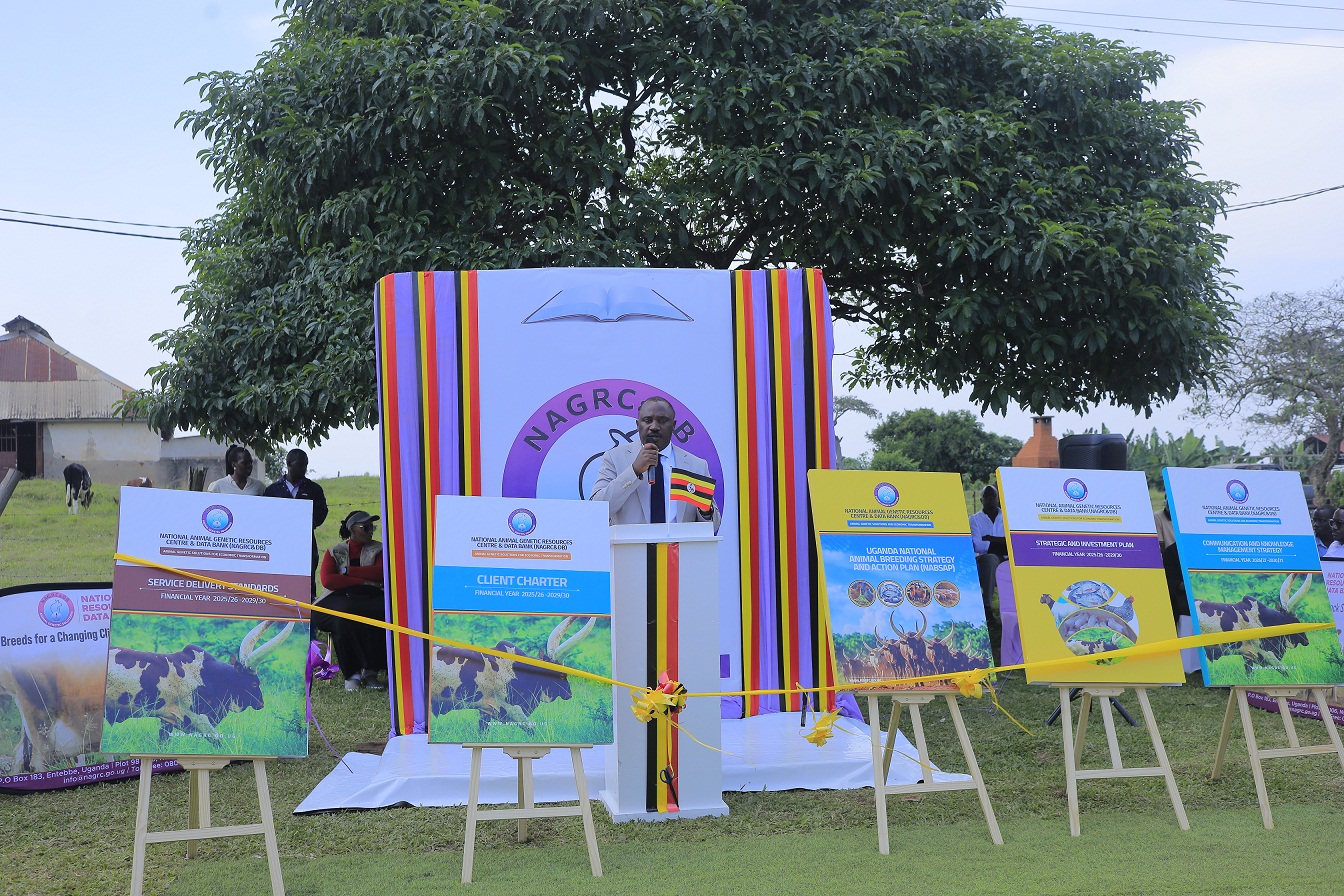
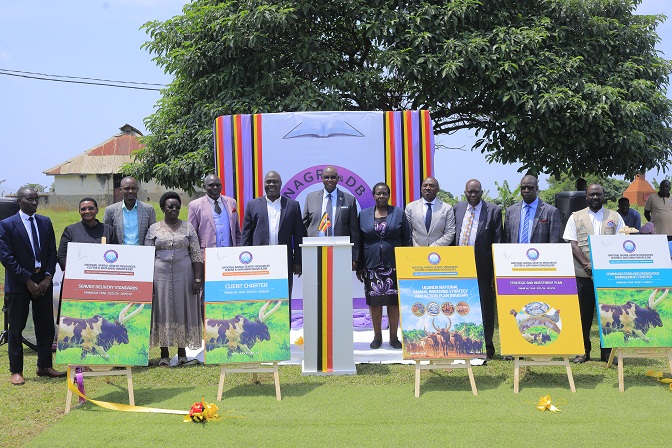
ENTEBBE: Parish Development Model (PDM) farmers are set for a major boost in livestock production as the National Animal Genetic Resources Centre and Data Bank (NAGRC&DB) rolls out a new five-year plan to make quality dairy, piggery and poultry breeding stock more accessible and affordable.
The move is expected to give thousands of farmers a stronger foundation for building profitable livestock enterprises and moving from subsistence production into the money economy.
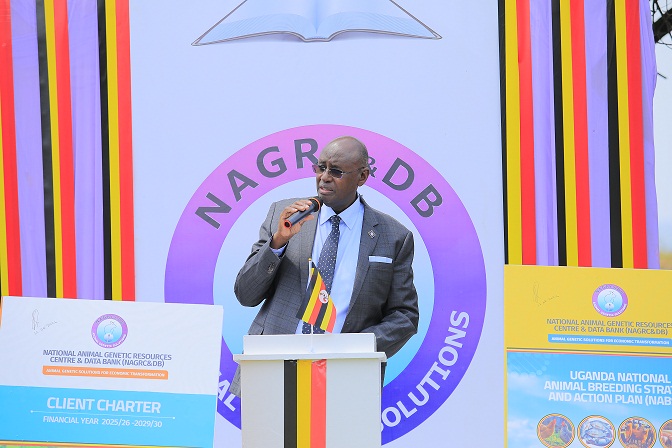
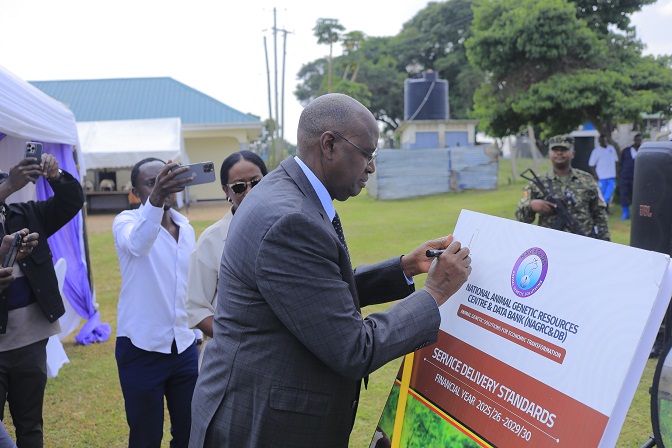
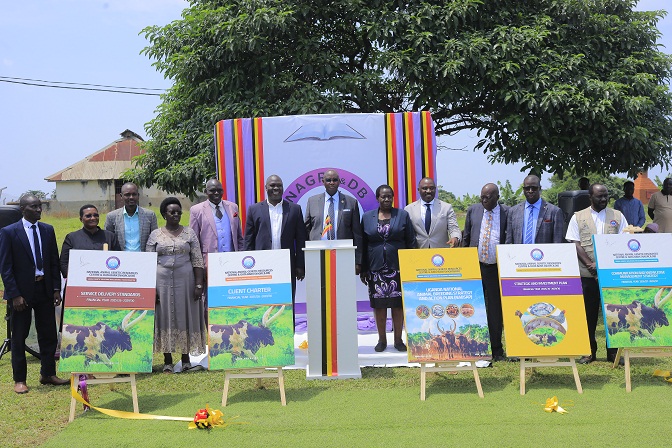
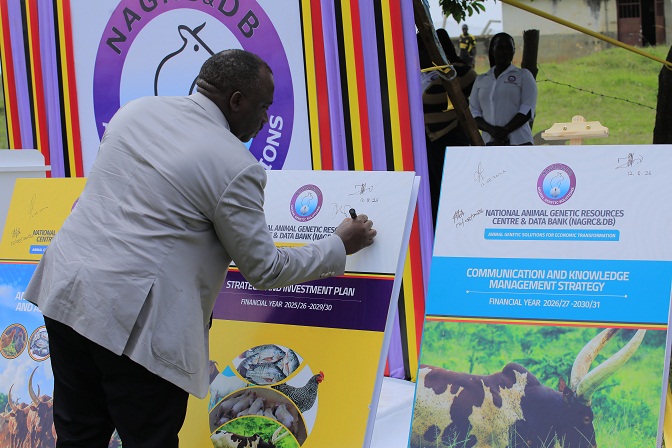
NAGRC&DB made the commitment on August 12, 2026, during the launch of five major institutional documents designed to transform Uganda’s animal breeding sector and improve services to farmers.
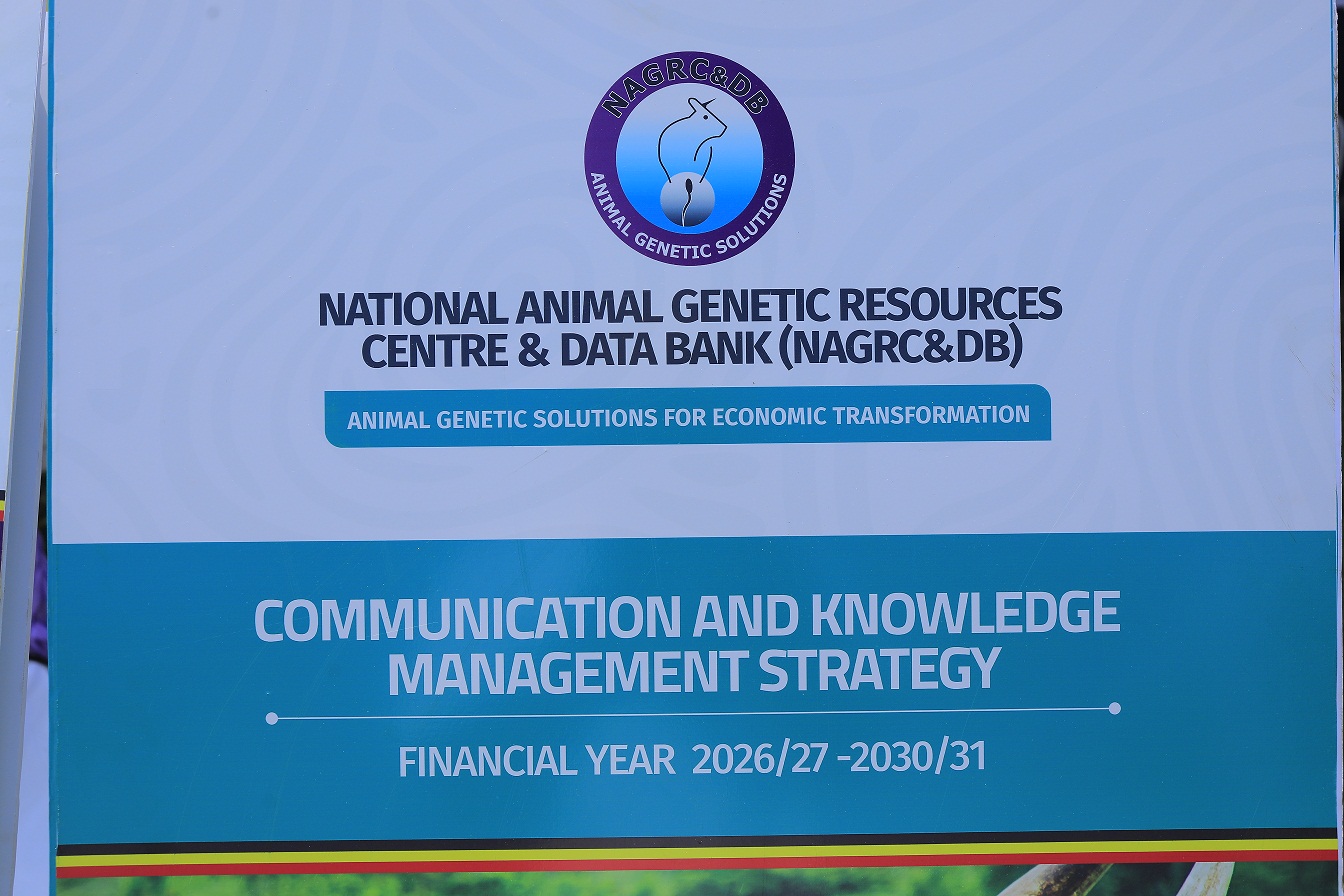
The documents include the Client Charter for FY2025/26 to 2029/30, Service Delivery Standards, the Uganda National Animal Breeding Strategy and Action Plan (NABSAP), the Strategic and Investment Plan for 2025/26 to 2029/30, and the Communication and Knowledge Management Strategy for 2026/27 to 2030/31.
The documents are designed to move Uganda’s livestock sector towards higher productivity, improved genetics, climate resilience and stronger commercialisation.
Minister of State for Animal Industry, Hon. Bright Kanyontore Rwamirama (PhD), officially launched the documents at the NAGRC&DB headquarters in Entebbe.
Rwamirama challenged the institution to ensure the plans do not remain on shelves.
He said their real value would be measured by the results farmers experience on the ground.
The Minister called for stronger accountability, better service delivery and wider adoption of modern animal breeding technologies.
He also urged NAGRC&DB staff, management, the Board and partners to ensure the new direction delivers visible benefits to farmers.
PDM FARMERS IN THE SPOTLIGHT
At the heart of the new Strategic and Investment Plan is a major commitment to PDM farmers.
NAGRC&DB plans to accelerate the breeding and multiplication of productive and farmer-preferred dairy and beef cattle, goats, pigs, poultry and fish.
The agency will also work to make these improved breeds more available and affordable.
For PDM beneficiaries, particular attention will go to dairy cattle, piggery and poultry enterprises.
The plan provides for highly subsidised breeding stock for farmers as part of efforts to support household wealth creation.
NAGRC&DB farms and ranches will serve as breeding, multiplication and technology-transfer hubs.
The agency will work with local governments, farmer organisations and PDM structures to reach beneficiaries.
The approach is expected to go beyond simply giving farmers animals.
Farmers will also be connected to technical guidance on breeding, feeding and enterprise management.
This means PDM financing can be backed by better genetics and knowledge, giving farmers a stronger chance of turning livestock projects into sustainable businesses.
The ultimate target is increased productivity and household incomes.
It also supports the wider PDM ambition of moving households from subsistence production into the money economy.
NAGRC&DB will monitor progress by tracking the livestock breeds and poultry genetic resources introduced, multiplied and made available to PDM farmers.
BETTER BREEDS, BETTER FARM RETURNS
The Uganda National Animal Breeding Strategy and Action Plan (NABSAP) provides the national framework behind the intervention.
Published in 2026, the strategy seeks to make animal breeding more productive, inclusive, climate-resilient and economically sustainable.
Uganda’s livestock sector has faced challenges including low genetic productivity, inadequate breeding infrastructure, limited access to quality breeding materials, uncontrolled cross-breeding and climate shocks.
The strategy seeks to address these challenges while protecting Uganda’s indigenous animal genetic resources.
Its four priority areas include characterisation and monitoring of animal genetic resources, sustainable use and development, conservation, and stronger policies, institutions and capacity.
For farmers, successful implementation means improved access to productive and market-oriented breeds.
It also means access to genetics that can better withstand changing climatic conditions.
The strategy further recognises the importance of conserving indigenous genetic diversity, which remains critical for future breeding and climate adaptation.
FARMERS TO GET BETTER SERVICES
NAGRC&DB is also promising a major improvement in the way it serves farmers and other clients.
The new Client Charter establishes a social contract between the institution and its clients.
It spells out services, rights, obligations and commitments.
It also provides channels through which farmers and other clients can give feedback and lodge complaints.
Under the Charter, complaints must be acknowledged within 48 hours.
Complaints requiring investigation are expected to be concluded within 14 days.
The Service Delivery Standards go further by setting measurable targets.
Clients should be attended to within five minutes of arriving at service points.
Written correspondence should receive a response within five working days.
The standards also require NAGRC&DB to provide clear, accurate, timely and relevant information.
For farmers, breeders and suppliers, the new standards provide a clear yardstick for judging the quality of service they receive.
KNOWLEDGE AT THE FARMER’S FINGERTIPS
The new Communication and Knowledge Management Strategy is expected to strengthen how farmers access information.
The strategy covers public awareness, farmer communication, knowledge management, organisational learning, stakeholder partnerships and digital communication.
It is intended to ensure that reliable information about NAGRC&DB programmes, technologies, products and services reaches the people who need it.
The strategy also strengthens systems for generating, validating, packaging, preserving and sharing technical knowledge.
This is expected to help farmers make better decisions about breeding, feeding and livestock enterprise management.
‘LAUNCHING POSSIBILITIES’
Speaking on behalf of the Board Chairperson, Eng. Robert Ssenozi, the Board member representing farmers in the Central Region, said the launch was about more than documents.
He described it as a commitment to action and said the occasion was about “launching possibilities”.
He linked those possibilities to NAGRC&DB’s mandate to lead the commercialisation of animal breeding and improve animal genetics and productivity.
Representatives from the Executive Office of NAGRC&DB, Uganda National Farmers Federation and the Office of the Prime Minister also attended the event.
A representative of the Office of the Prime Minister, speaking on behalf of the Deputy Head of Public Service, congratulated NAGRC&DB and urged its employees to uphold the standards contained in the new documents.
The National Planning Authority also welcomed the strategy.
Dr Israel Mugezi, Senior Planner for Agriculture, representing the Director of the National Planning Authority, stressed the importance of building a competitive and sustainable animal industry.
He said Uganda needs climate-resilient, high-yielding and affordable genetics to strengthen its livestock economy.
He linked improved livestock production to Uganda’s export ambitions, including value-added products such as milk powder.
The approach also supports the country’s broader agro-industrialisation and value-addition agenda under the Fourth National Development Plan.
FROM PLANS TO FARMERS
The five documents are designed to work together.
NABSAP sets the national direction for animal breeding.
The Strategic and Investment Plan translates that direction into investments and programmes, including support for PDM farmers.
The Service Delivery Standards establish performance targets.
The Client Charter strengthens accountability to farmers and other users.
The Communication and Knowledge Management Strategy ensures that information, feedback and lessons are shared across the system.
The big test now is implementation.
For farmers, success will be measured not by the number of documents launched but by what happens at the farm.
That means more affordable quality breeding stock.
Better dairy cows.
Improved piggery breeds.
Better-performing poultry.
Improved access to technical knowledge.
Faster and more responsive services.
And, ultimately, higher production and household incomes.
With NAGRC&DB farms and ranches positioned as breeding and technology-transfer hubs, the new strategy could give PDM farmers an important push towards commercially viable livestock enterprises.
The initiative also offers Uganda an opportunity to build a stronger livestock industry based on improved genetics, better services and sustainable production.
For the ordinary farmer, the message is simple: better breeds, better productivity and better opportunities to make money from livestock.
GOT A HOT STORY? LET US KNOW!
Got breaking news, explosive secrets, or hard evidence?
Renowned dancer-turned-singer Ritah Dancehall has shared her honest perspective on how dancers are perceived and treated within Uganda’s entertainment industry.
Speaking candidly, Ritah noted that because the dance industry is still developing and has yet to establish a strong foundation in Uganda, many people continue to view dancers as hustlers or individuals who have failed in life.
The dance industry has yet to establish a solid base in Uganda’s entertainment industry. A dancer in Uganda is considered and seen as someone who is a failure and a hustler in life.
Ritah further explained that despite the negative perceptions surrounding dancers, the profession remains a difficult hustle, with many dancers struggling to earn meaningful income from their talent.
She revealed that she has personally performed on various artists’ stages only to receive little or no payment, highlighting the financial struggles dancers face compared to musicians.
Despite being judged the way people want to, our end point is hunting for money. Sometimes I take to artists’ stages and end up not getting paid. Like at Dexta Daps’ stage, I got a little pay, but getting a payment like how an artist gets paid—let’s say Shs3 million as the least—is something a dancer doesn’t get.
According to Ritah, the entertainment industry still has a long way to go in recognizing dancers as professionals and ensuring they are fairly compensated for their contribution to performances.
She believes that dancers deserve greater respect, better pay and more opportunities as the Ugandan entertainment industry continues to grow.
The Chief of Defence Forces Gen Muhoozi Kainerugaba has appointed Maj Gen Felix Busizoori as the new deputy commander of the Uganda People’s Defence Forces (UPDF), replacing Maj Gen Joseph Ssemwanga.
Ssemwanga has been appointed General Commanding Officer of the UPDF Reserve Forces, replacing Lt Gen Charles Otema Awany, who is due to retire from the army next week.
Busizoori, who was previously commander of the UPDF 4th Infantry Division, will be replaced by Maj Gen Wilberforce Sserunkuma, the former commander of the 3rd Infantry Division.
Brig Gen Michael Hyeroba, the former 1st Deputy Commander of the Infantry Division, has been appointed commander of the 3rd Infantry Division.
The changes were announced on Saturday by Col Chris Magezi, the UPDF Acting Director of Defence Public Information, who said the appointments and transfers take immediate effect.
Until his latest appointment, Busizoori had been overseeing the implementation of Executive Order No. 3, issued by President Yoweri Museveni in May 2023, which banned commercial charcoal production and trade and ordered the eviction of migrant cattle keepers from northern Uganda.
Days before his appointment, Busizoori ordered the free distribution of impounded charcoal to residents from traders who had violated the executive order and banned the importation of charcoal from neighbouring South Sudan.
Members of Parliament have reiterated the need for major changes in the Ugandan education system, with a focus on technical and vocational training.
The call was made during the 55th Commonwealth Parliamentary Association (CPA) Africa conference in Lilongwe, Malawi on Thursday, 13 August 2026.
Uganda’s delegation, led by the Speaker, Jacob Marksons Oboth, re-echoed the mismatch between the job market and the education system, saying this is denying the youth the much-needed opportunity to attain their potential.
Hon. Emely Kugonza (NRM, Buyanja East County), presented a paper titled “Bridging the Skills Gap: Aligning Education with Labour Market Demands in Africa.”
In his presentation, Kugonza described Uganda’s current educational framework as one which is still carrying the imprint of an inherited colonial model, designed to produce workers for export-oriented production rather than a self-sufficient economy.
As such, Kugonza argued that, Uganda is left with a generation of graduates who hold academic certificates but lack the practical competencies needed by employers.
He said that while Ugandan universities continue to churn out graduates, employers are concerned about a skills gap, citing areas that are lacking such as engineering and vocational skills.
Kugonza warned that this will, in the long run result into loss of demographic opportunity with negative implications on the country’s peace and security.
He commended government for the interventions in place to tackle the widening skills gap among young people, citing the 2020 lower secondary school curriculum’s shift toward competency-based learning and the ongoing expansion of Business, Technical and Vocational Education and Training institutions across the country.
He however urged government to reposition citizens from being suppliers of raw materials to producers of high-value goods.
Hon. Fortunate Nantongo (NUP, Kyotera district Woman representative) advised that skilling of learners ought to be embedded in the education system from primary school level.
She also called for adequate funding of the country’s technical and vocational institutes.
Hon. Bernard Otim (NRM, Maruzi North County) proposed that learning institutions, from primary level to higher institutions should be transformed into skilling centres as a way of absorbing the biggest unemployed youth population.
Hon. Naome Kabasharira (NRM, Rushenyi County) applauded a recent government policy on promotion of science and innovation, stating that hands-on curriculum is one of the strategies in which youths can become competitive in an increasingly shrinking job market.
Hon. Silas Aogon (Ind., Kumi Municipality) on the other hand urged Parliament to play its oversight role in ensuring that the Technical and Vocational Education and Training (TVET) Act is implemented, saying that policy on paper is not enough.
He also contended that there is a need for adequate budget allocation towards skilling institutions and training hubs, if they are to achieve the intended objective of solving youth unemployment, hence becoming engines of wealth creation.
The MPs framed their reform agenda as essential to renewing the social contract between government and Ugandan citizens.
They stressed that whilst the growing youth population is an asset, it remains untapped, cautioning that without deliberate reform, Uganda risks deepening its cycle of youth unemployment and poverty even as opportunities in oil, minerals, and other sectors expand.
Do you have a story in your community or an opinion to share with us: Email us at Submit an Article
About UGNEWS24
UGNEWS24 is a Uganda local news service, a product of
SOLAVIA GROUP LIMITED,
Reg. No. 80048169153974.