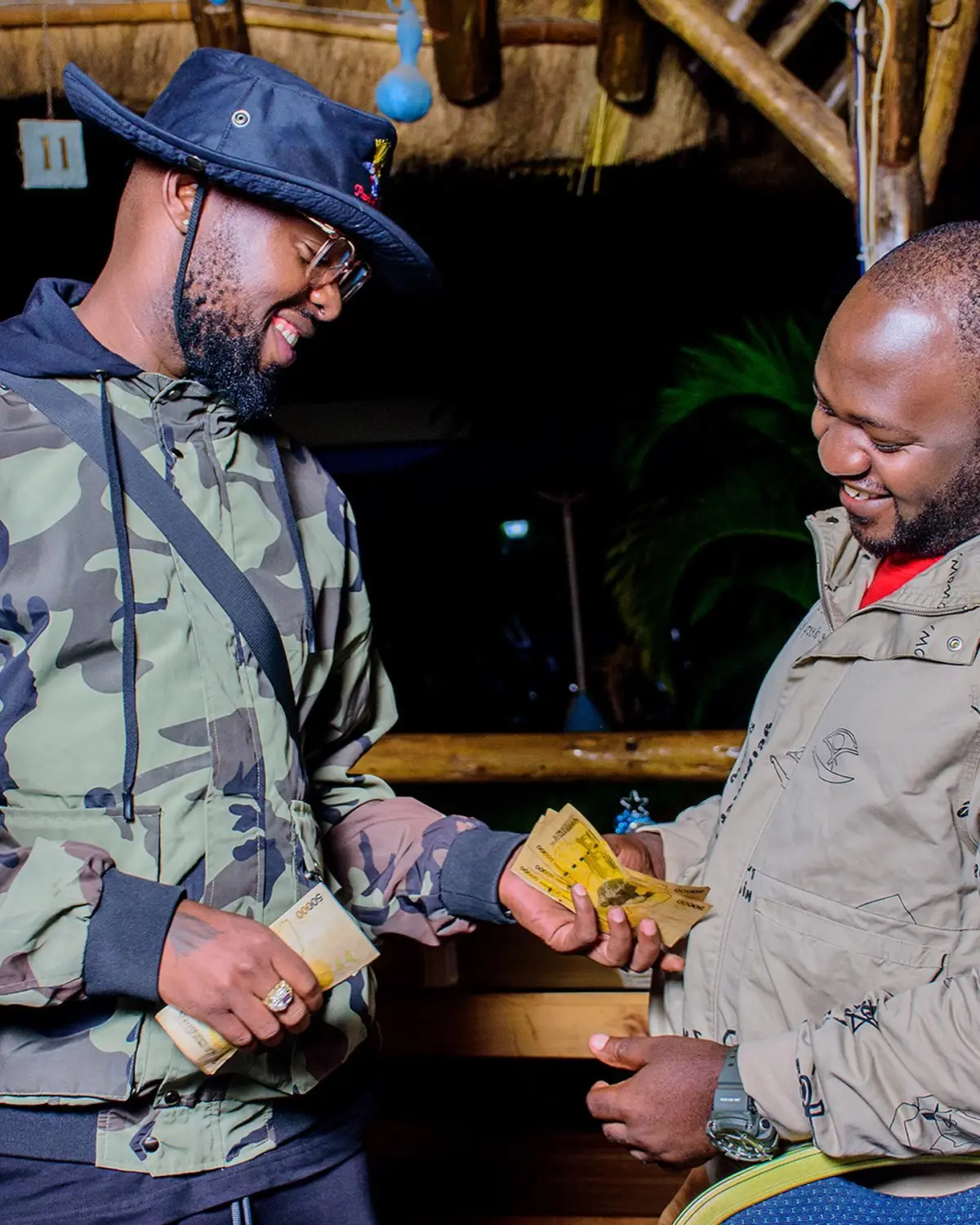
Ugandan music legend Jose Chameleone continues to prove that his influence stretches far beyond Uganda’s borders.
The singer was warmly received in Tanzania, where he attended the Kizimkazi Festival 2026 and had an opportunity to meet Tanzanian President Samia Suluhu Hassan, adding another memorable chapter to his long and colourful East African music journey.
Clearly moved by the reception, Chameleone took to social media to thank President Samia, the festival organisers and Tanzanians for the love shown to him.
“Sincere thanks to His Excellency President Samia Suluhu Hassan, and all Tanzanians for your love and special reception. Thank you organizers of Kizimkazi Festival 2026 for the great event that was well organized. Kizimkazi Kumenoga! Tanzania, I love you so much,” Chameleone posted.
For an artist whose career has been built on crossing borders, blending sounds and commanding audiences across the region, the Tanzania visit was more than just another performance. It was a reminder of the long-standing relationship Chameleone has enjoyed with East African music lovers.
Over the years, the Leone Island boss has remained one of Uganda’s most recognisable musical exports, with a catalogue that has travelled across Kenya, Tanzania, Rwanda, Burundi and beyond. From his early hits that helped define a generation of East African pop music to his more recent appearances, Chameleone has maintained a rare ability to command attention wherever he goes.
His meeting with President Samia Suluhu Hassan also gave the trip an extra layer of significance, with the musician sharing his appreciation for what appeared to be a special reception during the Kizimkazi Festival festivities.
And, true to form, Chameleone was not leaving Tanzania quietly.
His message, punctuated with the energetic declaration “Kizimkazi Kumenoga!”, captured the mood of an artist who was clearly enjoying the moment and the affection of his hosts.
Don’t want to miss out on any story? For updates on all Sqoop stories, follow this link on Telegram: https://t.me/Sqoop
From Granaries to Food Aid: What Happened to Uganda’s Indigenous Food-Storage Systems?
For generations, the granary was more than a place to keep food. It was a household food-security system.
Across Uganda, communities developed different forms of traditional storage using materials that were locally available, mud, grass, reeds, wood, fibre and other plant materials. In Tooro, the granary was known as enguli, in Teso, it was known as edula. In Karamoja, households traditionally maintained their own food stores. These structures were adapted to local conditions and, importantly, were part of a wider system of producing, drying, storing and preserving food for the months when harvests were no longer available.
Today, many of these granaries are disappearing. That may seem like a small change in rural architecture. It is not. It raises a much bigger question about what Uganda may have lost in the transition from indigenous food systems to modern development programmes.
The question is particularly relevant now, when food insecurity and climate shocks are again exposing weaknesses in the country’s food systems.
In Karamoja, the Integrated Food Security Phase Classification estimates that about 473,000 people, 32 percent of the analysed population were facing Crisis or worse levels of acute food insecurity between April and July 2026. The assessment attributes the deterioration to climatic shocks, below-average food and livestock production, pests and diseases, and high food prices.
The government has responded with emergency food assistance. In July, it announced a major relief operation, while also pointing to longer-term measures including valley dams and modern grain-storage silos.
Relief is necessary when people are hungry. But the bigger question is what happens between one emergency and the next.
Uganda is not alone in facing this question. In Ethiopia, researchers and aid agencies have documented how years of sustained food-aid dependency gradually eroded household and community-level grain storage, leaving families more exposed, not less, when the next drought arrived. It is a pattern worth heeding: emergency relief that is not paired with rebuilding local storage capacity tends to treat the symptom while leaving the underlying vulnerability in place.
This is where Uganda’s forgotten granaries deserve another look.
The old system was not perfect. Traditional granaries could be vulnerable to rodents, insects, moisture and theft. FAO’s work in Karamoja documented some of these limitations. But it also found that Karimojong households traditionally maintained food stores holding roughly 50 to 500 kilograms of grain. FAO’s subsequent support for community cereal banks built on this existing practice rather than simply replacing it.
The idea was simple but powerful: grain could be bought when prices were low, stored and sold later, while households could borrow food and repay in kind. In this way, storage became part of a local system for managing seasonal scarcity and reducing dependence on food aid.
There is a similar lesson from Teso.
Traditional edula granaries were used to store food between harvests, but they also served as seed reserves for the next planting season. Their disappearance has therefore affected not only food storage but also the preservation of indigenous crop varieties. Recent reporting from Teso has documented the connection between declining granary use, loss of indigenous foods and difficulties in maintaining seed supplies.
This matters for climate resilience.
Indigenous food crops were not necessarily high-yielding under ideal conditions, but some were valued because they could withstand difficult seasons. Farmers in Teso, for example, continue to report using traditional varieties alongside improved varieties because of their ability to tolerate dry spells.
Uganda’s climate response therefore needs to think beyond the production stage.
A farmer may receive improved seed, fertiliser or irrigation support and produce a good harvest. But if there is nowhere safe to store that harvest, much of the resilience created at production level can disappear.
The same applies to seeds. If farmers consume or sell all their harvest because they lack storage, they may have to buy seed the following season. A climate shock can then become an economic shock, followed by another production shock.
This is why the granary should not simply be dismissed as an outdated structure.
The answer is also not to romanticise the past. Uganda should not rebuild vulnerable storage systems exactly as they were. Instead, it should ask what indigenous systems got right and combine that knowledge with modern science.
This combination has already been tried elsewhere. In India, drought-prone states such as Odisha have deliberately revived and formalised community seed and grain banks as part of official climate-adaptation policy, pairing indigenous storage knowledge with modern seed science and management practices. It gives Uganda a working model to draw on, not just a hypothetical one.
Imagine a climate-resilient community food reserve built around an improved version of the traditional granary: raised above the ground, better protected against rodents and moisture, ventilated appropriately, constructed partly from local materials where practical, and combined with improved post-harvest handling, moisture testing and pest management.
Such a system could store both food and seed.
At community level, it could connect to small grain banks, farmer groups, extension services, local markets and weather information. During good seasons, farmers could store part of their harvest. During lean periods, households could access food without waiting for an emergency relief operation.
This is not an entirely new idea. Uganda’s experience with cereal banks in Karamoja already demonstrated how community storage could help break the cycle of scarcity, high seasonal prices and food-aid dependence.
The lesson is therefore not that Uganda should choose indigenous knowledge instead of modern technology.
It is that climate resilience should combine the two.
Our development programmes have become very good at funding visible infrastructure—irrigation systems, dams, roads, agricultural inputs and other facilities. But resilience is ultimately measured by what happens when the rain fails.
Does a household still have food?
Does a community still have seed?
Can farmers preserve part of a good harvest until the difficult months?
Can communities access food without immediately depending on emergency assistance?
Those questions should become part of how climate-smart agriculture and food-security projects are designed.
The granary may have disappeared from many Ugandan homesteads, but the principle behind it remains remarkably relevant: store during abundance so that scarcity does not become a crisis.
As Uganda responds to today’s climate and food-security challenges, perhaps the question is not whether we should go back to the granary.
It is whether we can move forward by remembering what the granary was designed to do.
Do you have a story in your community or an opinion to share with us: Email us at Submit an Article
BEN KUMUMANYA: LC 1 & 11 Executive council are a bedrock of Uganda’s Decentralisation,Writes Brian Mugenyi
The Permanent Secretary in the Ministry of Local government Mr. Ben Kumumanya has said that the Local Council I (LC I) and Local Council II (LC II) structures remain the bedrock of Uganda’s decentralised system of governance.
Since the introduction of decentralisation, Mr. Kumumanya says Government has deliberately brought leadership and decision-making closer to the people, enabling communities to participate actively in identifying priorities, monitoring public services and holding leaders accountable.
“This has been demonstrated through the bold participation of citizens during the recent visits by the Ministers of Local Government to the Bugisu Sub-region, where communities openly exposed corrupt practices and demanded greater accountability,” said Kumumanya.
As Uganda prepared for the Village (LC I) and Parish/Ward (LC II) elections, citizens had another opportunity to strengthen this democratic foundation by electing leaders of integrity, competence and commitment to public service. The Ministry of Local Government continues to champion decentralisation as an effective approach to promoting good governance, accountability, inclusive development and citizen participation.
” Through decentralisation, communities become active partners in development rather than passive beneficiaries,” he emphasized.
The LC I and LC II Executive Committees are designed to ensure that every aspect of community life is represented through dedicated office bearers, including the Chairperson, Vice Chairperson, General Secretary, Secretary for Finance, Secretary for Defence and Security, Secretary for Production and Environmental Protection, and Secretary for Information, Education and Communication, Secretary for Youth Affairs, Secretary for Persons with Disabilities and Secretary for Women Affairs as provided for under the Local Governments Act.
This structure ensures that residents know where to seek assistance on specific community matters while promoting inclusive, accessible and responsive local governance.
According to Mr. Kumumanya, the LC I Executive Committee plays a central role in village administration by implementing council decisions, convening meetings, mobilising citizens to participate in government programmes, maintaining law and order, promoting sanitation and environmental protection, identifying vulnerable households for government interventions, safeguarding public property and monitoring service delivery. The Committee also serves as the vital link between communities and higher levels of Local Government by communicating local priorities and development needs.
“LC I and LC II leaders occupy a unique position because they are the closest elected leaders to the people. Their understanding of community realities enables them to respond quickly to local concerns while ensuring that government programmes reach the intended beneficiaries. Their responsibilities extend beyond administration to mobilising communities to participate in national development initiatives such as the Parish Development Model (PDM), Emyooga, immunisation campaigns, environmental conservation and community sanitation programmes,” he says.
These leaders also play a crucial role in maintaining peace, security and social harmony. Working closely with security agencies and residents, they identify emerging security concerns, resolve neighbourhood disputes and promote peaceful coexistence. One of their most valuable responsibilities is resolving disputes involving land boundaries, family matters, domestic conflicts and other community disagreements before they escalate into lengthy and costly court processes. Through mediation and reconciliation, Local Councils strengthen social cohesion while reducing pressure on the formal justice system.
Equally important is their role in promoting transparency and accountability. As Government intensifies efforts to eliminate corruption, communities must recognise that the fight begins at the grassroots. Honest and vigilant Local Council leaders help safeguard public resources by verifying beneficiaries of government programmes, monitoring public projects and reporting cases of corruption, abuse of office and poor service delivery. The courage demonstrated by communities in exposing corruption during recent ministerial visits illustrates the important partnership between citizens and Government in strengthening accountability.
The forthcoming LC I and LC II elections therefore presented an opportunity for communities to elect leaders who place public interest above personal gain. Citizens should carefully assess the character, honesty, commitment and track record of those seeking office. Communities deserve leaders who are approachable, accountable, hardworking and committed to serving all citizens without discrimination. Such leadership strengthens public trust and creates an environment where development programmes can succeed.
In addition he says that decentralization is founded on the principle that decisions affecting communities are best made with the active participation of those communities. Through elected Local Councils, citizens influence local priorities, participate in planning processes and contribute to monitoring government performance. This participatory approach strengthens democratic governance while enhancing community ownership of development initiatives.
The Ministry of Local Government remains committed to strengthening Local Councils through continuous policy support, capacity building and collaboration with other government institutions. Strong Local Councils translate into stronger Local Governments, improved service delivery, greater accountability and more responsive governance.
As Ugandans prepared to elect their next LC I and LC II leaders, every eligible voter had an important civic responsibility. Participating in these elections is not simply about choosing individuals to occupy leadership positions; it is about shaping the future of our communities. Every vote contributes to strengthening decentralisation, promoting peace and security, improving accountability and accelerating socio-economic transformation.
“The Ministry of Local Government therefore encouraged all eligible citizens to participate actively in the electoral process by offering themselves for leadership where qualified and by voting peacefully and responsibly. Together, through strong Local Councils and effective decentralisation, Uganda will continue to deepen democratic governance, improve service delivery and build resilient communities that drive sustainable and inclusive national development. The strength of our nation begins at the village and parish level, where citizens and their elected leaders work hand in hand to transform communities and realise Uganda’s development aspirations,” he said.
Do you have a story in your community or an opinion to share with us: Email us at Submit an Article
BUKEDEA — The Ministry of Health has come under scrutiny over the prolonged delay in completing a Shs549 million maternity ward at Okunguro Health Centre II in Bukedea Town Council, with an inspection team from the Office of the President questioning the ministry’s supervision of the project.
The concerns emerged during a monitoring exercise led by the Deputy Head of the Resident District Commissioners (RDCs) Secretariat and Anti-Corruption Unit, Dr Sr Mary Grace Akiror, alongside Bukedea district leaders.
The team established that construction of the maternity ward had stalled for about two years despite the Ministry of Health allocating funds to the project in the 2024/2025 and 2025/2026 financial years.
Bukedea District Health Officer Dr Emmanuel Odeke Okallany said the project was divided into two phases at a combined cost of Shs549 million.
According to Odeke, BAO Financial Services Limited was contracted by the Ministry of Health to undertake the works, but district authorities and intended beneficiaries were not adequately involved in the procurement and implementation process.
The first phase, valued at Shs265 million, covered excavation of the foundation, construction of the slab and raising of the walls to beam level.
The second phase, worth Shs284 million, was intended to cover roofing and installation of doors and windows. However, the project remains incomplete.
Odeke said the district’s ability to monitor and supervise the project had been undermined by the contractor’s failure to provide local authorities with the Bills of Quantities (BoQs), making it difficult to establish the scope and cost of the works.
He said the Ministry of Health had since asked the district to provide an additional Shs200 million in the 2026/2027 financial year to facilitate completion of the maternity ward.
The additional funding would cater for plastering, painting, ceiling works and construction of a veranda, among other outstanding works, before the contractor returns to the site.
Other Projects Inspected
The monitoring team also inspected several other government projects across Bukedea District.
At the district wall fence project, valued at Shs149 million, the team established that the work executed was commensurate with the resources invested.
The team also inspected projects at Bukedea Health Centre IV, including the maternity ward, incinerator, drugs store and medical stores. Officials observed that the work completed was generally commensurate with the funds spent.
The team further inspected construction of a 0.6-kilometre low-cost sealed road valued at Shs398 million.
The road is being constructed by Taba Services Ltd under the Road Transport Infrastructure Programme of the Ministry of Works and Transport.
The monitoring team noted that construction was progressing well and urged district authorities to maintain close supervision to ensure quality and value for money.
The exercise also covered Kwarikwar Seed Secondary School, constructed under Transitional Development Grants.
The team assessed the Shs500 million project, which includes a four-classroom block, a mini-administration block and a girls’ toilet, and established that the works represented value for money.
RDC Raises Concern Over Centrally Awarded Projects
Bukedea Resident District Commissioner William Wilberforce Tukei said local governments continued to face challenges monitoring projects awarded directly by central government ministries.
Tukei said some contractors report to project sites without first engaging district authorities, creating difficulties in supervision and accountability.
He warned that the arrangement could contribute to poor workmanship because local leaders may have limited information about project scope, costs and contractual obligations.
He also raised concern over the failure by some implementing ministries and contractors to share Bills of Quantities with district authorities.
According to Tukei, this makes it difficult for local governments to effectively monitor project implementation or raise concerns where the quality of work does not correspond with the money invested.
Leaders Call for Stronger Accountability
Bukedea District Vice Chairperson LC5 Anne Akello commended the RDCs Secretariat for conducting the monitoring exercise, saying it had strengthened the resolve of political and technical leaders to improve service delivery.
Akello said local leaders remained committed to ensuring that government resources reach their intended beneficiaries, citing programmes such as the Cattle Restocking Programme and the Parish Development Model.
She also urged technical officers to remain committed to their responsibilities despite challenges they may face in the execution of their duties.
At the close of the monitoring exercise, Dr Sr Mary Grace Akiror pledged to raise concerns surrounding the stalled Okunguro Health Centre II maternity ward with the Permanent Secretary of the Ministry of Health, in a bid to secure a lasting solution and ensure the facility is completed for public use.
Do you have a story in your community or an opinion to share with us: Email us at Submit an Article
The driver who was allegedly involved in the fatal road crash at Nalulanda along Entebbe Road that claimed the lives of two journalists has been arrested.
Kigozi John Baptist was arrested in a joint inter-agency operation following the crash that killed Sanyuka TV producer and trade marketing officer Badru Kasirye and digital content creator Isaac Ndamagye. Entertainment presenter Brian “Macona” Ssemanda was also seriously injured in the accident and remains under medical care.
The development was announced by SP Michael Kananura, the Community Liaison Officer and Public Relations Officer in the Directorate of Traffic and Road Safety, who posted the update on his X handle.
“[#UPDATE] The driver identified as Kigozi John Baptist involved in the fatal crash @Nalulanda along Entebbe Road that claimed the lives of 2 journalists and seriously injured another, has been arrested in a joint inter-agency operation,” Kananura posted.
He added that Kigozi will be produced in court at the appropriate time to face charges related to the crash.
#UPDATE: The driver identified as Kigozi John Baptist involved in the fatal crash @Nalulanda along Entebbe Road that claimed the lives of 2 journalists and seriously injured another, has been arrested in a joint inter-agency operation. He will be produced in court at the… pic.twitter.com/MwoaGtteCb
The accident occurred in the early hours of Monday as the three were reportedly returning from a celebrity boxing event between Chicken Chicken and Shawa.
Kasirye reportedly died at the scene, while Ndamagye also succumbed to injuries sustained in the crash. Macona was rushed to hospital in critical condition.
The accident has since sparked an outpouring of grief from Uganda’s media and entertainment fraternity, with colleagues and friends paying tribute to the deceased and calling for prayers for Macona’s recovery.
Kigozi’s arrest brings a new development to the investigation, with police expected to provide further details as the case progresses.
Don’t want to miss out on any story? For updates on all Sqoop stories, follow this link on Telegram: https://t.me/Sqoop
KAMPALA — In a strategic move set to redefine parliamentary communications, veteran media practitioner and Red Pepper co-founder Dr. Arinaitwe Rugyendo has been appointed as the Principal Press Secretary (PPS) to the Speaker of the 12th Parliament of Uganda, Rt. Hon. Jacob Oboth-Oboth.
The high-profile appointment has sparked widespread acclaim across Uganda’s media and public affairs landscape, with stakeholders describing the decision as a masterstroke for the legislative arm of government.
Among the deluge of congratulations flooding social media platforms and public forums, close colleagues and mentees expressed overwhelming confidence in Dr. Rugyendo’s ability to elevate the institution’s public relations. One heartfelt tribute read:
“Greetings, Uganda! Join me to congratulate my beloved brother & mentor, Dr. Arinaitwe Rugyendo on his appointment as Principal Press Secretary to the Speaker of the 12th Parliament, Rt. Hon. Jacob Oboth-Oboth. I trust in his capabilities. Parliament has got a Nile Perch, not a Tilapia!”
The striking metaphor—comparing Dr. Rugyendo to the formidable Nile Perch rather than the smaller Tilapia—underscores the media fraternity’s high regard for his deep expertise, editorial clout, and strategic acumen.
A Veteran Media Titan & Administrator
Dr. Rugyendo brings decades of media management and strategic communication experience to the Office of the Speaker. As one of the founding directors of Red Pepper, he played a pivotal role in shaping Uganda’s modern print media landscape. Over the years, he has established himself as a leading voice on digital innovation, media ethics, and governance.
Beyond journalism, Dr. Rugyendo is widely celebrated for his administrative acumen in Ugandan sports. During his tenure as Chairman of the Uganda Premier League (UPL) Board, he spearheaded governance reforms, commercial partnerships, and brand growth, solidifying his reputation as a transformative leader.
Elevating Parliamentary Communications
As Principal Press Secretary, Dr. Rugyendo will serve as the chief media advisor and spokesperson for Speaker Jacob Oboth-Oboth. His core mandate includes managing the Speaker’s official communications, shaping legislative messaging, and strengthening the relationship between Parliament and the public.
With Speaker Oboth-Oboth prioritizing transparent governance and active public engagement in the 12th Parliament, the former Red Pepper director’s appointment provides the formidable communication backbone required to deliver this vision effectively.
Do you have a story in your community or an opinion to share with us: Email us at Submit an Article
KAMPALA, UGANDA — The future of Uganda’s transport sector may not arrive with the familiar roar of an internal combustion engine. It may arrive almost silently.
A boda boda rider, Frank Mawejje, swaps a depleted battery instead of queuing at a petrol station. An electric bus pulls smoothly away from a terminal without emitting a single cloud of diesel smoke. In garages across Kampala, mechanics who spent decades diagnosing engine knocks are now learning the language of lithium-ion batteries, electric motors, and digital controllers.
For Uganda, this shift represents much more than a technological upgrade. It carries all the markers of an economic turning point.
At the center of this transition is Fred Ssenoga, Chief Executive Officer of the Union Transport Alliance (UTA)—an organization working to integrate Uganda’s fragmented transport workforce into a structured, commercially viable, and tech-driven ecosystem.
Alongside him is Frank Mawejje, UTA’s Boda Boda Chairman. His advocacy for electric motorcycles—coupled with the team’s recent exposure to China’s transport infrastructure—has added practical urgency to Uganda’s mobility debate.
A Market of 50 Million Needs a New Mobility Blueprint
The urgency of this transition is anchored in demographic reality. Data from the 2024 Census placed Uganda’s population at 45.9 million people, with projections indicating the country will cross 50 million citizens before the end of 2026.
That means Uganda is rapidly evolving into a high-density market of citizens who must move daily—to offices, schools, markets, industrial hubs, and health facilities.
The core policy question is no longer whether Uganda needs expanded transport systems, but what kind of transport economy the country intends to build for its next 50 million citizens.
The Evolution of the Boda Boda
For decades, the boda boda has served as Uganda’s primary informal economic engine. Yet, its operational model has remained tethered to volatile imported fossil fuels. Fuel costs represent the single largest daily overhead for riders, directly cutting into their household earnings.
Electric motorcycles fundamentally alter that economic calculation. By swapping petrol for battery power, daily operating expenses drop significantly.
Following the UTA delegation’s exposure trip to China, Frank Mawejje highlighted a critical insight: China’s success lies in building an integrated mobility ecosystem where vehicle assembly, battery swapping, charging networks, and financing operate as one unit.
For Mawejje, the lesson was clear: China did not simply buy electric vehicles—it constructed an industrial economy around them.
Building a Localized Value Chain
Consider the traditional petroleum value chain: bulk imports, fuel stations, mechanic garages, and spare parts. Electric mobility requires an equally comprehensive localized ecosystem:
Battery-Swapping & Fast Charging Networks
Battery Leasing & Diagnostics
EV Electronics & Powertrain Maintenance
Fleet Telemetry & Digital Payment Gateways
This is where Fred Ssenoga’s vision for UTA comes into focus. By organizing boda boda riders, taxi operators, bus companies, and truck drivers under a single umbrella, UTA turns the informal transport worker into a structured commercial participant with access to asset financing, insurance, and digital tools.
The Policy Imperative
The Ministry of Works and Transport faces a timely opportunity to create clear regulatory frameworks for e-mobility. Priority must be given to setting technical standards for imported batteries, regulating swapping infrastructure, and integrating EV technical skills into vocational institutes.
Uganda is approaching a 50-million-person mobility market. The transition from petrol to electricity is no longer a distant concept—it is already on the road. The choices made today by policymakers, investors, and organized transport leaders will determine who builds, and who owns, Uganda’s future mobility economy.
Do you have a story in your community or an opinion to share with us: Email us at Submit an Article
In the 1960’s, Uganda was the main tourism destination in Eastern Africa and Tourism became one of the country’s main economic sectors.
However, the period of turmoil in the 1970’s and 80’s saw the wildlife hunted to virtual extinction in all the national parks, tourism infrastructure vandalized and looted and as a result Uganda lost its position as the number one to neighboring countries like Kenya who consolidated their position and enforced the safari brand that to date they are known world over for – safari!
In the mid eighties the current government took over power and started the long arduous and painful process of restoring peace, the economy which has evidently moved in a crawling manner though tourism now seems to have a flicker of hope and optimism.
Uganda has been said to be a blank page because very little is known of this beautiful country out there implying there is urgent need for the government to mobilize the stake holders and create a conducive environment for them to formulate synergies between each other.
In Uganda, tourism’s direct contribution to GDP in 2012 was estimated at roughly US$834 million. This represented 4% of total Ugandan GDP while globally, tourism generates about 10% of total world GDP and employs over 10% of the global workforce.
The tourism sector continues to be a strong and growing contributor to the national economy, investment, both direct foreign as well as domestic, and employment, particularly in rural areas where few other jobs are available, but also in urban centres. It contributes nearly 26% of Uganda’s total exports earnings. The hospitality sub sector alone employs country-wide an estimated 65,000 people with the related transport sector accounting for another 20,000 jobs.
Secondary and tertiary employment in other sectors providing support services and supplies to the tourism sector add further to this share.
In the strategic plan for Uganda 2004 – 2008 and more recently in the review of Uganda’s Tourism Master Plan, a lot of talk was and continues to be made on Uganda’s potential and it seems to be the case that this word has always been used in the vaguest of ways especially when there is no specific manner to describe an activity in detail. However, there is no doubt that tourism in Uganda is on the rise as indicated by available statistics from Uganda Bureau of Statistics (UBOS) from 2007 to 2012.
Tourism compared to other export sectors is unique in that consumption takes place in Uganda resulting in a higher added value within the country. Expenditure of the tourists gives rise to six major economic impacts that include the Gross National Product (GNP); foreign exchequer earnings and the Balance of Payment; Employment; government revenue; regional distribution of income and investment.
As a result tourism plays a key role in the enhancement of the economic and social well being of Uganda and its people through foreign exchange earnings, the creation of jobs and consumption of Ugandan goods and services. At the same time a successful tourism industry contributes to the preservation of Uganda’s physical and aesthetic environment thus preserving the culture and unique heritage.
Uganda boasts of one of the largest variety of natural resources on the African continent which range from fresh water bodies like lakes and rivers, Loft Mountains, forests, numerous flora and fauna found in our protected areas. Distinctively, Uganda as a tourist destination has a variety of game stock that habit that un spoilt lush and green beauty which is endowed with numerous outstanding attractions based on its lakes, rivers, forests and ecology, ice capped mountains of the Rwenzori.
In Uganda, tourism’s direct contribution to GDP in 2012 was estimated at roughly US$834 million.
This country continues to outshine other East African countries with its vast range of bird species and most of all it is the home to over 50% of the world remaining mountain gorillas at Bwindi Impenetrable Forest and Mgahinga Gorilla National Park. Africa review recently also noted Uganda’s tourism growth is the fastest growing in Africa.
What is at Stake – Regarding Tourism in Uganda
Tourism has not developed as expected despite the country’s potential and tourism attractions. The strength of Uganda’s Tourism industry is in its unspoilt wilderness attractions such the Mountain Gorillas, the rich cultures and special combination of nature and culture. In the past Uganda’s tourism sector has had challenges related to insecurity in some parts of the country, however this has been solved and Uganda is now generally a peaceful destination though there remains the biggest challenge of improving Uganda’s image internationally.
To date many Ugandans get surprised by the questions they are asked when they are attending International tourism exhibitions. The people out there still think of Uganda as the country of Idi Amin; to many people dying of HIV Aids, war; corruption etc. The recent walk to work, women with sauce pans, traders sit down, taxi operators strike, students strike and the falling shilling are a pointer to something going wrong. The aforementioned call for the government to re think its approach and listen to voices of reason as there could be “enough justification” for the demonstrations.
The above scenario just serves to show that Uganda has not rolled out its PR machinery and this is at stake for Uganda – improving its image. In the case of Rwanda, it is a younger Tourist destination but it has now surpassed Uganda in as far as marketing Rwanda as the “only place” to see mountain gorillas in Africa.
Rwanda recognizes that they don’t have much by way of tourism but they acknowledge that their strength lies in their ability to creatively market so they are capitalizing on it.
At the beginning of 2008, Kenya was thrown into a tumultuous time for nearly three months and this disrupted Kenya’s Tourism industry to an extent that there were reported up to 91% cancellations and this affected tourist arrivals as well as the Kenyan economy.
However, the Kenya PR machinery was at work providing updates on the situation and this provided a counter effect on all the media reports that tended to concentrate on only the negative things about the prevailing situation at the time.
After the civil unrest ended the Political machinery set to work to make promotions on the country, road shows and familiarization trips were sponsored for the big agents in UK and USA. More funds were allocated to the marketing budget so as to revamp the efforts of promoting the destination. This had a great effect of quick starting the recovery of Kenya’s Tourism and economy.
Uganda has usually not responded whenever we have had negative publicity about whatever is happening here. It has been said that nothing on the planet is new. Everything has always existed before but it is just redressed and then re packaged as if it is new!
Uganda needs to turn to the drawing table and make comparative studies to review the strategies adopted by Uganda in the 1960,s and modify them to position itself in the international Tourism market now. Uganda is competing against new destinations and new products so it is relevant that the products Uganda puts out are of quality and typically unique to Uganda.
The World Tourism Organization reports a global growth in Tourism and it actually is the fastest growing sector of most economies. In Uganda Tourism had a growth rate of 21% from 1995 – 2012 with exception of the year 2009 when the world experienced a credit crunch.
Tourism promotion and marketing has been very limited not only because of insufficient fund allocation but also human resource personnel and misplaced priorities for the government of Uganda’s line departments like Uganda Tourism Board, Uganda Wildlife Authority among others.
Uganda has always relied on hand outs from donors even though now it is positioning itself to be self reliant as per 2013 / 2014 budget. Now is the time to change focus and use Tourism which has the potential to bring in Forex. With appropriate personnel and marketing; tourism may once again become the leading country wide economic sector with even stronger economic impact than Agriculture and industry in respect of foreign earnings.
The potential has already been demonstrated when a few years ago government formulated the ten year tourism master plan and the private sector responded positively by investing in and putting up new facilities in various locations in Uganda. This has continued to be the case but a number of problems still plague the sector and have inhibited its development.
Certain of these problems have been drastic and caused many facilities to go into liquidation consequently preventing tourism from realizing its potential. However, there is optimism in the sector now and we begin to see tourism development and investment by the private sector who have gained confidence in the sector’s abilities. Stake holders see the opportunity to accomplish what they would not have accomplished fifteen years ago.
Among the numerous products that Uganda has are; Bwindi Impenetrable Forest, Mgahinga Gorilla National Park, Kisoro, Queen Elizabeth National Park, Kibale Forest, Rwenzori Mountains, Lake Bunyonyi, Semliki etc. The Albertine area is the largest and most popular tourism region of Uganda. Existing Activities: include bird watching, game drives, Mountain Climbing, water based activities on Kazinga Channel, Chimpanzee tracking, gorilla trekking, fishing on Lakes George and Edward, salt mines, community groups, the pygmies etc.
What is needed to Improve Uganda Tourism?
Uganda Tourism Night has a project proposal on sanitation facilities along the tourist circuits. However, due to the capital intensive nature of the project and yet it has no direct benefit to Uganda Tourism Night, we are seeking funding from government, NGO’s that can fund this on a purely commercial basis.
Training of community guides, organized community groups that can provide equipment for rental to tourists who wish to partake of an activity in the area, home stay experiences, development of marketing materials, maps, build good roads, improve condition of airstrips/ airfields and introduce cheaper scheduled flights to the park areas so as to shorten the long driving distances to our parks.
There is also need to reinstate the national carrier for Uganda to provide direct flights, convenient and affordable travel fares from source markets and also to urgently up grade Kasese airfield to international airport status thus implement the decision to enable tourists arrive there directly.
Improve visibility by putting signage on the roads, position tourist police along the road side to allow tourists to report any misbehavior by tour operators like those leaving them on the road side stranded.
Night game drives in all parks plus bush camping and more circuits in the Murchison Falls National Park and Queen Elizabeth National Park areas.
Simplify merchant (Visa & Master cards) banking to increase the tourist spend. Reduce the risk of losing cash and the inconvenience of carrying large wards of money.
There is also need for additional access points on the Rwenzori. Additional activities and a business development plan for Rwenzori.
Interest information and resource centre, restaurants, house boats, boat rides, additional walks, toilets along the circuits.
Policy Guidelines and Action Steps to achieve the Tourism Needs
There is need for Continuous hands on training of existing and new tour guides as well as hospitality staff.
In addition to encouraging the local media and NGO’s to become partners in the tourism awareness process, we can also encourage building among the previously neglected small and medium tourism enterprises and emerging entrepreneurs.
Updates on the security situation through provision of information to visitors will help improve their safety and security. In line with this, a section for Tourism Police under Uganda Police that was created needs to be adequately facilitated. This will help not only in effective prosecution for cases where tourists are involved but will also build confidence of / among the tourists.
We also need to emphasizethe development of products that offer good potential for development take for instance cultural forms of tourism, cruise tourism, sports tourism, conference and incentive travel.
For infrastructure we need to maintain and upgrade existing roads in order to improve accessibility and mobility through areas like Rukungiri – Kihihi road; Ishasha road; the road to Buhoma from Kihihi; the road to Ruhijja from Kabale; the road from Muko in Kabale to Nshongi and Nkuringo; the road to Nyakalengiya; the Kyenjojo – Masindi road and some access roads/tracks in Murchison Falls and Queen Elizabeth National Parks.
There is need for anagent review of the government’s financial contribution to tourism as well as the process of determining such contribution which will in the end lead to a creation of a dedicated tourism development fund that will help provide funds for tourism enterprises and local community activities not catered for by existing state financing agencies. Such a fund should be subject to regular auditing and scrutiny.
Investors that come up with products that help to diversify the tourism product take for instance cruise boats on Lake Victoria should be supported and encouraged. These investors (especially those with joint partnerships with Ugandans) should not only be protected but they should also be able to transfer skills and technology to Ugandans.
Representation by the tour operators on the Uganda Wildlife Authority (UWA) and Uganda Tourism Board (UTB) has been achieved as the Association of Uganda Tour Operators has representatives now. However, at the Export Promotion Board, Uganda Investment Authority, Civil Aviation Authority and Kampala Capital City Authority the tour operators lack representation.
To compete with other destinations, the private sector MUST be supported by significant government spending in marketing the country. This is not happening in Uganda.
Other East African neighbors including Kenya, Tanzania and Rwanda spend significantly more on promoting themselves as a tourism destination and consequently boast far higher tourist earnings. Kenya’s tourism marketing budget for the 2011/2012 financial year was set at Kenya Sh1.4 billion as compared Uganda’s Sh 600 million. The last budget reading 2013/ 2014 is even more sickening from the Ugandan side.
We have an incredible tourism product but the world will not find out about us without a serious Government of Uganda commitment to promote Uganda. Currently Uganda has too many tourism line segments / government departments doing the same thing in the name of promoting/marketing tourism. Among these are Uganda Wildlife Education Centre, Uganda Export Promotion Board, Uganda Wildlife Authority, Uganda Tourism Board, Civil Aviation Authority etc that all have budgets and departments for promotion and marketing. This continues to pose a danger of diluting the marketing and promotional efforts at the international level with the consequent wastage of valuable resources. A solution to this would be the merging of tourism into a Uganda Tourism Authority with directorates for marketing, human resource, wildlife management etc.
International marketing should be the responsibility of Uganda Tourism Board though marketing and promotion plans need to be developed jointly not only with the afore mentioned but also with the private sector such as the tour operators, hoteliers and local communities. More resources should be devoted to the marketing and promotion of tourism particularly on the international front where per capita income is greatest.
The continued elimination of tourism promotion by the Ugandan government has caused severe loss of the market share, visitor dollars, and tax revenues that could take years to recoup. However, as our Members of Parliament face difficult choices, many are coming to understand the power of tourism marketing as a revenue generator, just as marketing is recognized as the engine driving sales and profits in the private sector.
Uganda must operate like Apple, Nike, Coca Cola and similar businesses that have followed the marketing path to success. Substantial cuts to destination marketing programs are counterproductive and will have long-term negative economic consequences. The afore mentioned companies did not just create outstanding products and assume the world would beat a path to their door. They understood the critical need to market their products in an effective way that created consumer demand. It is a fact marketing will generate more tax revenue by driving substantial increases in visitation and spending in local communities.
Also the successful development of any tourism destination is dependent on reliable and in many cases affordable air transportation. Uganda is un fortunate not to have its own national carrier. This makes Uganda rely on other commercial airlines whose main objectives are to maximize profit and manage yield. If we are to get more tourists coming to Uganda, it is important that we not only get our own national carrier but also to build strategic alliances with other global players.
In line with the themes adopted by the ruling NRM Party in Uganda such as poverty alleviation and prosperity for all, I wish to say that Government of Uganda needs to expeditiously avail funds to market Uganda internationally. Tourism creates jobs, both through direct employment within the tourism industry and indirectly in sectors such as retail and transportation. When these people spend their salaries on goods and services, it leads to what is known as the “multiplier effect,” creating more jobs. The tourism industry also provides opportunities for small-scale business enterprises, which is especially important in rural communities, and generates extra tax revenues.
A viable solution to solve the funding gap would be to operationalise the Tourism Levy. I don’t know whom to blame but I think this goes down to weaknesses at our mother ministry of Tourism. Why do I say so? In April 2008, the President passed the Tourism Act which to date has never been implemented. What we are witnessing is conferences/ meetings/ workshops all discussing the same issues. .
The Uganda Alcohol Industry Association (UAIA) has asked the government to reconsider the directive requiring bars, malwa joints and other alcohol selling establishments to open from 3pm on working days, arguing that the measure could hurt compliant businesses while leaving the illicit alcohol market largely untouched.
The association, which represents licensed and tax compliant alcohol producers, importers and distributors, said it supports the government’s objectives of protecting children, promoting productivity and strengthening discipline, but wants the implementation of the directive reviewed.
The call comes days after Local Government Minister Balaam Barugahara directed bars, malwa joints and other alcohol outlets not to open before 3pm on working days, with repeated violations attracting closure and other enforcement action.
In a statement dated August 12, UAIA Chairperson Emmanuel Njuki said the industry fully supports the protection of people under 18 and stronger action against businesses that sell alcohol to minors.
However, the association questioned the blanket 3pm opening rule, noting that the minister himself had stated that the directive is subject to national laws, licensing requirements and lawful local government regulations.
“Any enforcement should therefore rest on a valid legal instrument,” the association said, arguing that a uniform restriction would primarily affect compliant businesses while leaving the wider informal alcohol market largely untouched. UAIA warned that restricting licensed outlets could shift daytime demand towards cheaper and unregulated alcohol, potentially worsening the very harms the government intends to address.
It also said such a shift could affect tax revenue, jobs, hospitality and tourism. Instead of the 3pm blanket opening rule, the association proposed that government concentrate enforcement on the illicit alcohol trade while working with the industry on traceability, age verification, responsible consumption programmes and alcohol awareness education.
The association said it wants to work with government towards a “productive, disciplined and protective” Uganda, but called for measures that are lawful, evidence based and genuinely effective.
The statement follows the minister’s August 10 directives, which also addressed the sale of alcohol to minors, betting hours, access for journalists to local council sittings and public display of approved local government budgets.
STATEMENT ON THE MINISTRY OF LOCAL GOVERNMENT DIRECTIVES OF 10 AUGUST 2026 https://t.co/oR3WSKSPeo
— Uganda Alcohol Industry Association (UAIA) (@uaia_ug) August 14, 2026
Don’t want to miss out on any story? For updates on all Sqoop stories, follow this link on Telegram: https://t.me/Sqoop
Musician Eddy Kenzo finds it quite laughable that a section of individuals on Twitter accuse his manager Martin Beta Muhumuza of being a CMI operative.
Martin ‘Beta’ Muhumuza is a proficient brand and recording label manager with experience in Audio and Visual production.
He is Eddy Kenzo’s longtime manager and a big boss at the Big Talent Entertainment record label and has also been a backbone for many musicians’ success.
Yesterday, as Muhumuza celebrated his birthday, several of his friends painted their social media timelines with his photos as they wished him a happy birthday. Others, however, saw it as an opportunity to share some unconfirmed information about him. According to a Twitter user identified as Kayabula Lukyamuzi Ed, Muhumuza is linked to the CMI.
“So Eddy Kenzo is managed by a one Muhumuza Martin, an officer with the UPDF attached to CMI in charge of these recent abductions,” wrote Kayabula on Twitter before adding, “Well, like I said…it’s up to Kenzo (to) explain to his unsuspecting followers.” In response to the tweet, Eddy Kenzo mocked the tweep while laughing off the rumours that had been sent out.
“Nze obwedda ndy’eno nkayana nabantu nti taja gasima ate topic yakyuseda!! nga ndi mabega nyo Banange mungamba ngako nemanya nti oli twamuvako kati tuli kwono other wise nfwaaaa nseko cheiiii,” Kenzo’s reply read. Muhumuza and Kenzo have been working together for the longest time and together have achieved so much success including winning Uganda’s first BET award among other things.
Several other tweeps, mostly those with allegiance to the People Power group have jumped onto the narrative and are spreading it widely.
About Post Author
About UGNEWS24
UGNEWS24 is a Uganda local news service, a product of
SOLAVIA GROUP LIMITED,
Reg. No. 80048169153974.