Outspoken singer Lil Pazo Lunabe has weighed in on why Ugandan musicians struggle to command the larger-than-life celebrity appeal enjoyed by stars such as Tanzanian superstar Diamond Platnumz.
According to Lil Pazo, the problem is not a lack of talent but the unique environment within Uganda’s entertainment industry, where musicians who try to fully embrace the celebrity lifestyle can allegedly end up paying the price.
The “Ekibusuuli” singer claims that Ugandan artists risk losing relevance when they start behaving exactly like the kind of celebrities they are expected to be.
In Uganda, when a musician behaves exactly like a real celebrity star should conduct themselves, their career ends up collapsing and struggling.
Lil Pazo made the remarks while reacting to comments by former Kawempe South MP and 2026 presidential contender Mubaraka Munyagwa, who recently took a swipe at Ugandan musicians for lacking the star appeal exhibited by their counterparts in other countries.
Munyagwa used Diamond Platnumz as a perfect example of an artist who has mastered the art of looking and behaving like a celebrity.
According to Munyagwa, Uganda is home to several artists who are arguably more talented than Diamond, but the Tanzanian superstar’s powerful branding, image and celebrity persona have helped him stand out and attract lucrative endorsement deals.
The founder of Teso Talent Foundation has been sentenced to one year in prison after pleading guilty to diverting donor funds intended to educate vulnerable children in the Teso sub-region. Boniface Eyagu was convicted by the Ngora Magistrate’s Court after admitting to theft charges arising from the misuse of money donated by United Kingdom-based sponsors to pay school fees for disadvantaged pupils.
According to the prosecution, the case arose after the donors became suspicious of inconsistencies in accountability reports submitted by Eyagu whenever they sent money to support learners. Their concerns deepened after they contacted the administration of Vienna Nursery and Primary School to follow up on the sponsored pupils and discovered that the full amount intended for school fees had not been received.
Prosecutors told court that the donors had entrusted Eyagu, through his organisation, with Shs3.5 million to clear school fees for ten pupils at the school. Instead, Eyagu paid only Shs400,000 to the school and diverted the remaining Shs3.1 million for personal use. During investigations, Eyagu admitted receiving the funds and acknowledged using the balance for his own benefit.
Appearing before Ngora Magistrate Isaac Boniface Abilu, Eyagu pleaded guilty and asked the court for leniency, saying he was willing to refund the money within one month. “I am guilty for having failed to use that money as intended, and I request the court to forgive me and allow me to pay the money back to the complainant. I am a breadwinner taking care of my wife, our young baby and my parents,” Eyagu told court.
The prosecution urged the court to impose an appropriate sentence, arguing that misappropriating donor funds discourages investors and development partners from supporting vulnerable communities. “The beneficiaries were pupils who hoped for a better future through education,” the prosecutor submitted.
In sentencing, Magistrate Abilu noted that although the offence carries a maximum sentence of ten years’ imprisonment, Eyagu’s guilty plea and cooperation with investigators warranted a reduced sentence. He said Eyagu had been entrusted with safeguarding the interests of vulnerable children but instead betrayed that responsibility.
“You risked their future in your own hands, yet the law requires us to uplift and protect the welfare of children,” the magistrate said. He added that the sentence was intended to deter others who may be tempted to misuse funds meant for vulnerable beneficiaries.
“For that reason, I sentence you to one year in prison and order you to refund the Shs3.1 million to the UK donors within two months,” Abilu ruled. Having spent one day on remand, Eyagu will serve the remaining 11 months and 29 days of his sentence. He is also facing separate investigations in Soroti and Kapelebyong districts over alleged fraud involving the same UK-based donors.
GOT A HOT STORY? LET US KNOW!
Got breaking news, explosive secrets, or hard evidence?
Posta Uganda has unveiled a new Strategic Plan, Client Charter and Service Delivery Standards, as it repositions itself as a one-stop provider of postal and logistics services in an increasingly digital economy.
The plan unveiled the Uganda Media Centre, signals what officials describe as a fresh chapter for one of Uganda’s oldest public institutions. They will guide how it serves customers over the next five years while improving accountability, efficiency and public trust.
ICT and National Guidance Minister, Justine Kasule Lumumba, who presided over the launch, said the initiative is intended to improve access to public services while reducing the time and cost citizens incur travelling to different government offices.
“This development is aligned with the government’s broader agenda of improving efficiency, transparency and access to public services.”
Lumumba said one of the most significant changes will be the establishment of one-stop government service centres within Posta Uganda offices.
The launch comes at a time when the government is pushing public institutions to become more efficient, transparent and citizen-centered.
The Chairperson of the Posta Uganda Board of Directors, Kirunda Sulaiman Balyejussa, said the reforms are aimed at making the corporation more responsive to the needs of customers.
“These initiatives demonstrate our resolve to modernize Posta Uganda and ensure we remain relevant, efficient and customer-focused in a rapidly evolving service environment,” he said.
Balyejussa said the institution is building on its nationwide network of more than 100 branches, government backing and experienced workforce to regain its position as a trusted provider of communication and logistics services.
He explained that the Strategic Plan provides the long-term direction for the corporation, while the Client Charter outlines what customers should expect whenever they seek Posta Uganda’s services.
The Service Delivery Standards, on the other hand, introduce clear timelines and performance targets that staff will be expected to meet.
He said the three documents were developed after consultations with stakeholders and benchmarking with other service providers, adding that they will help ensure consistency in service delivery across all Posta Uganda branches.
Under the arrangement, Ugandans will be able to access services from several government agencies including the Uganda Revenue Authority (URA), Uganda Communications Commission (UCC), National Information Technology Authority Uganda (NITA U) and Uganda Registration Services Bureau (URSB) without travelling to different offices.
She said the initiative is expected to reduce both the cost and time citizens spend accessing government services, particularly for people living outside major urban centres.
Government plans to roll out the service centres gradually to districts and sub-regional towns using Posta Uganda’s existing branch network.
After years of being viewed as a traditional postal service, Posta Uganda is betting that these reforms will help redefine its role as a modern public service provider in Uganda’s increasingly digital economy.
Established more than a century ago during the colonial era, Posta Uganda was created to provide postal services nationwide.
Over the years, its role expanded beyond delivering mail to include courier services, financial services, agency banking, e-commerce logistics, document delivery and government communications.
However, like postal agencies across the world, Posta Uganda has struggled to keep pace with rapid technological change.
The decline in traditional letter writing, increasing competition from private courier companies and growing public expectations for faster services have forced the institution to rethink its operations.
GOT A HOT STORY? LET US KNOW!
Got breaking news, explosive secrets, or hard evidence?
Rather than releasing his next project in the traditional way, Ugandan singer Rickman Manrick is offering someone else the chance to own it outright.
The singer has announced that his unreleased album, Yatula, is up for sale at $30,000 (approximately Shs111 million), with the buyer set to receive full ownership and all rights to the nine-track project.
Taking to social media, Rickman made the offer public, writing: “Am selling all the masters of this album at 30k USD. Full rights and ownership of the album.”
Am selling all the masters of this album at 30k usd . Full rights and ownership of the album. pic.twitter.com/1X5OHUKz94
The sale goes beyond purchasing copies of the music. Whoever buys the album will own the master recordings and acquire complete control over how the project is released, distributed, marketed, licensed and monetised in the future.
Yatula features nine songs, including Muwangude, Yatula, Ndagukunda featuring Lilian, Lullaby featuring Lydia Jazmine, Kiro Kilamba, Yo Body featuring Sky Boy, Yasenga Jensula, Simanyi featuring Mbeewo and Bwotyo.
The project was produced by Artin Pro, B.L.T Pro, Gene, Yeee Femi and Andre, with songwriting contributions from several writers.
Rickman’s announcement has quickly sparked debate online, with fans and industry observers questioning whether a record label, investor or music company will purchase the album before it reaches the public.
While some have praised the move as an unconventional business strategy that could open new opportunities for artistes to monetize their work, others are curious about what prompted Rickman to put an entire unreleased album on the market instead of releasing it himself.
Don’t want to miss out on any story? For updates on all Sqoop stories, follow this link on Telegram: https://t.me/Sqoop
Housing Finance Bank has reaffirmed its commitment to supporting Uganda’s agricultural sector by complementing the Ministry of Agriculture, Animal Industry and Fisheries’ (MAAIF) ongoing livestock vaccination campaign, an initiative aimed at protecting farmers’ livelihoods and strengthening the country’s livestock value chain.
Livestock remains a critical source of income for millions of Ugandan households, providing farmers with opportunities to earn, invest and support their families. However, disease outbreaks continue to pose a major threat to livestock productivity, farmer incomes and the sustainability of agricultural enterprises.
The ongoing vaccination campaign in Kitgum, Pader and Gulu districts is making significant progress, having reached 23,078 farmers across 22,455 locations, with 662,146 livestock vaccinated so far. The intervention is helping farmers protect their animals, reduce losses associated with livestock diseases and contribute to national efforts to improve animal health.
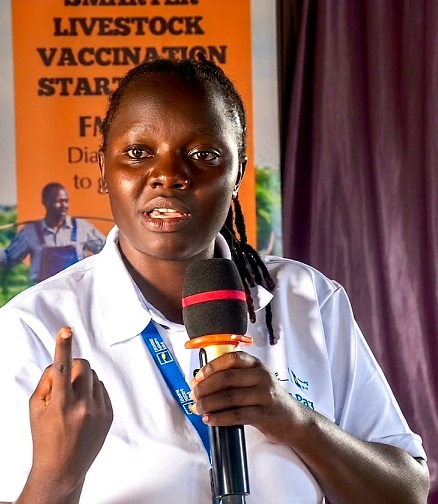
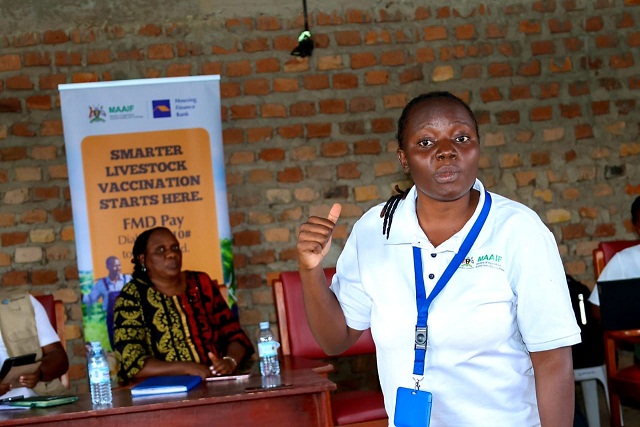
HFB Official trains farmers how HFB Vaccipay works
While awareness of livestock vaccination continues to grow, access and affordability can sometimes determine whether farmers are able to vaccinate their animals on time. Recognising this gap, Housing Finance Bank is supporting MAAIF’s efforts by providing convenient payment options that enable farmers to participate in the vaccination programme without disrupting their farming activities.
Through HFB VacciPay, farmers can register at MAAIF district offices, any Housing Finance Bank branch or through the Bank’s agent network. Payments can be made via USSD 22510# for farmers using feature phones or through Housing Finance Bank Agents equipped with smart devices that support the Bank’s web-based payment platform. This ensures farmers across different regions can access the service through channels that are convenient and familiar to them.
Speaking about the initiative, Ag. Head of Business and Institutional Banking, Joel Mastiko, said, “The cost of preventing disease is almost always lower than the cost of recovering from an outbreak. Yet many farmers are forced to postpone essential vaccinations because the money is needed elsewhere. By making it easier for farmers to access financing and payment solutions for livestock vaccination, we are helping them protect an asset that supports their livelihoods, families and future investments.”
He added, “Every healthy herd represents more than just livestock; it represents income, resilience and opportunity for farming communities. Supporting initiatives that strengthen animal health is part of our broader commitment to developing practical financial solutions that respond to the real needs of Ugandans.”
The vaccination campaign continues to expand across the region, with upcoming activations scheduled in Amuru on 10 August, Nwoya on 11 August, Zombo on 12 August, Nebbi on 13 August and Pakwach on 14 August. These engagements will extend access to vaccination services for more farmers and further support efforts to protect livestock and strengthen agricultural communities.
Housing Finance Bank continues to champion financial inclusion by creating solutions that enable individuals, businesses and communities to participate in Uganda’s economic growth. Through partnerships such as the MAAIF livestock vaccination campaign, the Bank is contributing to stronger agricultural value chains, improved farmer resilience and sustainable national development.
Singer Ava Peace believes Uganda’s music industry has experienced a slow year due to the country’s political activities, saying the general elections shifted public attention away from entertainment.
Speaking in an interview with Galaxy TV, the singer explained that the industry has struggled to maintain momentum because much of the country’s focus was on politics at the beginning of the year.
According to Ava Peace, both musicians and fans have felt the impact, resulting in a quieter period for the entertainment sector.
“The year hasn’t been good to politicians than to musicians. There has been no focus on the music, but we pray things become easy and we get back to doing music,” she said, expressing hope that the industry will recover as the political season fades.
Ava Peace also dismissed claims that Ugandan music is no longer making an impact beyond the country’s borders. She pointed to the international success of her own music, revealing that one of her songs recently trended in Fiji.
She further cited the achievements of legendary acts such as Radio and Weasel, who earned BET recognition, Eddy Kenzo, who won a BET Award, and Jose Chameleone, who continues to perform across the region, including in Tanzania.
The International Crimes Division of the High Court has sentenced former Guantanamo Bay detainee Jamal Kiyemba, also known as Abdullah or Tonny Kiyemba, to six years’ imprisonment after convicting him of soliciting or inviting support for the Allied Democratic Forces (ADF), a designated terrorist organisation.
In her sentencing decision delivered on Tuesday, Justice Susan Okalany ordered that the four years, two months and 19 days Kiyemba has already spent on remand be deducted from the sentence, leaving him with a remaining prison term of one year, nine months and 11 days.
Kiyemba had been charged with three offences under the Anti-Terrorism Act: rendering support to a terrorist organisation, belonging to or professing to belong to a terrorist organisation, and soliciting or inviting support for a terrorist organisation. But he was acquitted of the first two charges, and found guilty of soliciting support for the ADF.
The court held that the prosecution had failed to prove that he rendered material support to the group or that he belonged to it, but established the offence of solicitation.
During sentencing, Chief State Attorney Jacquelyn Okui argued that the offence was serious because it endangered national security, public safety and public order. She told the court that the ADF has been responsible for killings, abductions, destruction of property, displacement of civilians and widespread fear in Uganda.
Okui further submitted that terrorist organisations rely on external support to sustain their operations and that encouraging such support facilitates terrorism. She noted that Kiyemba committed the offence at Kampala’s Old Taxi Park, a busy public place, and urged the court to impose a custodial sentence of at least seven years to deter similar conduct.
In mitigation, defence lawyers Musa Kabega and Faisal Balikurungi described Kiyemba as a 47-year-old first offender, husband and father of seven children who had served as a cleric at Masjid Taqwa and was the sole breadwinner for his family before his arrest.
The defence told the court that Kiyemba had expressed genuine remorse, undergone treatment for bipolar disorder while in custody and had been rehabilitated during more than four years on remand. Counsel also argued that there was no evidence his actions resulted in recruitment, financing or any act of violence linked to the ADF.
The defence further urged the court to consider Kiyemba’s lengthy history of detention without conviction. The court heard that he spent six months in prison after his 2013 arrest before obtaining mandatory bail, another seven months on remand following a 2014 arrest, and four years and seven months in custody after a 2015 arrest before the charges were withdrawn.
The court also heard that Kiyemba had previously spent more than four years at the United States detention facility at Guantanamo Bay without being convicted and was later issued a clearance certificate.
Justice Okalany said the earlier arrests and withdrawn charges could not be treated as evidence of criminal conduct or aggravating factors. Instead, she said they demonstrated the exceptionally long periods Kiyemba had spent in detention without conviction and were therefore relevant to his personal circumstances during sentencing.
In determining the sentence, the judge observed that soliciting support for a terrorist organisation is inherently serious because it can facilitate terrorism and threaten national security. She added that committing the offence in a crowded public place heightened its gravity.
However, the court found that the offence arose from a single incident and that there was no evidence Kiyemba recruited members, raised funds, provided material support or committed acts of violence on behalf of the ADF. Justice Okalany also considered his status as a first offender, his family responsibilities, his remorse and his mental health condition as mitigating factors.
After balancing the seriousness of the offence against the mitigating circumstances and the lengthy period already spent in custody, the judge concluded that a longer custodial sentence was unnecessary. She therefore imposed a six-year prison sentence effective from the date of conviction and directed that the period Kiyemba spent on remand from May 12, 2022, to July 29, 2026, be credited in accordance with the law.
Before concluding the proceedings, Justice Okalany addressed an administrative error involving two detention warrants held by the Uganda Prisons Service under separate criminal case numbers. She explained that the duplication resulted from a mistake at Buganda Road Chief Magistrate’s Court, where the same case had inadvertently been assigned two different case numbers.
The judge noted that the error had been corrected during committal proceedings in December 2022 and directed the Uganda Prisons Service to recognise that Kiyemba has only one case before the International Crimes Division.
Kiyemba has the right to appeal both his conviction and sentence before the Court of Appeal within 14 days.
GOT A HOT STORY? LET US KNOW!
Got breaking news, explosive secrets, or hard evidence?
Two years after their highly publicized departure from Theron Music left their music career hanging in the balance, Kataleya and Kandle have revealed the song they credit with bringing them back into Uganda’s music conversation.
The duo says there was a point when they genuinely questioned whether they would ever recover from the uncertainty that followed their exit from the record label.
But that changed with Tompa.
Speaking about the song, Kataleya and Kandle described it as the breakthrough they desperately needed at a time when they were trying to rebuild both their confidence and their careers.
According to Kandle, the collaboration with Vinka only happened after several failed attempts to interest her in other songs.
“We sent her a few songs but she didn’t like any of them,” she recalled. “We went back to the studio and created Tompa. When she heard it, she immediately loved it and asked us to record it properly.”
What followed became one of the biggest songs of the year.
The collaboration has since attracted more than 1.4 million YouTube views, introducing the duo to a new wave of listeners while reminding old fans why they had become one of Uganda’s most exciting female acts.
For Kataleya, the song represented much more than commercial success.
“We had gone through a difficult time and Tompa helped bring us back,” she said. “We are grateful to Vinka because she believed in the song and made the collaboration easy.”
The pair also praised Vinka’s professionalism and enthusiasm in the studio, saying her positive attitude made the recording process smooth despite the pressure they were under.
Having rebuilt their momentum, Kataleya and Kandle are now looking ahead rather than behind. The trio are expected to reunite on stage when they perform together at Vinka’s upcoming concert at Lugogo Cricket Oval, bringing full circle a collaboration that helped relaunch the duo’s career.
This angle focuses less on gratitude to Vinka and more on the duo’s resilience and comeback, making it feel like a stronger feature for an entertainment page.
Don’t want to miss out on any story? For updates on all Sqoop stories, follow this link on Telegram: https://t.me/Sqoop
Peter Okoye, popularly known as Mr. P, has become emotional while reflecting on one of the most painful chapters of his life, opening up about how his then girlfriend, Lola, became pregnant when he was 27 and the fallout that followed within his family.
The former P-Square singer shared the story in a recent video posted on his Instagram page, explaining that he chose to announce the pregnancy himself because he did not want someone else to break the news first.
According to Mr. P, he made the announcement during the Soundcity Awards shortly after P-Square received an award.
When I was 27 years old, my girlfriend then, Lola, became pregnant. I did not want the news to break from someone else, so I decided to announce it myself. We attended the Soundcity Awards, and after receiving the award, I dedicated it to God Almighty, our fans, and everyone who had supported us. Lastly, I dedicated it to the mother of my unborn child.
Mr. P alleged that the announcement immediately caused tension behind the scenes, claiming his elder brother, Jude Okoye, and his twin brother, Paul Okoye, also known as Rudeboy, strongly opposed his decision and feared it would damage the group’s career.
He went on to accuse them of trying to convince him to end the pregnancy and making further allegations against Lola.
Immediately after that, Jude and Paul walked out, saying my announcement would ruin our career. They insisted that Lola should abort the baby. They even forged an email to frame her, claiming the child was not mine and accusing her of using the pregnancy to trap me.
Mr. P’s latest claims add another chapter to the long-running public dispute involving the Okoye brothers, which has seen both sides make a series of allegations over their personal and professional relationship.
At the time of publication, Jude and Paul had not publicly responded to Peter’s latest allegations.
About UGNEWS24
UGNEWS24 is a Uganda local news service, a product of
SOLAVIA GROUP LIMITED,
Reg. No. 80048169153974.