The UNMF president took to social media to reflect on the federation’s journey, sharing an infographic that highlighted what he considers its biggest achievements since 2023.
For Kenzo, the biggest victory has been bringing musicians under one umbrella while pushing reforms that he says are beginning to reshape Uganda’s music industry.
He pointed to the amendment of the Copyright and Neighbouring Rights Act, the establishment of regional musicians’ SACCOs and closer collaboration with government as milestones that have strengthened the industry’s future.
Kenzo also credited UNMF with expanding its membership, organising training programmes and supporting systems designed to improve copyright management and royalty collection.
These achievements are a testament to the power of unity, purpose and collective action. Together, we are building a sustainable and prosperous future for every musician in Uganda.
Looking ahead, Kenzo challenged musicians to build on that momentum.
Since the start of UNMF, the journey has been fruitful. Look at some of the achievements we have accomplished. This should inspire us to take on more responsibilities to ensure we reach the promised land where all creatives are earning fairly from their works.
His message arrives as UNMF continues to attract mixed opinions across the industry.
While many musicians support the federation’s work, others, including Liam Voice, Lutty Neika, and Vyper Ranking, say they still do not fully understand its role and have chosen to stay away.
Since the start of UNMF the journey has been fruitful and look at some of the achievements we have accomplished.
This should inspire us to take on more responsibilities to ensure we reach the promised land where all creatives are earning fairly from their works. pic.twitter.com/5b3JYjYWCw
The period, which they have often described as “depressing,” seemed destined to rob them of their promising music career until Vinka stepped in with a collaboration that returned them to the music charts.
“We reached out to her, sent a few songs, but she didn’t like them. So we went back to the studio and made Tompa, sent it to her, and she liked it. She asked that we record that, and we returned to the studio. She was very vibrant in the studio when we recorded the song; we did the video. It was easy and fun,” says Kandle.
Tompa has now surpassed 1.4 million views on YouTube and is one of their most-watched videos on the app. They are grateful for the feat.
Speaking about working with the Swangz Avenue star, Kataleya noted how Vinka is an energetic artist who likes what she does.
“We want to thank Vinka; she really made it easy for us coz we had issues around that time, but she gave us a song that brought us back in the industry. We’re really grateful,” Kataleya added.
The duo cannot wait to perform with her again during her #VinkLiveAndLoud concert scheduled for 21st August at Lugogo Cricket Oval.
She loves what she does, she’s energetic, she’s a nice person. The first time we performed with Vinka was magical and it’s going down again on 21st (August).
At least 14 people have died following a fatal road crash involving a taxi and a sand truck in Lwera Swamp, Kalungu District, along the Kampala–Masaka Highway.
According to a statement issued by the Uganda Police Force, the accident occurred on the night of Monday, 3 August 2026, at around 11:00pm at Kamunga Trading Centre in Lwera Swamp.
The crash involved a Toyota Hiace taxi registration number UA 662AQ and a Sino truck registration number UBS 040F that was transporting sand.
Police said all the 14 victims who died on the spot were occupants of the taxi, while four other people sustained injuries. The injured victims—two from each vehicle—were rushed to Masaka Regional Referral Hospital for medical attention.
Police officers visited the scene and commenced investigations to establish the exact circumstances surrounding the crash.
The driver of the truck is reported to have fled the scene, and police said efforts are underway to trace and apprehend him.
The latest incident adds to growing concerns over road safety on the Kampala–Masaka Highway, one of the country’s busiest transport routes, where fatal crashes have often been linked to reckless driving, speeding and poor road discipline.
Police have continued to urge motorists to exercise caution, observe traffic rules and prioritise the safety of all road users.
Do you have a story in your community or an opinion to share with us: Email us at Submit an Article
Kampala — dfcu Bank has projected a pre-tax loss of Sh26.3 billion for the first six months of 2026, highlighting mounting pressure from rising operating expenses and increased loan impairment charges, despite recording strong growth in customer deposits, lending and its overall balance sheet.
According to the bank’s unaudited half-year financial results, the projected pre-tax loss of Sh26.3 billion is an improvement from the Sh39.7 billion pre-tax loss recorded during the same period last year but still underscores the profitability challenges facing the lender.
After accounting for an income tax credit of Sh10.5 billion, the bank expects to post a net loss after tax of Sh15.8 billion.
The financial results reveal a mixed performance, with business growth remaining strong while earnings continue to come under pressure.
Customer deposits increased significantly by Sh410 billion, rising from Sh2.46 trillion a year ago to Sh2.87 trillion by June 30, 2026. The bank said the increase has strengthened its funding base and reflects continued customer confidence.
At the same time, loans and advances to customers grew by 21%, reaching Sh1.44 trillion from Sh1.19 trillion in the corresponding period last year, demonstrating sustained demand for credit from both households and businesses.
The expansion in lending, however, came at a cost.
The bank set aside Sh11.8 billion as impairment allowances on loans and advances, reflecting heightened caution over asset quality as it continues to expand its loan book. Operating expenses also rose sharply to Sh230 billion, up from Sh150.4 billion in the previous year, placing additional strain on profitability.
Despite the projected loss, dfcu’s financial position remains solid.
Total assets expanded to Sh3.94 trillion, while liquid assets stood at Sh2.18 trillion, including Sh662.7 billion in cash and cash equivalents. Shareholders’ equity reached Sh755.4 billion, with the bank maintaining a 27% capital ratio, well above regulatory requirements.
dfcu Chief Executive Officer Charles Mudiwa said the institution remains well-capitalised and liquid enough to continue supporting customers and financing economic activity.
The results indicate that while dfcu continues to grow its balance sheet through higher deposits and increased lending, restoring profitability remains a key priority as management works to contain costs, improve efficiency and maintain the quality of its loan portfolio.
The half-year performance paints the picture of a bank that is expanding its market presence but still navigating the financial pressures associated with rapid business growth and a challenging operating environment.
Do you have a story in your community or an opinion to share with us: Email us at Submit an Article
Sheebah Karungi has publicly applauded fellow singer Lydia Jazmine, praising her resilience, discipline and determination after years of building a successful music career.
In a message shared on social media, Sheebah reflected on their journey, saying they entered the music industry around the same time and worked with many of the same people.
She said watching Lydia grow into the woman and artist she is today has been inspiring.
Looking beyond the fame, Sheebah acknowledged the challenges many female artists face while trying to succeed in an industry largely dominated by men.
She said she understands the sacrifices, disappointments, loneliness and pressure that come with the journey, making Lydia’s success even more meaningful.
I celebrate your resilience. I celebrate your discipline. I celebrate your consistency. I celebrate your courage. I celebrate your kindness too. Some people mistake kindness for weakness. Some people take good hearts for granted. But never let this world harden you. Your kindness is one of the reasons you’ve remained so deeply loved.
Sheebah also commended Lydia for supporting fellow artists without expecting anything in return, saying that generosity reflects the kind of person she has remained despite her success.
More than anything, however, Sheebah admired Lydia’s determination to keep investing in herself, even when others doubted her.
And today, you stand as a woman who can proudly say, “I built this.” Not many people understand what it means to build something from absolutely nothing. They see the lights, the applause, the success but they never see the sleepless nights, the disappointments, the sacrifices, the fear, or the faith it took to get there.
Sheebah ended her message by encouraging Lydia never to question her worth, reminding her that every achievement came through hard work, persistence and grace.
As anticipation continues to build for Vinka Live & Loud, organisers have revealed why fans will need to arrive much earlier than they normally would for a concert.
Scheduled for Friday, 21st August 2026 at Lugogo Cricket Oval, the event will open its gates at exactly 3:00 PM, while the main show will begin promptly at 7:00 PM.
According to the organisers, the decision to open the venue four hours before the headline performance is intentional.
Unlike a typical concert where audiences arrive shortly before the main act, #VinkaLiveAndLoud will be curated as a full-day lifestyle and entertainment experience, giving fans much more than just live performances.
From the moment the gates open, guests will be welcomed into a vibrant concert atmosphere featuring immersive brand experiences, interactive consumer activations and exciting showcases from some of Uganda’s leading brands.
Fans will have the opportunity to engage in games, win giveaways, sample products and enjoy unique experiences throughout the afternoon.
Food lovers will also be spoilt for choice, with a carefully selected lineup of food vendors serving a variety of local favourites and contemporary cuisine. Whether attendees are looking for a quick snack or a full meal before the performances begin, there will be something for everyone.
The entertainment will extend beyond the main stage. DJs will keep the energy high, while dedicated lifestyle and hospitality zones will offer the perfect spaces for friends and families to relax, socialise and enjoy refreshing drinks as excitement builds towards the night’s performances.
Adding to the anticipation, organisers have also hinted that several surprise acts will perform before Vinka takes to the stage. While the identities of the guest performers remain a closely guarded secret, fans can expect exciting collaborations and memorable appearances that will make arriving early worthwhile.
Speaking about the concept behind the event, Mugerwa Robert, Events Manager at Swangz Avenue, said the goal is to create an experience that offers value from the moment fans enter the venue.
“This will not be your typical concert; it will be an all-day celebration of music, culture and lifestyle” said Mugerwa.
We’ve intentionally planned to open the gates at 3:00 PM because we want fans to experience everything we’ve curated from immersive brand activations and great food to refreshing drinks, live entertainment and exciting surprises.
We want people to come early, explore the venue, enjoy the atmosphere and be part of the full Vinka Live & Loud experience before the main show begins at exactly 7:00 PM.
The concert will mark a defining milestone in Vinka’s career as she headlines her first-ever solo concert after years of delivering chart-topping hits including Love Panic, Bailando, Thank God, Omukwano Gwo, All Over You, Chips Na Ketchup, Batuleke, Sirubala and many more.
Produced by Swangz Avenue, the company behind some of Uganda’s biggest live entertainment productions, Vinka Live & Loud will feature world-class stage production, spectacular lighting and sound, immersive visual effects and unforgettable moments designed to set a new benchmark for live entertainment in Uganda.
Tickets are currently on sale online or USSD *165*20# with Standard tickets at UGX 35,000, VIP tickets at UGX 85,000, and VVIP Tables of 8 at UGX 4,000,000.
Organisers are encouraging fans to secure their tickets in advance and arrive early to enjoy the complete Vinka Live & Loud experience.
With music, food, drinks, interactive experiences, surprise performances and world-class entertainment all planned from the moment the gates open, Vinka Live & Loud promises to be much more than a concert; it will be a full-day celebration that fans won’t want to miss.
Veteran actor, comedian, and educationist Dr. Philip Luswata has opened up about why he first ventured into the arts and entertainment industry.
He revealed that his initial motivation was to avoid returning to school.
Speaking during an interview, Luswata admitted that he believed a career in the creative industry would free him from academics.
However, he soon discovered that succeeding in the profession demanded even more reading, research, and continuous learning than he had ever imagined.
I joined the arts and entertainment industry with the aim that I didn’t want to return to school. However, I found out that it needed more reading and studying.
Nearly three decades into his illustrious career, Luswata says the very industry he thought would keep him away from books has instead pushed him to pursue higher education.
He revealed that he is now in the final stages of completing his PhD.
I’m now pursuing and nearing the completion of my PhD. Throughout my life, I have been forced to study. Even in my old age, I’m still studying. I didn’t understand what I had joined. I probably would have become an engineer, but in this field where we use our brains a lot, you have to think differently. Whatever you think about, you must first read, understand it, and master it.
Luswata also challenged the common perception that the entertainment industry is an easy career reserved for academic failures, insisting that such beliefs are misguided.
Sometimes I wonder when people say this industry is easy and only for failures because I believe that perception is completely wrong.
KAMPALA: The Ministry of Energy and Mineral Development came under intense scrutiny on Friday after Parliament’s Public Accounts Committee (PAC) questioned glaring inconsistencies in the accounting for Shs17.3 billion in government counterpart funding under the Uganda Rural Electrification Access Project (UREAP), with officials struggling to explain conflicting figures on compensation payments, project accounts and ministry records.
The heated hearing, chaired by Kassanda North MP Patrick Nsamba Oshabe, examined the Auditor General’s report for the financial year ending June 30, 2025, as senior ministry officials attempted to reconcile differences between the Auditor General’s findings, the project’s financial statements and the ministry’s own submissions on how the funds were utilised.
At the centre of the controversy was government counterpart funding under the African Development Bank-supported Uganda Rural Electrification Access Project, a flagship programme intended to expand electricity access across the country.
According to the Auditor General, government approved compensation worth about Shs34 billion for Project Affected Persons (PAPs). However, by the time of the audit, only approximately Shs14.6 billion, representing about 40 percent of the approved compensation, had actually been paid.
Ministry officials told the committee that the government counterpart funding was primarily intended to compensate landowners affected by electricity infrastructure works, while a small portion financed biodiversity restoration activities, including tree planting.
However, committee members immediately pointed to the project’s financial statements, which indicated that the entire Shs17.3 billion allocated by government had already been spent, despite records showing that only Shs14.6 billion had actually reached the Project Affected Persons during the audit period.
The contradiction immediately raised red flags.
“Money cannot simply appear without a purpose,” Oshabe told ministry officials, insisting that every shilling appropriated by Parliament must be fully accounted for.
As pressure mounted, ministry officials altered their explanation, saying part of the counterpart funding had also financed operational activities related to compensation, including property valuation, field verification and facilitation of compensation teams.
The explanation failed to convince the committee.
“You told us 99 percent of this funding was meant for compensation. Now you are changing the story,” Oshabe said.
The hearing became even more explosive after ministry officials disclosed that the African Development Bank had authorised the use of an additional Shs13.48 billion from uncommitted loan funds to finance compensation after government delayed releasing part of its counterpart contribution.
Committee members observed that when the government counterpart funding and the additional donor financing were combined, nearly Shs30 billion had been available for compensation.
Yet the Auditor General’s report still showed that only Shs14.6 billion had actually reached the Project Affected Persons during the audit period.
“Something is not adding up,” Oshabe observed. “You have government funds, donor funds, yet only a fraction reached the Project Affected Persons.”
Eng. Irene Pauline Bateebe maintained that the Auditor General’s report reflected the project’s financial position as of June 30, 2025, and argued that additional compensation payments had been made before the project officially closed on March 31, 2026.
The committee, however, questioned why the ministry’s written responses submitted to Parliament still reflected the earlier figures instead of updated project accounts.
The hearing took another dramatic turn when ministry officials revealed that about 32,000 Project Affected Persons remained uncompensated even after the project’s completion.
Officials further disclosed that government has since sought an additional Shs33 billion loan to settle the outstanding compensation claims.
That revelation triggered another round of tough questions.
“Government committed itself to finance this component. Why are you borrowing again instead of meeting your own obligation?” Oshabe asked.
Committee members also questioned how the number of Project Affected Persons increased from an estimated 37,000 to more than 61,000 during project implementation, saying the sharp increase raised concerns about project planning, valuation and compliance with environmental and social safeguards.
Throughout the hearing, Oshabe reminded accounting officers that Parliament’s oversight powers extend beyond issues specifically identified by the Auditor General.
“Parliament is not limited to questions raised by the Auditor General. We are entitled to ask how public money was spent,” he said.
He also criticised ministry officials for appearing before the committee without detailed expenditure schedules despite managing a project worth more than Shs453 billion.
Committee members further questioned why senior project managers were unable to clearly explain how grant funds were allocated for the procurement of electricity meters, cables and connection materials.
The compensation dispute also raises broader questions about compliance with environmental and social safeguards governing infrastructure projects financed by multilateral lenders such as the African Development Bank, where timely compensation of affected communities is a key requirement before project implementation begins.
The committee directed the Ministry to submit a comprehensive reconciliation detailing the utilisation of the Shs17.3 billion government counterpart funding, the actual compensation paid to Project Affected Persons, operational expenditures charged against the counterpart funds, biodiversity restoration costs and the justification for seeking an additional Shs33 billion loan after the project’s closure.
The grilling follows a string of damaging findings contained in the Auditor General’s report on the Uganda Rural Electrification Access Project.
The audit found that by June 30, 2025, total cumulative donor disbursements had reached 95 percent, while Government of Uganda counterpart funding stood at only 50 percent.
Although the project achieved 100 percent completion of Medium and Low Voltage infrastructure across 13 lots, only 98,584 of the planned 141,451 electricity customer connections had been completed, representing only 69 percent implementation.
The Auditor General further reported that the project had Shs29.49 billion available during the year under review but spent only Shs15.59 billion, translating into an absorption rate of just 53 percent.
The report also confirmed that out of 37,501 Project Affected Persons approved by the Chief Government Valuer, only 15,096 (40 percent) had been compensated by the end of the 2024/2025 financial year, largely because of underperformance in government counterpart funding.
The wider audit of the Ministry of Energy and Mineral Development painted an equally troubling picture.
The Auditor General reported that the ministry had long outstanding receivables amounting to Shs128 billion, some dating back to the 2021/2022 financial year.
The ministry’s domestic arrears had exploded by more than 1,000 percent, rising from Shs7.14 billion to Shs80.11 billion, largely due to historical rural electrification liabilities that had previously not been recognised in the financial statements.
Auditors also noted that the ministry had reported mineral resources worth Shs35.57 trillion, although the estimates were based on geological information dating back to the 1920s, with validation still ongoing.
The report further uncovered several procurement irregularities, including failure to prepare multi-year procurement plans, non-compliance with reservation schemes, failure to conduct market assessments and splitting procurements.
In the mining sector, auditors found delays in converting 10 mining licences, while eight mineral rights applicants were granted licences without undergoing adequate evaluation. Another 114 licence applications took more than 100 days to be processed.
The report also found that 17 traders were buying and selling minerals without mineral rights or valid mineral dealer’s licences, while 14 exploration licence holders were carrying out mining operations beyond the activities permitted under their licences.
Auditors further established that weighbridges and related accessories, procured and delivered in November and December 2021, had still not been installed by October 2025, representing a delay of almost four years.
The report further criticised the ministry for lacking a recognised national reporting code for mineral resources, an accredited registry of competent persons and a standardised framework for reporting mineral resources.
Auditors also identified weaknesses in the management of ministry assets, including under-utilised facilities, non-functional beneficiation centres, lack of documented monitoring procedures and untitled government land.
Financially, the ministry received only Shs724.33 billion out of an approved budget of Shs1.176 trillion, representing 62 percent budget performance, although it spent 99.3 percent of the funds released.
Performance was equally poor.
Out of 23 sampled outputs, 19 (83 percent) were only partially implemented, one output (4 percent) was not implemented at all, while three outputs (13 percent) could not even be assessed because they lacked planned activities, performance targets or measurable indicators.
The Auditor General also found that under the Rural Electrification and Connectivity Project, several engineering, procurement and construction (EPC) works were reported as completed even though Resettlement Action Plan (RAP) implementation remained below 100 percent.
The report further revealed that petroleum facilities continued receiving completion certificates and operating licences despite being incomplete and operating below minimum standards, while 245 petroleum facilities were operating without valid operating licences or construction permits.
Finally, although the ministry had already reduced its electricity connection target from the national requirement of 300,000 to 226,890 because of funding gaps, only 39,701 electricity connections (17.5 percent) had actually been completed, leaving 187,189 planned connections unfinished.
GOT A HOT STORY? LET US KNOW!
Got breaking news, explosive secrets, or hard evidence?
Ugandan music legend Jose Chameleone has become the first non-Tanzanian artist to headline the prestigious Bongo Flava Honors, capping the milestone with a special recognition for his decades-long contribution to East African music.
The award-winning singer received the honour on Friday night during the annual celebration at The Dome in Masaki, Dar es Salaam, where thousands of music lovers gathered to celebrate artists whose work has shaped the region’s entertainment industry.
Founded by Tanzanian hip-hop pioneer and politician Joseph Mbilinyi, popularly known as Sugu (formerly Mr II), Bongo Flava Honors pays tribute to musicians whose influence has transcended generations. The event has grown into one of Tanzania’s most respected music platforms, celebrating artistic excellence through live performances rather than playback shows.
Chameleone’s appearance marked a historic first for the event, making him the inaugural foreign artist to headline the concert since it was established.
Known for timeless hits that have dominated East African airwaves for more than two decades, Chameleone’s recognition highlighted the lasting appeal of his music beyond Uganda’s borders and reaffirmed his place among the region’s most influential performers.
Over the years, Bongo Flava Honors has celebrated some of Tanzania’s biggest music icons, including Lady Jaydee, Professor Jay, TID, Mr Nice, Juma Nature and Matonya, making Chameleone’s inclusion a significant acknowledgement of his impact on the regional music industry.
The emotional moment was further amplified by a standing ovation from the audience, reflecting the strong connection the singer has maintained with Tanzanian fans throughout his career.
Following the ceremony, Chameleone’s mother, Prossy Mayanja, thanked the people of Tanzania for the love and support they have consistently shown her son over the years.
The recognition comes at a time when Chameleone continues to cement his legacy as one of East Africa’s most enduring music exports, with a catalogue of hits that remains popular across the region decades after launching his career.
Don’t want to miss out on any story? For updates on all Sqoop stories, follow this link on Telegram: https://t.me/Sqoop
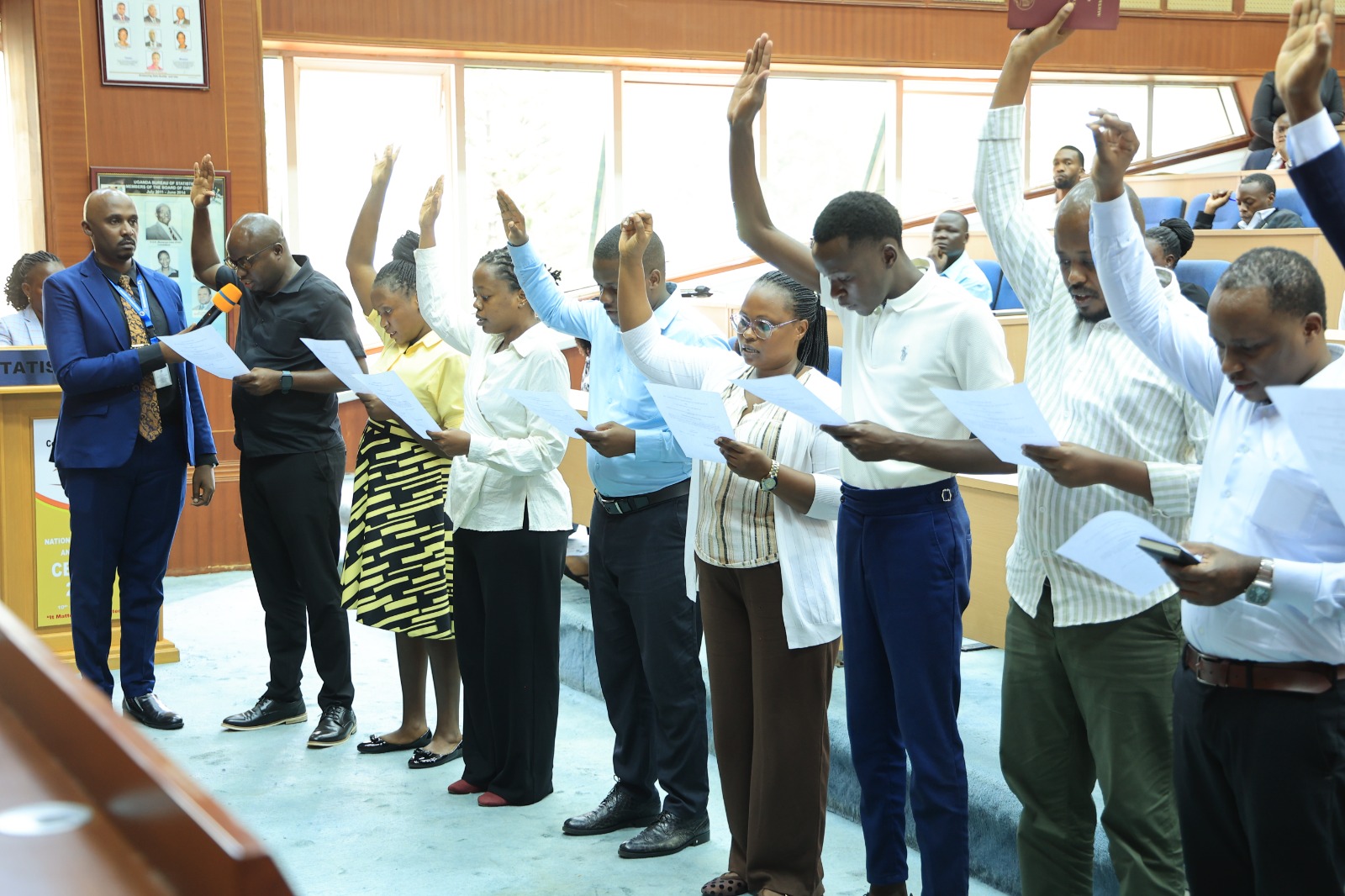
KAMPALA – Expect a knock on your door! The Uganda Bureau of Statistics (UBOS) has unleashed 80 freshly trained field data collectors to fan out across the country for the 9th Uganda National Household Survey (UNHS) 2026/27.
The recruits completed a tough 15-day training before being commissioned for the massive exercise, which will run for 12 months and gather information from households nationwide.
To make the mission smoother, the officers have been split into 16 teams, each headed by a Field Supervisor. UBOS says the teams were carefully arranged according to language skills to ensure easy communication with families in different regions.
But before the teams hit the road, UBOS Executive Director Dr. Chris N. Mukiza fired a tough warning: keep people’s secrets, record the truth, and don’t tamper with the data.
“You must keep all information confidential. Do not disclose your data sources,” Dr. Mukiza warned, reminding the officers that the Uganda Bureau of Statistics Act, 1998 protects the confidentiality of every respondent.
He also cautioned them against altering information collected from households.
“Record the information exactly as it is given. Don’t change anything. The data you collect will guide government planning and improve the lives of Ugandans,” he stressed.
Dr. Mukiza didn’t stop there. He warned that any officer who performs poorly, breaks discipline, or manipulates data risks being shown the exit door and could be blacklisted from future UBOS surveys.
The nationwide survey will collect crucial information on education, health, housing, food security, employment, and household living conditions. The findings will help government measure poverty, monitor economic and social trends, and shape policies aimed at improving the welfare of Ugandans.
The exercise builds on the 8th Uganda National Household Survey, whose report was released in May 2025. UBOS says the new round will provide fresh and reliable statistics to support evidence-based planning, policy formulation, and national development.
GOT A HOT STORY? LET US KNOW!
Got breaking news, explosive secrets, or hard evidence?