Blog

  • KADAGA FUMES! “Some Negotiators Don’t Read Deals”…As Regional Currency Plan Crawls

    KADAGA FUMES! “Some Negotiators Don’t Read Deals”…As Regional Currency Plan Crawls

    Uganda has entered into debt, trade and investment agreements that have disadvantaged the country because of poor decisions by technocrats and policymakers involved in the negotiations, First Deputy Prime Minister Rebecca Kadaga has said.

    Kadaga says some deals signed for the country reflect either a lack of knowledge on the issue or that the negotiators sign without reading through what they are committing the country to. This, according to her, has cost the country many opportunities, as well as securing costly loans. She called on economic and trade think-tanks like SEATINI Uganda to help the government to build a pool of capable negotiators.

    Kadaga was speaking at the event to mark 30 years of SEATINI in Uganda, and the commemoration of economist Yash Tandon’s contribution to national, regional and global economic equity efforts. The events are under the theme: Advancing Africentric Alternatives for Equitable and Sustainable Development. It is aimed at advancing the continent’s move for independence from the Western-backed decisions that influence the global financial architecture.

    Kadaga, also Uganda’s Minister for East African Community Affairs, also called for support for her view on a regional currency. She wants this expedited, but says the pace is being affected by the bureaucratic processes of the East African Community.

    Among the considerations is the harmonisation of monetary policies across all the eight member states and the convergence criteria.  The primary targets under the convergence criteria are the 8 percent inflation target, fiscal deficit within 3 percent, a gross public debt cap at 50 percent of the GDP, and a foreign reserve cover of not less than 4.5 months of import cover.

    There are also several secondary targets, and Kadaga says it might take forever for all the countries to simultaneously meet these targets. She prefers the European Union model where the euro was launched, and countries played catch-up as they continued using their currencies alongside the EU currency.

    At their last meeting in Uganda last week, the EAC monetary affairs committee agreed on 2031 as the new deadline for a single currency. The single currency is aimed at facilitating cross-border trade, which Kadaga says is difficult under the current conditions and even expensive due to currency conversions.

    She also called for faster abolition of trade barriers across the borders.

    In his view, Dr Ezra Suruma, presidential advisor and former Finance Minister, said the problem with regional integration is the love for sovereignty, where each country wants to cling to its interests like currency. According to him, this is not only in the EAC or Africa, but that all regional economic blocs encounter it as a challenge. This makes it difficult for one country to influence things at the regional level.

    But Suruma, who was among the negotiators for the revival of the EAC, advises that Uganda should continue making policies that cater for its interests, while also taking into consideration the need to enhance regional integration.

    On debt and capital availability, Suruma says this will continue to be a challenge for as long as capital is still controlled by the West, which itself is capitalistic by nature. And this, he says, does not only affect state borrowing but also the local private sector, which wants to borrow from the domestic market.

    Suruma explained how he was sacked by the government as Chairman/Managing Director at the then Uganda Commercial Bank for opposing its privatisation against the Western (IMF and World Bank) backed government position of privatising all state parastatals. He says that the only solution to capital is having a strong local financial industry independent of Western capitalist influence.

    He says Africa must have the knowledge, capacity, and confidence to define and pursue its own development pathway. Suruma commended SEATINI’s 30-year contribution to strengthening Africa’s voice in global economic governance. He emphasized that lasting economic transformation depends on building productive economies, creating jobs for young people, and ensuring Africa shapes, not merely responds to, the global trade agenda.

    SEATINI Uganda Executive Director Jane Nalunga reaffirms the organisation’s commitment to advancing Africentric alternatives for equitable and sustainable development through research, policy influence and strategic partnerships. This, she says, is more important today as the countries of the world are becoming more inward-looking, with each one seeking to influence the world order to their own benefit.

    According to her, collaboration amongst all African regional economic blocs will be vital to strengthen the negotiation capacity of the continent as it seeks African solutions to its own needs.

    David Luke, Director, Firoz Lalji Institute for African at the London School of Economics and Political Science, says the multiple crises and volatility facing countries today mean poorer regions like Africa must rethink their economic and political strategies.

    “The consensus era that followed the Second World War — with its norms of multilateralism, non-discrimination, and special treatment for developing countries including development aid — is giving way to a world shaped by contestation, fragmentation, and strategic rivalry,” he says, adding that emerging tensions related to national economic security considerations are reshaping the rules-based global order, including the multilateral trading system itself.

    “The role of the WTO has diminished as a forum for the negotiation of trade agreements. Its dispute settlement system is no longer effective.” The commemoration also featured the launch of the Yash Tandon Trade and Development Knowledge Hub, a continental platform for Africentric policy research, knowledge exchange and policy engagement. Also launched was the Africentric Trade and Development Policy Academy, aimed at strengthening Africa’s capacity in trade, fiscal and investment policy leadership while nurturing “a new generation of progressive thinkers and practitioners”.


    GOT A HOT STORY? LET US KNOW!

    Got breaking news, explosive secrets, or hard evidence?

    Email us: redpeppertips@gmail.com

    We accept tips, documents, videos, photos, and recordings—the more evidence you have, the better.

    CONFIDENTIALITY IS OUR TOP PRIORITY. SOURCES ARE ALWAYS PROTECTED!

    About Post Author

  • ‘Nassanga Remix’ returns to YouTube after copyright mix-up – Sqoop

    ‘Nassanga Remix’ returns to YouTube after copyright mix-up – Sqoop

    Kalifah Aganaga’s chart-topping Nassanga Remix has been reinstated on YouTube after a copyright claim that briefly took the song off the platform was traced to an accidental Content ID registration.

    The remix, which features Winnie Nwagi, Weasel Manizo and Lil Pazo Lunabe, had become one of Uganda’s fastest-growing releases, amassing more than one million YouTube views within two weeks of its release before it suddenly disappeared from the platform.

    Its removal sparked widespread speculation among fans, with many questioning whether the hit song had fallen victim to a copyright dispute.

    It has since emerged that the takedown resulted from an error by deejay Junior Hassa, who had uploaded the song’s instrumental to YouTube and unknowingly registered it under the platform’s Content ID system.

    The registration mistakenly identified the original version of Nassanga Remix as infringing on Hassa’s upload, triggering an automatic copyright strike and the song’s temporary removal.

    Speaking in a phone interview with NRG Radio Uganda, Hassa apologised to Kalifah Aganaga and fans, insisting the incident was never intentional.

    “I thought they would not make the song come off as mine. I was not claiming the song’s copyright and I thought everything was okay. They called me saying that their song had received a strike. I removed the Content ID and the copyright claim. I do not have money to pay them, but I’m so sorry. Kalifah and his fans should forgive me,” he said.

    After learning of the mistake, Hassa removed both the Content ID claim and the instrumental from his account, allowing YouTube to restore the original video.

    The song has since returned to the platform, much to the relief of fans and the artists involved.

    The incident has also highlighted the growing importance of understanding YouTube’s Content ID system, which automatically detects copyrighted material and can issue claims or takedowns when ownership information is incorrectly submitted.

    With the copyright issue resolved, Nassanga Remix is expected to resume its impressive run on YouTube as it continues to gain traction among music lovers.

    Don’t want to miss out on any story? For updates on all Sqoop stories, follow this link on Telegram: https://t.me/Sqoop

  • PHOTOS: Media personality Tina Teise officially ties the knot with Paul Muhinda Nasasira

    PHOTOS: Media personality Tina Teise officially ties the knot with Paul Muhinda Nasasira

    PHOTOS: Media personality Tina Teise officially ties the knot with Paul Muhinda Nasasira – Matooke Republic
  • Bien sparks debate after questioning Uganda’s global music ambition – Sqoop

    Bien sparks debate after questioning Uganda’s global music ambition – Sqoop

    Kenyan singer and former Sauti Sol frontman Bien-Aimé Baraza has stirred debate after suggesting that Uganda’s thriving local music industry may be limiting its artistes’ drive to compete beyond the country’s borders.

    Speaking during a podcast, the award-winning musician argued that Uganda’s entertainment ecosystem is so strong domestically that many artists can sustain successful careers without feeling the need to pursue regional or international markets.

    According to Bien, a single hit song is often enough to keep a Ugandan artist in demand for performances across the country for an extended period.

    “In Uganda, one hit song can take an artist around the whole country. You have to be there to understand how that system works,” he said.

    Bien contrasted Uganda’s music scene with Kenya’s, where he said artists quickly exhaust performance opportunities in major cities such as Nairobi, Mombasa and Kisumu, forcing them to expand into other African markets much earlier in their careers.

    He further argued that the comfort of Uganda’s domestic market has, in some cases, slowed creative growth, with artists focusing more on producing music that resonates locally than creating records capable of competing on the continental or global stage.

    The remarks have generated mixed reactions online.

    Some commentators agreed with Bien’s assessment, arguing that Uganda’s vibrant nightlife and steady calendar of concerts provide musicians with enough opportunities to thrive without aggressively pursuing international audiences.

    Others, however, accused the Kenyan star of overlooking the progress Ugandan musicians have made across Africa, pointing to artists who have successfully built regional fan bases despite limited industry infrastructure and funding.

    The debate has also reignited broader conversations about what it takes for East African artistes to achieve global success, with some arguing that stronger investment in music export, distribution, management and cross-border collaborations is just as important as artistic ambition.

    Bien’s comments add to an ongoing discussion about whether East Africa’s music industries are doing enough to position their artists on the global stage, or whether strong domestic success has become both a blessing and a barrier to international growth.

    Don’t want to miss out on any story? For updates on all Sqoop stories, follow this link on Telegram: https://t.me/Sqoop

  • RETIRING BITATURE ON THE SPOT AS UMEME FREEZES DIVIDENDS! Shareholders Face Tough AGM After Sh223.6bn Loss…But Company Rules Out Winding Up, Plots Energy Comeback

    RETIRING BITATURE ON THE SPOT AS UMEME FREEZES DIVIDENDS! Shareholders Face Tough AGM After Sh223.6bn Loss…But Company Rules Out Winding Up, Plots Energy Comeback

    Business mogul Patrick Bitature is set to face shareholders for another term on the Umeme Limited board as the electricity distributor heads into a high-stakes Annual General Meeting (AGM) with no final dividend on the table after posting another massive financial loss.

    The company has officially announced that Bitature, who is retiring by rotation in line with the company’s Articles of Association, will seek re-election at the AGM slated for August 21, 2026, at Mestil Hotel.

    But the biggest blow for investors is the Board’s decision to freeze the final dividend for 2025, meaning shareholders will not receive any additional payout beyond the interim dividend already paid last year. The Board will ask shareholders to formally approve the decision during the meeting.

    The dividend freeze comes after Umeme reported a staggering Sh223.6 billion net loss for the year ended December 31, 2025, as the company’s electricity distribution concession ended on March 31, 2025, leaving it with only three months of operating revenue compared to a full financial year in 2024. Revenue plunged from over Sh2.3 trillion in 2024 to Sh530 billion in 2025.

    Despite the poor financial performance, the company says shareholders already benefited from an interim dividend of Sh222 per ordinary share, which was declared after Umeme received a partial government buyout payment of US$126.8 million (about Sh457.3 billion) in 2025. However, directors insist no further dividend should be declared until the company’s financial position improves.

    The AGM is expected to attract keen attention from investors because Umeme is now operating in a completely different environment following the handover of the national electricity distribution network to Uganda Electricity Distribution Company Limited (UEDCL).

    The company maintains that government has not fully paid the Buy Out Amount due under the concession agreement and has already commenced arbitration proceedings before the London Court of International Arbitration to recover what it says is the outstanding balance. Management says it remains focused on protecting shareholders’ interests through both arbitration and negotiations with government.

    Shareholders will also vote on the reappointment of Ernst & Young as external auditors for 2026 while authorising the Board to determine their remuneration.

    Although Umeme has exited electricity distribution, directors say the company is not winding up. Instead, it has streamlined operations and is exploring fresh investment opportunities in the energy sector using the expertise accumulated during its 20-year concession. Shareholders are expected to receive an update on these potential ventures during the AGM before any binding commitments are made.

    The company says that during its two decades of operation it invested US$856 million in Uganda’s electricity distribution network, increased customer connections from 290,000 to 2.2 million, cut energy losses from 38% to 16%, and significantly improved revenue collection and network reliability before handing over operations to government.


    GOT A HOT STORY? LET US KNOW!

    Got breaking news, explosive secrets, or hard evidence?

    Email us: redpeppertips@gmail.com

    We accept tips, documents, videos, photos, and recordings—the more evidence you have, the better.

    CONFIDENTIALITY IS OUR TOP PRIORITY. SOURCES ARE ALWAYS PROTECTED!

    About Post Author

  • Makerere University Showcases AI-Pod report

    Makerere University Showcases AI-Pod report

    Makerere University today hosted the AI-Enhanced Platform for Opportunity Development (AI-POD) interim report showcase, bringing together government officials, academia, industry partners, and students to review the progress of the Uganda–Japan AI-POD Internship Project and explore its potential to position Uganda as a global hub for AI-enabled digital talent.

    The event showcased the progress made by students from Makerere University, Uganda Institute of Information and Communications Technology (UICT), and the International University of East Africa (IUEA), who have spent the past several months developing innovative artificial intelligence solutions through the Akademia Internship Programme. 

    The interim report highlighted encouraging progress across the AI-POD ecosystem, including solutions such as AI Translation Checker, AI-POD Daily Report System, AI Avatar, AI World, AI-DOJO, and AI-Recruiter. These platforms are designed to overcome language and cultural barriers, improve business communication, support recruitment, and facilitate international collaboration through artificial intelligence. Several of the solutions are now ready for pilot deployment and business trials.

    Students also demonstrated innovative applications they have developed during the programme, with the AI-POD and UgaJapa projects among the standout presentations. Their work illustrated how AI can solve real-world challenges while creating employment opportunities and strengthening Uganda’s position in the global digital economy.

    Delivering the keynote presentation, Robert Bob Okello, Founder and CEO of Maarifasasa Limited, challenged Uganda’s young professionals to prepare for emerging global opportunities, particularly Japan’s growing demand for digital talent. He emphasised that success will depend on professional mindset, industry-relevant skills, strong academia-industry collaboration, and enabling digital infrastructure.

    Speaking on behalf of the Ministry of ICT and National Guidance, officials applauded the initiative for nurturing local talent and building international partnerships that empower young innovators. The Ministry reiterated its commitment to supporting programmes that transform student innovation into sustainable businesses capable of creating jobs and contributing to national development.

    The AI-POD project continues to demonstrate the power of collaboration between Uganda and Japan in preparing the next generation of AI professionals, creating pathways for global employment, and positioning Uganda as a producer of world-class digital solutions.

    Since its start early this year, the initiative has grown from an initial cohort of 12 students to nearly 40 young innovators working across six AI-powered projects.

    Do you have a story in your community or an opinion to share with us: Email us at Submit an Article

  • Parliament Vets New State Minister for Internal Affairs Juma Witonze Kisekka

    Parliament Vets New State Minister for Internal Affairs Juma Witonze Kisekka

    The Parliamentary Appointments Committee has vetted the newly appointed Minister of State for Internal Affairs, Juma Witonze Kisekka, marking a key step in the approval process following his recent nomination.

    The committee, chaired by Speaker Jacob Marksons Oboth, conducted the vetting on today morning. It was attended by Deputy Speaker Thomas Tayebwa alongside other Members of Parliament serving on the committee.

    Kisekka was nominated by President Yoweri Kaguta Museveni three days ago to serve as Minister of State for Internal Affairs.

    Following the vetting, the Appointments Committee is expected to compile and submit its report to the President, in line with the constitutional procedure for ministerial appointments.

    The committee’s recommendations will inform the next stage of the appointment process before Kisekka formally assumes office.

    Do you have a story in your community or an opinion to share with us: Email us at Submit an Article

  • STEEL MEETS STATS! Roofings, UBOS Team Up to Drive Uganda’s Industrial Revolution

    STEEL MEETS STATS! Roofings, UBOS Team Up to Drive Uganda’s Industrial Revolution

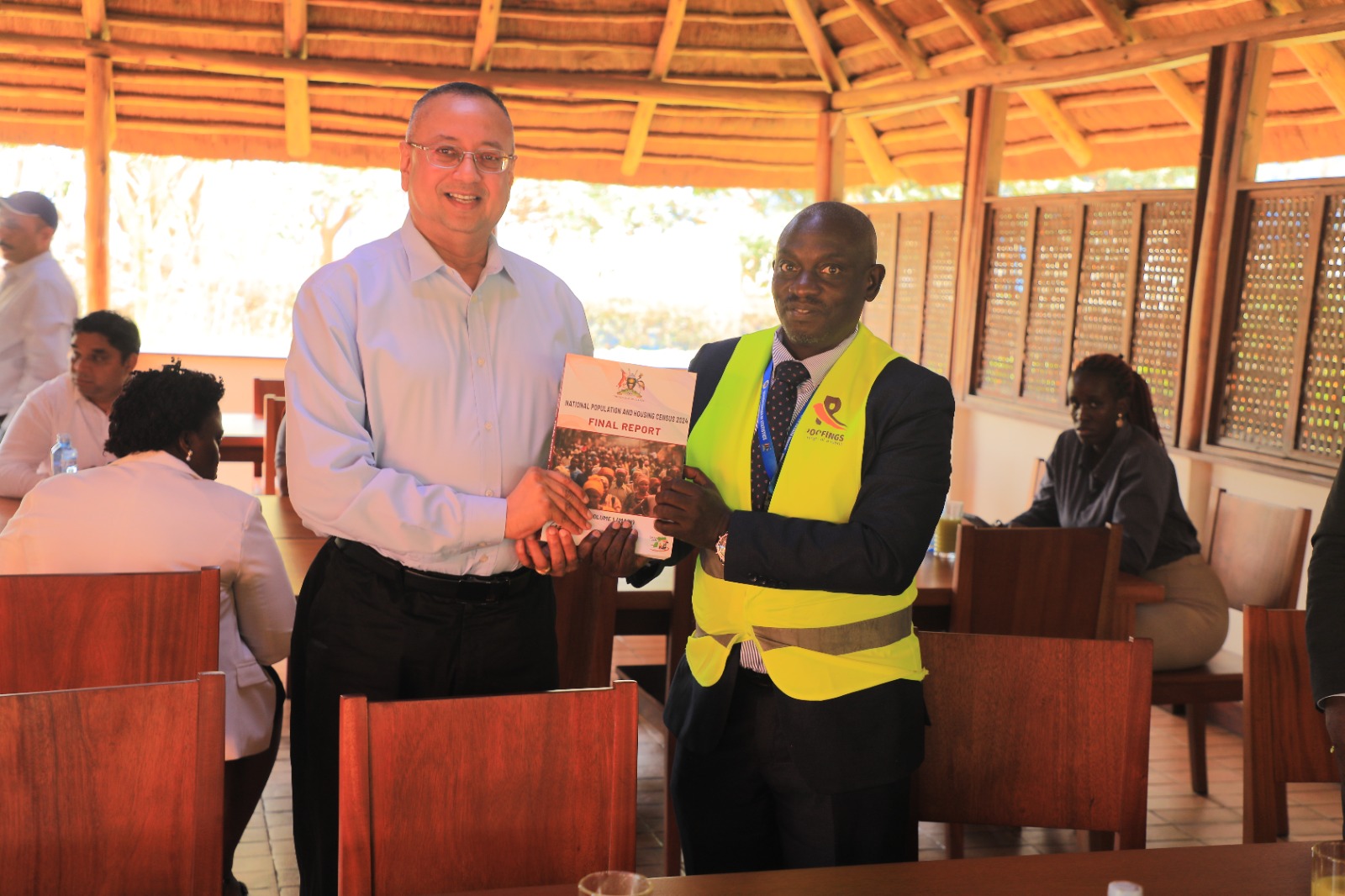
    KAMPALA – Uganda’s industrial giant Roofings Group has joined forces with the Uganda Bureau of Statistics (UBOS) in a strategic partnership aimed at harnessing the power of credible data to fuel investment, boost manufacturing and accelerate the country’s industrial transformation.

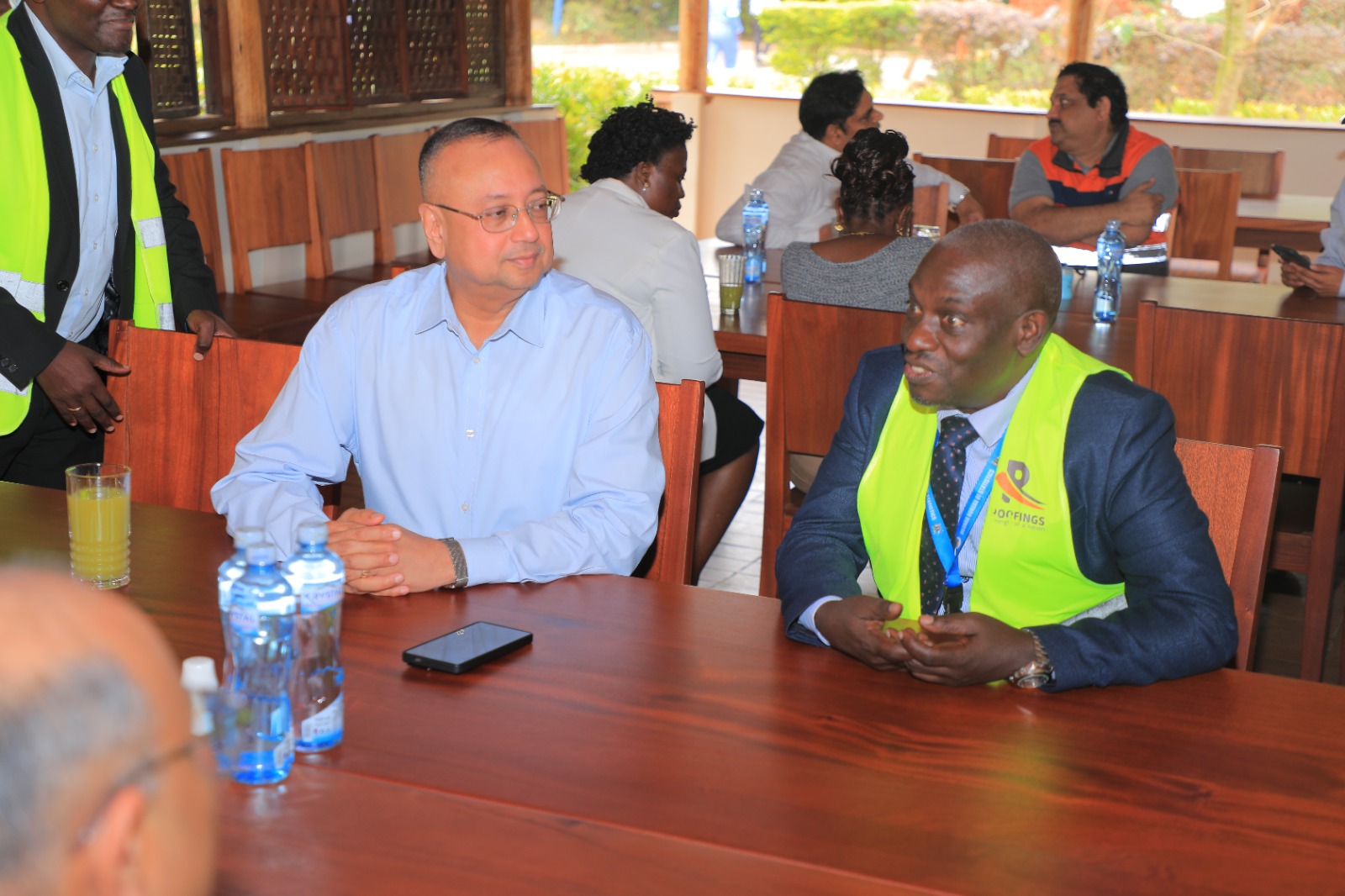
    The landmark collaboration was unveiled after a high-powered UBOS delegation toured Roofings’ state-of-the-art manufacturing complex at the Kampala Industrial and Business Park in Namanve, where the two institutions agreed that reliable statistics have become a critical ingredient for business success in an increasingly competitive global economy.

    The UBOS team, led by Deputy Executive Director Dr. Vincent F. Ssenono on behalf of Executive Director and Chief Statistician Dr. Chris N. Mukiza, was received by Roofings’ Chief Corporate Affairs Officer Dr. Martin F. Kyeyune, who showcased the company’s remarkable growth journey and massive industrial investments.

    The discussions focused on how official statistics can strengthen industrial planning, guide investment decisions, identify export opportunities and support evidence-based policies that stimulate economic growth.

    FROM A $2M START-UP TO A $500M INDUSTRIAL EMPIRE

    One of the standout moments of the engagement was the revelation of Roofings’ extraordinary rise from a modest US$2 million investment in 1994 into an industrial powerhouse now valued at more than US$500 million.

    Over the past three decades, the company has grown into one of East and Central Africa’s leading steel manufacturers through aggressive investment in modern technology, value addition, expanded production capacity and export-oriented manufacturing.

    Company officials said access to reliable and timely data from UBOS will enable the manufacturer to make smarter investment decisions, improve production planning, identify new export markets and reduce reliance on inaccurate market information.

    UBOS reaffirmed its commitment to providing quality, credible and timely statistics to support businesses, government agencies, development partners and the wider public.

    The Bureau also emphasized that stronger partnerships with the private sector are essential in building a robust National Statistical System capable of driving Uganda’s socio-economic transformation through informed decision-making.

    Roofings Group Chief Executive Officer Sheikh Arif welcomed the collaboration, describing it as a significant milestone in strengthening institutional partnerships and promoting a culture of data-driven decision-making across Uganda’s industrial sector.

    He noted that accurate statistics are increasingly becoming a strategic asset for businesses seeking to improve competitiveness, foster innovation and achieve sustainable growth in both domestic and international markets.

    As Uganda intensifies efforts to expand its manufacturing base under its industrialisation agenda, the partnership between Roofings and UBOS is expected to play a key role in ensuring that future investment decisions are guided by reliable evidence, positioning the country for stronger industrial growth and increased regional competitiveness.


    GOT A HOT STORY? LET US KNOW!

    Got breaking news, explosive secrets, or hard evidence?

    Email us: redpeppertips@gmail.com

    We accept tips, documents, videos, photos, and recordings—the more evidence you have, the better.

    CONFIDENTIALITY IS OUR TOP PRIORITY. SOURCES ARE ALWAYS PROTECTED!

    About Post Author

  • Why AgaNaga Is Not Bothered by Stars Missing His Festival Press Conference

    Why AgaNaga Is Not Bothered by Stars Missing His Festival Press Conference

    Questions about the absence of several top Ugandan artists dominated discussions after Kalifah AgaNaga‘s Nassanga Festival Mukibira press conference, but the singer insists many people missed the point.

    AgaNaga hosted the press conference on July 29 at Forest Resort Lweza ahead of his August 1 concert.

    Lil Pazo, Coco Finger and Allan Hendrick turned up to support the singer, but fans quickly noticed that several other big names stayed away.

    The spotlight soon shifted to Eddy Kenzo, Weasel Manizo, and Winnie Nwagi, who all feature on the “Nassanga Remix” but missed the event.

    Social media users quickly picked up the discussion, with many questioning why only Lil Pazo represented the remix collaborators at the press conference.

    Responding to the conversation on Galaxy TV, AgaNaga dismissed suggestions that the turnout of musicians determined the success of the event.

    The press conference was not all about the musicians who featured on the ‘Nassanga Remix.’ It was meant to give people an idea of what to expect from the concert. It was never about the musicians because some of them could not even attend.

    He stressed that updating fans about the concert, not the turnout of musicians, was his priority.

    The purpose of the press conference was to let my fans know how the concert has been organised.

    With the press conference behind him, AgaNaga wants people to shift their attention to the August 1 concert instead of continuing to debate who showed up at the media event.

  • DFCU BLEEDS! Sh15.8bn Loss Sparks Investor Panic As Crane Curse, Court Wars & Internal Turmoil Hit Bank

    DFCU BLEEDS! Sh15.8bn Loss Sparks Investor Panic As Crane Curse, Court Wars & Internal Turmoil Hit Bank

    KAMPALA – For the first time in years, dfcu Bank has been thrown into the red, posting a shocking Shs15.8 billion half-year loss that has rattled shareholders, reignited questions about the never-ending Crane Bank saga and exposed deeper troubles simmering beneath one of Uganda’s biggest financial institutions.

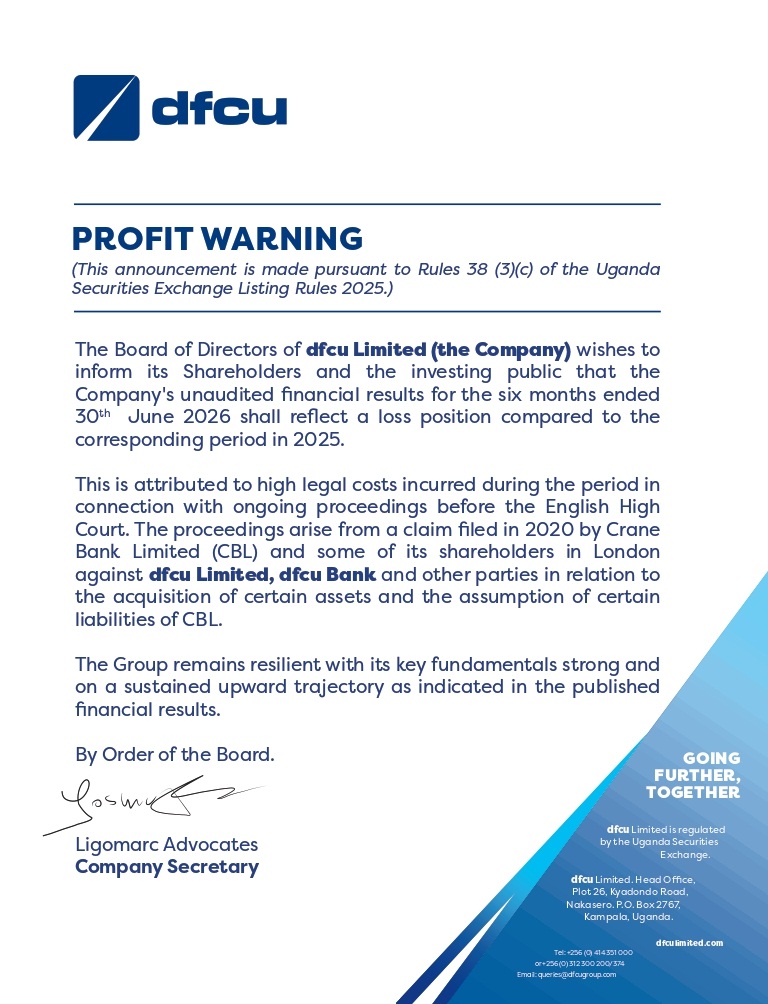
    The Uganda Securities Exchange-listed lender, which made Shs34.5 billion profit during the same period last year, stunned the market after issuing a profit warning before unveiling its June 2026 financial results.

    The turnaround is dramatic.

    In just one year, the bank has swung by more than Shs50 billion, with earnings per share collapsing from Shs46.18 to negative Shs21.08, leaving investors nursing heavy paper losses, according to the bank’s Interim Condensed Consolidated Financial Statements (Unaudited) for the six-month period ended 30 June 2026.

    In its official communication to shareholders, the Board squarely blamed the losses on massive legal bills arising from the ongoing case before the English High Court, where Crane Bank Limited (CBL) and some of its former shareholders continue fighting dfcu over the controversial 2017 acquisition of Crane Bank’s assets and liabilities.

    The London suit, filed in 2020, has become one of the most expensive legal battles involving a Ugandan financial institution.

    Yet, while management points at legal costs, analysts say the financial statements reveal a more complicated picture.

    The bank’s core business actually continued growing.

    Net interest income climbed from Shs150.4 billion to Shs158.9 billion, while fees and commissions rose to Shs35.3 billion. Trading income also jumped sharply from Shs15.5 billion to nearly Shs28 billion, showing that banking operations themselves remained healthy.

    But all those gains were swallowed almost overnight.

    Operating expenses ballooned from Shs150.4 billion last year to Shs230 billion this year—an astonishing increase of nearly Shs80 billion in just six months.

    The result was devastating.

    Instead of recording a Shs39.7 billion pre-tax profit like it did last year, dfcu ended the first half of 2026 with a Shs26.3 billion pre-tax loss, eventually closing with a Shs15.8 billion net loss after tax.

    Adding salt to the wound, the bank also increased provisions for expected bad loans.

    Credit impairment charges climbed to Shs11.8 billion, reflecting increased caution as the lender prepared for possible defaults among borrowers.

    Despite the earnings collapse, dfcu continued attracting deposits.

    Customer deposits surged by more than Shs416 billion to Shs2.87 trillion, while its loan book expanded to Shs1.44 trillion from Shs1.2 trillion a year earlier.

    Total assets also grew from Shs3.53 trillion to Shs3.94 trillion, indicating customers have largely remained loyal despite the uncertainty.

    However, insiders insist the legal case is only one of several fires management is trying to extinguish.

    Sources familiar with operations claim the bank has in recent months grappled with internal operational challenges, cybersecurity incidents, employee dissatisfaction and increasing customer complaints.

    Although the bank has not publicly linked these issues to its financial performance, sources allege management has been quietly handling several fraud-related incidents internally to avoid further unsettling investors.

    dfcu has previously admitted suffering a major electronic fraud in a range of about Sh10bn after detecting unauthorized transactions that were later reported to CID. Investigations resulted in criminal proceedings against suspects accused of electronic fraud and theft.

    This year, the State House Anti-Corruption Unit, working with CID and the Office of the Director of Public Prosecutions, announced it had foiled an alleged Shs689 million fraud attempt targeting funds held in a dfcu account using allegedly forged court documents before any money could be withdrawn.

    The lender has also found itself battling customers in court over frozen bank accounts.

    In one of the latest rulings, the High Court ordered dfcu to unfreeze businessman Bob Ainebyoona’s account after finding that the bank had continued restricting access even after criminal proceedings against him had ended in acquittal.

    Justice Joyce Kavuma ruled that banks cannot freeze customer accounts arbitrarily and must act within the law while balancing anti-money laundering obligations with customers’ constitutional property rights.

    Another court also ordered the bank to release accounts belonging to businessman Dr Dennis Daniel Ssemugenyi, adding to a growing list of legal disputes involving customers.

    Inside the bank, sources further allege that staff morale has deteriorated amid complaints of tough performance targets, disagreements over management decisions and fears of possible restructuring. These claims remain unverified, and dfcu has not publicly commented on them.

    Questions are also beginning to emerge over whether CEO Charles Mudiwa, who returned from Zambia can steer the institution through its most turbulent period since the Crane Bank takeover.

    For now, the Board insists there is no cause for panic.

    It says the Group’s fundamentals remain strong and that the underlying banking business continues on an upward trajectory despite the exceptional legal costs.

    “The Group remains resilient with its key fundamentals strong and on a sustained upward trajectory,” the board said in its profit warning.

    Whether investors buy that explanation remains to be seen.

    With billions already spent on legal fees, customer confidence under pressure, fresh court battles emerging and the London Crane Bank case still far from conclusion, many shareholders fear the worst may not yet be over.

    The coming months could determine whether dfcu stages a comeback—or whether Uganda’s most expensive banking acquisition continues to haunt the lender nearly a decade later.


    GOT A HOT STORY? LET US KNOW!

    Got breaking news, explosive secrets, or hard evidence?

    Email us: redpeppertips@gmail.com

    We accept tips, documents, videos, photos, and recordings—the more evidence you have, the better.

    CONFIDENTIALITY IS OUR TOP PRIORITY. SOURCES ARE ALWAYS PROTECTED!

    About Post Author

About UGNEWS24

UGNEWS24 is a Uganda local news service, a product of SOLAVIA GROUP LIMITED, Reg. No. 80048169153974.

Registered office

Plot 2335, Buwambo-Katadde-Najjo Road,
Nansana Municipality, Wakiso District, Uganda
P.O. Box 214231, Kampala

© 2026 SOLAVIA GROUP LIMITED. All rights reserved.