Blog

  • DFCU BLEEDS! Sh15.8bn Loss Sparks Investor Panic As Crane Curse, Court Wars & Internal Turmoil Hit Bank

    DFCU BLEEDS! Sh15.8bn Loss Sparks Investor Panic As Crane Curse, Court Wars & Internal Turmoil Hit Bank

    KAMPALA – For the first time in years, dfcu Bank has been thrown into the red, posting a shocking Shs15.8 billion half-year loss that has rattled shareholders, reignited questions about the never-ending Crane Bank saga and exposed deeper troubles simmering beneath one of Uganda’s biggest financial institutions.

    The Uganda Securities Exchange-listed lender, which made Shs34.5 billion profit during the same period last year, stunned the market after issuing a profit warning before unveiling its June 2026 financial results.

    The turnaround is dramatic.

    In just one year, the bank has swung by more than Shs50 billion, with earnings per share collapsing from Shs46.18 to negative Shs21.08, leaving investors nursing heavy paper losses, according to the bank’s Interim Condensed Consolidated Financial Statements (Unaudited) for the six-month period ended 30 June 2026.

    In its official communication to shareholders, the Board squarely blamed the losses on massive legal bills arising from the ongoing case before the English High Court, where Crane Bank Limited (CBL) and some of its former shareholders continue fighting dfcu over the controversial 2017 acquisition of Crane Bank’s assets and liabilities.

    The London suit, filed in 2020, has become one of the most expensive legal battles involving a Ugandan financial institution.
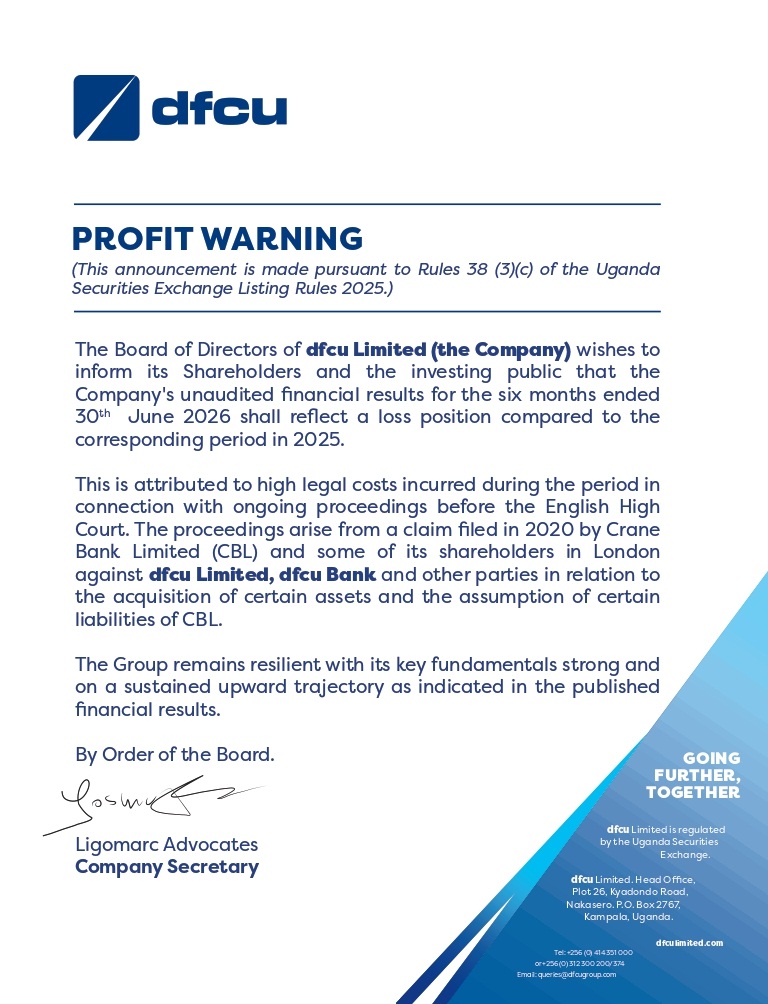
    Yet, while management points at legal costs, analysts say the financial statements reveal a more complicated picture.

    The bank’s core business actually continued growing.

    Net interest income climbed from Shs150.4 billion to Shs158.9 billion, while fees and commissions rose to Shs35.3 billion. Trading income also jumped sharply from Shs15.5 billion to nearly Shs28 billion, showing that banking operations themselves remained healthy.

    But all those gains were swallowed almost overnight.

    Operating expenses ballooned from Shs150.4 billion last year to Shs230 billion this year—an astonishing increase of nearly Shs80 billion in just six months.

    The result was devastating.

    Instead of recording a Shs39.7 billion pre-tax profit like it did last year, dfcu ended the first half of 2026 with a Shs26.3 billion pre-tax loss, eventually closing with a Shs15.8 billion net loss after tax.

    Adding salt to the wound, the bank also increased provisions for expected bad loans.

    Credit impairment charges climbed to Shs11.8 billion, reflecting increased caution as the lender prepared for possible defaults among borrowers.

    Despite the earnings collapse, dfcu continued attracting deposits.

    Customer deposits surged by more than Shs416 billion to Shs2.87 trillion, while its loan book expanded to Shs1.44 trillion from Shs1.2 trillion a year earlier.

    Total assets also grew from Shs3.53 trillion to Shs3.94 trillion, indicating customers have largely remained loyal despite the uncertainty.

    However, insiders insist the legal case is only one of several fires management is trying to extinguish.

    Sources familiar with operations claim the bank has in recent months grappled with internal operational challenges, cybersecurity incidents, employee dissatisfaction and increasing customer complaints.

    Although the bank has not publicly linked these issues to its financial performance, sources allege management has been quietly handling several fraud-related incidents internally to avoid further unsettling investors.

    dfcu has previously admitted suffering a major electronic fraud in a range of about Sh10bn after detecting unauthorized transactions that were later reported to CID. Investigations resulted in criminal proceedings against suspects accused of electronic fraud and theft.

    This year, the State House Anti-Corruption Unit, working with CID and the Office of the Director of Public Prosecutions, announced it had foiled an alleged Shs689 million fraud attempt targeting funds held in a dfcu account using allegedly forged court documents before any money could be withdrawn.

    The lender has also found itself battling customers in court over frozen bank accounts.

    In one of the latest rulings, the High Court ordered dfcu to unfreeze businessman Bob Ainebyoona’s account after finding that the bank had continued restricting access even after criminal proceedings against him had ended in acquittal.

    Justice Joyce Kavuma ruled that banks cannot freeze customer accounts arbitrarily and must act within the law while balancing anti-money laundering obligations with customers’ constitutional property rights.

    Another court also ordered the bank to release accounts belonging to businessman Dr Dennis Daniel Ssemugenyi, adding to a growing list of legal disputes involving customers.

    Inside the bank, sources further allege that staff morale has deteriorated amid complaints of tough performance targets, disagreements over management decisions and fears of possible restructuring. These claims remain unverified, and dfcu has not publicly commented on them.

    Questions are also beginning to emerge over whether CEO Charles Mudiwa, who returned from Zambia can steer the institution through its most turbulent period since the Crane Bank takeover.

    For now, the Board insists there is no cause for panic.

    It says the Group’s fundamentals remain strong and that the underlying banking business continues on an upward trajectory despite the exceptional legal costs.

    “The Group remains resilient with its key fundamentals strong and on a sustained upward trajectory,” the board said in its profit warning.

    Whether investors buy that explanation remains to be seen.

    With billions already spent on legal fees, customer confidence under pressure, fresh court battles emerging and the London Crane Bank case still far from conclusion, many shareholders fear the worst may not yet be over.

    The coming months could determine whether dfcu stages a comeback—or whether Uganda’s most expensive banking acquisition continues to haunt the lender nearly a decade later.


    GOT A HOT STORY? LET US KNOW!

    Got breaking news, explosive secrets, or hard evidence?

    Email us: redpeppertips@gmail.com

    We accept tips, documents, videos, photos, and recordings—the more evidence you have, the better.

    CONFIDENTIALITY IS OUR TOP PRIORITY. SOURCES ARE ALWAYS PROTECTED!

    About Post Author

  • Lukwago’s Bail Hope Crushed as High Court Demands Fresh Medical Proof

    Lukwago’s Bail Hope Crushed as High Court Demands Fresh Medical Proof

    Judge clears his four sureties, rejects claims he could flee or interfere with witnesses, but says prison doctors must first confirm his medical condition cannot be managed behind bars

    Former Kampala Capital City Lord Mayor Erias Lukwago will remain in custody after the High Court rejected his application for bail in the case where he is accused of misprision of treason.

    In a detailed ruling delivered by Justice David Matovu of the High Court Criminal Division in Kampala, the court found that Lukwago had met several requirements necessary for bail, including having a permanent place of residence and presenting credible sureties.

    However, the judge declined to release him, citing gaps in the medical evidence presented before court and the fact that the case had already moved from the Chief Magistrate’s Court to the High Court for trial.

    Lukwago had asked the court to grant him bail pending the hearing and determination of Criminal Case No. 0762 of 2026, in which he faces charges of misprision of treason.

    He was charged before Makindye Chief Magistrate’s Court on June 17, 2026, where he denied the allegations and was subsequently remanded to Luzira Prison.

    His lawyers later filed a bail application, arguing that his continued detention posed a risk to his health due to several chronic medical conditions.

    The former Lord Mayor told court that he suffers from hypertension, cylindrical bronchiectasis, persistent loss of smell, tinnitus, residual cervical radiculitis, gastroesophageal reflux disease and hiatus hernia.

    Through his lawyers, Lukwago argued that his medical condition required specialised treatment and monitoring beyond what was available in prison.

    His legal team, led by Counsel Medard Lubega Sseggona, argued that Lukwago was entitled to bail as a constitutional right because he was presumed innocent until proven guilty.

    They told court that Lukwago had a fixed residence, had served in several public leadership positions, was a practising lawyer and had no reason to escape trial.

    The defence also presented four sureties whom they said were capable of guaranteeing his attendance before court whenever required.

    The sureties included advocate Chrisestom Katumba, Lukwago’s law partner at Lukwago & Co Advocates; Abdul Sewankambo, his biological brother; Mukono Municipality Member of Parliament Betty Nambooze Bakireke; and lawyer Moses Kasibante.

    Justice Matovu found the four sureties suitable, saying they had demonstrated their ability to ensure that Lukwago appears in court.

    The judge noted that the sureties had fixed places of residence and had provided local council documentation confirming their addresses.

    “Given the fact that even counsel for the Respondent did not challenge their suitability, this court finds these four sureties to be substantial,” Justice Matovu ruled.

    Despite the strength of the sureties, the court found that one major issue remained unresolved — Lukwago’s medical condition.

    The defence relied on a report from Mulago National Referral Hospital, where a team of five consultants examined Lukwago and made recommendations concerning his treatment.

    The specialists reportedly advised that Lukwago should continue receiving medical attention and undergo a spinal review by his primary surgeons in India.

    However, Justice Matovu said the report needed confirmation from prison medical authorities because it was prepared following proceedings before the Makindye Chief Magistrate’s Court, which no longer had jurisdiction over the matter after Lukwago was committed to the High Court.

    The judge said the court needed evidence from prison medical officers indicating whether Lukwago’s conditions could or could not be managed while in custody.

    “The Applicant ought to have his medical report certified by a medical officer of the prison if this court is to rely on this medical evidence,” Justice Matovu stated.

    The ruling also dealt a blow to prosecution arguments that Lukwago would interfere with witnesses or run away if granted bail.

    The State had argued that Lukwago was influential because of his position as a lawyer and politician and that his release could affect the trial.

    Prosecution lawyers also claimed that Lukwago knew witnesses in the case and could interfere with them.

    But the High Court rejected the argument, describing it as speculative.

    Justice Matovu said the court could not hold Lukwago responsible for alleged actions of an associate and noted that investigations appeared to have been completed.

    The judge further observed that the first prosecution witness in the related High Court case had already testified.

    The court also dismissed concerns that Lukwago could flee the country, saying his character, public record and positions of responsibility showed that he was unlikely to abscond.

    The judge found that Lukwago had a fixed place of abode at Bulwa Zone, Wakaliga, Rubaga Division in Kampala, supported by local authority documentation and his national identification card.

    However, the court pointed out that the bail application itself had been overtaken by developments because Lukwago’s case had already been committed to the High Court.

    Justice Matovu explained that the original application was filed in relation to proceedings before Makindye Chief Magistrate’s Court, but the lower court proceedings had ended after Lukwago was committed for trial before the High Court.

    The judge directed the Deputy Registrar of the High Court Criminal Division to follow up on the committal papers and ensure that the case file is allocated to a judge for further management.

    The ruling means Lukwago will remain in custody as he awaits further court proceedings.

    The case is connected to proceedings arising from the High Court trial involving opposition politician Dr Kizza Besigye and two others, where Lukwago had been serving as part of the defence team.

    Lukwago, a long-time opposition figure and former Kampala mayor, maintains his innocence and continues to fight the charges against him.

  • PHOTOS: Tanzanian stars Zuchu and Diamond Platnumz reveal pregnancy following split

    PHOTOS: Tanzanian stars Zuchu and Diamond Platnumz reveal pregnancy following split

    Tanzanian music star Zuchu has announced that she is expecting her first child with her husband, Diamond Platnumz.

    The announcement comes just weeks after Zuchu had publicly revealed that she and Diamond Platnumz had broken up, leaving many fans believing the couple had once again gone their separate ways.

    However, the latest revelation has surprised their followers, confirming that the two are now preparing to welcome their first child together after years of an on-and-off relationship that frequently made headlines.

    Sharing the joyful news on Instagram, Zuchu posted a series of maternity photos alongside the caption, “Growing Love and Eating for Two, pls be a chubby baby.”

    Diamond Platnumz also celebrated the milestone on his own social media pages, writing, “New Heart beats in the Family,” as he shared photos from the pregnancy announcement.

    The couple’s relationship has been one of East Africa’s most talked-about celebrity romances, marked by several breakups, reconciliations, and eventually marriage.

    Take a look at the photos below;

    The post PHOTOS: Tanzanian stars Zuchu and Diamond Platnumz reveal pregnancy following split appeared first on MBU.

  • Mark Da Urban Compares BBLs to Plastic Eggs, Reveals His Dating Preference

    Mark Da Urban Compares BBLs to Plastic Eggs, Reveals His Dating Preference

    Mark Da Urban has revealed that cosmetic surgery is not a dealbreaker for him, but when it comes to choosing a partner, he will always pick a natural woman.

    The Ugandan dancehall singer, born Mark Olule, shared his views during an interview on Galaxy TV, where he weighed in on the growing popularity of cosmetic procedures such as Brazilian Butt Lifts (BBLs).

    To drive home his point, Mark used an unusual comparison.

    Do you eat plastic eggs? Can you? That should tell you everything. I prefer natural things, and that is the same when it comes to women.

    Although he does not criticise women who choose cosmetic surgery, Mark says the trend does not surprise him because beauty enhancements have become increasingly common.

    A woman can shave off her eyebrows only to draw them back on with a pencil, so I am not surprised that others choose to get BBLs because there are men who like women with bigger bottoms.

    Even so, the singer says his preference has never changed.

    As for me, I prefer women who are natural.

  • Why media personality Kasuku considers long-distance romance a waste of time

    Why media personality Kasuku considers long-distance romance a waste of time

    Media personality Kasuku has explained why he is not a fan of long-distance relationships, saying they rarely work out because the people involved eventually begin living in completely different worlds.

    Speaking during a discussion, Kasuku argued that when one partner lives abroad while the other remains in Uganda, their experiences and outlook on life gradually become too different.

    To illustrate his point, he cited the example of someone in Kampala dating a partner in Canada, saying the two environments shape people differently.

    Your partner will come back seeing you as local because they’re used to seeing people move freely and dress how they want back in Canada.

    According to Kasuku, these contrasting lifestyles can affect how partners perceive each other, making it difficult to maintain the same connection they had before the distance.

    He also pointed out that video calls do not always present an accurate picture of a relationship. He believes people often use filters or only show the best version of themselves during virtual conversations, making it harder for their partners to truly understand who they are in everyday life.

    For that reason, Kasuku maintains that long-distance relationships are often a waste of time, as they can create unrealistic expectations and make it difficult for couples to build a genuine connection despite staying in regular contact.

    The post Why media personality Kasuku considers long-distance romance a waste of time appeared first on MBU.

  • Mesach Semakula reveals his true wealth beyond material possessions

    Mesach Semakula reveals his true wealth beyond material possessions

    Veteran musician Mesach Semakula has shared an interesting perspective on what he considers his greatest wealth, revealing that the most valuable things in his life are not necessarily material possessions.

    Speaking during a recent interview, Semakula explained that the wealth he deliberately shares with the public consists of the things he considers truly meaningful, while other possessions remain private.

    Using his age as an example, the singer said growing older is one of the blessings he proudly celebrates.

    I am soon making 50 years old and it’s valuable to me. So I make sure that I put it out there for everyone to know.

    Semakula also described his children as one of his greatest treasures. He explained that although he kept them away from the public eye while they were young, he now proudly introduces them because they are old enough to make their own decisions.

    According to him, making them visible can also create opportunities, as people who recognize them as his children may be willing to support or guide them in different professional spaces.

    He added that his family is another priceless asset that he never hesitates to show the world.

    “I let people know my valuable assets, and those that aren’t, are left out,” he said.

    When the conversation shifted to material possessions such as land, houses, and businesses, Semakula surprised many by saying he does not place the same value on them.

    He argued that physical wealth is temporary and can disappear over time, unlike life and family, which he considers eternal blessings.

    “You can have some of these physical possessions now and in the next few years they’re nowhere to be seen,” he said.

    The post Mesach Semakula reveals his true wealth beyond material possessions appeared first on MBU.

  • MBARARA LC1 POLLS! MP Mpaka, Speaker Tashobya Dragged Into Election Chaos

    MBARARA LC1 POLLS! MP Mpaka, Speaker Tashobya Dragged Into Election Chaos

    By Amos Tayebwa

    Mbarara

    Mbarara City’s Local Council One (LC1) elections descended into chaos on Wednesday after violent clashes, teargas, and gunfire forced the cancellation of polls in several villages, with rival political heavyweights Mwine Mpaka and Bony Tashobya Karutsya being accused by locals of fueling the unrest through alleged behind-the-scenes influence.

    The electoral exercise ground to a halt in Karugangama, Nyakaizi, Mandela, Kakika, Kabucebebe, Rwobuyenje South and Rwenkanja cells, where violence, disputes over voter registers and accusations of political interference disrupted voting.

    The worst scenes unfolded in Karugangama Cell, where security officers fired teargas and bullets into the air to disperse rival supporters after a bitter showdown between incumbent LC1 chairman and NRM flag bearer Hajji Japhari Mpiima and independent challenger Wilson Kafureka.

    Trouble erupted after the two camps rejected the voter register being used. Mpiima’s supporters accused election officials of manipulating the register in favour of Kafureka after allegedly receiving a bribe, triggering violent confrontations that brought the polling exercise to a standstill.

    Following the cancellation of the election, angry voters and candidates pointed fingers at influential politicians, claiming the grassroots contest had turned into a proxy political battle.

    Residents alleged that Mbarara City South MP Mwine Mpaka openly backed Mpiima while City Speaker Bony Tashobya Karutsya supported Kafureka. Both leaders were also accused by some residents of allegedly injecting money into the campaigns to strengthen their preferred candidates.

    Although neither politician publicly addressed the allegations, residents insisted the rivalry between the two political camps had transformed what should have been a village election into a high-stakes political contest.

    At the centre of the dispute is the proposed Kanyeite-Karugangama Bridge across River Rwizi.

    Locals say the bridge project has for months exposed divisions between the rival camps. Kafureka reportedly spearheaded a community initiative to mobilise residents and well-wishers to contribute money towards constructing a permanent bridge, an idea that allegedly failed to receive backing from some leaders, including area legislators.

    Mpaka and Bony have been contacted for a comment.

    Mpiima dismissed the fundraising initiative as a political mobilisation tool designed to boost his opponent ahead of the elections.

    “The truth is there are some big politicians from the City Council, including the Speaker, who are driving their political interests ahead of the 2031 elections. They are the ones who have fueled violence in our area. They confused people by claiming they would construct the bridge, yet they lack the capacity. Our people pay taxes and constructing such a bridge is the responsibility of the central government. We simply want a free and fair election,” Mpiima said.

    Karugangama Cell has more than 1,000 registered voters, making it one of the most politically significant LC1 contests in the city.

    Political tensions were also reported in Mbarara City North Division, where voters blamed the rivalry between Division Mayor Gumisiriza Kyabwisho and former mayoral aspirant Benon Mugume for contributing to violence that disrupted voting in several polling stations.

    Mbarara City Returning Officer Violet Atuhurra confirmed that although voting was successfully conducted in most villages, elections had to be cancelled in several areas because of violence and disputes over the voters’ register.

    She said fresh polling would be organised once guidance is received from the Electoral Commission.

    Atuhurra also acknowledged receiving complaints alleging interference by politicians at different levels.

    “We received complaints about influence from politicians, including councillors, Members of Parliament and former contestants who involved themselves in these elections, causing unnecessary chaos. We have continued warning them to allow voters to freely elect leaders of their choice,” she said.

    With repeat elections now expected in the affected villages, the dramatic scenes have cast a shadow over Mbarara City’s grassroots democratic process, exposing how national and city-level political rivalries can spill into even the smallest village elections.


    GOT A HOT STORY? LET US KNOW!

    Got breaking news, explosive secrets, or hard evidence?

    Email us: redpeppertips@gmail.com

    We accept tips, documents, videos, photos, and recordings—the more evidence you have, the better.

    CONFIDENTIALITY IS OUR TOP PRIORITY. SOURCES ARE ALWAYS PROTECTED!

    About Post Author

  • EC Orders Fresh Polls In 1,135 Villages

    EC Orders Fresh Polls In 1,135 Villages

    Registers destroyed, violence and voter disputes derail voting as Commission sets August 1 date for repeat elections

    The village elections that were expected to usher in new LC1 leaders across Uganda suffered disruptions in hundreds of areas, forcing the Electoral Commission to announce fresh polling dates for more than 1,000 villages.

    Electoral Commission Chairperson Justice Simon Byabakama Mugenyi has revealed that elections failed to take place or were interrupted in 1,135 villages after chaos, violence, destruction of voting materials and disputes over voter registers.

    The affected villages represent 1.6 percent of the country’s 71,214 villages that were scheduled to hold elections for LC1 Council Chairpersons on Tuesday, July 28, 2026.

    Despite the challenges, the Commission described the exercise as largely successful, saying voting was completed in 70,079 villages representing a 98.4 percent success rate.

    Justice Byabakama said millions of registered village residents turned up to participate in the election of their local leaders in what he described as a generally peaceful and orderly process.

    But behind the success story were pockets of trouble that disrupted voting in some communities.

    According to the Commission, some villages witnessed violence and confusion, while others lost polling materials after registers were destroyed, vandalised or stolen.

    Some areas were also affected by disagreements after individuals whose names were missing from the official Village Residents’ Register attempted to vote using National Identity Cards.

    The Electoral Commission maintained that having a National Identity Card alone was not enough to qualify someone to vote in the LC1 elections.

    Only residents whose names appeared on the Village Residents’ Register were eligible to participate.

    The Commission said some of those turned away caused disruptions, forcing election officials to suspend polling in certain villages.

    To resolve the crisis, the Electoral Commission has announced a fresh election timetable.

    Villages where voters’ registers were destroyed will begin fresh registration today, Thursday, July 30, followed by display of registers on Friday, July 31.

    Residents in those areas will return to the polls on Saturday, August 1, 2026.

    Villages that experienced violence and disruptions but still have intact registers will also vote on August 1.

    For areas where candidates died after being nominated, the Commission has ordered fresh nominations for the vacant positions today, campaigns tomorrow, and voting on Saturday.

    However, candidates who were already nominated and are still alive will not repeat the nomination process.

    Justice Byabakama warned individuals intending to disrupt the repeat elections, saying security agencies would deal firmly with anyone who attempts to create chaos.

    The Commission also appealed to political actors, candidates and residents in affected villages to maintain peace and follow electoral guidelines.

    The LC1 elections are a key stage in Uganda’s local government electoral roadmap, with the newly elected village committees expected to participate in the election of Parish/Ward (LCII) Council Chairpersons.

    The Electoral Commission said it remains committed to completing all remaining elections and ensuring that every village forms its leadership structures in accordance with the law.

  • Ugandan influencer Bad Black quits skin bleaching after 13 years

    Ugandan influencer Bad Black quits skin bleaching after 13 years

    Bad Black, a Ugandan socialite and influencer who has proudly promoted skin bleaching for the last 13 years, says she will no longer be tampering with her skin complexion and would appreciate having her dark chocolate complexion back.

    Via Snapchat, Bad Black reveals that it is now time for her children to embrace the real version of her, and she is “done hiding.”

    Bad black before bleaching her skin

    I have been bleaching my skin for the past 13 years, but it’s finally time for my children to embrace and see the real woman who gave them life-the woman who has sacrificed everything for them. I’m done hiding. Forget bleaching. I’m done. This is the real me, and I’m choosing to love every part of myself.

    Bad Black is currently undergoing recovery after a successful BBL procedure, and she states that that will be enough enhancement to take her through the remaining part of her life.

    She also considers deleting photos and videos that show her light-skinned self off her Instagram and TikTok pages to embrace a rebirth of the melanin version of her.

    Good thing now am well shaped with my biina why I pressure myself with skin bleaching am sure i will look so beautiful carrying my bbl with respect and integrity.

    Am also considering deleting all my instagram pictures because reborn Badblack’s melanin dark chocolate sexy mama. Also i will delete all my TikTok videos to rebrand new me this August.

    If you meet Badblack few years try to meet Badblack after Dark ba dear you all will need to restudy what’s coming. The moment I walked out dat theater da masks are off am that what I always wanted to be.

    The post Ugandan influencer Bad Black quits skin bleaching after 13 years appeared first on MBU.

  • COFFEE GOLD RUSH! Brazil Harvest Delay Sends Prices Soaring, Ugandan Farmers Smile

    COFFEE GOLD RUSH! Brazil Harvest Delay Sends Prices Soaring, Ugandan Farmers Smile

    September arabica coffee (KCU26) on Monday closed up +10.75 (+3.43%), and September ICE robusta coffee (RMU26) closed up +42 (+1.12%).

    Coffee prices settled sharply higher on Monday amid concern that heavy rain in Brazil will further disrupt the country’s coffee harvest and tighten global supplies.  On Monday, Somar Meteorologia reported that 32.4 mm of rain, or 2700% of the historical average, fell in the week ended July 26 in Minas Gerais, Brazil’s biggest coffee-growing region.

    The slow pace of Brazil’s coffee harvest is supportive of coffee prices.  The harvest among members of Cooxupe co-op was 47.3% complete as of July 17, behind the year-earlier pace of 59%.  On July 17, Safras & Mercado reported that Brazil’s 2026/27 coffee harvest was 64% complete as of July 15, behind last year’s comparable level of 77% and the five-year average of 70%.

    Last Friday, coffee prices tumbled to 3-week lows due to the USDA’s forecast last Wednesday that global coffee output in the 2026-27 season will rise by +6.0% (10.8 million bags) to a record 189.7 million bags, mainly due to improved growing conditions in Brazil. The USDA expects global arabica production to rise +12% y/y, although robusta production is expected to fall by -0.7% y/y.  World ending stocks are expected to rise +1.9 million bags to 26.3 million bags.  On June 3, the USDA’s Foreign Agricultural Service (FAS) forecast a record 2026/27 Brazil coffee crop of 71.9 million bags, up +14% y/y.

    Rising inventories are weighing on robusta coffee as ICE robusta inventories climbed to a 4.25-month high of 4,254 lots last Wednesday, although inventories were mildly below that level at 4,228 lots on Monday.  By contrast, a bullish factor for arabica coffee prices was that ICE arabica coffee inventories fell to a 2.5-year low of 292,810 bags on Monday.

    Concerns that an El Niño weather pattern could hurt Brazil’s coffee crop next year are bullish for prices. Coffee trader Commercial said the El Niño weather pattern may delay rains in Brazil this September and October, when tree flowering normally occurs, hurting Brazil’s 2026/27 coffee crop.

    On July 8, the US Climate Prediction Center said the El Niño weather pattern that emerged across the equatorial Pacific last month will likely be one of the strongest in more than 75 years. This sets the stage for months of possible floods, droughts, and temperature fluctuations later this year that could hinder coffee production in Asia and South America.

    Soaring coffee exports from Vietnam, the world’s largest robusta producer, are bearish for robusta prices.  On July 3, Vietnam’s National Statistics Office reported that Vietnam’s 2026 coffee exports (Jan-Jun) rose by +7.3% y/y to 1.05 MMT.  Vietnam’s 2025 coffee exports jumped by +17.5% y/y to 1.58 MMT. Also, Vietnam’s 2025/26 coffee production is projected to climb +6% y/y to a 4-year high of 1.76 MMT (29.4 million bags).

    About Post Author

About UGNEWS24

UGNEWS24 is a Uganda local news service, a product of SOLAVIA GROUP LIMITED, Reg. No. 80048169153974.

Registered office

Plot 2335, Buwambo-Katadde-Najjo Road,
Nansana Municipality, Wakiso District, Uganda
P.O. Box 214231, Kampala

© 2026 SOLAVIA GROUP LIMITED. All rights reserved.