Kampala-based philanthropist and social media personality Mami Deb has opened up about her marriage, revealing the intimate ways she expresses love for her husband, Michael Cleave.
The couple, who have been officially married for close to two years, held a glamorous destination wedding in the Maldives in November 2024.
Speaking in a recent interview, Mami Deb shared that she goes the extra mile to take care of her husband, including personally attending to him at home.
“I am genuinely into my husband and very happy with him. I shower him whenever I’m home, I scratch his back and this has enabled the relationship to grow better every day,” she said.
She explained that such acts of care and affection have played a big role in strengthening their bond and keeping their relationship thriving.
Mami Deb added that their love continues to blossom because of the strong connection they share, often giving fans glimpses of their life together on social media.
Spice Diana has sparked speculation about a possible move into politics in the future.
The singer made the remarks during a Ramadan charity activation at her home in Salaama, where she distributed food items to Muslim neighbors and friends.
During the interaction, one resident asked whether she had plans of joining politics someday. In response, Spice Diana gave a calm but intriguing answer that left many people wondering about her future plans.
“When the time is right, I will come to you,” she said.
While addressing the crowd, the singer acknowledged that politics in Uganda can be challenging, often involving confrontation and tension.
“You see what’s happening in politics, there’s a lot of tear gas,” she said. “But what I know is that when the time reaches and I’m ready, mine will be different.”
Spice Diana explained that her close connection with ordinary people helps her understand their everyday needs, something she believes would shape her leadership style if she ever chooses to join politics.
“I know the people around here and what they need,” she noted.
However, she emphasized that only time will determine the direction her life takes.
“You never know what will happen, so let’s just wait and be alive,” she added.
A silent but deadly crisis is unfolding in Mbarara, where medical experts are raising the alarm over a surge in maternal deaths linked to unsafe abortions—warning that the lives of young women are increasingly hanging in the balance.
Doctors and health workers from Mbarara Regional Referral Hospital say the situation is spiraling, with desperate girls and women turning to dangerous backstreet procedures that often end in tragedy.
Speaking during a media café organized by the Health Journalists Network in Uganda at Adit Mall, leading obstetrician Prof. Rogers Kajabawangu did not mince words as he exposed the scale of the crisis.
The senior medic revealed that the hospital is now overwhelmed with post-abortion complications—most of them from procedures carried out in unsafe, unregulated environments.
“The facility has registered the highest number of cases related to abortion which are normally practiced outside the hospital,” he said, warning that many of these cases arrive too late, when complications have already turned fatal.
In a chilling revelation, Kajabawangu noted that complications from unsafe abortions have now climbed the deadly ranks to become one of the leading causes of maternal deaths in Uganda.
Prof. Kajabawangu and Nuwenshaba addressing Journalists
“Complication of abortion is one of the biggest causes of maternal death… it is number five now in the country,” he said.
Behind the statistics lies a painful reality—young girls, students, and vulnerable women facing unwanted pregnancies with limited options, stigma, and fear pushing them into the shadows.
But instead of pushing for stricter crackdowns, experts are now shifting the conversation to prevention.
“Our advocacy is not so much to make abortion illegal,” Kajabawangu explained. “Our advocacy is in reducing unwanted pregnancies so that we have fewer and fewer women who end up thinking about aborting—and therefore ending up with unsafe abortions.”
He emphasized that expanding access to family planning is the most effective weapon in this fight, arguing that if every woman who does not want to get pregnant is supported with contraception, the demand for risky abortions would significantly drop.
“If we continue and find that every woman who doesn’t want to get pregnant is on a family planning method, then we will get fewer and fewer women getting unwanted pregnancies,” he said.
But even as prevention takes centre stage, frontline health workers are dealing with the brutal aftermath.
Midwife and maternal health advocate Pleasure Nuwenshaba painted a grim picture of what happens when things go wrong.
Pleasure Nuwenshaba
“Look for people who are skilled… think about the safe environment where you are going to have abortion,” she urged, stressing that many victims end up in critical condition because they rely on unqualified providers.
She underscored the life-saving importance of post-abortion care—services that remain a controversial yet essential part of Uganda’s healthcare system.
“Post-abortion care is much more important,” she said. “If there is no offer for post-abortion care, very many women would be dead.”
Nuwenshaba also highlighted the need for compassion in handling victims, many of whom are young girls battling fear, stigma, and trauma.
“Counselling has to be non-judgemental… you have to be kind and talk to them politely without judging or discriminating,” she added.
The crisis has also exposed a dangerous contradiction—while abortion remains highly restricted in Uganda, the consequences of unsafe procedures are filling hospital wards.
Health experts warn that without urgent intervention, the death toll could continue rising quietly, claiming lives that could have been saved through education, access to contraception, and timely medical care.
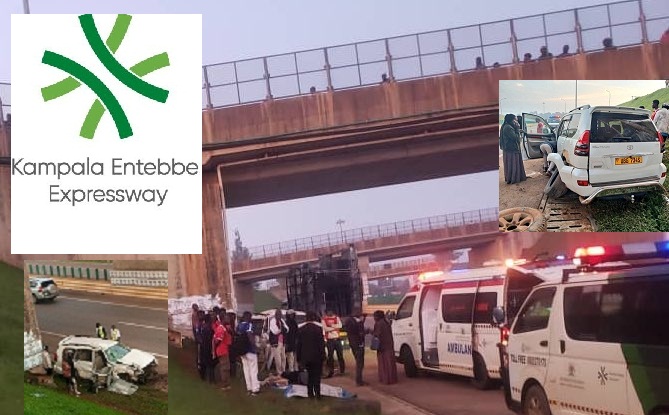
Grief has quickly turned into anger after a fatal crash on the Kampala–Entebbe Expressway on Monday exposed what critics are calling a dangerous mix of confusion, negligence and institutional complacency at the Kampala Entebbe Expressway (KEE).
According to the Directorate of Traffic and Road Safety, the crash happened at around 6:30am at the Mpala section and involved a Toyota Land Cruiser, registration number UBG 734S. The driver, Ssenyonjo Bosco, a businessman from Masaka, was travelling with his family towards Entebbe when he reportedly lost control of the vehicle. Three occupants, including the driver, died instantly, while two others were left with severe injuries.
But even before the wreckage was cleared, a different kind of crash had begun—this time between official narratives.
In its own statement, KEE offered a different explanation, saying the driver “reportedly dozed off due to fatigue after a long-distance journey.” The agency added that its incident response team worked with police to secure the scene and manage traffic, while urging motorists to rest and avoid driving while tired.
Yet that explanation has triggered sharp criticism, not just for what it says—but for what it avoids.
“How do two agencies that were on the same scene end up with conflicting accounts?” one critic questioned, pointing out that police suggested loss of control while KEE leaned on fatigue. “Can an entity contracted to manage the Expressway rely on ‘reportedly’ when lives have been lost?”
That single word—“reportedly”—has become the centre of outrage, seen by many as a convenient shield rather than a factual conclusion.
“This is a textbook example of institutional complacency,” says Ronald Amanyire, A ministry of Works official. “Instead of addressing the facts, you rush to absolve yourselves.”
The criticism goes further, accusing KEE of failing to confront deeper safety concerns on the stretch where the crash occurred. Chief among them is the issue of lighting.
“The section you manage has no lighting. That is not speculation; it is a matter of public record,” Amanyire stated, adding that repeated warnings about darkness on that part of the expressway had gone ignored.
Even more troubling is the claim that KEE deliberately avoided stating the exact time of the crash in its communication—despite police indicating it occurred early in the morning when visibility would have been low.
“You have conveniently avoided stating the exact time the crash occurred—because acknowledging it would expose the consequences of your negligence,” he charged.
Road users have reportedly complained about the same stretch before, with some saying they eventually gave up raising concerns after receiving no meaningful response.
“When I raised it, not a single credible explanation was offered—not even the usual fallback of ‘funding constraints,’” he said, painting a picture of an agency unwilling to engage until tragedy strikes.
Now, with three lives lost, the silence is being interpreted as something far more serious than oversight.
“This crash is not an accident in the abstract. It is the predictable outcome of systemic failure.”
At the centre of the storm is a growing belief that the expressway, a toll road paid for by the public, is being managed without adequate regard for safety standards. The absence of lighting at Mpala section raises serious questions about why critical infrastructure is being neglected—and why.
“A road section that citizens pay to use remains in total darkness because someone benefits from keeping it that way. That is corruption, not misfortune,” Amanyire wonders, in one of the strongest indictments yet.
Beyond the physical conditions of the road, the incident has exposed a deeper crisis—one of credibility. When two institutions present conflicting explanations for the same fatal crash, public trust erodes.
“We cannot prevent future incidents if investigations and public statements are issued in such a disorganized and contradictory manner,” critics warned. “We need clarity, accountability, and a single evidence-based explanation—not guesswork.”
At its core, this is no longer just about one crash. It is about a system that appears reactive rather than preventive, defensive rather than transparent.
For the families who lost their loved ones, the official statements offer little comfort. What they—and the public—are demanding is not speculation, but truth.
“The public deserves transparency, not deflection. The families affected deserve truth, not convenient narratives.”
Until those answers are provided, the Kampala–Entebbe Expressway risks carrying more than just traffic—it carries growing doubt about whether those entrusted with its management are doing enough to keep Ugandans safe.
And as the debate intensifies, one question hangs heavily in the air: if the warnings had been taken seriously earlier, would three people still be alive today?
The United States Embassy Kampala has sounded the alarm over rising visa fraud in Uganda, revealing that dozens of people are already facing criminal charges.
Speaking at a press briefing in Kampala, senior regional security officer James V. Bloomer said at least 43 individuals have been taken to court since July 2025 over attempts to secure US visas through fraudulent means.
Bloomer said the embassy continues to encounter applicants using forged documents or relying on middlemen who falsely claim they can influence visa decisions. He warned that such shortcuts not only fail but often lead to prosecution.
“Stop using middlemen, submitting fake documents or paying what some people call visa bonds. These things will not help you get a visa,” he said.
He urged Ugandans to apply directly through official channels, emphasising that the only reliable source of information is the embassy’s website and approved procedures.
Bloomer stressed that the United States remains open to genuine travellers but made it clear that the process must be followed honestly.
“As the US, we are committed to working with Ugandans who genuinely want to travel to America. Visa fees are strictly set by our headquarters in Washington DC and cannot be changed by individuals,” he added.
At the same briefing, Uganda Police Force spokesperson Kituuma Rusoke said visa fraud is part of a broader pattern of scams affecting multiple government services.
He noted that fraudsters often target people seeking quicker services in agencies such as the Uganda Revenue Authority and the Ministry of Lands, convincing them to pay large sums of money for supposed fast-tracked assistance.
Musician Pallaso has weighed in on the ongoing debate surrounding the Copyright Amendment Bill, claiming stronger enforcement would have made him extremely wealthy.
Taking to his social media platforms, Pallaso stated that he would already be a billionaire if Uganda had fully updated and enforced its copyright laws.
The singer went on to highlight the earning potential of his music, specifically pointing to one of his most popular tracks.
“If Uganda’s copyright laws were fully updated and enforced, my birthday song alone could buy me a private jet. See you in Parliament tomorrow,” he wrote.
Pallaso’s comments come at a time when the Copyright Amendment Bill is under intense debate in the Parliament of Uganda, with many musicians pushing for stronger protections and fair compensation for their work.
The proposed law aims to ensure that artists earn royalties whenever their music is played on television, radio, and other platforms—something many in the creative industry believe could transform their livelihoods.
Media personality and events deejay Etania Mutoni has opened up about her relationship with singer Joshua Baraka, describing it as the biggest blessing in her life.
Speaking during an interview with a local television station, Etania expressed deep appreciation for her partner, revealing that their relationship has brought her happiness and personal growth.
“I have been in this relationship for years now and I can tell you it’s been my biggest blessing. I am dating someone who gives me freedom and happiness,” she said.
Etania explained that she is flourishing in the relationship, highlighting the sense of peace and emotional support she enjoys with Baraka.
The couple, who have reportedly been together for close to four years, have often been open about their love, showing no hesitation in publicly expressing their affection for each other.
Their relationship continues to capture the attention of fans, with many admiring the bond they share and how they support each other’s careers
A stunning judgment from the Commercial Division of the High Court has peeled back the lid on a shadowy web of gold brokerage, rebel connections and suspicious dollar transfers after the court dismissed a multi-million-shilling claim brought by Entebbe Mayor Fabrice Brad Rulinda against Stanbic Bank Uganda.
In a detailed ruling delivered by Stephen Mubiru, the court examined a controversial financial transaction involving more than US$73,262.50 that had been wired into Rulinda’s dollar account at Stanbic’s Bugolobi Village Mall branch before the bank reversed the funds after reporting the transaction to the Financial Intelligence Authority.
Rulinda had sued the bank claiming it breached its banking contract with him when it reversed the funds without his consent and blocked his account. He sought recovery of the money, damages, interest and costs.
But what unfolded in court would instead raise explosive questions about the origins of the money and Rulinda’s own admissions linking the funds to controversial dealings involving gold and M23 rebel group.
According to court records, the drama began in August 2017 when two large deposits suddenly landed in Rulinda’s account. On August 10, a sum of US$422,957.50 was wired into the account from a company identified as Green Global Corporation. The very next day another US$73,262.50 followed.
The bank immediately flagged the unusual transfers because they were inconsistent with the ordinary activity on the account. Alarmed by the scale and nature of the transactions, Stanbic reported the matter to the Financial Intelligence Authority on August 30, 2017.
In a letter dated August 31, 2017, the FIA instructed the bank to halt transactions on the account until the account holder explained the source and purpose of the funds.
The explanation never came.
Instead, the sending company soon demanded that the transaction be reversed, claiming it had been caught up in what it described as a fraudulent scam. The bank complied and returned the US$73,262.50 to the sender.
The account was frozen and police launched investigations that eventually saw Rulinda prosecuted on charges related to money laundering.
Although the criminal charges were later withdrawn, the civil battle that followed has now produced some of the most explosive revelations yet about the controversial transaction.
In its defence, Stanbic argued that the transaction was not only suspicious but illegal and tied to dealings that violated international sanctions against the M23 rebel movement operating in eastern Democratic Republic of Congo.
Lawyers representing the bank told court that the plaintiff had himself admitted involvement in transactions relating to gold dealings linked to the rebels.
“The plaintiff admitted having been involved in dealings involving gold mining and the M23 rebels in the Democratic Republic of Congo,” the defence argued.
Court records show that during police investigations Rulinda gave a statement describing how he allegedly facilitated contacts between foreign gold buyers and M23 rebel representatives.
In that statement he said he was doing brokerage and consultancy work and had introduced foreign businessmen looking for gold to members of the rebel group.
“I am doing consultation work and brokerage here in the region,” he said in the statement presented in court.
He went on to describe meetings allegedly held in Nairobi and later in Kampala between the foreign businessmen and representatives of the rebel group.
“They first wanted to be introduced to M23 rebels from Congo to do the gold business,” he said.
The court heard that Rulinda allegedly arranged meetings between the buyers and individuals identified as rebel representatives.
“Indeed, I organised and they met at Serena conference meeting room upstairs,” the statement read.
According to the same statement, the foreign businessmen agreed to channel money through Rulinda’s bank account before it was allegedly passed on to the rebels.
“They agreed to transfer money through my account then I would withdraw and in turn give the money to the M23 because he was not comfortable dealing directly with the rebels,” the statement said.
The court heard that the role played by the plaintiff placed him squarely within the definition of a money-laundering participant. Justice Mubiru observed that a launderer does not have to be the person who originally committed the crime that generated the money. A person may engage in money laundering by acquiring, using or possessing proceeds of crime, or by entering into arrangements that facilitate the acquisition, retention or control of those proceeds by others.
“This includes the use of one’s bank account to obscure the source of funds or provide a veil of legitimacy to criminal proceeds,” the court explained.
Justice Mubiru noted that the March 23 Movement, commonly known as M23, is widely recognised internationally as an illegal armed group.
The United Nations Security Council has imposed sanctions on the rebel movement and repeatedly demanded that it disarm and withdraw from territories in eastern Congo.
In Resolution 2076 adopted on November 20, 2012, the Security Council strongly condemned the group’s attacks on civilians and humanitarian workers.
The resolution condemned “summary executions, sexual and gender-based violence and the large-scale recruitment and use of child soldiers,” while warning that those responsible would be held accountable.
The court noted that international investigations have long linked rebel groups like M23 to illicit mineral trading networks that stretch across borders in the Great Lakes region.
These networks exploit weak controls in the mineral trade by disguising illegally mined resources as legitimate exports from neighbouring countries.
“The engagement of the M23 in the illicit transfer of minerals to neighbouring countries where they are laundered was common knowledge,” the judgment notes.
Justice Mubiru said the transaction at the centre of the dispute bore the hallmarks of such criminal financial systems.
“This transaction does not generally look like normal commercial activity,” the judge ruled.
“It is criminal money laundering dressed up to look like normal commercial activity.”
According to the court, the purpose of the arrangement was to give the funds a commercial appearance in order to conceal their illicit origin.
“The purpose of the plaintiff’s involvement was to provide a veneer of commercial respectability to the shifting of criminal funds,” the judgment reads.
“The commercial veneer was bent or distorted to accommodate the criminal purpose.”
The judge explained that under anti-money laundering laws, prosecutors do not need to prove exactly which crime produced the funds.
It is enough to demonstrate that the individual involved knew or suspected the money came from criminal activity.
The court cited international legal precedents such as R v Montila and R v Hilda Gonmdwe Da Silva, which establish that suspicion alone may be sufficient to meet the legal threshold in civil proceedings.
Justice Mubiru further explained the concept of “wilful blindness,” where a person deliberately avoids confirming facts they suspect to be illegal.
“When a person has his suspicion aroused but deliberately omits to make further enquiries, he is deemed to have knowledge,” the ruling states.
The judge compared the situation to the famous American case United States v Jewell, where a driver claimed ignorance about drugs hidden in his vehicle despite obvious warning signs.
“The law treats deliberate ignorance as equivalent to actual knowledge,” the judge observed.
In Rulinda’s case, the court said the warning signs were overwhelming.
There was no evidence showing the transaction was part of any legitimate business relationship with the sender company. The account had previously shown minimal activity before suddenly receiving massive deposits. The funds were routed through his personal account as a third party without any clear economic reason. And the money was allegedly destined for an armed rebel group operating in a high-risk jurisdiction.
“These circumstances, when taken together, create a compelling inference that the funds were more likely than not derived from criminal conduct,” the judgment concluded.
The court also examined the withdrawals made by the plaintiff after the deposits were credited to his account.
Bank records showed that he quickly withdrew US$10,000 and US$50,000 on the same day, followed by other large withdrawals including US$155,800 in cash.
The statement also revealed payments at Dubai Duty Free and tuition payments for a child.
Justice Mubiru said these transactions reinforced the suspicion surrounding the funds.
Under Uganda’s Anti-Money Laundering Act, the judge explained, it is an offence for anyone to enter into arrangements that facilitate the use, movement or concealment of criminal property.
“A person commits an offence when he enters into an arrangement which he knows or suspects facilitates the acquisition or use of criminal property by another person,” the court ruled.
The court further held that banks are legally obligated to report suspicious transactions and may freeze accounts when such suspicions arise.
Financial institutions are required to notify the Financial Intelligence Authority within 48 hours of detecting suspicious activity.
Stanbic therefore acted within the law when it reported the transaction and reversed the funds.
“The defendant at all material times had a legal obligation to monitor and report suspicious transactions,” Justice Mubiru said.
He added that failure by a financial institution to report suspicious transactions could itself lead to criminal liability.
The judge also explained that banks have the power to freeze accounts when they suspect the funds may be criminal property.
“If the bank can establish that its employees genuinely suspected money laundering, it may freeze the account to prevent the immediate transfer or withdrawal of suspected illicit funds,” the ruling states.
From unexplained large deposits and rapid cash withdrawals, to the absence of contracts and the use of third-party transfers, the pattern was unmistakable. The court concluded that Fabrice either knew—or deliberately chose to ignore—the possibility that the funds were proceeds of crime.
In legal terms, that is called “wilful blindness.”
“If an accused has his suspicion aroused but deliberately omits to make further enquiries, he is deemed to have knowledge,” the court emphasised, underscoring that turning a blind eye is just as culpable as direct involvement.
In the end, the court concluded that the conduct of the plaintiff met the legal threshold of money laundering.
“All in all, this issue is answered in the affirmative; the plaintiff’s impugned conduct amounted to money laundering,” Justice Mubiru ruled.
While it found that the bank acted as a “reasonable and honest banker” in detecting and reporting the suspicious activity, it sharply faulted the decision to debit and return funds to the sender without a court order or customer authorization.
That move, the judge ruled, crossed the line.
“A bank cannot unilaterally act as a court to determine the legitimacy of funds,” the judgment declared, adding that the proper course of action in such cases is to freeze the account—not to reverse transactions outright.
In simple terms, reversing a credit is meant to correct an error. But debiting a customer’s account—especially weeks after funds have settled—is an entirely different matter, and must be backed by legal authority.
Despite this breach, Rulinda’s case ultimately collapsed under the weight of its own illegality.
The court invoked the powerful legal doctrine that you cannot seek justice from a wrongdoing rooted in illegality. Any contract or claim tied to money laundering is automatically void and unenforceable.
“From a dishonourable cause an action does not arise,” the judge ruled, effectively slamming the door on the plaintiff’s claims.
In the end, the suit was dismissed with costs, leaving behind a trail of hard lessons about the dark intersections of banking, crime, and global illicit networks.
The judgment now casts a long shadow over the murky intersection between Uganda’s gold trade, cross-border financial flows and rebel-linked mineral networks operating in eastern Congo.
Vipers Sports Club president Lawrence Mulindwa has raised the stakes in the title race, promising a massive Shs300 million bonus if his team successfully defends the Uganda Premier League crown this season.
The pledge adds to an already generous reward system. Just last week, the squad received Shs50 million for finishing top at the end of the first round. If they go on to win the league again, the total payout will far exceed the Shs200 million Mulindwa awarded them after last season’s triumph.
In that campaign, Vipers clinched the title with 69 points, narrowly beating NEC FC by two points. They went on to complete a domestic double, defeating KCCA FC 2–0 in the Uganda Cup final.
Mulindwa’s latest promise stands in sharp contrast to the official league prize, with FUFA awarding just Shs60 million to the champions.
On the pitch, the Venoms remain firmly on course. They collected 36 points from 14 first-round matches, despite an unusual situation that left them one game short. Their postponed fixture against Kitara FC was never played, but later sparked controversy when FUFA awarded Kitara the points.
Even so, Vipers have maintained their dominance. After 21 matches, they sit top of the table with 50 points, holding a four-point lead over Kitara and staying ahead of KCCA, who trail in third place.
With the title race heating up, Mulindwa’s cash incentive has added extra motivation as Vipers push to retain their crown.
Ugandan beatboxer RK Himself, whose real name is Owen Rawlings Kikomeko, has set a new endurance milestone in beatboxing after performing continuously for 28 hours and five minutes, surpassing the previous 25 hour record set by German beatboxer Peter Wehrmann in Berlin.
The record attempt began on March 15, 2026, at 2:35pm when RK Himself started performing live on NBS Pulse from Next Media Park in Kampala.
After more than a full day of continuous beatboxing, RK Himself finally stopped at 7pm the following day, completing the 28 hour and five minute marathon.
The milestone now awaits official confirmation from Guinness World Records.
Speaking about the achievement, RK Himself described the milestone as a dream come true and a goal he had worked toward for many years.
I am happy to have broken this record. I have always wanted to be a great man in the world, and today I feel I have made it.
Read the full story here: https://nilepost.co.ug/entertainment/328005/singer-kikomeko-breaks-beatboxing-endurance-record-with-28-hour-marathon