Minister says Uganda cannot keep training youths for jobs that don’t exist
By Evans Najuna
ENTEBBE — Government has put Technical and Vocational Education and Training (TVET) bosses on the spot, warning them against churning out graduates with skills the economy does not need.
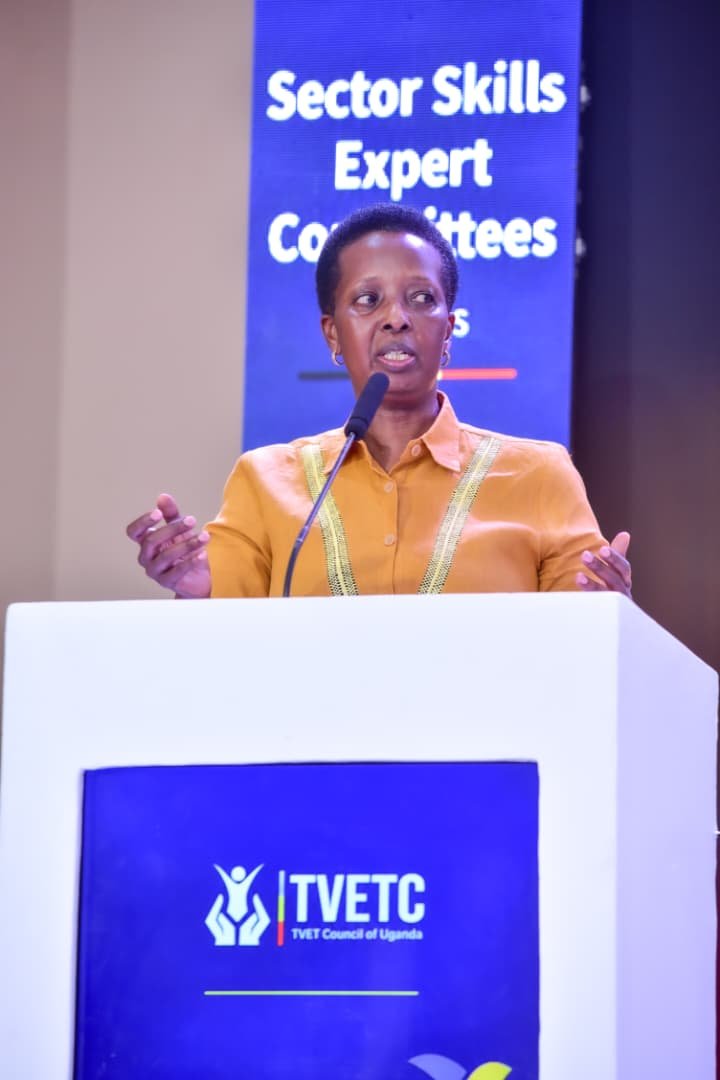
The warning came Tuesday during the launch of the Sector Skills Expert Committees (SSECs) at Protea Hotel, Entebbe, where Government challenged training institutions to stop operating in isolation from the job market.
State Minister for Education and Sports, Phyllis Chemutai, said Uganda must urgently establish what skills employers need now — and what they will need in the future.
“This is not merely an education question. It is a question of national development,” Chemutai said.
She warned that Uganda’s huge youthful population could either become an economic advantage or a major development challenge, depending on whether young people acquire relevant skills.
Uganda’s population stood at about 45.9 million in 2024, with 77.8% below the age of 35, according to figures cited by the Minister.
Chemutai said Government cannot continue training young people only for them to graduate and sit at home waiting for jobs that may not exist.
“We cannot afford to educate a generation that is waiting for opportunities that do not exist. We must educate and skill a generation that is capable of creating opportunities,” she said.

‘STOP TRAINING FOR THE SAKE OF IT’
TVET Council Executive Director Moses Kasakya was equally blunt, saying some institutions continue offering courses simply because the programmes exist rather than because there is demand for the skills.
“That is the problem the Sector Skills Expert Committees are designed to help address,” Kasakya said.
The committees are expected to identify skills gaps, provide labour-market intelligence, advise on funding priorities, recommend new training programmes and flag courses that have become irrelevant.
Kasakya said the success of TVET should not be judged by how many certificates institutions produce.
Instead, he said, the focus should be on whether graduates have the right competencies, at the right time, quality and location, based on actual and emerging economic demand.
INDUSTRY ALSO WARNED
Government also turned its attention to employers, with Chemutai saying the private sector cannot continue complaining about skills shortages while leaving the entire responsibility for training to Government.
“Industry must become a co-producer of skills,” she said.

She called for closer collaboration between companies and training institutions so that the skills being taught reflect what is actually happening in the workplace.
According to Chemutai, Uganda’s changing economy is already creating demand for specialised skills in areas including artificial intelligence, cybersecurity, big data, biomedical engineering, petroleum, oil and gas and other emerging technologies.
She said the same approach should apply to agro-industrialisation, tourism, mining, ICT and manufacturing.
“If Uganda is investing in agro-industrialisation, we must know what skills the agricultural and agro-processing value chains require,” she said.

KAGINA DEMANDS HARD EVIDENCE
TVET Council Chairperson Allen Kagina challenged the newly appointed committees to stop making broad claims about skills shortages and instead provide evidence of exactly what employers require.
Rather than simply reporting that “the industry needs more technicians”, Kagina said the committees should produce recommendations backed by employer evidence, investment trends, occupational information, technological changes and labour-market data.
“You are intended to provide the intelligence that connects Uganda’s productive sectors to the skills system,” she said.
Kagina also warned against turning the committees into another bureaucratic layer dominated by meetings without results.
“Our vision is not ‘more TVET’ in the narrow sense. It is better-connected TVET: industry-led, evidence-informed, quality-assured and responsive to Uganda’s development ambitions,” she said.
She pointed to Germany, Singapore and Switzerland as countries from which Uganda could draw lessons on linking vocational education to economic development, while cautioning against copying their systems wholesale.
“We don’t need to copy another country’s system. But we should learn from countries that have treated vocational skills as part of their economic architecture rather than as a peripheral education service,” Kagina said.

Chemutai said Uganda has significant agricultural, mineral, industrial and technological opportunities but warned that resources alone cannot transform the country.
She said development would require skilled workers, entrepreneurs, professionals and technicians capable of turning those opportunities into productive enterprises.
“The Uganda we want cannot be built by policies alone. It must be built by skilled hands, informed minds, disciplined institutions and citizens who are able to turn Uganda’s resources into productive enterprises,” she said.
The Minister subsequently launched the Sector Skills Expert Committees, giving them the task of strengthening the link between Uganda’s training institutions and the world of work.
GOT A HOT STORY? LET US KNOW!
Got breaking news, explosive secrets, or hard evidence?
Email us: redpeppertips@gmail.com
We accept tips, documents, videos, photos, and recordings—the more evidence you have, the better.
CONFIDENTIALITY IS OUR TOP PRIORITY. SOURCES ARE ALWAYS PROTECTED!
About Post Author
