The Local Council I (LC I) and Local Council II (LC II) administrative structures remain the cornerstone of Uganda’s decentralized system of governance. Since the inception of decentralization, the Government has deliberately brought leadership and decision-making closer to the people—empowering communities to actively identify priorities, monitor public services, and hold leaders accountable.
This vibrant citizen engagement was recently demonstrated during visits by Ministers of Local Government to the Bugisu Sub-region, where local communities openly exposed corrupt practices and demanded greater transparency.
As Uganda prepares for the upcoming Village (LC I) and Parish/Ward (LC II) elections, citizens have a crucial opportunity to reinforce this democratic foundation by electing competent, dedicated leaders of high integrity.
A Comprehensive Structure for Responsive Governance
Under the Local Governments Act, the LC I and LC II Executive Committees are designed to ensure every facet of community life is represented through dedicated portfolios:
Executive Officers: Chairperson, Vice Chairperson, General Secretary, and Secretary for Finance.
Security & Development: Secretary for Defence and Security; Secretary for Production and Environmental Protection.
Public Outreach & Services: Secretary for Information, Education, and Communication.
Special Interest Groups: Secretary for Youth Affairs; Secretary for Persons with Disabilities (PWDs); Secretary for Women Affairs.
This structured composition ensures residents know exactly where to seek assistance on specific matters while fostering inclusive, accessible, and responsive grassroots governance.
Core Roles and Responsibilities of Local Councils
Local Council leaders occupy a unique position as the closest elected officials to the people. Their core responsibilities span administrative duties, socio-economic mobilization, and conflict resolution:
Grassroots Administration: LC I Executive Committees implement council decisions, convene village assemblies, safeguard public property, and communicate local priorities to higher levels of Local Government.
Socio-Economic Mobilization: Local leaders drive community participation in major national initiatives, including the Parish Development Model (PDM), Emyooga, immunization campaigns, environmental conservation, and local sanitation drives.
Dispute Resolution & Social Cohesion: By mediating boundary disputes, domestic conflicts, and neighborhood disagreements, Local Councils resolve issues before they escalate—strengthening social harmony while easing pressure on the formal judicial system.
Peace & Security: Working closely with security agencies and residents, councils maintain vigilance, identify emerging threats, and safeguard law and order at the village level.
Grassroots Vigilance: The First Line of Defense Against Corruption
As the Government intensifies its fight against corruption, the front line begins in the village and parish. Honest Local Council leaders protect public resources by verifying beneficiaries of government programs, monitoring infrastructure projects, and reporting instances of abuse or substandard service delivery.
The courage demonstrated by communities in exposing corrupt officials during recent ministerial tours underscores the power of civic partnership in demanding accountability.
The Upcoming Elections: A Civic Responsibility
The forthcoming LC I and LC II elections offer citizens a chance to choose leaders who prioritize the public interest over personal gain. Voters should evaluate candidates based on their track record, honesty, approachability, and commitment to serving all community members without discrimination.
Decentralization thrives on the principle that decisions affecting a community are best made with the direct involvement of those who live there. Participating in these elections goes beyond filling political offices—it directly shapes local development, security, and service delivery.
The Ministry of Local Government remains committed to empowering Local Councils through policy support, capacity building, and institutional collaboration. Strong Local Councils build stronger Local Governments, leading to a more prosperous and resilient nation.
Call to Action: The Ministry encourages all eligible Ugandans to participate actively in the electoral process—whether by offering themselves for leadership or by voting peacefully and responsibly. The strength of our nation begins at the village level.
Do you have a story in your community or an opinion to share with us: Email us at Submit an Article
Uganda’s first Miss Universe Uganda, Mitchelle Daka, has begun a new chapter in her journey to the global stage after visiting Uganda Breweries Limited (UBL) headquarters in Luzira alongside fellow pageant queens.
Daka, who was crowned on August 1, was joined by first runner-up Kimberly Jael Aremo and Top Supermodel Teopista Aromach for a visit hosted by V&A Sherry, which has named Daka its Face of V&A 2026.
The visit offered the queens an opportunity to tour the UBL brewery, meet members of the company’s leadership and see where V&A Sherry is produced, while also celebrating their achievements following the inaugural Miss Universe Uganda competition.
Daka’s victory has placed her at the centre of a historic moment in Ugandan pageantry. She will become the first Ugandan to compete at the Miss Universe competition in its 75-year history when she represents the country in Puerto Rico in November.
For the brand, however, its relationship with Daka began before she won the crown.
V&A Sherry had selected her as its Face of V&A ahead of the Miss Universe Uganda finale, citing her qualities and potential. Her subsequent victory has given the partnership added significance as she prepares to take Uganda to the international stage.
“We decided to host the queens to show them where the amazing V&A Sherry is made, to show our support and congratulate them upon winning,” said Roy Ronald Tumwizere, Brand Manager, V&A Sherry.
“They will be going to the global pageants, and we promise to keep supporting them as they represent our country on the global stage.”
The partnership is built around V&A’s “Yours to Share” philosophy, which positions meaningful moments and achievements as experiences that become more special when shared with others.
As the brand’s Face of V&A and ambassador, Daka is expected to embody that message throughout her reign and as she prepares for her international debut.
UBL Marketing Director Catherine Ndungu congratulated Daka, Aremo, Aromach and the other contestants who took part in the inaugural competition, praising them for stepping forward to represent their communities.
“First, allow me to say that you all look so beautiful. I and the team here are very proud of you, and we are excited to see what the partnership with Miss Universe Uganda means for the brand,” Ndungu said.
UBL Head of Spirits Hilda Aguti also congratulated the queens and welcomed the partnership between V&A Sherry and Miss Universe Uganda, saying it reflected the brand’s commitment to supporting women.
“We congratulate you for winning, and we would like to see what our partnership with the Miss Universe platform is going to be like beyond the run,” Aguti said.
“We appreciate the good work done by Joram and team because it is in line with what V&A stands for, women empowerment.”
Joram Muzira, Director of Miss Universe Uganda, thanked V&A Sherry for supporting the inaugural competition and its focus on creating opportunities for women.
For Daka, the visit was also a reminder that her relationship with the brand began before the crown.
She thanked V&A for believing in her early on and choosing her as Face of V&A before she became Miss Universe Uganda, expressing hope that the partnership would be mutually beneficial.
With her Miss Universe debut now approaching, Daka’s focus will shift from making history at home to representing Uganda on one of the world’s biggest beauty pageant stages.
She will travel to Puerto Rico in November, where she will carry Uganda’s flag as the country’s first contestant in the 75-year history of the Miss Universe competition.
Don’t want to miss out on any story? For updates on all Sqoop stories, follow this link on Telegram: https://t.me/Sqoop
What started as an ordinary rehearsal morning turned into an unexpected celebration for singer-songwriter Kenneth Mugabi when Roy Tumwizere walked into his live session at Marish Studio in Bukoto with a surprise announcement.
Tumwizere revealed that V&A Sherry would sponsor Mugabi’s 10th anniversary concert, set for September 12 at Ndere Cultural Centre.
The concert will mark a decade of Mugabi’s music career and is part of his ongoing 10 Years of Kenneth Mugabi celebration. The September show will also give fans a chance to shape the setlist, with Mugabi revisiting songs from across his catalogue.
More than 30,000 fans tuned into the live rehearsal, where they helped Mugabi select songs for the upcoming performance. Among the tracks revisited during the session were Sanyu, Nkwengomba and Naki, songs that have helped establish his reputation as one of Uganda’s distinctive soul voices.
For Tumwizere, the partnership is about more than attaching a brand to a concert. He described it as a recognition of the persistence, creativity and commitment that have defined Mugabi’s decade in music.
“Kenneth Mugabi’s decade-long musical journey represents years of creativity, persistence and commitment to his craft, a story that V&A believes deserves to be recognised and shared,” Tumwizere said.
He added that he was particularly excited about the partnership because he is personally a fan of Mugabi’s music.
“I am excited about this partnership because, personally, I am a great fan of Mugabi, and V&A Sherry is made for moments like these. Celebrating 10 years is a milestone worth recognising and sharing,” he said.
For Mugabi, the concert is as much about the people who have supported his music as it is about marking his own achievement.
The show will also double as his birthday celebration, giving him an opportunity to bring together fans who have followed his journey from the early days of the Kibun’omu album.
“This concert is special because it doubles as my birthday and is my way of celebrating that journey with everyone who has been part of it from the days of the start of the Kibun’omu album,” Mugabi said.
“Having V&A Sherry on board makes the celebration even more special, and I am excited for us to share this moment.”
The partnership comes at a significant point in Mugabi’s career. Rather than simply looking back at his achievements, the singer is using the anniversary to reconnect with the audience that has grown with his music.
The concept for the September concert places fans at the centre of the experience, with the audience choosing songs they want Mugabi to perform. The show is expected to combine some of his defining records with deeper cuts from his catalogue.
Mugabi has also kept one major detail under wraps. During the rehearsal, he revealed that an East African music legend he has long admired will join him on stage, although he declined to disclose the identity.
“V&A has surprised me this morning. I’m also keeping this as a surprise for my fans,” he said.
The September concert will therefore offer more than a celebration of Mugabi’s past 10 years. It will bring together his music, his fans and a few surprises as he begins the next chapter of his career.
V&A Sherry is also planning to complement the music with curated settings, special cocktails and an experience designed around celebrating milestones and sharing memorable moments.
For an artist whose music has often centred on emotion, storytelling and human connection, the anniversary concert promises to be a fitting celebration of the people who have been listening along the way.
After 10 years, Mugabi is not simply counting the years. He is inviting the people who helped make the journey possible to sing the songs, share the memories and celebrate what comes next.
Don’t want to miss out on any story? For updates on all Sqoop stories, follow this link on Telegram: https://t.me/Sqoop
KAMPALA — Uganda Airlines has been rocked by a damning internal audit into its global communications strategy, with more than Sh1.6bn billion in questionable, unsupported or irregular expenditure coming under scrutiny and the airline’s Head of Public Relations and Corporate Affairs, Shakila Rahim Lamar, emerging as a key official in the audit findings.
The explosive findings reviewed by RedPepper are contained in a Management Letter on the Audit of the Contract Management Process dated February 16, 2026, prepared by Uganda Airlines’ Internal Audit department.
The audit specifically examined the procurement of the Global Communications Strategy, referenced as UNACL/CONS/22-23/00188, and flagged a string of procurement, contract management, expenditure and accountability concerns involving TBH Holding Ltd and Metropolitan Republic Uganda Ltd.
At the centre of the storm is a communications contract that was initially estimated at about Sh1.117 billion, but which eventually recorded actual expenditure of Sh1.628 billion, representing a Sh478.7 million overrun against the contracted amount.
But the audit trail goes even deeper.
Auditors questioned how TBH Holding Ltd ended up with a contract in the first place, arguing that the bidding documents did not reflect the recommendation of the Evaluation Committee to divide the work between the two firms.
According to the audit, the Evaluation Committee had recommended TBH Holding Ltd for global footprint content and Metropolitan Republic Uganda Ltd for content creation.
However, the original terms of reference did not divide the scope in that manner.
More dramatically, the audit states that Metropolitan Republic Uganda Ltd was the only bidder that submitted a bid within Uganda Airlines’ USD300,000 budget, quoting USD276,231.
TBH Holding Ltd, on the other hand, had an evaluated price of USD382,013 and, according to the audit, should therefore not have been recommended for the contract award.
Then came the negotiations.
On November 30, 2023, Uganda Airlines negotiated with both firms, eventually agreeing to pay Sh500 million to Metropolitan Republic Uganda Ltd and Sh650 million to TBH Holding Ltd.
The audit says the two entities were contracted for a similar scope and that the negotiations “may be inferred” to have been aimed at bringing TBH in as an additional Best Evaluated Bidder within the airline’s overall USD300,000 budget.
The Contracts Committee subsequently awarded TBH the contract despite the deviation from the pre-approved terms of reference.
SH1.63BN SPENDING — BUT WHERE DID THE MONEY GO?
The audit found that while the communication strategy had been estimated at Sh1.117 billion, the two contracts were eventually signed at a combined Sh1.15 billion.
But actual execution, based on purchase orders and invoices, shot up to Sh1.628 billion — a 42 percent overrun, amounting to Sh478.755 million.
Metropolitan Republic Uganda Ltd had been contracted for Sh500 million but had actual reported expenditure of Sh408.451 million.
TBH Holding Ltd, however, had a contract value of Sh650 million, yet the audit recorded actual expenditure of Sh1.220 billion against it.
That means TBH’s actual spending was about Sh570.3 million above its contracted amount.
Auditors recommended that management should continuously compare actual expenditure against estimated and contracted amounts and ensure that any variations or additional expenditure are properly reviewed, approved and documented by the Contracts Committee.
SH258.6M CREATIVE BILL
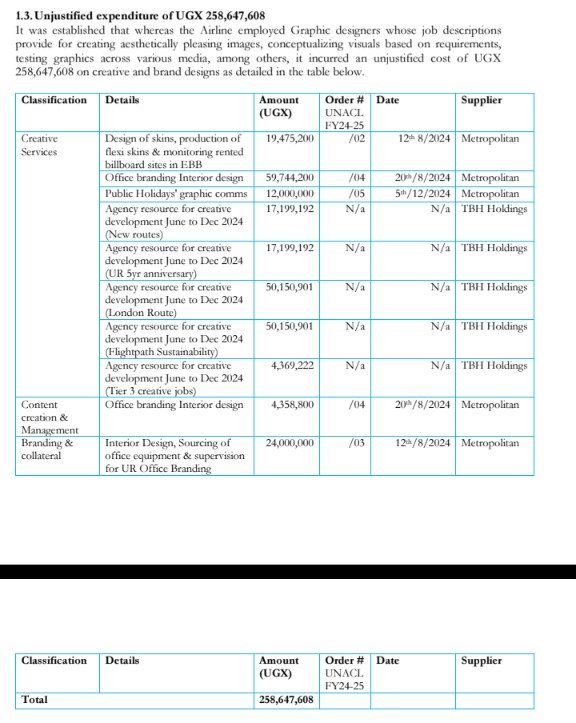
The audit also put a spotlight on Sh258.647 million spent on creative and brand design work.
Auditors questioned why Uganda Airlines was paying external agencies for creative services when the airline already employed graphic designers whose job descriptions included creating images, developing visuals and testing graphics across different media.
Among the expenditure flagged were payments to Metropolitan for billboard skins and monitoring, office branding and interior design, public holiday graphics, as well as other branding and content-related services.
TBH was also paid for agency creative resources covering projects including new routes, the airline’s five-year anniversary, the London route, Flightpath Sustainability and Tier 3 creative jobs.
The total flagged under this section was Sh258,647,608.
The auditors recommended that future creative and brand design work should be handled internally by Uganda Airlines’ employed graphic designers.
More significantly, the audit specifically recommended that the Manager Corporate Affairs and Public Relations should justify and account for the Sh258.647 million expenditure in the presence of the airline’s internal graphic designers.
SH164M PAID WITHOUT PURCHASE ORDERS
The audit then uncovered another eyebrow-raising issue.
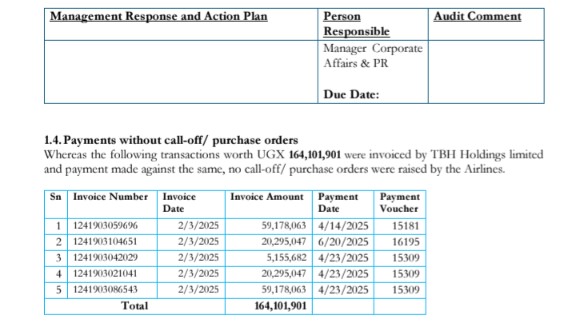
TBH Holdings Ltd invoiced Uganda Airlines for Sh164.101 million, and payments were made despite the absence of call-off or purchase orders.
The invoices included payments of Sh59.178 million, Sh20.295 million, Sh5.155 million, another Sh20.295 million and Sh59.178 million, bringing the total to Sh164.101 million.
Auditors recommended that, as contract manager, the Manager of Corporate Affairs and Public Relations should provide justification and an account for the money paid without call-offs or purchase orders.
The Chief Finance Officer was also advised to enforce complete procure-to-pay documentation before vendors are paid.
SH778.9M AFTER CONTRACT EXPIRY
And this is where the audit takes another dramatic turn.
The auditors established that Metropolitan Republic Uganda Ltd’s contractual period ended on February 23, 2025.
TBH Holding Ltd’s contract subsequently ended on March 12, 2025.
Yet Uganda Airlines continued procuring services from TBH after the contract had expired.
According to the audit, there was no documented approval from the Contracts Committee for an extension of TBH’s contract.
The result?
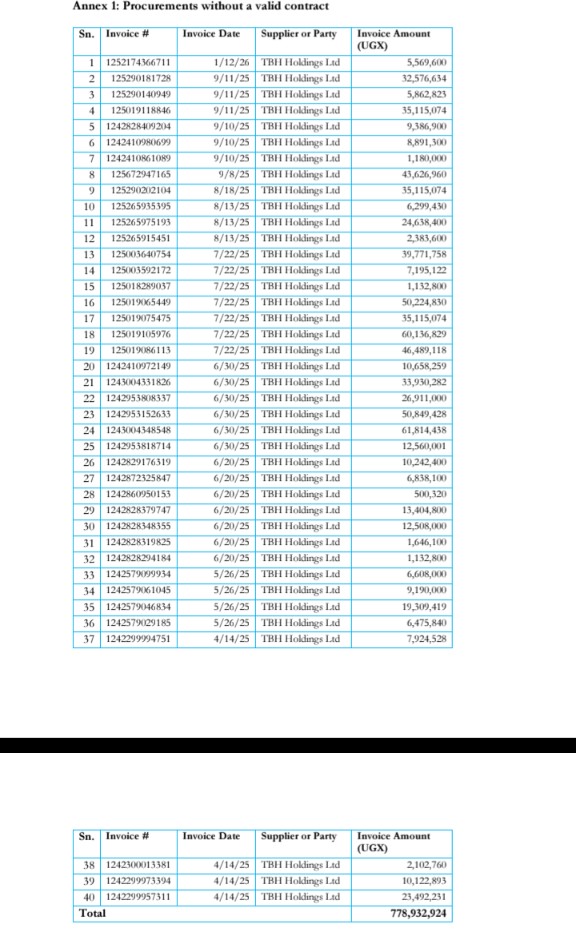
A staggering 40 transactions worth Sh778,932,924 were procured from TBH without a valid contract.
Auditors warned that operating without a valid contract exposes the airline to payments for undelivered, partially delivered or poor-quality services, retrospective justification of irregular procurements and the inability to enforce service levels, timelines and quality standards.
They recommended a strict “no contract, no service, no payment” policy, except for properly authorised emergency procurement.
SH1.575BN — NO PROOF OF DELIVERY
The audit also found that Sh1.575 billion had been spent under the global communications strategy contract, but auditors could not find sufficient evidence showing that the contracted services had actually been delivered.
Apart from quotations, call-off orders and invoices, auditors said there were no documented delivery records or contract management reports in the procurement files or Oracle Fusion ERP system.
Missing evidence included delivery notes or job cards, monitoring reports for media houses and social media, proof of billboard installations, repositories of developed photos, videos, audio and visual advertisements, graphical designs, meeting minutes, performance evaluations and budget reports.
Auditors consequently recommended that the Manager Corporate Affairs and Public Relations provide the contract management records and prove delivery of the deliverables under the contract.
NEW DEAL RAISES FRESH FEARS
As if the findings were not enough, auditors discovered that a new procurement process for the global communications strategy was already ongoing.
The concern was that the new procurement was based on the same terms of reference and scope of work as the previous contract that had generated the audit findings.
Auditors warned that this could result in duplication of services or deliverables, potentially causing further financial loss to Uganda Airlines.
The Contracts Committee was therefore advised to review the new procurement to ensure that proper needs assessment, scoping and resource allocation had been undertaken.
THE TBH MONEY TRAIL
The audit annex provides a detailed list of the 40 transactions made to TBH after the contract had expired.
The transactions range from millions to tens of millions of shillings.
Among them was a Sh5.56 million invoice dated January 12, 2026; Sh32.57 million and Sh5.86 million invoices dated September 11, 2025; and a Sh35.1 million invoice dated September 10, 2025.
Other payments included Sh43.6 million, Sh35.1 million, Sh24.6 million, Sh39.7 million, Sh50.2 million, Sh35.1 million, Sh60.1 million and Sh46.4 million, among numerous other transactions.
The annex ultimately totals the disputed post-contract transactions at Sh778,932,924.
The audit letter was signed by Ronald Otukol, Manager Internal Audit, and copied to the Chairperson of the Contracts Committee and the Acting Manager of the Procurement and Disposal Unit.
For Shakila Rahim Lamar, Uganda Airlines’ Head of Public Relations and Corporate Affairs, the audit places the office responsible for Corporate Affairs and PR squarely in the accountability chain, particularly regarding the creative expenditure, payments made without call-offs and purchase orders, and contract management records.
The audit, however, does not by itself establish that Lamar personally received money, committed fraud or acted corruptly.
Rather, it identifies expenditure and contract-management weaknesses and assigns accountability actions to the relevant management offices.
The findings now raise hard questions over how Uganda Airlines manages multimillion-shilling communications contracts, why external agencies were engaged for work apparently capable of being performed internally, why payments continued after contract expiry, and why billions in expenditure were not backed by the delivery documentation expected by auditors.
For an airline operating on public resources, the big question is no longer simply how much was spent on public relations.
It is: What exactly did Uganda Airlines get for the money?
GOT A HOT STORY? LET US KNOW!
Got breaking news, explosive secrets, or hard evidence?
Email us: redpeppertips@gmail.com
We accept tips, documents, videos, photos, and recordings—the more evidence you have, the better.
CONFIDENTIALITY IS OUR TOP PRIORITY. SOURCES ARE ALWAYS PROTECTED!
Hollywood is starting to chase a new kind of entertainment, and it is designed to fit inside a smartphone.
Microdramas, short scripted shows made for vertical screens, have become hugely popular in Asia and are now gaining ground in the United States.
Unlike traditional TV dramas, these shows move quickly. Episodes often last only a few minutes, but creators pack them with romance, betrayal, revenge and cliffhangers that make viewers want to keep watching.
That formula is already turning into serious business. The US microdrama market could reach about $1.5 billion this year, according to estimates cited by Reuters.
As the audience grows, major entertainment companies are taking notice.
The format also has a major advantage: it costs much less to produce than traditional television. At the same time, viewers can watch an episode almost anywhere, whether they are commuting, taking a break or scrolling on their phones.
Some platforms have found another way to keep viewers hooked. They offer the first few episodes for free, then charge users to continue watching the story.
For Hollywood, that combination of cheap production, quick episodes and an increasingly mobile audience is becoming difficult to ignore.
Microdramas may have started as a phone-first trend, but they are quickly becoming a serious part of the entertainment business.
KAMPALA, UGANDA — The Uganda Police Force has warned members of the public against an online investment platform operating in Uganda under the name “Hut 8,” following complaints that some investors are allegedly unable to access their accounts or withdraw their money.
In a statement issued Tuesday, August 18, 2026, Police said preliminary information indicates that individuals were allegedly lured through social media platforms to deposit money with promises of financial returns.
Police said some of those who invested are now reportedly experiencing difficulties accessing their accounts or withdrawing their funds.
Although no formal complaints have so far been received by Police, the force said the legitimate Hut 8 Corporation has publicly distanced itself from the alleged investment solicitations in Uganda.
According to Police, the company has stated on its X account that it has no authorised representatives or investment operations soliciting funds in Uganda.
The Police said it is working with relevant regulatory and financial-sector agencies and is ready to receive complaints and information that could help establish the circumstances surrounding the activities.
The investigation will also seek to identify the individuals or entities behind the alleged investment scheme and determine appropriate action in accordance with the law.
Police seek evidence from victims:
Police have urged anyone affected by the alleged scheme to report to the nearest Police station and provide all available evidence.
Such evidence may include payment records, mobile-money and bank transaction references, telephone numbers, social-media accounts, online links, screenshots, chat messages and details of individuals who recruited or promoted the platform.
The force also warned members of the public against paying additional money to individuals claiming they can facilitate withdrawals or unlock frozen accounts.
Police further cautioned suspected victims against falling for a second scam involving individuals who claim to recover lost funds in exchange for an upfront payment.
“This may constitute another form of fraud,” Police warned.
The force said further updates will be communicated as investigations progress.
Do you have a story in your community or an opinion to share with us: Email us at Submit an Article
ByteDance is taking new steps to protect Hollywood’s copyrighted material after its AI technology sparked concerns over the use of movie characters and celebrity likenesses.
The company behind TikTok has agreed with the Motion Picture Association (MPA) to strengthen copyright safeguards for its AI video and image-generation tools.
The agreement follows months of tension between the technology company and Hollywood studios.
Earlier this year, the MPA sent ByteDance a cease-and-desist letter after concerns emerged over its Seedance 2.0 AI video tool.
The technology allowed users to create highly realistic clips, including content featuring famous actors and characters that belong to major movie franchises.
That raised alarm among studios worried that AI could allow users to recreate their intellectual property without permission.
ByteDance has responded by strengthening its safeguards and working with the MPA on ways to prevent unauthorised use.
The deal comes as Hollywood and technology companies continue to negotiate over AI, copyright, and the future of creative work.
For ByteDance, the agreement could help ease tensions with the film industry.
For Hollywood, it is another step toward putting limits around increasingly powerful AI tools.
YouTube is changing the way it counts video views, and creators could soon see their numbers rise much faster.
Starting August 24, a public view will count as soon as someone starts playing a video. The change will cover regular videos, Shorts, and live streams.
In simple terms, viewers will no longer need to watch for a certain amount of time before their playback counts as a public view.
That could be good news for musicians and creators who closely follow their YouTube numbers. Songs and videos could reach major view milestones faster under the new system.
However, the change does not mean creators will automatically make more money.
YouTube will still use separate engagement figures to measure how viewers interact with videos and determine important monetisation metrics.
The platform will also keep its “Engaged views” figure in YouTube Analytics. This will help creators see how many people actually stayed and watched their content.
The biggest change will therefore be the number that fans see publicly below a video.
For artists, that could make milestones such as 10 million, 50 million or 100 million views easier to reach. But the bigger public number will not necessarily mean viewers spent more time watching.
In short, YouTube is making it easier for a video to register a public view, but meaningful engagement will still matter.
He says he eventually gave up counting when the seventh vehicle arrived.
I stopped counting on the 7th car that came for the money collected from Kololo from the King Saha concert.
The crowd was just as difficult to keep track of.
From morning, fans lined up to get into the venue, and the flow did not stop as the concert went on.
Even as King Saha reached the final song of his performance, Nobat says more fans were still entering.
I had never seen a concert where people lined up from morning until the end of the show. Even when Saha sang his last song, fans were still entering.
Leaving Kololo was no different.
The crowds formed lines again as they made their way out, adding another unusual scene to a concert Nobat says stood out from the many shows he has witnessed.
I have never seen a concert where people lined up while entering and even when leaving. When it was time to get out, we were still moving in lines.
The self-styled “Generational Promoter” could only sum up the experience in three words: “What a concert!”