The Ministry of Finance, Planning and Economic Development has established a Project Execution Unit to strengthen implementation of loan-funded projects and ensure that borrowed funds deliver the intended results.
This was revealed before the Committee on National Economy on Tuesday, 11 August 2026, where the Minister, Hon. Henry Musasizi, led a team of technical officers to present the ministry’s report on public debt, grants, guarantees and other financial liabilities.
The move comes amid persistent concerns from members over low utilisation and absorption of borrowed funds, which they say undermines the intended benefits of loans while increasing the country’s debt burden.
The Ag. Commissioner for Development Assistance and Regional Cooperation Department, Juvenal Muhumuza, said the Project Execution Unit will closely monitor implementation of projects and ensure that challenges affecting their performance are addressed.
“The unit will follow up issues affecting project performance on a regular basis and flag them to management for action,” said Muhumuza, who represented the Permanent Secretary.
Muhumuza also revealed that the ministry has tightened management of counterpart funding following cases of misuse by government entities. He said monitoring, approval and utilisation of counterpart funding has now been centralised under the Office of the Accountant General. “This reform is aimed at addressing diversion of funds from intended purpose under, under budgeting, inadequate accountability and oversight of counterpart funding,” said Muhumuza.
He observed that poor performance of some loan-funded projects arises from delays in procurement, clearance of environmental reports and payment of contractors, among other implementation challenges. These bottlenecks have been addressed under new Standard Operating Procedures approved by Cabinet in March 2025, Muhumuza said.
He supported Musasizi’s position that Uganda can sustain its public debt if challenges affecting the performance of borrowed funds are addressed. In this he cited a facility established at the National Planning Authority to support timely preparation of feasibility studies and project designs.
Hon. Patrick Wakida (NRM, Kabweri County) expressed concern that government was not investing borrowed funds wisely, warning that the country could be heading towards a debt trap.
“If you look at how much of the debt we actually have, you realize it eats in the national budget, we are paying more to clear debts than investment,” he said. Hon. Hassan Kirumira (NUP, Katikamu South) criticised government’s increasing reliance on borrowing from commercial banks, saying it was crowding out private sector borrowers.
Hon. Boniface Okot (NRM, Kole South) asked the ministry to address duplication of projects, where government entities operating within the same sector acquire loans to implement similar projects.
“The commercial banks prefer lending to government, as it is less risky. This makes access to credit for the private sector expensive. We need to minimize domestic borrowing in order to boost the private sector,” Kirumira said.
The committee asked the ministry to assess government entities with a history of poor loan utilisation and prioritise borrowing for institutions with demonstrated capacity to implement projects within agreed timelines.
Do you have a story in your community or an opinion to share with us: Email us at Submit an Article
Ugandans are lining up across the country to collect new national identity cards, with the exercise turning into a nightmare of long queues, confusing collection points and citizens being sent from one district to another in search of their IDs.
Citizens who registered in Wakiso District say they are being forced to move from one collection centre to another, with some being directed to Kira, Nansana, Makindye-Ssabagabo, Entebbe and other areas to collect their cards.
The queues, according to frustrated citizens, are stretching for hours and, in some places, resemble the River Nile.
And now, with thousands of Ugandans rushing to collect renewed national IDs, the question being asked is simple: why can’t NIRA decentralise collection to parish level?
The pressure has been made worse by the fact that many old national IDs expired around the same period.
At the same time, children who were registered years ago have now grown into adults and are joining the queue to collect their first cards.
But there is another twist.
In some places, the new IDs are reportedly not yet being accepted for certain transactions, with citizens instead being asked to produce their old cards.
For Ugandans who have already spent hours in queues trying to obtain the new cards, the situation is becoming a source of anger and frustration.
And behind the current chaos lies a damning picture of the National Identification and Registration Authority (NIRA), contained in the Auditor General’s findings.
The institution charged with defining the identity of every Ugandan is itself facing what amounts to an identity crisis.
The audit exposes funding gaps, staffing shortages, system failures, delayed IDs, weak planning, procurement shortcomings, poor asset management and serious weaknesses in the country’s civil registration systems.
At the centre of the storm is former Executive Director Rosemary Kisembo, who took over on May 14, 2021, with a strong ICT background from the Uganda National Roads Authority (UNRA).
She replaced Judy Obitra Gama, whose tenure ended after a string of challenges at the authority.
Kisembo’s contract expired in May 2026, putting the leadership of NIRA under fresh scrutiny as the institution struggles to clear a massive backlog of national IDs.
“She came in as the technocrat to fix things,” an insider told RedPepper. “But now the system is exposing her. The pressure is unbearable.”
SHS6BN DEBT
According to the Auditor General, NIRA was sitting on domestic arrears amounting to UGX6.075 billion.
This was an increase from UGX6.025 billion recorded the previous year.
While the increase may appear relatively small compared with NIRA’s wider budget, the Auditor General’s findings point to broader financial and planning weaknesses within the authority.
But the biggest headache is manpower.
NIRA has an approved structure of 571 positions, but only 422 were filled.
That leaves 149 positions vacant — representing a 26 percent vacancy rate.
Several critical departments are badly understaffed.
Internal Audit has a 67 percent staffing gap.
Communication and Public Relations is also short by 67 percent.
ICT is missing nearly half of its required workforce.
Civil Registration Services and Legal Affairs are also severely depleted.
“How do you run a national identity system without people?” an insider asked. “This is not just a gap — it’s a collapse.”
NO PERMANENT HOME
NIRA is also operating without a permanent headquarters.
The authority has been operating from temporary premises at Kololo Independence Grounds.
The arrangement has raised concerns about efficiency and public service delivery.
Even more troubling, according to the audit findings, is the absence of a front desk or customer care officer at the headquarters to guide citizens seeking services.
For an institution serving millions of Ugandans, the lack of a proper customer-care structure has left citizens struggling to find information and direction.
“You go there and it’s confusion,” one citizen complained. “No direction, no help, just queues and frustration.”
PROCUREMENT TROUBLES
The problems extend into procurement.
NIRA failed to indicate procurements reserved for registered associations.
As a result, no contracts were awarded to such associations as required by the relevant guidelines.
The Procurement and Disposal Unit itself is understaffed and under-resourced.
Only two of the three required staff positions were filled.
The unit also conducted just one training out of four that had been planned.
“This is a system limping from one mistake to another,” a source said.
ASSETS IN CHAOS
NIRA has a transport policy, but the authority lacks a comprehensive framework for managing other important assets, including ICT equipment and furniture.
The audit also points to weaknesses in maintenance records, asset tracking and accountability.
“It’s like running a digital authority with analogue thinking,” an analyst remarked.
SHS69.7BN FUNDING GAP
NIRA’s strategic operations have also been hit by a major funding shortfall.
The authority planned to receive UGX751.9 billion, but faced a funding gap of UGX69.72 billion — about nine percent of the planned amount.
The shortfall affected implementation of key interventions.
Even more worrying, NIRA failed to finalise its new strategic plan aligned to national priorities by the July 2025 deadline.
The authority was therefore left operating without the strategic roadmap that was supposed to guide its next phase.
The National Planning Authority rated NIRA’s budget compliance at only 63.2 percent.
Performance indicators were also criticised for being vague, generic and, in some cases, inappropriate.
“It’s like they are measuring shadows,” a policy expert said.
THE ID NIGHTMARE
But it is the national ID exercise where the crisis becomes most visible to ordinary Ugandans.
NIRA’s mass enrolment and ID renewal programme has been hit by funding shortages, staffing gaps and operational challenges.
Over a three-year period, UGX666.85 billion was budgeted for the exercise.
However, only UGX410.05 billion was received.
That left a massive funding shortfall of UGX256.8 billion.
And even the money that was received was not fully utilised.
UGX15.24 billion remained unspent in the 2024/2025 financial year.
“They don’t have enough money, and the little they have, they don’t use properly,” an insider said.
The staffing problem made matters worse.
NIRA had planned to deploy 13,787 temporary workers for the mass enrolment exercise.
Only 9,809 were deployed.
That left a shortfall of nearly 4,000 workers.
The result has been slow processing, delayed approvals and mounting queues.
As of October 2025, more than 11.5 million Ugandans had applied for ID renewals.
But only 45 percent had been cleared for printing.
For first-time applicants, the situation was even worse.
Only 0.2 percent had been approved for printing.
“That is basically zero,” an analyst said. “It means the system is not working.”
Even among applicants who had been approved, only 41 percent of the cards had actually been printed.
And then came another shocking revelation.
Out of 4.3 million applications for new National Identification Numbers, or NINs, not a single one had been allocated as of the period covered by the audit.
By late October 2025, a staggering 17 million applicants were still waiting for their national IDs.
“This is not just delay,” a source said. “It is a complete system failure.”
WHY NOT PARISH COLLECTION?
The current situation has reignited calls for NIRA to rethink how IDs are distributed.
Citizens, particularly in heavily populated areas such as Wakiso, are asking why collection cannot be brought closer to the people.
Instead of forcing citizens to travel to distant district or municipal collection points, NIRA could decentralise the process to parishes.
Such an arrangement would reduce congestion at collection centres and cut the transport costs and time currently being spent by citizens chasing their cards.
For Wakiso residents, the problem is particularly acute.
A person who registered in one area can reportedly be directed to another location to collect the card.
One citizen may be sent to Kira.
Another to Nansana.
Another to Makindye-Ssabagabo.
Another to Entebbe.
The result is a frustrating game of “go there, come back, try another centre.”
And with millions seeking new cards at the same time, the pressure on collection points has become enormous.
SYSTEM CAN’T TALK TO ITSELF
The audit also exposes problems beyond national IDs.
Marriage registration systems are affected by ICT gaps and weak data security.
Birth and death registration processes face delays.
The National Security Information System (NSIS), which serves as the backbone of NIRA’s operations, cannot register births and deaths.
It is also not fully integrated with third-party systems.
Data migration has been delayed and some modules remain incomplete.
“There is nothing ‘national’ about a system that cannot talk to itself,” an ICT expert observed.
The authority also does not have a business continuity site.
That means a major disaster affecting its main systems could potentially disrupt the country’s entire identity infrastructure.
“This is a national security risk,” a senior official warned.
The audit further points to inconsistencies in data records, weaknesses in issuing death certificates and delays across civil registration services.
PARLIAMENT’S WARNINGS
Oversight has also come under scrutiny.
Of 11 recommendations issued by Parliament’s Public Accounts Committee, only two had been fully implemented.
The rest were either partially implemented or ignored.
At the top, Board Chairman Joseph N. Biribonwa faces mounting pressure over governance concerns.
Sources also describe an atmosphere of internal fights, leaks and lobbying.
“There is a war going on,” a source said. “People are feeding information to State House, trying to influence what happens next.”
KISEMBO’S FUTURE
The leadership question now hangs over NIRA.
Kisembo was appointed in May 2021 as the technocrat expected to bring an ICT-driven transformation to the authority.
But the Auditor General’s findings have put her tenure under intense scrutiny.
Sources claimed she was lobbying for another term as the problems mounted.
“It’s squeaky bum time,” an insider said.
The shadow of her predecessor, Judy Obitra Gama, also hangs over the situation.
Gama’s tenure ended after challenges surrounding NIRA’s performance.
Now the big question is whether the current leadership has done enough to justify continuity or whether the authority requires a fresh start.
“Yes, she has achievements,” a senior observer admitted. “The ID renewal process did start. Systems were introduced. But leadership is judged on outcomes — and right now, the outcomes are deeply troubling.”
For ordinary Ugandans, however, the debate is much simpler.
They want their IDs.
They do not want to travel across districts.
They do not want to spend entire days in queues.
And they certainly do not want to be handed a new card only to be told somewhere else that they must produce the old one.
As millions continue to wait, NIRA faces the biggest test of its credibility yet:
Can the authority fix the system before the queues become Uganda’s new national identity?
GOT A HOT STORY? LET US KNOW!
Got breaking news, explosive secrets, or hard evidence?
Parliament’s Committee on Physical Infrastructure has demanded that Uganda Railways Corporation (URC) account for 81 railway wagons reportedly sold as scrap for Shs3.7 billion.
The committee, chaired by Hon. Mwine Mpaka, raised the concerns on Tuesday, 11 August 2026, during an on-site inspection of URC headquarters as part of its ongoing inquiry into the corporation’s operations, assets, expenditure and procurement.
The inquiry comes ahead of Parliament’s consideration of additional resources to support the recovery and revitalisation of URC.
Mpaka questioned URC management over the disposal of railway assets, saying the committee had established that 81 wagons had been sold as scrap. He said MPs had also come across an advertisement for the sale of additional wagons in Tanzania, which had not been brought to the committee’s attention.
“We have come across another advert of wagons you want to sell in Tanzania, and you had not told us,” Mpaka said.
The committee chairman said the inspection was intended to establish the condition of URC’s assets and assess its expenditure before Parliament considers allocating additional resources to the corporation.
The scrutiny comes as URC seeks sustained government funding to rebuild its operations following years of inadequate investment, ageing equipment and a shortage of specialised railway personnel.
URC Managing Director Benon Kajuna told MPs that the corporation currently has only four mainline locomotives available for cargo operations, while its Kampala–Mukono passenger service operates with five coaches.
Kajuna said URC requires more than Shs100 billion annually for five years to stabilise its operations.
The corporation is also pursuing the procurement of 10 new locomotives and 100 flat wagons with support from the African Development Bank, alongside major rehabilitation of the railway line between Mombasa and Kampala.
However, MPs questioned whether Ugandans should wait five years before seeing significant improvements in railway services.
Bunyole West County MP Hon. James Waluswaka challenged the proposed recovery timeline, arguing that URC needed to deliver results more quickly.
“When you talk about five years, that means we shall be serving the lunch at dinner time,” Waluswaka said.
Waluswaka also questioned whether the procurement of new locomotives could be accelerated given the urgency of restoring an efficient and reliable railway system.
Kajuna explained that the manufacturing lead time for a new locomotive is about 2.3 years after a contract is signed because the equipment must be manufactured, tested and delivered.
The committee also revisited concerns over locomotives purchased during the 10th Parliament that had reportedly failed to operate effectively on Uganda’s metre-gauge railway.
Kajuna disputed suggestions that the locomotives were incompatible with the railway, explaining that their longer design created difficulties at a turning point affected by construction works for a flyover.
He further highlighted a shortage of specialised personnel within URC.
“We don’t have a signalling and telecommunications engineer. We don’t have an electrical engineer in the URC,” he said.
Kajuna attributed the skills gap partly to the suspension of railway staff training in the 1990s, when the government was pursuing plans to concession the railway.
He said URC is now recruiting specialised personnel and plans to establish a railway training institute under an African Development Bank-supported project.
The committee’s inquiry is expected to inform Parliament’s assessment of URC’s funding needs and the measures required to restore the corporation’s capacity to provide efficient passenger and freight railway services.
Do you have a story in your community or an opinion to share with us: Email us at Submit an Article
A test of the Kampala-Entebbe Expressway toll system has exposed operational gaps after a bus that should have paid Shs15,000 was allowed through a toll barrier after a Shs5,000 electronic card meant for light vehicles was manually used to clear it.
The incident shocked Members of Parliament who witnessed the test on Tuesday, 11 August 2026, during an on-site inspection of toll collection, management and maintenance operations along the expressway.
The development raised fresh concerns over revenue leakage, accountability and the effectiveness of the tolling system, particularly after MPs established that manual intervention remains possible despite earlier assurances that the system is automated.
The Parliamentary Committee on Physical Infrastructure, chaired by Hon. Mwine Mpaka, was assessing the operations of the expressway, including toll collection and the systems in place to safeguard revenue.
During the test, a toll card issued under Class 2, covering light vehicles with or without trailers and attracting a Shs5,000 charge per trip, was used to clear a bus classified under Class 4a, which covers large goods vehicles and buses with four to five axles and attracts a Shs15,000 charge per trip.
Although the card was not valid for the bus category, the officer on duty manually opened the barrier, allowing the vehicle to pass.
The incident prompted MPs to question how often such interventions occur and whether they could be contributing to revenue losses on the expressway.
The concerns came as the Ministry of Works and Transport considers the future management of toll collection following the takeover of operations by Pinnacle Security from EGIS.
Engineer Isaac Menya, a Network Planning Engineer at the ministry, was tasked by the committee to advise on the most appropriate model for managing the toll points.
Menya recommended that government could take over toll collection directly through a dedicated entity, provided adequate funds are guaranteed for road maintenance.
“My recommendation is that it does no harm for government to actually manage this toll directly, but under some mechanism where there is availability of money to maintain that road,” Menya said.
He cited Ethiopia, where toll expressways are largely managed through state-owned public enterprises, and Kenya, which uses public-private partnerships in which private investors build, finance and operate highways through long-term concessions.
However, Menya cautioned that placing the expressway under conventional government structures without a suitable operational framework could create bureaucratic delays in responding to routine maintenance and operational challenges.
He said a dedicated government entity would provide greater flexibility in managing toll revenue and carrying out routine maintenance without lengthy administrative procedures.
Meanwhile, Pinnacle Security General Manager Ivan Katamba told the committee that the company would engage the Ministry of Works and Transport on the possibility of removing toll exemptions for some categories of road users.
The proposal follows concerns from MPs that toll-free access could be contributing to revenue losses.
Hoima City Woman Representative Hon. Nyakato Asinansi questioned why contractors carrying out maintenance works on the expressway should be exempted from the Shs5,000 toll fee when they are paid by the government.
Committee chairperson Mwine Mpaka also demanded a comprehensive list of all individuals and categories of road users currently holding toll-free passes.
The inspection at Kajjansi formed part of the committee’s wider assessment of the management, toll collection systems and maintenance of the Kampala-Entebbe Expressway as Parliament scrutinises the effectiveness and sustainability of its operations.
Do you have a story in your community or an opinion to share with us: Email us at Submit an Article
Ugandan singer King Saha was on Tuesday evening reportedly arrested at his home in Kyanja following a dramatic security operation that witnesses say was punctuated by gunfire and left at least one person injured.
The arrest came just hours after the singer had been moving around Kampala mobilising fans to attend his much-anticipated concert scheduled for Friday at Kololo Airstrip.
According to eyewitness accounts and videos circulating on social media, armed security personnel raided the singer’s residence before taking him away to an unknown destination.
Witnesses claim gunshots were fired during the operation, with one man reportedly shot in the leg. The injured individual is said to have been rushed to hospital for treatment, although his condition had not been officially confirmed by press time.
Videos shared online show scenes of panic outside the singer’s apartment as people ran for safety amid the sound of gunfire.
This is how the situation looked as JATT drove away King Saha from his premises in Kyanja, amid gunfire that left several people injured. pic.twitter.com/1Z0A5gGumw
The circumstances surrounding King Saha’s arrest remain unclear, and authorities had not yet issued an official statement explaining the operation or confirming where the singer had been taken.
Earlier in the day, King Saha had been seen in Kampala city centre rallying supporters to attend his concert, which is expected to take place on Friday at Kololo Airstrip.
This was King Saha before he was arrested, he was in the City Center rallying people to attend his concert that is due to happen this Friday at Kololo Airstrip.
He later left and headed to his apartment in Kyanja and this is where he was arrested. pic.twitter.com/ukbbL3klQD
His arrest has since sparked concern among fans and members of the entertainment industry, with many demanding clarity over his whereabouts and the reasons behind the operation.
The incident comes just days before what is expected to be one of the singer’s biggest concerts, throwing uncertainty over preparations for the show.
More details are expected as the situation develops.
Heads are set to roll at the Ministry of Finance, Bank of Uganda and Police after President Yoweri Museveni cleared Principal Accountant General Lawrence Ssemakula and eight other Finance Ministry officials who had been caught up in the Shs60 billion Bank of Uganda money scandal.
The President has ordered fresh investigations to identify and arrest what he described as the real culprits behind the fraudulent transactions, saying the nine Finance officials should not be held responsible for the theft.
The dramatic intervention has thrown the Shs60 billion scandal wide open, with questions now being raised over how senior government officials were arrested and interdicted before the real masterminds behind the transactions were identified.
Museveni has also reinstated Ssemakula as Principal Accountant General and given him a fresh three-year contract with immediate effect.
Ssemakula had been among the officials suspended as investigations intensified into the alleged theft involving money held in Bank of Uganda accounts.
The President has directed the Criminal Investigations Directorate (CID) and the Directorate of Public Prosecutions (DPP) to return to the drawing board and conduct proper investigations instead of continuing to blame officials he has now declared innocent.
The directive is expected to trigger a fresh scramble within the security and financial sectors as investigators seek to establish who actually authorised and executed the suspicious transactions.
The scandal involves approximately Shs22.5 billion intended for the World Bank and another Shs31.5 billion meant for the African Development Fund.
The funds were allegedly fraudulently wired to Japan and London respectively.
Investigations have reportedly indicated that the transactions were coordinated and required specific instructions to the central bank, rather than being the result of a simple computer or system breach.
Nine officials from the Ministry of Finance had been charged in connection with the scandal.
But with Museveni now clearing the officials, attention has shifted to the people who allegedly engineered and executed the transactions.
MAFIA PLOT?
Even more explosive are allegations that Ssemakula may have been caught in a separate internal power struggle at the Ministry of Finance.
Sources told RedPepper that some technocrats at the ministry had allegedly been fighting Ssemakula and wanted him removed from office.
According to the sources, sometime back an official from Police CID allegedly approached Ssemakula over the creation or control of a self-accounting vote for CID.
There was also reportedly a push involving the Government Citizen Interaction Centre (GCIC), which operates under State House and serves as a public contact point for government information, feedback and service delivery monitoring.
Sources claim there was an attempt to have a vote created for GCIC.
Ssemakula allegedly resisted the moves.
According to the sources, it was after these disagreements that a plan was allegedly hatched to get rid of him.
The allegations could not independently be established by RedPepper, but sources insist that the internal battles at the Finance Ministry form part of the wider background that investigators must now examine.
One source claimed that a senior official at the ministry was working with others in the alleged scheme to have Ssemakula pushed out.
The allegations raise a critical question: was Ssemakula merely a casualty of the Shs60 billion scandal, or was his suspension and arrest also linked to an internal struggle over control of government financial votes?
It remains unclear whether some of the disputed financial votes were created following Ssemakula’s arrest but this is a story for another day.
M7 GETS THE FILE
Sources say President Museveni has now received information about the circumstances surrounding the arrests and suspension of the Finance officials.
The President’s decision to clear the nine officials is therefore expected to have far-reaching consequences.
Sources say heads could roll if the fresh investigations establish that officials deliberately manipulated the original probe or targeted innocent technocrats.
Museveni’s directive effectively shifts the focus from the nine Finance officials to the people who allegedly planned, authorised and executed the suspicious transfers.
The big question now is who gave the instructions that enabled the money to leave the Bank of Uganda accounts.
Investigators will also have to establish who benefited from the transfers and whether there were people inside or outside government who coordinated the transactions.
The scandal has already exposed serious questions about controls surrounding government funds and the relationship between the Ministry of Finance, the central bank and other institutions involved in public financial management.
SEMAKULA BACK
For Ssemakula, the President’s intervention marks a dramatic reversal.
The Accountant General, who had been suspended and dragged into the scandal, is now returning to his office with a fresh three-year contract.
His reinstatement also raises questions about the circumstances under which he was initially interdicted and charged.
If the President’s directive is followed through, CID and DPP will now have to establish where the original investigation went wrong and who the real perpetrators are.
The development is likely to intensify scrutiny of the Finance Ministry, Bank of Uganda and security agencies involved in the initial probe.
It also places enormous pressure on investigators to establish the full chain of events surrounding the Shs60 billion transactions.
For now, the biggest mystery remains: who moved the money, who authorised the transfers, who benefited — and who allegedly wanted Ssemakula out?
Sources say more heads could roll once the fresh investigations get underway.
More details to follow.
GOT A HOT STORY? LET US KNOW!
Got breaking news, explosive secrets, or hard evidence?
A law firm in Jinja has declined to continue with the clerkship training of a bar course student, citing what it described as unexpected and unbudgeted demands for daily transport, breakfast and lunch allowances.
In a letter dated August 10, 2026, Okalang Law Chambers informed the Department of Postgraduate Legal Studies and Legal Aid at the Law Development Centre (LDC) that it could no longer accommodate the student, identified as Nabwire Judith, who had been referred to the firm for bar course clerkship.
According to the letter, Nabwire reported to the firm’s Jinja office on Tuesday, August 4, but immediately requested a one-week leave of absence, saying she had travelled from Mbarara by bus the previous day and needed a full week to rest.
The firm said that although the request appeared unusual, it granted her the leave.
However, upon returning to the firm on August 10, the student reportedly demanded that the law firm provide her with daily transport, breakfast and lunch allowances.
The firm said the demands were “highly unfavourable” and would result in expenses that had not been budgeted for.
“For the reasons above, we are unable to have her in our law firm for Clerkship training, and we therefore refer her back to your office,” the firm stated in the letter addressed to the Acting Head of the Department of Postgraduate Legal Studies and Legal Aid at LDC.
The firm copied the student on the communication.
The letter, referenced OLC/J/GEN/2026, does not indicate whether the student had previously been informed of the firm’s policies regarding transport, meals or other allowances during the clerkship.
Do you have a story in your community or an opinion to share with us: Email us at Submit an Article
Kampala, 11th August 2026 – Uganda Development Bank Ltd (UDB), the country’s national Development Finance Institution, has today announced sponsorship towards the upcoming Tusker Lite Rwenzori Marathon in line with the Bank’s support towards the tourism sector.
The announcement was made Tuesday at an event held at UDB Head Office in Kampala. The event was attended by Dr. Patricia Ojangole, Managing Director, Uganda Development Bank who handed a cheque worth UGX 20 million to Amos Wekesa, Team Lead for Tusker Lite Rwenzori Marathon.
The 2026 edition of the Tusker Lite Rwenzori Marathon will take place on August 22, 2026, in Kasese District.
Speaking after the handover, Joshua Allan Mwesiga, Director Strategy and Corporate Affairs, Uganda Development Bank said on top of the financial contribution, the Bank will also be fielding a team of staff to participate in the marathon.
“We are supporting the marathon because we believe tourism is a key foreign exchange for the country and by supporting the sector, we are supporting Uganda’s growth,” Mwesiga said.
“As part of our mandate, the Bank seeks to enhance Uganda’s attractiveness as a preferred tourism destination, through diversifying tourism opportunities by promoting experiential tourism including scaling up the country’s cultural, heritage, and culinary tourism,” he added.
Beyond its economic significance, Mwesiga says the marathon aligns with the Bank’s culture pillar that puts people first by prioritizing staff well-being.
This is the second time the Bank is sponsoring the Rwenzori marathon and the third time staff are participating as runners. Mwesiga noted that despite its vast socio-economic potential, the tourism sector still requires support in terms of expansion of accommodation facilities, enabling infrastructure, specialised vehicles as well as skilling.
On his part, Amos Wekesa, the Team Lead, Tusker Lite Rwenzori Marathon commended Uganda Development Bank for continuously rallying behind the initiative.
“I want to thank Uganda Development Bank for the continuous support towards Tusker Lite Rwenzori Marathon. In the last two to three years, I know that the leadership in Kasese has convened several meetings focused on how to develop the district, and UDB has played a very key role in those discussions,” Wekesa said.
He said the annual event which is anticipated attract 8,000 runners from 27 countries presents an opportunity to invest in the Rwenzori sub-region. He pointed out the gaps that exist in hotel rooms which are perennially overbooked in the lead up to the marathon.
“To those looking to invest in the tourism sector, Ugandan Development Bank is an essential partner to engage given the Bank’s low interest rates.”
This year, the Rwenzori Marathon was officially awarded World Athletics Label Road Race status, becoming the first marathon in Uganda — and the only the third one in East Africa — to receive the prestigious international designation.
According to Wekesa, this status makes the marathon a launchpad for any Ugandan seeking to qualify for any international marathon including the Olympics.
GOT A HOT STORY? LET US KNOW!
Got breaking news, explosive secrets, or hard evidence?
KAPEEKA, Uganda — Gen. Salim Saleh, National Water and Sewerage Corporation (NWSC) Managing Director Dr. Eng. Silver Mugisha and other key stakeholders have discussed the need for better land ownership management and coordination as the key to solving Kampala’s solid waste crisis, arguing the capital’s garbage problem stems from a failure to organize land rather than a shortage of trucks.
The two spoke last week Tuesday in Kapeeka, in Nakaseke district, at a meeting called by Gen. Saleh, senior presidential adviser and coordinator of Operation Wealth Creation, to review a joint sanitation drive in the capital.
The discussion centered on Organic Dark Matter, a joint initiative of the city authority, Operation Wealth Creation and the water corporation launched earlier this year to address a sanitation emergency in a city that collects less than half the waste it produces. Kampala generates an estimated 2,500 to 3,000 metric tons of waste a day, much of it left uncollected because of thin collection infrastructure, illegal dumping and limited disposal capacity.
About 80% of that waste is organic, making it bulky and hard to handle.
NWSC operates the city’s sewage and faecal sludge treatment infrastructure, including three treatment plants — Bugolobi, Lubigi and Nalukolongo — along with the Kinawataka sewage pre-treatment system, where the corporation and private cesspool trucks discharge their loads. The upgraded Bugolobi plant was rebuilt with a design capacity of 45,000 cubic meters a day and generates biogas power from the waste it treats, with dried sludge sold to farmers. Even so, sewer lines reach only a small share of the city, leaving most residents dependent on pit latrines and septic tanks that must be emptied by truck.
The meeting pointed to a complex land tenure systems and weak coordination among land-owning institutions are among the main drivers of poor waste management— particularly the disposal of organic waste, which needs land that is often tied up in contested or fragmented ownership.
Sorting out that ownership is a precondition for any lasting fix, the meeting agreed.
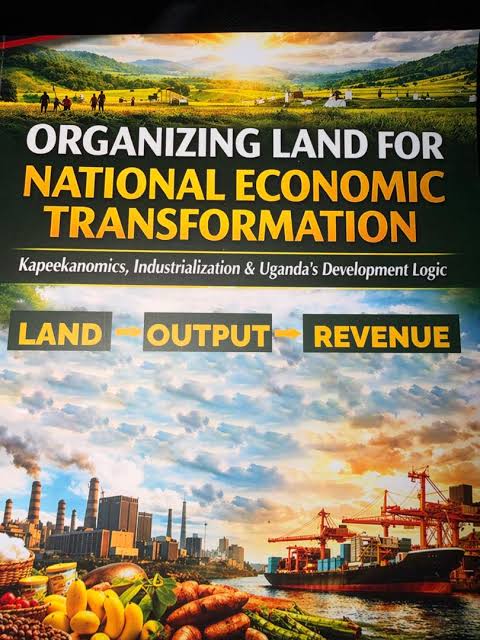
Gen. Saleh has pressed the argument beyond sanitation. In a book published in April, co-authored with development scholar Dr. Pascal Odoch, he contends that Uganda’s development bottleneck is not a shortage of land but a failure to organize it, recasting land from a “dead capital” problem into a coordination problem at the heart of the country’s uneven growth.
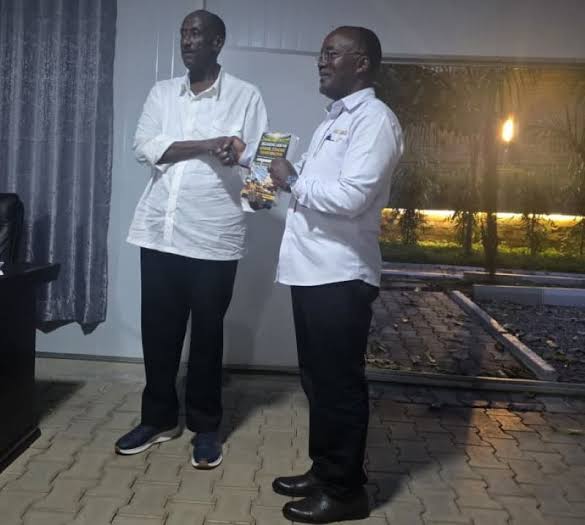
He gave Dr. Mugisha a copy of the book, “Organizing Land for National Economic Transformation: Kapeekanomics, Industrialization and Uganda’s Development Logic,” on the sidelines of the meeting.
Kapeeka is home to the China-Uganda Liao Shen Industrial Park, a 5.2-square-kilometer manufacturing hub that has grown from maize gardens into a base for dozens of factories over the past decade.
Gen. Saleh, who has long promoted the park as a model of concentrated infrastructure that draws industry, commended Dr Mugisha and NWSC for moving quickly to invest in and support the wider Namunkekera industrial development.
There, NWSC upgraded the Kapeeka water supply system, drawing on the River Mayanja to serve the park and nearby communities.
Dr. Mugisha reaffirmed the corporation’s commitment to strengthening cooperation among agencies, tightening coordination among institutions and mobilizing stakeholders and development partners to advance public health, environmental protection and sustainable waste management across the capital.
The reform push faces institutions long used to working in isolation.
Kampala’s waste system has repeatedly buckled under pressure, most recently when Uganda’s first National Cleaning Day produced volumes that overwhelmed collection teams and clogged the Buyala disposal facility for days.
The meeting was also attended by Hon. Ronald Kibuule, former minister of state for water; Dr. Akankwasa Barirega, executive director of the National Environment Management Authority; Ambassador Phillip Idro; and Dr. Zalwango, director of environment at Kampala Capital City Authority.
GOT A HOT STORY? LET US KNOW!
Got breaking news, explosive secrets, or hard evidence?
When Master Grain Milling Limited produced its first bag of wheat flour in 2013, the business was a modest operation running a single production line.
Thirteen years later, the Jinja-based company has evolved into a structured agri-processing enterprise with an annual turnover of over Shs60 billion in the 2025/2026 financial year, supported by expanded production capacity, a nationwide distribution network and a growing workforce.
At the centre of this transformation has been access to finance, with Equity Bank Uganda playing a key role in helping the company overcome funding constraints and invest in its expansion.
The partnership began in 2018 when Master Grain Milling turned to Equity Bank for financing after its previous bankers could no longer provide the financial support required to sustain its growth.
“Equity Bank saved us some time back. Our former bankers reached a point where they couldn’t support us financially, but Equity Bank came on board and gave us the exact funds we needed,” said Hajji Swammit Itaaga, the Managing Director of Master Grain Milling Limited.
He said the Bank provided sufficient capital on favourable terms and continued to support the company through trade financing as the business expanded.
“Equity Bank offered us a great deal with sufficient capital and has consistently supported our growth through reliable trade,” Itaaga said.
MD of Master Grain Millers Limited, Hajji Swammit Itaaga receiving a Thank you gift from Equity Bank Managing Director Gift Shoko during the tour
The financing came at a critical stage in the company’s development. With improved access to capital, Master Grain Milling invested in modern machinery and began putting in place the systems required to transition from a largely owner-managed enterprise into a structured corporate business.
In 2019, the company acquired a modern production line from Europe, significantly increasing its production capacity. The investment was accompanied by changes in the way the company operated. Master Grain Milling established dedicated finance, production and sales departments and expanded its distribution network through regional depots across the country.
The company also replaced its ageing transport fleet with new commercial trucks and strengthened its sales network with about 22 sales representatives, each equipped with company vehicles to serve distributors across Uganda.
Meddy Mbaziira, the company’s Head of Sales and Marketing, said the transformation has fundamentally changed the way the business operates.
“Initially, the structures weren’t there because it was a one-man-run business, but right now the business has structures,” Mbaziira said.
Adding, “We have dedicated finance and production teams, as well as a sales department with around 22 sales representatives across the country. Where we once relied on a fleet of very old trucks, we now operate with brand-new ones, making distribution easy.”
The changes have enabled the company to move beyond simply increasing production to building an integrated business capable of manufacturing and distributing its products across Uganda.
Despite the investments in machinery and distribution, Master Grain Milling says its next phase of growth depends largely on access to more working capital.
“If we continue working closely with Equity Bank to meet these current needs, we will be able to employ even more people,” Itaaga said.
The issue highlights one of the challenges facing growing manufacturers and agro-processors in Uganda. Investing in machinery creates production capacity, but businesses also require sufficient working capital to purchase raw materials, meet operating expenses, maintain inventories and fulfil orders while waiting for payments.
For Master Grain Milling, unlocking this financing could therefore determine how quickly its existing industrial capacity is translated into higher output and revenues.
The company’s growth prospects were recently assessed during a visit to its Jinja plant by Equity Bank’s executive leadership.
In the group photo is the MD of Master Grain Millers Limited, Hajji Swammit Itaaga, (in the middle standing next to Equity Bank Board Chairman Henry Rugamba(Army Green Shirt) Equity Bank Managing Director Gift Shoko in shades during the tour
The delegation, led by Board Chair Henry Rugamba and Managing Director Gift Shoko, toured the facility to understand the company’s operations, assess its expansion journey and discuss opportunities for further growth.
The visit underscored the bank’s approach of working closely with businesses beyond providing credit, particularly as they seek to expand production, strengthen value chains and create employment.
For Master Grain Milling, the partnership with Equity Bank has evolved from addressing an immediate financing challenge to supporting a longer-term industrial growth journey.
Its next ambition is to fully utilise its 540-tonne daily production capacity.
With additional working capital, management expects to increase production, meet growing market demand, strengthen the business and create more jobs.
For Equity Bank, the Master Grain Milling story demonstrates the role that responsive financing can play in helping Ugandan enterprises move from small-scale operations into more structured and productive businesses.
As Uganda seeks to expand local manufacturing and value addition in agriculture, businesses such as Master Grain Milling show how access to finance, investment in technology and stronger business structures can combine to turn production capacity into sustainable economic growth.
About Post Author
About UGNEWS24
UGNEWS24 is a Uganda local news service, a product of
SOLAVIA GROUP LIMITED,
Reg. No. 80048169153974.