Blog

  • SHOWDOWN! Gulu court sets hearing date for betPawa and gambler they refused to pay

    SHOWDOWN! Gulu court sets hearing date for betPawa and gambler they refused to pay

    The Gulu court has set 9th May, 2023 to start hearing a case where a gambler sued Inter World Company Limited trading as betting firm-betPawa Uganda for allegedly refusing to pay his shs10million jackpot winnings.

    According to Denish Ojok, when efforts to get his money from betPawa amicably failed, he decided to use legal means.

    He engaged Gulu based Abore Advocates & legal consultants and in particular the firm manager Patrick Obore.

    The firm hit the road running and wrote an intention to sue notice to betPawa on 18th Jan, 2022.

    The firm would later file civil suit No 12 of 2022 on behalf of Ojok. The case went into mediation (cause No.003 of 2022) but the two parties failed to agree.

    “…I was appointed by the Court to mediate over this matter. I indeed fixed two mediation dates and both advocates, Counsel Abore Patrick and Douglas Odyek and parties attended the last date that is 02nd June, 2022, but parties failed to agree.

    “I declare that the mediation has failed and parties referred back to trial Magistrate for scheduling conference and further management of the case,” reads a mediation report from Paulino Ogwang (Advocate).

    U-TURN

    Along the way Ojok lost contact with his lawyers and was no longer getting updates from them. He could no longer track the case’s progress in court.

    To make matters worse, Ojok started to get threats from unknown people telling him to back off the case.

    That he is no body and unworthy to compete with international firms like betPawa.

    HEARING DATE SET

    His file later curiously got lost from court. We have, however, learnt that the file has been traced and the hearing date has been set on 9th May, 2023.

    He expects to represent himself in court having been abandoned by his lawyers.

    HOW DID WE REACH HERE

    Ojok told Gulu Chief Magistrate that on 12th January, 2022 he placed a bet on a Jackpot at 9:32am using account name 0703200460.

    He allegedly qualified to win shs10million but since then betPawa has neglected to pay him.

    He avers that with ticket number 93053504, he went on to predict 15 matches.

    He hit 12 matches and 3 were cancelled.

    He however, argues that if betPawa had followed Jackpot rules, he would now be shs10m rich.

    He says all efforts to recover his jackpot prize have proved futile and has now asked court to determine the matter.

    DEMANDS

    He wants a declaration that there is a lawful contract for Jackpot Category pick 15 created by ticket number-ID 93053504. A declaration that betPawa breached Jackpot rules. An order for betPawa to pay his Shs10m winnings, interests on decretal sum at court rate from the date of judgment till payment in full, general, special and punitive damages, costs of the suit and any other relief by court.

    betPawa, through their lawyers of Kunihira &Co Advocates, insists that Ojok is not entitled to the said claim.

    “The Plaintiff [Ojok] did not qualify for pick 15 jackpot under the defendant’s [betPawa] standard betting rules,” court documents read.

    According to betPawa Jackpot rules, in case of a match postponement/abandonment, they have the right to wait for 24 hours for the match to start/resume.

    In case the postponed/abandoned match does not continue in the next 24 hours from initial kick off time, ‘next rule’ applies whereby—any cancelled match will get its outcome from the match listed above it on the ticket.

    The score line of the game above will be used to settle your prediction for the cancelled match/selection.

    Denish says with this rule at play, he was entitled to his shs10million Jackpot because the score line of the games above the cancelled ones were all in his favour.


    DEAR READER, DO YOU HAVE A HOT STORY YOU WOULD LIKE US TO PUBLISH…
    FRAUD IN BANKS, BETTING FIRMS, CHEATERS, DIVORCE FILES, SEX NETWORKS, SEX FOR MARKS, HARASSMENT OF ALL NATURE AT OFFICE BY YOUR BOSS, CHILD NEGLECT, WETLAND OCCUPATION, ENVIRONMENTAL DEGRADATION, VIDEOS, IMPUNITY or CORRUPTION (in government agencies/ MDA’s, NGOs, Ministries, Private sector), FIGHTS IN OFFICES, JOB WARS/ WITCH HUNT, URA TAX FRAUD/NON-COMPLIANCE, CHEATING MONEY LENDERS, BUSINESS WRANGLES, SUBSTANDARD PRODUCTS, GOLD SCAMS, NSSF REMITTANCES NON COMPLIANCE, LAND ISSUES, INTERNAL AUDIT REPORTS EXPOSES, POLITICAL WRANGLES…ETAL.
    CALL/TEXT/WHATSAPP 0777959024 OR EMAIL: redpeppertips@gmail.com WITH AS MUCH EVIDENCE AS POSSIBLE.
    SOURCE PROTECTION/CONFIDENTIALITY IS OUR NO.1 PRIORITY.

    About Post Author

  • Kapa Cat Says Uganda’s Music Industry Has Lost Its Competitive Spirit

    Kapa Cat Says Uganda’s Music Industry Has Lost Its Competitive Spirit

    Kapa Cat believes Uganda’s music industry has lost the competitive spirit that once kept fans entertained.

    Speaking on Galaxy TV, the outspoken dancehall artist said many musicians have become too comfortable and no longer embrace friendly music battles that can generate excitement around their music.

    She revealed that she once approached Karole Kasita with the idea of a music battle, but the singer declined the challenge.

    I asked Karole Kasita for a music battle, but she said she was afraid and could not do it.

    Kapa Cat said her proposal had nothing to do with creating conflict between artists.

    Instead, she wanted to use the battle as a promotional tool to excite fans and draw attention to Ugandan music.

    I explained that it was purely for promotion. Battles are good as long as they remain musical and entertaining.

    Kapa Cat also named the only male artist she would hesitate to face in a music battle.

    Of all the male artists in Uganda, Peter Miles is the only one I would fear battling, but I would still give it my best.

    She argued that healthy competition has always helped keep the music industry vibrant and believes today’s artists should not shy away from friendly musical contests.

  • Sherry Matovu Dismisses Claims She Kept Her Children From Their Father

    Sherry Matovu Dismisses Claims She Kept Her Children From Their Father

    Sherry Matovu says she has never kept her children away from their biological father, insisting that they have always had the freedom to know and communicate with him.

    The media personality made the clarification while responding to claims that she denied her children access to their father, Tadius Katumba.

    According to Sherry, she chose not to let cultural expectations interfere with her children’s relationship with him.

    I have never stopped my children from knowing or talking to their father. My culture may have its own beliefs, but I have never denied them that right.

    She also denied trying to convince her children to replace Katumba with her husband, Abdul ‘Ssendegeya’ Salam, saying the relationship they share today developed on its own.

    I never forced my children to love Mr. Sendegeya or forget their biological father. That bond came naturally because of the way he treated them.

    Sherry said life after her separation was difficult for the children, especially during school visitation days when they watched other families spend time together.

    My children would watch other parents arrive together while they were alone. It was painful for them, but when Mr. Sendegeya came into our lives, he stepped into that fatherly role with love and commitment. Today, everything is history.

    She revealed that she feared her youngest daughter would struggle to accept Sendegeya because she was still a baby when the separation happened.

    Instead, the two quickly formed a close relationship.

    I thought my last-born would find it hard to relate with him, but it turned out to be the easiest transition. She embraced him with so much love, and he embraced her as his own.

    Sherry said her children now have their father’s phone number, although she believes he has not remained actively involved in their lives.

    My children have their father’s number, but he seems too busy to pay attention to them. I want to thank Mr. Sendegeya for loving me the right way, making me feel like the woman I am, and giving my children the fatherly love they needed. I am a proud mother because of him.

  • Sherry Matovu Opens Up About Young Motherhood and Her Unexpected TV Break

    Sherry Matovu Opens Up About Young Motherhood and Her Unexpected TV Break

    Long before viewers came to know her on Bukedde TV, Sherry Matovu was navigating the challenges of young motherhood while trying to build a future.

    The presenter revealed that she had her first child before achieving fame and joined Bukedde TV when her baby was only four months old.

    Looking back, she described that period as one of the most demanding chapters of her life.

    It was not an easy move, but I needed to make that decision. Giving birth at an early stage came with many challenges, but I kept believing that better days would come.

    Matovu’s path into television began with an opportunity she never saw coming.

    After appearing in a Carry Powder commercial, Bukedde TV invited her to audition as the station searched for someone to fill the gap created by Stecia Mayanja‘s frequent travels.

    She said she walked into the auditions with no expectations, only to leave with an opportunity that would transform her career.

    I went for the auditions without knowing what would happen, and the rest is history. It all felt like a joke at first because I never imagined it would happen that way.

    Despite having no formal training in television, Matovu chose to trust the opportunity.

    She said her manager encouraged her to take the chance, and she focused on giving it everything she had.

    This was always my dream, but I did not expect it to come immediately, and I never studied this professionally. I simply gave it my best, and everything fell into place.

  • Bujjingo clarifies World Cup picks were opinions, not prophecies

    Bujjingo clarifies World Cup picks were opinions, not prophecies

    Pastor Aloysius Bujjingo has defended his prediction for the 2026 FIFA World Cup winner after Spain lifted the trophy instead of the teams he had earlier tipped to win the tournament.

    Before the World Cup, Bujjingo had named France, Portugal, Argentina or Brazil as the likely champions. Following Spain’s victory, some critics accused him of making a “fake prophecy,” but the House of Prayer Ministries pastor insists his remarks were never meant to be taken as a prophecy.

    Speaking about the criticism, Bujjingo clarified that his prediction was based purely on his passion for football and not divine revelation.

    Messi isn’t the Messiah. In football, I support whoever has something to offer, which is why I chose Portugal over Argentina. I don’t support Ronaldo or Messi; I’m a football fan, and I support whoever plays well.

    It wasn’t a prophecy because I never claimed it was one. It was simply my personal opinion as a football fan. In fact, I have previously shared the same space with FIFA President Gianni Infantino because of my love for sports.

    Bujjingo further dismissed those mocking him, arguing that one of the teams he predicted still reached the World Cup final.

    He also claimed Argentina’s defeat was a result of placing too much attention on Lionel Messi instead of the team.

    What made them lose is wanting to share God’s authority with a person (Messi). They shifted the attention from Argentina to Messi and God showed them who’s the one in charge and even stopped the supply of the ball from reaching Messi.

    The post Bujjingo clarifies World Cup picks were opinions, not prophecies appeared first on MBU.

  • The Anger We Carry: How the Fire That Drives Us Can Also Consume Us

    The Anger We Carry: How the Fire That Drives Us Can Also Consume Us

    There is a certain kind of anger that lives quietly inside many of us.

    It comes from being abandoned when we needed someone. From being rejected when we believed we deserved a chance. From being underestimated, betrayed, humiliated, or made to feel as though we were not enough.

    Sometimes, it comes from people who told us we would never make it.

    And sometimes, the anger is directed at ourselves. At the mistakes we made. The opportunities we wasted. The years we believe we lost. The version of ourselves we wish we had become sooner.

    Anger is complicated because it is not always a bad thing.

    Sometimes, anger is exactly what gets us moving.

    There are people who have built incredible lives because they were tired of being looked down on. There are artists who created their best work because someone told them they were not talented enough. There are entrepreneurs who refused to quit because someone once made them feel as though they would never amount to anything.

    That anger can become fuel.

    It can make you work harder. It can make you more disciplined. It can give you the determination to prove, not just to others but to yourself, that you are capable of more.

    There is something powerful about saying, “You thought I could not do it? Watch me.”

    And sometimes, that attitude is necessary.

    The problem begins when the fuel becomes the fire.

    Because anger has a way of changing the person who carries it.

    At first, it may give you focus. You want to succeed because you were doubted.

    Then you start succeeding, but the anger remains.

    Now, you are no longer working toward something. You are working against someone.

    Every achievement becomes a response to an old wound. Every opportunity becomes another chance to prove someone wrong. Every new person is viewed with suspicion because someone from your past hurt you.

    Eventually, you stop seeing people as they are and start seeing them through the lens of what others have done to you.

    That is when anger becomes dangerous.

    Because anger only breeds more anger.

    Someone hurts you, and you become angry. You carry that anger into another relationship, where you become defensive, suspicious, or unnecessarily harsh. The other person reacts to your behaviour. You feel attacked. Now you are angry again.

    And the cycle continues.

    The tragedy is that sometimes the people who suffer most from our unresolved anger are not the people who caused it.

    The person who abandoned you may no longer be in your life, but you punish the person who loves you now.

    The person who betrayed your trust may be long gone, but you refuse to trust someone who has done nothing wrong.

    The people who doubted you may have forgotten what they said, but you continue living your life as though you are still standing in front of them, trying to prove your worth.

    That is the strange thing about anger.

    It can keep you connected to people you thought you had left behind.

    You may believe you have moved on because you no longer speak to them, but if their actions still determine how you treat everyone else, they still have a place in your life.

    We should not romanticise this kind of anger.

    Yes, it can motivate you.
    Yes, it can push you to succeed.
    Yes, it can help you discover a strength you did not know you had.

    But it is not a sustainable foundation for a peaceful life.

    At some point, you have to ask yourself a difficult question:

    “What happens when I finally prove them wrong?”

    What happens when you become successful? When you earn the money? When you achieve the dream? When everyone finally sees what you always knew about yourself?

    If anger is the only thing driving you, what will be left when the people you wanted to prove wrong no longer matter?

    This is why we must learn to transform anger rather than simply obey it.

    Use it as information.

    If you are angry because you were treated badly, let that teach you what you will and will not accept again.

    If you are angry because you were underestimated, let that push you to develop your abilities.

    If you are angry because you were abandoned, let it remind you to become someone who does not abandon themselves.

    If you are angry because you failed, let that failure become a lesson rather than a permanent sentence.

    The goal is not to pretend that what happened did not hurt.

    It is to stop allowing what happened to control everything that comes next.

    There is also a difference between boundaries and bitterness.

    A boundary says, “You hurt me, and I will not allow you to do it again.”

    Bitterness says, “You hurt me; therefore, everyone must pay for what you did.”

    One protects you.

    The other isolates you.

    Isolation can be particularly deceptive because it often feels like strength. We tell ourselves that we do not need anyone. We become proud of our ability to survive alone. We reject vulnerability because vulnerability once led to pain.

    But human beings were never designed to live entirely without connection.

    There are good people in the world.

    People who genuinely want to love us. People who want to support us. People who have no intention of repeating the mistakes of those who came before them.

    If we allow our anger to convince us that everyone is a threat, we may push away the very people who could have helped us heal.

    That is perhaps the greatest cost of unresolved anger.

    It can make us mistake kindness for weakness, love for manipulation, advice for criticism, and concern for control.

    We become so prepared for betrayal that we cannot recognise loyalty.

    So prepared for rejection that we reject first.

    So afraid of being abandoned that we never allow anyone close enough to stay.

    We must be careful.

    The world has enough anger already.

    There will always be someone who hurt us. Someone who disappointed us. Someone who did not believe in us. Someone who walked away.

    We cannot control what people do to us.

    But we can decide how long we will allow their actions to live inside us.

    Success is a beautiful response to being underestimated, but peace is an even greater one.

    Because the ultimate victory is not simply becoming everything they said you could never be.

    It is becoming that person without becoming bitter in the process.

    It is being able to look back at the people who hurt you and realise that they no longer have the power to determine who you become.

    You can still remember.

    You can still learn.

    You can still protect yourself.

    But you do not have to carry the anger everywhere you go.

    Put it down when you can.

    Not because what happened was acceptable.

    Not because the people who hurt you deserve forgiveness on your timeline.

    But because you deserve to experience life without constantly fighting battles that are already over.

    Anger can light the fire that gets you started.

    But it should never be the only thing keeping you warm.

    Because anger breeds anger.

    And if we are not careful, the people who hurt us yesterday will continue hurting us tomorrow, not because they are still present, but because we have allowed their pain to become our personality.

    The challenge is to use the fire without becoming consumed by it. To let anger motivate you without allowing it to define you. To succeed without needing everyone who doubted you to witness it. And, perhaps most importantly, to remain open enough to recognise the good people who come into your life after the bad ones are gone.

    Because sometimes healing is not about forgetting what happened.

    Sometimes it is simply refusing to let it happen again through you.

  • We Have Never Been More Connected, Yet We Have Never Felt More Alone

    We Have Never Been More Connected, Yet We Have Never Felt More Alone

    The greatest irony of the modern world is not artificial intelligence. It is not flying cars that never came or robots replacing jobs. It is that humanity has built the greatest communication network in history, only to become increasingly lonely.

    Never before have we had so many ways to reach one another.

    A phone call. A text message. WhatsApp. Instagram. X. TikTok. Snapchat. Email. Video calls. Group chats. Voice notes. We can speak to someone on the other side of the planet faster than our grandparents could speak to the neighbour across the road.

    Yet millions of people have quietly discovered a painful truth: being connected is not the same as feeling connected.

    Maybe loneliness was never about distance.

    Maybe it has always been about understanding.

    We often imagine loneliness as sitting in an empty room with nobody around. Reality is far more unsettling. Some of the loneliest people are surrounded by others. They laugh at parties, reply to every message, post every highlight, and appear socially active, yet carry a silence inside them that nobody notices.

    You can be in a group chat with two hundred people and still have nobody to tell when your world begins to crumble.

    Technology solved the problem of access. It never solved the problem of intimacy.

    Somewhere along the way, communication became confused with connection. We became experts at staying in touch without ever truly touching each other’s lives.

    We know what our friends ate for lunch because they posted it. We know where they travelled because they uploaded pictures. We know what music they are listening to because they shared a playlist.

    Yet we have no idea what keeps them awake at three in the morning.

    We have mistaken information for understanding.

    The internet gave us audiences instead of communities, followers instead of friends, engagement instead of empathy, and visibility instead of vulnerability.

    There was a time when communities were not built because people were exceptionally kind. They were built because people needed one another. Families ate together. Neighbours borrowed sugar from next door. Friends showed up without needing an invitation. Presence was not planned; it was expected.

    Today, we can watch every moment of someone’s life without ever being part of it.

    Perhaps the most dangerous illusion social media has created is the belief that being seen means being known.

    It does not.

    A person can receive thousands of likes on a photo and still eat dinner alone every night. Someone can have hundreds of birthday messages and still have nobody to call when their car breaks down. Another can go viral and still feel invisible.

    Attention has become the counterfeit currency of affection. It looks valuable until you actually need love, loyalty, or support. That is when you discover that an algorithm cannot comfort you, a notification cannot hug you, and a follower cannot replace a friend.

    The cruel irony is that we have become incredibly good at documenting our lives while becoming increasingly hesitant to share them honestly.

    We post achievements but hide disappointments. We upload smiles while swallowing anxiety. We announce promotions but quietly mourn heartbreak.

    We have learned how to perform happiness instead of pursuing it.

    Because everyone else is performing too, we begin to believe we are the only ones who feel lonely.

    Perhaps that is why modern loneliness feels heavier than the loneliness of the past. We do not simply feel alone; we feel alone while watching everyone else appear connected.

    It is an illusion.

    But illusions can still hurt.

    The truth is that human beings have never needed constant communication. They have always needed genuine connection. One honest conversation can heal more than a thousand casual messages. One friend who truly understands you is worth more than a thousand followers who merely recognize your name.

    Real connection has never been measured by how often people speak.

    It is measured by how safe they feel when they do.

    Maybe that is the lesson hidden beneath all our technology. We did not fail to invent enough ways to communicate. We simply forgot that conversation without vulnerability is just noise.

    Loneliness has survived every technological revolution because it was never waiting for a better invention.

    It was waiting for better presence.

    We have learned how to reach almost anyone in the world.

    Perhaps the next challenge is learning how to truly reach one another.

  • UIRI BOSS PROF. KWESIGA DRAGGED TO LABOUR COURT! Faces Arrest Threat Over Ignoring Ministry Orders in Staff Dismissal Row

    UIRI BOSS PROF. KWESIGA DRAGGED TO LABOUR COURT! Faces Arrest Threat Over Ignoring Ministry Orders in Staff Dismissal Row

    The Executive Director of the Uganda Industrial Research Institute (UIRI), Prof. Charles Kwesiga, has been dragged before the Ministry of Gender, Labour and Social Development over an escalating labour dispute involving three former employees who accuse the institute’s management of unfair reassignment, illegal removal from the payroll and failure to pay their salaries and gratuity.

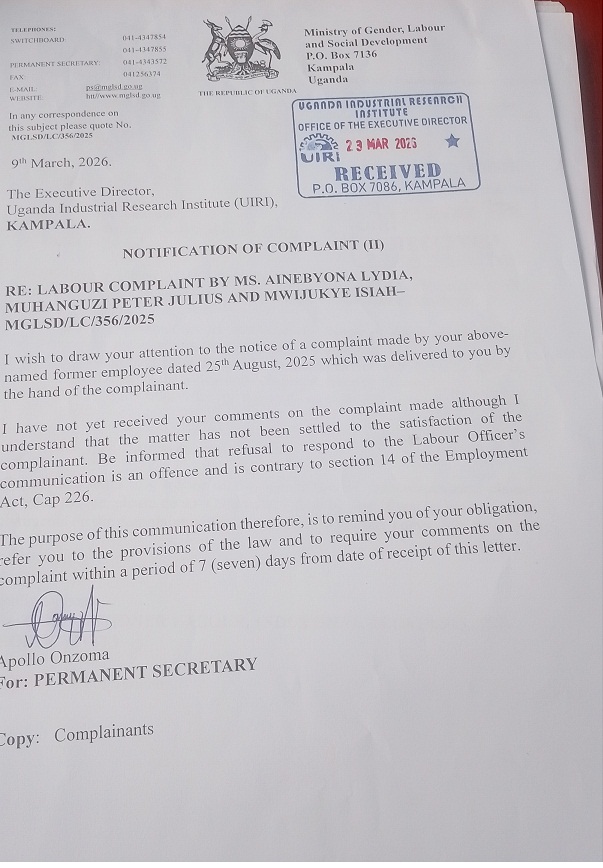
    The dispute has now taken a dramatic turn after the Ministry of Gender issued a second official notification warning UIRI management that failure to respond to the Labour Officer’s communication is an offence under the Employment Act, exposing the institute’s leadership to possible legal action for non-compliance.

    In a letter addressed to the Executive Director and copied to the complainants, the Ministry reminded UIRI that it had failed to respond to a labour complaint filed by Ainebyona Lydia, Muhanguzi Peter Julius and Mwijukye Isiah.

    The notification, issued on behalf of Permanent Secretary Aggrey David Kibenge, states that the complainants first lodged their complaint on August 25, 2025, but despite receiving the documents, UIRI had not submitted its response.

    “I have not yet received your comments on the complaint made although I understand that the matter has not been settled to the satisfaction of the complainant,” the Ministry wrote.

    The Ministry further warned that refusal to respond to communication from a Labour Officer is an offence contrary to Section 14 of the Employment Act, Cap 226 and ordered UIRI management to submit its response within seven days upon receipt of the letter.

    The complaint stems from events that unfolded on the night of April 8, 2025, when the three employees attached to the office of Deputy Executive Director Dr. Dick Kamugasha say they unexpectedly received emails from Acting Human Resource Manager Alex Tumwizere informing them they had been reassigned with immediate effect.

    The affected employees include Ainebyona Lydia, who served as Personal Assistant to the Deputy Executive Director, Muhanguzi Peter Julius, a driver, and Mwijukye Isiah, a security officer.

    According to the complaint submitted to the Commissioner for Labour, none of them was consulted before the transfers were effected.

    They claim that even their immediate supervisor, Dr. Kamugasha, was unaware of the decision when they informed him the following morning.

    The trio argues that the reassignment was ordered to take effect the very next day, making it impossible to conduct a proper handover of office, something they say is a fundamental professional requirement.

    The employees further allege that upon reporting to work the following day, they discovered that both the office of the Deputy Executive Director and that of the Personal Assistant had been broken into and fitted with new locks.

    They say no explanation has ever been given regarding who authorized the breaking into the offices or changing of the locks.

    Ainebyona says she remains deeply concerned about the personal belongings and official documents that were left inside the offices and whose safety has never been guaranteed.

    The complaint further describes the reassignment as a deliberate career setback.

    Ainebyona argues that moving her from Personal Assistant to the Deputy Executive Director to a Front Desk Officer amounted to a major professional demotion despite her academic qualifications.

    She says she successfully completed a Bachelor of Office and Information Management at Makerere University and is a fully subscribed member of the Association of Secretaries and Administrative Professionals in Uganda (ASAPU).

    She insists her qualifications would be grossly underutilised in the new assignment.

    The three employees also point to what they describe as contradictions within UIRI’s leadership regarding the status of Deputy Executive Director Dr. Dick Kamugasha.

    According to their complaint, then Trade Minister Francis Mwebesa communicated that Dr. Kamugasha had been reappointed and would remain in office until July 31, 2028.

    However, they say internal communications from the Executive Director’s office repeatedly informed staff that the office of the Deputy Executive Director had fallen vacant on three separate occasions since September 2024.

    The employees say this conflicting information created uncertainty within the institution because they continued reporting to Dr. Kamugasha every working day.

    They further claim Dr. Kamugasha himself opposed the decision to remove them from his office, describing it as an attempt to undermine his ability to execute his duties under the terms of his reappointment.

    The complainants say they sought intervention from both the Ministry of Public Service and the Ministry of Trade, Industry and Cooperatives, but received no response.

    They also approached the Human Resource Office after Serugo Osbert assumed office as Human Resource Manager.

    However, they allege that instead of listening to their grievances or offering guidance, the Human Resource Manager simply dismissed their concerns.

    The employees further accuse UIRI management of removing them from the payroll without any formal communication.

    According to the complaint, they have not received salaries since April 2025, neither have they been paid their gratuity, while their colleagues continued receiving both salaries and benefits.

    They say the situation has plunged them into financial distress as they continue servicing bank loans while supporting families who depend entirely on them.

    “We have bank loans which we are servicing and families where we are the sole bread winners,” the complainants state in their letter.

    The trio argues that they have unfairly become victims of what they describe as a leadership conflict between the Executive Director and the Deputy Executive Director.

    “If there is a conflict between the Executive Director and the Deputy Executive Director, we do not see reason why we should be dragged into it and sacrificed,” they wrote while appealing for urgent intervention from the Labour Ministry.

    The Ministry of Gender’s latest communication now raises the stakes for UIRI management by warning that continued failure to respond to the Labour Officer’s inquiries constitutes a breach of the Employment Act.

    When contacted by RedPepper for a comment, Prof. Charles Kwesiga said the matter is being handled by the Human Resource Office through the justice system.

    “The Human Resource office is handling the matter with the justice system,” Prof. Kwesiga said.

    COMING NEXT…In our next investigative publication, RedPepper lifts the lid on what insiders describe as an institution gripped by fear, internal wrangles and a powerful network of insiders allegedly operating with little accountability. The investigation examines claims that an institute mandated to drive value addition, innovation, machinery fabrication and the growth of small and medium enterprises has instead struggled with allegations of ghost projects, questionable spending, internal power struggles and alleged family cartels.

    Our investigation also examines insider claims of billions of taxpayers’ money allegedly spent with limited impact, growing staff discontent and an institution many believe has drifted far from its original mandate.

    With Prof. Kwesiga’s contract expected to expire in June next year, insiders further allege that intense lobbying is underway behind the scenes as pressure continues to mount over the future leadership of the institute.

    With Prof. Kwesiga’s contract expected to expire in June next year, and his deputy on forced ‘katebe’ insiders further allege that intense lobbying is underway behind the scenes as pressure continues to mount over the future leadership of the institute.


    GOT A HOT STORY? LET US KNOW!

    Got breaking news, explosive secrets, or hard evidence?

    Email us: redpeppertips@gmail.com

    We accept tips, documents, videos, photos, and recordings—the more evidence you have, the better.

    CONFIDENTIALITY IS OUR TOP PRIORITY. SOURCES ARE ALWAYS PROTECTED!

    About Post Author

  • ALLOWANCE ANXIETY! 2,290 Medical Pre-Interns Set for Deployment as Allowance Questions Refuse to Die

    ALLOWANCE ANXIETY! 2,290 Medical Pre-Interns Set for Deployment as Allowance Questions Refuse to Die

    Uncertainty continues to surround whether medical interns will continue receiving government allowances following the proposed policy changes that seek to abolish them, as more than 2,000 pre-interns prepare to report to internship sites across Uganda next month.

    According to the Ministry of Health’s internship deployment list, 2,290 pre-interns are expected to report in August. Kampala International University has the largest number of deployed interns, accounting for nearly a quarter of the total.

    It is followed by Makerere University with 198 interns, King Ceasor University with 162, the Islamic University in Uganda (IUIU) with 110, and Mbarara University of Science and Technology (MUST) with 86.

    While the release of the deployment list has ended months of uncertainty over placements, pre-interns say the government’s silence on the issue of living allowances has left them anxious.

    Dr Daniel Kirunda, a pre-intern, said the lack of communication from the government is deeply concerning, especially with only days remaining before the internship programme begins.

    Kirunda noted that the year-long internship is highly demanding, leaving little or no opportunity for part-time work. Without financial support, he fears many interns will struggle to meet basic living expenses.

    This year’s internship begins amid controversy over the proposed National Education and Training for Health Policy, which seeks to reform health professional training in Uganda. The Ministry of Health says the policy is intended to improve the quality of health education and strengthen the transition from classroom learning to professional practice.

    Among its proposals are the introduction of a pre-internship examination and a requirement for medical and other health trainees to complete their mandatory internship before graduation. The proposed reforms also recommend scrapping internship allowances, an issue that has repeatedly triggered disputes and industrial action between health workers and the government.

    Medical professionals and other stakeholders equally warned that the absence of allowances could undermine Uganda’s public healthcare system by making it difficult for young doctors to complete their training. Kirunda says the continued silence from the government has only heightened anxiety among interns preparing to begin their placements.

    However, the Minister of Health, Dr Chris Baryomunsi, has sought to reassure the interns, saying the government has not made a final decision on the matter. He explained that he intends to present the outstanding policy issues, including the question of allowances, to Cabinet for consideration.

    According to Baryomunsi, the government opted not to delay the internship programme while awaiting Cabinet’s decision, allowing deployments to proceed as scheduled in August. The minister has previously expressed support for maintaining intern allowances, acknowledging the critical role intern doctors play in sustaining healthcare services across the country.

    Medical interns currently receive a monthly government allowance of one million Shillings. However, speaking during a media briefing on Tuesday, another pre-intern, Dr Silver Ssengonga, argued that the current stipend is inadequate given the workload and cost of living. He said a more realistic monthly allowance would be four million Shillings.

    Ssengonga also referenced the unimplemented 2021 directive by President Yoweri Museveni, which proposed increasing intern doctors’ pay to about 2.4 million shillings per month, roughly half the salary earned by fully qualified medical officers.


    GOT A HOT STORY? LET US KNOW!

    Got breaking news, explosive secrets, or hard evidence?

    Email us: redpeppertips@gmail.com

    We accept tips, documents, videos, photos, and recordings—the more evidence you have, the better.

    CONFIDENTIALITY IS OUR TOP PRIORITY. SOURCES ARE ALWAYS PROTECTED!

    About Post Author

  • AFRICA CDC TO U.S.: Lift Uganda Ebola Travel Restrictions!

    AFRICA CDC TO U.S.: Lift Uganda Ebola Travel Restrictions!

    The Africa Centres for Disease Control and Prevention (Africa CDC) has called on the United States to lift travel restrictions imposed on Uganda following its recent Ebola outbreak, saying the country has demonstrated transparency and made significant progress in containing the disease.

    Africa CDC Director General Dr Jean Kaseya said the continental health agency had formally written to U.S. Health Secretary Robert F. Kennedy Jr. requesting the removal of the restrictions.

    “For the past three weeks, Uganda didn’t record a new case, and the last case was discharged on the 16th of July. Uganda is doing a great job. There is no reason for the U.S. to continue with this travel restriction,” Kaseya said.

    He was speaking at the opening of the ministerial segment of the African Union Extraordinary Session on Ending AIDS by 2030 and Strengthening Africa’s Health Systems in Accra on Tuesday.

    Kaseya’s appeal follows public health measures introduced by the U.S. Centers for Disease Control and Prevention (CDC) after Uganda declared an Ebola outbreak earlier this year.

    The measures included enhanced health screening for travelers arriving from Uganda, rerouting eligible passengers through designated U.S. airports for public health screening, and temporary entry restrictions for certain categories of travelers with recent travel history to Uganda.

    Although the measures did not amount to a blanket travel ban, Ugandan officials have argued that they have affected tourism, business travel, investment, and the country’s international image.

    Kaseya urged African governments to support Africa CDC’s appeal, arguing that countries that promptly declare disease outbreaks should not be penalized.

    “Being transparent cannot lead to countries to be punished. It’s time today to lift the status and then we’ll continue to support DRC on the challenge they are facing,” he said.

    The Africa CDC chief made the remarks as the continent battles what he described as the worst Ebola outbreak ever recorded in Africa, centred in the Democratic Republic of Congo (DRC).

    According to Kaseya, the outbreak has already claimed about 1,000 lives and continues to spread at an unprecedented pace.

    “Already 52 Ebola outbreaks. This is the worst one. After 65 days, we already have more than 2,400 confirmed cases. If we don’t stop this outbreak today, it will be the worst one that the world will be documenting,” he warned.

    Kaseya said more than 70 percent of new infections are now being detected through community transmission, indicating that many infected people are not being identified early enough.

    He explained that health authorities should ideally trace about 40 contacts for every confirmed Ebola case, but current surveillance is reaching less than 10 percent of the expected contacts.

    He attributed the deteriorating situation partly to insecurity in eastern DRC, where attacks by armed groups have disrupted response operations and forced health workers to withdraw from some affected areas.

    He added that the presence of more than one million internally displaced people has further complicated contact tracing and disease surveillance.

    To contain the outbreak, Africa CDC estimates that US$1.4 billion is required. African countries have so far pledged about US$110 million, surpassing an initial target of US$100 million but falling far short of the resources needed.

    Kaseya said Africa CDC and the World Health Organization (WHO) had jointly developed a continental response plan while accelerating clinical trials for Ebola vaccines and therapeutics.

    He reiterated that Africa CDC does not support travel bans or restrictions on international meetings during disease outbreaks, arguing that such measures discourage countries from reporting outbreaks promptly and undermine continental and global health security.

    The 25th Extraordinary Session of the African Union Executive Council, which is considering strategies to end AIDS by 2030, reduce preventable maternal deaths, strengthen health systems and improve Africa’s preparedness for disease outbreaks.

    Opening the meeting, Ghana’s Minister of Health, Kwabena Mintah Akandoh, urged African governments to increase domestic financing for health and invest in local production of medicines, vaccines and medical technologies to reduce dependence on external suppliers.

    He said recent global health emergencies had underscored the need for resilient health systems capable of responding effectively to future pandemics without relying heavily on foreign assistance.


    GOT A HOT STORY? LET US KNOW!

    Got breaking news, explosive secrets, or hard evidence?

    Email us: redpeppertips@gmail.com

    We accept tips, documents, videos, photos, and recordings—the more evidence you have, the better.

    CONFIDENTIALITY IS OUR TOP PRIORITY. SOURCES ARE ALWAYS PROTECTED!

    About Post Author

About UGNEWS24

UGNEWS24 is a Uganda local news service, a product of SOLAVIA GROUP LIMITED, Reg. No. 80048169153974.

Registered office

Plot 2335, Buwambo-Katadde-Najjo Road,
Nansana Municipality, Wakiso District, Uganda
P.O. Box 214231, Kampala

© 2026 SOLAVIA GROUP LIMITED. All rights reserved.