In London, tickets already on sale for the Miss Pride Africa Grand Finale event 2022 at the Royal Regency set to take place next saturday 26th November 2022 . It is not by coincidence or convenience that the grand event will be on next Saturday. It is simply that November is a month of happiness and love.
The big news is that celebrated musicians Vjojofficial, Nina Roz are set to thrill music fans on that same day. Vjoj who has been headlining a number of sold-out events in London and across over recently , will be the high light of the evening.
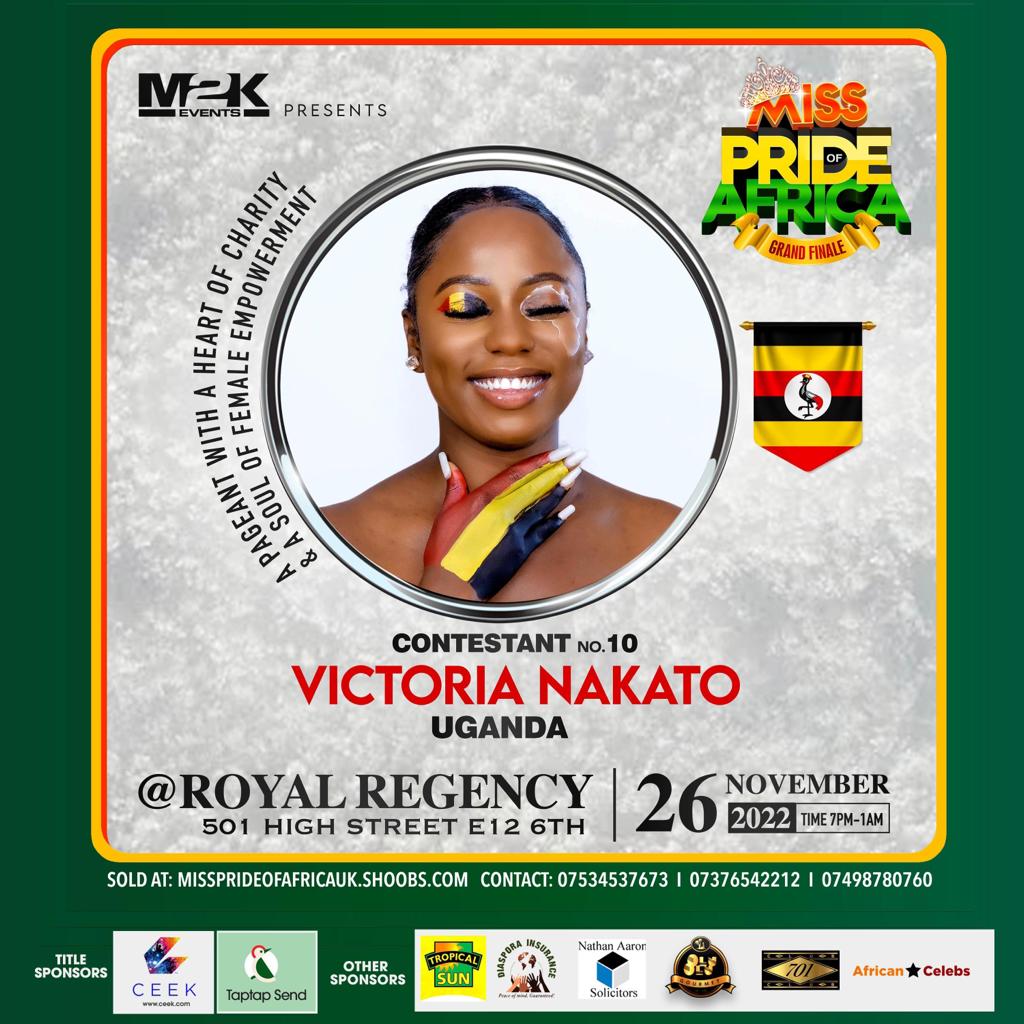
Victoria Nakato is contestant number 10
Moles reveal that Ugandan music lovers in London and other parts of the UK are already warming up to groove to Vjoj tunes.
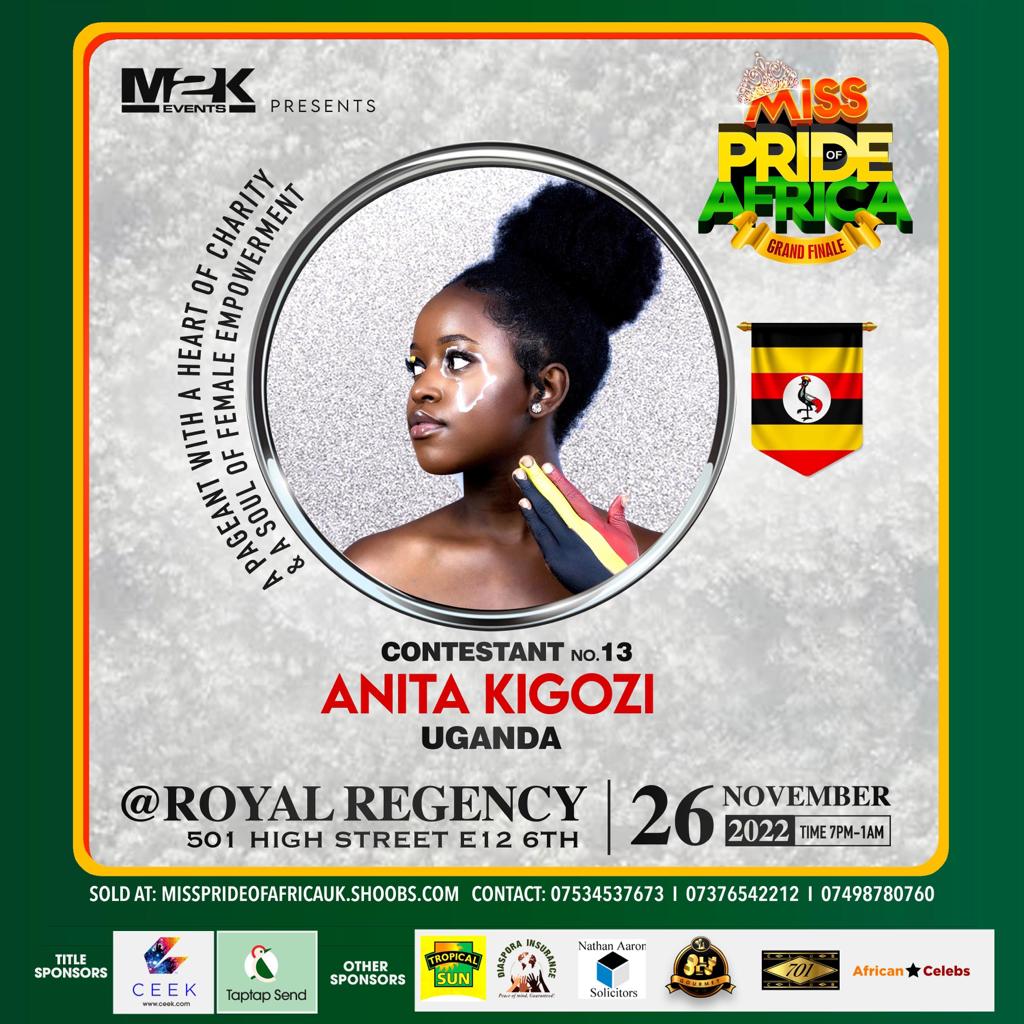
Anita Kigozi is contestant number 13
We are told preparations are already under way and the singer is in close door preparations for this event. Vjoj is a UK-signed Afrobeat Artist, Producer, film Director CEO, and founder of First choiceFilmz a UK-limited company, born and raised in Uganda.
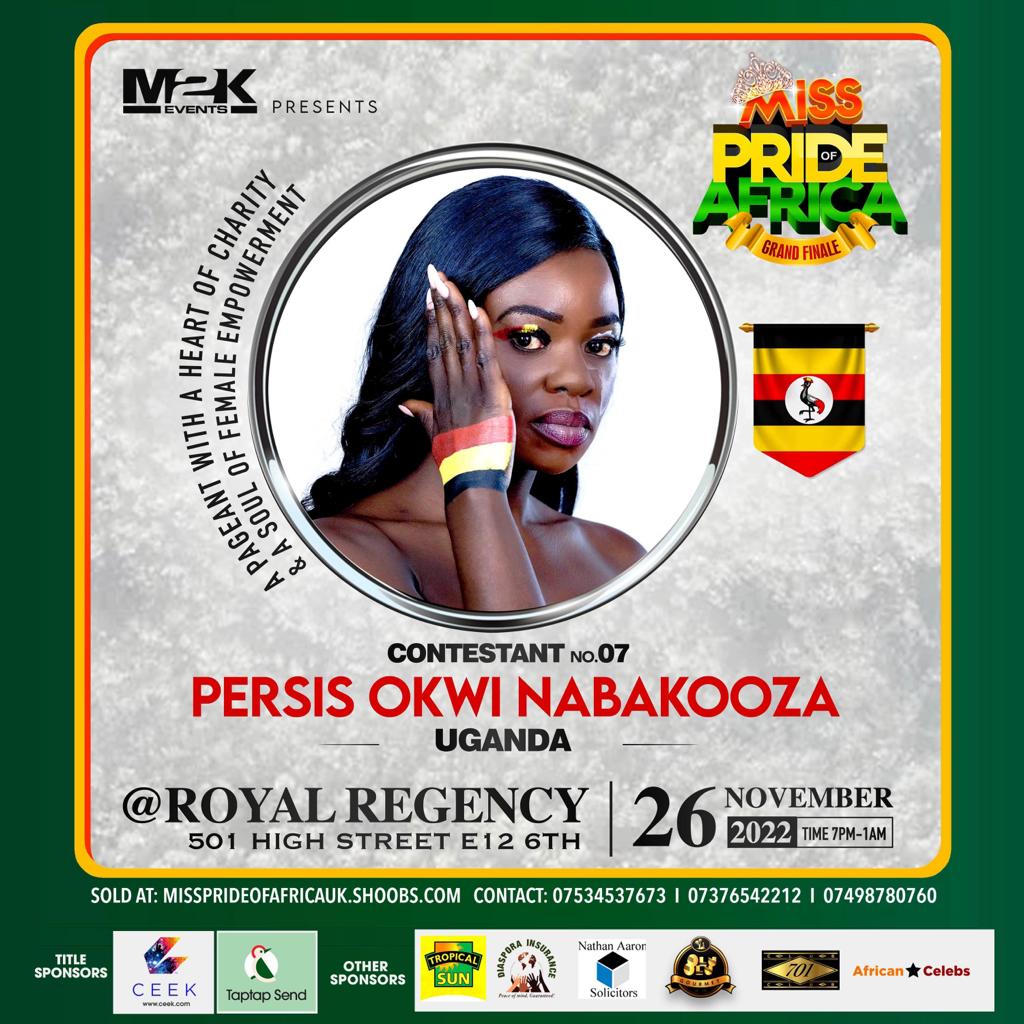
Persis Okwi Nabakooza is contestant number seven.
He is also a former Dj at Club Laface, PierOne, Mcqueen, Rio, and also Played at the Ministry of Sounds.
Miss Pride Africa is a pageant with a heart of charity and a soul of female empowerment.
Cardi B says no amount of children would ever convince her to stay in a relationship that no longer makes her happy.
The Grammy-winning rapper shared her views during a livestream, where she rejected the idea that having a baby can keep someone in an unhealthy relationship.
A baby won’t trap me… We could have ten kids, and I would still leave.
Cardi B said she values her independence and mental well-being above staying in a relationship for the sake of children.
She stressed that motherhood should never force anyone to remain with a partner if the relationship has become unhealthy.
Her comments quickly sparked debate across social media.
Many people praised her for encouraging others to prioritise their happiness and leave unhealthy relationships, while others criticised her direct approach.
Cardi B has often spoken openly about the highs and lows of her personal life.
Throughout the years, she has encouraged people to put their emotional well-being ahead of public opinion and outside expectations.
Ariana Grande has launched legal action against unidentified hackers she says spent years stealing her unreleased music and private files.
The American singer-songwriter filed the lawsuit in Los Angeles County Superior Court, accusing the hackers of targeting members of her creative team to gain access to unreleased songs, photos and videos.
According to the complaint, the hackers later sold some of the stolen material on the dark web, allowing it to spread across the internet without Grande’s permission.
The lawsuit says 45 unreleased songs leaked in 2023 alone and claims hundreds of leaks have surfaced since Grande’s debut in 2011.
Grande‘s lawyers say the alleged hacking amounted to a “malicious invasion of privacy” that hurt both her career and her creative process.
The lawsuit aims to identify the hackers and hold them responsible for the alleged theft and distribution of her intellectual property.
After weeks of monitoring, testing and uncertainty, Uganda has officially declared the 2026 Ebola outbreak over, with Health Minister Dr. Chris Baryomunsi announcing that the country is now Ebola-free.
The declaration came after Uganda successfully completed the mandatory 42-day monitoring period without recording any new Ebola infections.
“I am pleased to announce that Uganda has officially declared the end of the 2026 Ebola disease outbreak. Today, as we speak now, Uganda is Ebola-free,” Baryomunsi said.
But behind the declaration was a scientific decision that attracted questions why did Uganda count the 42 days from June 16 instead of the discharge date of the last Ebola patient at Mulago National Referral Hospital?
The Health Minister explained that the decision was based on science and the nature of the cases Uganda handled during the outbreak.
According to Baryomunsi, the 42-day countdown started on June 16, 2026, after the discharge of the last locally transmitted Ebola patient.
Although the last Ebola patient admitted at Mulago National Referral Hospital was discharged on July 17, 2026, health experts reviewed the circumstances surrounding that case and determined that the patient did not pose a transmission risk.
“Traditionally, we have been counting from the last patient discharged, like we communicated a month ago, but we have since reviewed the science,” Baryomunsi explained.
Why 42 days?
The minister said the 42-day period is based on Ebola’s incubation period.
Ebola symptoms usually appear between two and 21 days after infection. Therefore, health authorities monitor for two complete incubation cycles 42 days to confirm that no undetected transmission is taking place.
“Why do you count 42 days? You count 42 days because the incubation period of Ebola is 21 days. When you get infected, you can develop symptoms in a period of two to 21 days,” Baryomunsi said.
He explained that the purpose of the countdown is to allow enough time for any person who may have been exposed to develop symptoms.
“If there was an infection somewhere in the country which we had not detected, within 42 days it would have come out through symptoms. That is why we count two cycles,” he said.
Why Uganda did not count from the Congolese patient’s discharge
Baryomunsi said the final patient discharged from Mulago was a Congolese national who entered Uganda under unusual circumstances.
According to the minister, the man entered the country hidden inside a cargo truck and later contacted authorities after arriving.
He said investigations showed that the patient did not come into contact with anyone who could have been exposed to Ebola.
“He hid and came as luggage, as part of the contents of the cargo truck. When he reached town, he called and then he came and was hospitalized,” Baryomunsi said.
“So he did not expose his sickness to any person that we confirmed. There is no contact, there is no person who was at risk from this person.”
The minister said health officials therefore went back to the previous Ebola patient, the one discharged on June 16 because that was the case that could have created a transmission risk.
“The one who could have been at risk is the other one of June 16. That is why now we counted the 42 days,” he said.
Baryomunsi insisted the decision was not influenced by administrative pressure but was guided by medical evidence.
“This is not witchcraft. This is science,” he said.
Uganda recorded 20 cumulative Ebola cases during the outbreak that was reported in May 2026.
The Ministry of Health said 17 patients recovered, while two deaths were recorded.
Of the confirmed cases, five were locally acquired, including four health workers, while 15 cases were imported, including cases linked to neighbouring Democratic Republic of Congo (DRC).
The minister said health authorities successfully identified the source of infection, established the route of introduction, linked all confirmed cases and reconstructed the transmission chains.
“All confirmed cases were epidemiologically linked, transmission chains were completely characterized and reconstructed, and all identified contacts were institutionally quarantined and completed the mandatory 42-day follow-up without evidence of further transmission,” he said.
With the outbreak now officially over, Baryomunsi said Uganda will engage countries that imposed travel restrictions during the outbreak to review the measures.
He said Uganda is safe for international travel, tourism and investment.
“Nobody should fear coming to Uganda on the basis of the risk of Ebola,” he said.
The minister argued that international travel restrictions should be guided by science, noting that Ebola has existed in Africa for about 50 years but only a small number of cases have ever been exported outside the continent.
He said fewer than 30 Ebola cases have been exported from Africa globally, with most involving health workers who were evacuated for treatment after contracting the disease while responding to outbreaks.
How Uganda contained the outbreak
Ministry of Health Permanent Secretary Dr. Diana Atwine said Uganda’s preparedness systems played a major role in stopping the outbreak.
She explained that although Uganda had established health facilities around border areas before the outbreak, their capacity was increased after Ebola was detected.
She said the epicentre of concern was the border with the Democratic Republic of Congo, where Ebola cases continued to be reported.
“In Wera, we have got a full-fledged laboratory. In Fort Portal, we have a treatment unit there if we got more cases around,” Atwine said.
She added that Uganda also strengthened isolation centres and emergency response facilities, including in Arua, where suspected cases entering from the DRC were held and monitored.
The country improved rapid testing capacity, with the Arua facility able to provide results within four hours.
According to Atwine, Ebola response is not only about equipment but also ensuring availability of critical supplies such as personal protective equipment (PPE) to protect health workers.
She said Uganda’s health workers remained safe because of proper protection measures and strict infection prevention procedures.
Atwine revealed that government committed US$5 million(18,874,320,000 UGX (18.87 billion Ugandan Shillings)) towards the Ebola response.
She said development partners also supported the response through supplies, communication campaigns, deployment of personnel and other interventions, although their total financial contribution could not be immediately quantified.
She said government continued supporting Ebola prevention efforts in the DRC because controlling transmission across the border was important for Uganda’s own safety.
“If we do not support our people on the other side, it can cost lives,” she said.
Atwine said Uganda’s experience from previous Ebola outbreaks helped the country respond faster this time.
She credited mortality surveillance, community health systems, Village Health Teams (VHTs), emergency operations centres and experienced health workers for helping detect and contain the outbreak.
She said Uganda’s system allows authorities to receive alerts, test suspected cases quickly and respond before transmission spreads.
Atwine also emphasized that imported Ebola cases and locally transmitted outbreaks require different approaches.
“The protocol of local transmission and the protocol of imported cases are separate. We cannot mix them because the science and epidemiological picture are different,” she said.
Uganda has now closed the chapter on the 2026 Ebola outbreak, but health authorities say surveillance will continue, especially along the border with the DRC, which continues to battle Ebola cases.
For now, after 42 days of scientific monitoring, Uganda has passed the final test and declared itself Ebola-free.
Justice Simon Mugenyi Byabakama spends much of his time discussing elections, constitutional matters and public policy.
Long road trips, however, have a soundtrack of their own.
Speaking on Sanyuka Uncut, the Electoral Commission chairperson said gospel music is all he needs, revealing that he can drive from Kampala to Gulu without switching to another genre.
Any musician who sings gospel music. There are very many of them, including some from outside Uganda, especially in West Africa. Gospel music is what I enjoy. I can travel from here to Gulu listening to gospel music the entire way because there are so many great songs.
His playlist stretches far beyond Uganda.
Local gospel musicians, West African artists and musicians from other parts of the world all make the cut, leaving him with far too many favourites to choose from.
Our local gospel musicians make good music, and there are also musicians in West Africa and white musicians who sing really good gospel songs. So I listen to all of them. I do not have a preference.
For everyone else in the music industry, Byabakama had a simple message.
Musicians from other genres should forgive me because I do not follow their music.
I listen to all kinds of music, especially gospel. I don’t really follow other genres. As for social media, I’m not very active. People can make me the subject of jokes, but I don’t care as long as they don’t threaten the peace of the country.- Justice Simon Byabakama… pic.twitter.com/fIYTXESpdt
The Electoral Commission chairperson says Ugandans can mock him, create memes about him and even insult him if they wish.
However, he insists that freedom should never come at the expense of the country’s peace and stability.
Byabakama shared his views during an appearance on Sanyuka TV, where he opened up about his relationship with social media and the criticism that often comes with leading Uganda’s electoral body.
He revealed that he hardly spends time scrolling through social media because his demanding schedule leaves him with little time to keep up with online conversations.
I am not really a social media person. I do not have the time for it, but people are free to do as they please.
Despite regularly becoming the subject of jokes and criticism online, Byabakama says he has learned to take it all in stride.
He believes public figures should expect criticism, provided it does not fuel unrest or threaten national stability.
I always tell people that if you want to make comedy out of me, go ahead. There are those who specialise in insulting me, but I do not care, as long as you do not destabilise the country. As long as you have not caused chaos in the country, you can insult Byabakama as much as you like. Make comedy out of Byabakama if you wish, but do not tamper with the country’s stability.
So, meme away. Roast him. Put him in your next comedy routine if you must. Byabakama says he can handle the jokes.
Just keep the jokes funny and leave Uganda’s stability out of the punchline.
I listen to all kinds of music, especially gospel. I don’t really follow other genres. As for social media, I’m not very active. People can make me the subject of jokes, but I don’t care as long as they don’t threaten the peace of the country.- Justice Simon Byabakama… pic.twitter.com/fIYTXESpdt
Former Butambala County MP Muwanga Kivumbi has resurfaced after 18 days in mysterious circumstances, with unknown security operatives reportedly taking him to Nateete Police Station before whisking him away to Butambala Chief Magistrate’s Court.
The dramatic developments unfolded at around 9:30 a.m. as Kivumbi’s lawyers and National Unity Platform (NUP) leaders were attending the High Court hearing of his habeas corpus application.
They were alerted that Kivumbi had been brought to Nateete Police Station and immediately rushed there together with family members. However, access to him was reportedly blocked before security officers transferred him to Butambala Court under tight security.
Kivumbi disappeared about 18 days ago after he was allegedly picked up by plain-clothed security operatives, triggering demands from his family and lawyers for his release.
Earlier, the High Court had directed the Chief of Defence Forces, the Inspector General of Police and the Attorney General to establish his whereabouts and file affidavits before the case returns to court on July 29.
Police told court they were not holding Kivumbi, while the UPDF also denied having him in custody. In an affidavit, Lt. Col. Edgar Musasizi, the UPDF Director of Civil Affairs, said the military had not detained Kivumbi since he was granted bail by the High Court.
Attention has now shifted to Butambala Chief Magistrate’s Court, where authorities are expected to reveal the charges, if any, against the former legislator.
The Judiciary has announced revised security and media guidelines ahead of the hearing of the criminal case involving Dr. Kizza Besigye, Hajji Obeid Lutale and Captain Denis Oola at the Criminal Division of the High Court.
In a news release issued on Wednesday, July 29, 2026, the Judiciary said the measures form part of a broader security plan aimed at ensuring orderly, secure and efficient court proceedings while safeguarding the constitutional right to a fair and public hearing.
Under the new guidelines, access to the courtroom will be restricted to select judicial and non-judicial court staff, the accused persons, state and defence lawyers, accredited journalists and members of the public admitted subject to the available space.
The Judiciary directed all journalists intending to cover the trial to obtain prior accreditation through its Public Relations Office. It also noted that the number of court reporters allowed into the courtroom may be limited depending on available seating space.
Media personnel will also be required to submit all equipment, including cameras, audio recorders, laptops and other electronic gadgets, for security screening each time they attend court.
According to the guidelines, any requests for live broadcasting of the proceedings must be submitted to the Judiciary’s Public Relations Office and will be considered on a case-by-case basis.
The Judiciary further prohibited photography and videography inside the courtroom unless prior authorization is granted by the court, adding that images of the trial judge and witnesses will not be permitted without approval.
In addition, the use of communication devices such as mobile phones, tablets and other smart devices inside the courtroom has been banned.
The Judiciary said the revised measures are intended to maintain security, ensure orderly proceedings, preserve the integrity of the judicial process and uphold the constitutional principle of open justice.
For years, Uganda’s creative scene has been driven by individual brilliance. Designers, musicians, photographers and filmmakers have often built remarkable careers on their own. But for David Mulolo, better known as Speedball, and artist Joshua Waiswa, popularly known as Josh SB, the future belongs to collaboration.
The two creatives are joining forces for this year’s Speedball Summer, an event that will pair high-fashion streetwear with a live orchestral performance, creating an experience they believe reflects the evolution of Uganda’s creative economy.
Rather than another conventional runway show, audiences will witness garments presented against the backdrop of a live orchestra, an idea both men describe as natural rather than experimental.
“We were tired of the same old fashion runways,” says Mulolo. “We wanted something new, so we decided to spice it up with live orchestra music. It’s all art, so why limit it to only one discipline?”
For Josh SB, whose Bar Symphony concerts have become known for blending classical music with contemporary culture, the collaboration came together almost effortlessly.
“After creating a successful Bar Symphony experience, partnering with Speedball just felt right,” he says. “Their creative energy is as unique and edgy as mine. When we discussed the fashion show, the orchestra idea landed perfectly because it felt unique and disruptive.”
Beyond the spectacle, the partnership represents something much larger: a statement about what young Ugandans can accomplish together.
Mulolo says Speedball was founded to fill a gap in Uganda’s creative ecosystem by proving that ambitious young people can collectively raise industry standards through fashion campaigns, events and original content.
“The gap we’ve been trying to fill is showing what young people can achieve together,” he says. “We’re raising the standard through the projects we create.”
That ambition, however, comes with challenges. Mulolo believes the biggest obstacle isn’t necessarily funding but mindset.
“There aren’t enough hungry people who see what’s at stake,” he says. “What keeps me going is the fear of being average. I know too much not to be doing what I’m doing.”
Josh SB identifies a different hurdle: structure.
“The biggest challenge building creative brands is structure and order,” he explains. “Like any other business, you need systems. The magic lies in my team because they’re committed and operate within a clear structure.”
The conversation around Uganda’s creative industry increasingly extends beyond entertainment into economic development and tourism, something both creatives believe the country is only beginning to appreciate.
Josh argues that experiences are becoming global travel magnets.
“People now travel across continents for festivals, concerts and creative experiences much more often than they do to see wildlife,” he says. “That’s why more economic focus needs to be placed on the events industry and its infrastructure.”
Mulolo agrees, saying events such as Speedball Summer do more than entertain.
“They bring recognition to Uganda and show other young Ugandans what’s possible,” he says. “Whatever dreams you have, they can happen right here.”
While collaboration sits at the heart of this year’s production, both believe partnerships have become essential for the survival and growth of creative businesses.
“Collaboration is the only way to scale,” Josh says. “You tap into everyone’s strengths instead of trying to do everything yourself. Rather than giving 20 percent across everything, you leverage 100 percent of different people’s expertise.”
The same philosophy extends to nurturing future talent.
Mulolo says problem-solving remains the quality he values most when identifying creatives to work with.
“I always tell young people to pay attention to detail, question everything and then either do what’s not being done or do what’s already being done even better.”
Josh adds that discipline often outweighs raw ability.
“Talent alone is never enough,” he says. “It’s only the starting point. I look for people who are willing to go the extra mile and who have discipline and order.”
Both creatives also believe stronger collaboration is needed between government and the private sector if Uganda is to compete internationally.
Mulolo would like to see national creative campaigns bringing together the country’s best talent, while Josh believes institutional systems are the missing ingredient.
“Government and the private sector are willing to support because they’ve seen the commercial value of the industry,” he says. “But no one wants to invest in businesses that lack systems, proper operations and measurable returns.”
The show has also attracted support from Guinness Smooth under its “Make It Your Own” campaign, a partnership both artists say aligns naturally with their creative philosophy.
For Mulolo, the campaign encourages people to own their ideas and surroundings. Josh believes it creates room for young creatives to express themselves authentically while giving ambitious ideas the support needed to become reality.
At the centre of this year’s collection is a simple but powerful message: Made in Uganda.
Ordinarily, the phrase appears quietly on clothing labels as a manufacturing detail. Speedball wants audiences to see it differently.
“This year, ‘Made in Uganda’ is our statement,” Mulolo says.
Josh hopes that statement extends beyond fashion.
“We want people to leave believing Uganda is ready for the world stage, in output quality, collaboration and the ability to produce first-class creative experiences.”
That confidence is already translating into expansion. Following the show, Bar Symphony is scheduled to stage editions in countries including Kenya, Zambia and Mauritius, while Speedball plans to launch creative clinics at universities to mentor the next generation of innovators.
For both creatives, however, international ambitions begin at home.
Their message is not simply that Uganda can produce world-class fashion or orchestral performances, but that when creative disciplines, businesses and brands work together, they can build experiences capable of competing on the global stage.
If Speedball Summer succeeds in its mission, audiences will leave with more than memories of an unconventional runway. They will leave convinced that “Made in Uganda” is no longer just a label sewn into clothing, but an identity confidently taking its place before the world. The event is taking place on Saturday August 1 at Motive in Bugolobi.
The Electoral Commission (EC) has sent a clear warning to Ugandans participating in today’s LC I Chairperson elections: If your name is not on the official village register, you cannot vote.
As polling got underway across Uganda’s 71,214 villages, EC spokesperson Julius Mucunguzi defended the Commission’s electoral process amid growing complaints of voter register manipulation in some parts of the country.
Speaking during polling, Mucunguzi said the law leaves no room for exceptions because every election must be based on a verified voters’ register.
He explained that the process started months ago with village voter registration, where only Ugandan citizens aged 18 years and above who ordinarily live in a village and voluntarily presented themselves were registered.
Residents were later given an opportunity to inspect the register during the display exercise before nominations and campaigns began.
According to Mucunguzi, anyone who ignored the registration exercise cannot simply appear on polling day and demand to vote.
“Even if everyone knows you in the village, even if you are one of the respected elders, if you never registered, you cannot vote. You will only watch today’s election,” he said.
His comments came as dramatic scenes unfolded at several polling stations.
In Kasokoso, tempers flared after residents accused the NRM candidate of importing non-villagers onto the register to influence the election.
The situation escalated when the presiding Electoral Commission officer was reportedly taken away by police officers to an unknown location following protests from angry residents demanding answers.
Supporters of the National Unity Platform (NUP) staged protests that turned violent as they challenged the authenticity of the voters’ register.
Another standoff was reported in Bunga, where residents accused the incumbent LC I Chairperson of deleting names of genuine voters while altering the register to benefit his re-election campaign.
Some voters rejected the declared outcome and immediately announced plans to petition the Electoral Commission.
In Bunakijja Village in Katosi Town Council, clashes erupted between supporters of Democratic Party (DP) candidate David Mugabo and National Resistance Movement (NRM) candidate Haruna Lukoma causing the EC presiding officer to cancel the polling process. The two candidates and their supporters accused each other of voter intimidation. It is alleged that a drone carrying unidentified people showed up and disrupted the polling process.
In Katuuso , Buziga COU, the incumbent who had previously advised locals to vote for him without checking the register made a u-turn after he lost. Prior to the voting process, the three candidates including the incumbent agreed that voters participate in the polling process without the EC presiding officers registering. That changed when he lost and demanded that the process be followed legally,and he was declared winner.
In Makindye barracks polling station locals went up in arms after soldiers and police officers turned up to vote. They claimed the security officers are not locals , causing a scuffle that led the officers to flog some.
Most of the areas saw locals alleging that their names were not on the register, the incumbents tampered with the registers and foreigners participated in the voting.
Responding to the growing controversy, Mucunguzi said the Commission had already been alerted to similar allegations before polling and that EC Chairperson Justice Simon Byabakama had advised affected residents to follow the legal process.
He urged complainants to record formal statements, provide documentary evidence and submit their complaints to the Commission for investigation.
The EC spokesperson also warned that it is against the law for any incumbent or candidate to interfere with the village register, saying anyone found culpable will face the consequences provided under the law.
Voting officially began at around 11:00 a.m., with residents lining up behind their preferred candidates in accordance with Uganda’s electoral laws.
The nationwide exercise is expected to conclude with the election of LC I Chairpersons in all 71,214 villages, forming the foundation of the country’s local governance structure.
About UGNEWS24
UGNEWS24 is a Uganda local news service, a product of
SOLAVIA GROUP LIMITED,
Reg. No. 80048169153974.