Singer Lydia Jazmine has opened up about her views on dating and marriage within the entertainment industry.
She revealed that while she is open to dating a fellow celebrity, she would prefer to marry someone who lives outside the limelight.
The “You and Me” singer explained that dating someone in the same industry can work because both partners understand the demands that come with being public figures.
Asked whether she would date someone in the entertainment industry, Lydia responded, “Yes, I would because we’re doing the same job.”
However, when it comes to marriage, the singer admitted that she would rather settle down with someone who is not in the public eye.
“Getting married to someone in fame is a bit tough. The limelight comes with a lot of problems. So, at this point, I prefer someone who’s not in fame. I think that lasts longer and it’s more peaceful, with less stress.”
According to Lydia, dating within the industry requires both partners to be understanding of each other’s careers and the pressures that come with fame.
“But dating in the industry, both of you must be understanding to each other. When that is achieved, everything else will move on smoothly.”
Beyond fame and career, Lydia also revealed some of the qualities she looks for in a potential partner.
She admitted that physical appearance initially catches her attention, particularly how a man dresses, smells and presents himself.
“On outer looks, before knowing a man, I consider someone looking good, smelling good, and I also look at one’s shoes, watch and how you’re dressed. That talks a lot about you. In general, your appearance.”
When it comes to character, Lydia described herself as a humble and gentle person who values respect, care and understanding in a relationship.
“I’m not a complicated person. I’m very humble and gentle, so I want someone who is very understanding and respectful because I’m so respectful. I care a lot, so I want someone who cares too.”
For Lydia, respect is one of the most important foundations of a healthy relationship because it helps partners understand boundaries and avoid actions that could hurt each other.
“When someone has respect, that means there are very many things you won’t do. Respect covers a lot of things. A man or woman who respects the other always knows the boundaries of what they have to do or not.”
From the music to the woman behind it all, Lydia Jazmine opens up about her journey, the lessons life has taught her, the highs, the lows, and everything in between. Catch her live on NRG Studio as she gets real about her life and the person she’s becoming. #NRGRadioUG NRGAmshowUG
Ugandan socialite and businesswoman Zari Hassan has sparked conversation online after calling out women who, in her view, cross the line at weddings by getting overly close to the groom.
In a TikTok video, Zari reacted to several clips showing female guests dancing closely with grooms and appearing overly familiar with them during their wedding celebrations.
She described the behaviour as disrespectful and made it clear that the groom’s relationship with the woman would not change her reaction.
I do not care if you are the baby mama that never got married, or sidechic who wants to be known.
Her warning became even more direct.
I will beat you.
Zari also encouraged women to form a group with their friends and intervene if another woman starts “acting funny” with the groom.
If things get out of hand, she said she would handle the aftermath.
Irene Namatovu’s final rehearsal ahead of her Kampala Serena Hotelconcert turned into a star-studded gathering, with some of Uganda’s biggest music names showing up to support her.
The musicians sang alongside her and added their energy to the session, giving the rehearsal the feel of a celebration rather than just another preparation day.
Their appearance also underlined the support Irene has from fellow artistes as she prepares for one of her major shows this year.
Irene will take the Serena Hotel Kampala stage this Friday, August 21, for a concert expected to attract longtime fans and lovers of classic Ugandan music.
Event organiser Bajjo and Irene have also thanked fans who have already bought tickets and tables, while encouraging those who have not yet secured their spots to do so ahead of the show.
With the final rehearsal now done, Irene is ready for the main event, with some of Uganda’s most respected music figures already in her corner.
Ugandan social media activist and photojournalist Ninye Tabz has called on music fans to stop comparing King Saha and Ray G after the two artists held major concerts at the Kololo Independence Grounds a week apart.
Tabz wants fans to celebrate both musicians instead of turning their successful shows into a competition over who attracted the bigger crowd.
In a post on X, he urged fans to appreciate what both artists achieved at the Kampala venue.
Kindly stop the comparisons and let’s celebrate the victorious concerts and history made by our brothers King Saha yesterday and Ray G last weekend!
He followed up with another appeal to fans:
We can celebrate and congratulate without ridiculing others!
The debate comes after Ray G held his “Tuze Kololo” concert on August 7, before King Saha returned to the same venue a week later for the “Tondeka E Kololo Festival” on August 14.
Photos and videos from both events showed large crowds, with fans from different parts of the country turning up to support the two musicians.
The back-to-back concerts have since fuelled comparisons over which artist attracted the bigger audience, with supporters of both camps making their case online.
Kindly stop the comparisons and let’s celebrate the victorious concerts and history made by our brothers King Saha yesterday and Ray G last weekend!
We can celebrate and congratulate without ridiculing others!
[ August, 2026] Huawei Technologies Uganda Company Limited, a prominent leader in global information and communications technology (ICT) infrastructure and smart devices, has officially rolled out its 2026 campus talent acquisition campaign. The event is set to take place on Friday, August 21, 2026, at Kyambogo University (Venue: CTF 106), running from 8:00 AM to 1:00 PM.
Anchored by the inspiring theme “The Sky Is the Limit” and the collective slogan “A Better U for a Better Uganda,” this recruitment initiative is designed to ignite the career potential of final-year students and recent graduates, smoothing their transition from lecture halls into dynamic, high-impact trajectories within the tech sector. The outreach event targets bright young minds and ambitious graduates specializing in ICT-related fields, including Electrical and Telecommunications Engineering, Cybersecurity, Software Development, Computer Science, Finance, Logistics, Industrial Engineering, Human Resources, and Public Administration.
As Uganda accelerates its digital evolution, Huawei has spent the last quarter-century steadfastly dedicated to closing the digital skills divide and building local capability through a range of Corporate Social Responsibility programs. Core pillars such as the Huawei ICT Competitions, Huawei ICT Academy, Seeds for the Future, the National ICT Job Fair, and the Huawei Campus Recruitment Program all highlight Huawei’s long-term promise to drive sustainable digital inclusion, foster gender equity, and empower the next wave of Ugandan tech innovators alongside local universities and government entities.
The Kyambogo University drive offers participants an exclusive venue to connect directly with tech leaders, discover diverse career avenues, and pitch themselves to top Huawei executives for full-time roles and internships. Attendees will also gain firsthand insights into daily life at Huawei’s Uganda office from past alumni, while enjoying interactive sessions and the opportunity to win exciting gifts.
Hired candidates will enter a comprehensive career transition ecosystem crafted to accelerate their professional journey. This includes personalized 1-on-1 mentorship which pairs every new hire with an experienced professional to ease the jump from campus life to the corporate sphere as well as practical project exposure where recruits take on real-world responsibilities on cutting-edge national digital transformation projects. Furthermore, recruits gain access to Huawei’s advanced structured training programs and global self-learning hubs like iLearning and 3MS.
Eligible candidates are encouraged to register ahead of time, upload their academic transcripts and CVs, and attend the event ready to kickstart their careers and help shape Uganda’s digital future. Registration link:Huawei Graduate Recuitment
Do you have a story in your community or an opinion to share with us: Email us at Submit an Article
“A divided house cannot stand. We urge the people of Adjumani to be harmonious, work together, and get an acceptable candidate before the date of going to contest against other candidates who may come up,” Kinobe said.
Following the closure of the NRM nomination exercise tomorrow, the aspirants will embark on joint campaigns from August 20 to September 1, 2026.
Kinobe said the candidates will sit with the district leadership to harmonize their campaign programme, including the areas they will visit, before moving together across the constituency.
He explained that the joint campaign arrangement is intended to promote unity among the aspirants and supporters while giving voters an opportunity to interact with all the candidates.
The NRM primary is scheduled for September 3, 2026, when the party will select its flag bearer if consensus is not reached.
Kinobe also noted that the National Electoral Commission will use part of the period between August 20 and August 31 to update the voters’ register in the affected electoral area.
The successful NRM candidate will subsequently face other candidates during the national by-election process. The National Electoral Commission is scheduled to nominate candidates for the parliamentary by-election on September 7 and 8, 2026.
Kinobe said the entire process is being undertaken within the legal timeframe requiring a by-election to be held within 60 days following the death of a Member of Parliament.
He appealed to the people of Adjumani West and all NRM supporters to maintain peace and unity throughout the process.
He said the ideal outcome would be for the aspirants to agree on one acceptable candidate so that the party does not have to conduct a divisive primary.
“It would be good if the people of Adjumani, all of them, agree to have just one nominated candidate, and we don’t go for elections to split the people,” Kinobe said.
He assured the media and the public that the NRM Electoral Commission would continue providing updates as the nomination, joint campaigns, and primary election processes progress.
Do you have a story in your community or an opinion to share with us: Email us at Submit an Article
I first met Alex Mukulu in 1992, when I was a very young saxophonist finding my way as an artist.
At the time, I had the privilege of playing saxophone on a number of songs in Alex’s production, 30 Years of Bananas. It was one of the biggest and most successful theatrical productions in Uganda at the time. Uganda was celebrating 30 years of independence, and even the President attended the production.
One of the songs I played was “Masekela,” a tribute to the legendary South African trumpeter and musician Hugh Masekela.
What makes that memory even more remarkable to me today is that, 25 years later, I would have the incredible honour of meeting Hugh Masekela himself—and eventually calling him a friend.
I could never have imagined that as a young saxophonist standing on that stage in 1992, playing a tribute to an artist I deeply admired, my own musical journey would one day lead me to meet that very legend.
For a young musician like me, being part of something of that magnitude was unforgettable. But what I did not fully appreciate then was how much the experience would shape me as an artist.
Katumwa sharing stage with Masekela
Alex was not simply an actor or playwright. He was a thinker. He had a way of looking beyond the obvious, beyond the borders and beyond what was considered the norm. As a young artist, I found that incredibly inspiring.
Over the years, our relationship continued. As I grew in my own musical journey, Alex remained someone with whom I could share ideas, laughter and those light moments that make friendships special.
One particular memory remains very dear to me.
In 2012, after my Isaiah Katumwa Live at Serena concert, Alex practically went looking for me. He came to my home simply to tell me how brilliant he thought the production had been. What struck me was not only the compliment, but the questions that followed.
He wanted to know what inspired my songwriting. He was genuinely curious about the creative process. He wanted to understand what was happening inside the mind of another artist.
That was Alex.
He was funny, thoughtful and wonderfully unconventional. He had a way of making you think differently without making you feel that he was trying to teach you something.
Looking back now, I realise that my first encounter with Alex happened at a very formative moment in my life. I was a young saxophonist playing in one of Uganda’s landmark productions. Years later, I was an established musician, and Alex was still taking the time to encourage me, ask questions and celebrate the work.
That is the kind of person he was.
Uganda has lost a remarkable artist, but I believe we have also lost something more difficult to replace—a creative mind that was never afraid to think beyond the boundaries.
For me, however, Alex will always be more than a cultural icon.
He will remain the man I first encountered as a young saxophonist in 1992; the artist who opened my mind to thinking beyond the borders; the friend who shared laughter with me through the years; and the thoughtful soul who came to my home in 2012 simply to tell me, I saw what you did, and it was brilliant.
Alex, thank you for the light you shared.
May you rest in peace, my friend. Your curtain may have fallen, but your story continues through all of us you inspired.
Isaiah Katumwa
Do you have a story in your community or an opinion to share with us: Email us at Submit an Article
The Secretary- Office of the President, Hajji Yunus Kakande, has cautioned Resident District Commissioners (RDCs), Resident City Commissioners (RCCs) and other government field officers against indiscipline, urging them to uphold professionalism, respect institutional hierarchy and remain committed to effective public service.
Hajji Kakande made the remarks on Monday, August 17, 2026, while officiating at the opening of a three-day capacity-building workshop for RDCs/RCCs, Deputy RDCs/RCCs, Assistant RDCs/RCCs, Regional Internal Security Officers (RISOs) and District Internal Security Officers (DISOs) in Busoga Sub-region, held at the Source of the Nile Hotel in Jinja City.
He said indiscipline has no place in the Presidency and warned government officials against conduct that undermines authority, teamwork and effective administration.
“Indiscipline will not be accepted in the Presidency. The indiscipline I have seen these days, We shall not allow it. You should respect your elders. Why should you create anarchy?” Hajji Kakande said.
He urged the officers to maintain punctuality, discipline and respect for institutional hierarchy, noting that respect for senior leaders and colleagues is essential for effective management.
“We must respect our seniors. People no longer respect ministers,” he said.
Drawing from his long experience in public service, Hajji Kakande said officers who disregard their leaders or colleagues often struggle to succeed in public service.
“I have worked in the government for so many years. If you must succeed as individuals, you must respect others. People who have shown no respect for their leaders or colleagues have not survived long,” he said.
He advised the officers to regard discipline as a foundation for career growth and effective service to citizens.
“I am speaking as a parent: please be disciplined. You don’t lose anything when you have discipline,” he added.
Hajji Kakande challenged RDCs and other government representatives to go beyond occupying offices and instead actively identify obstacles affecting service delivery in their respective areas.
He said monitoring and ensuring the proper implementation of government programmes and projects should remain among the key responsibilities of RDCs.
“You are not in these positions merely to occupy office. Identify challenges and provide accurate and timely solutions,” he said.
He urged RDCs to closely monitor government projects and establish whether they are being implemented according to approved specifications, standards and timelines.
“Establish whether the project is being implemented well. Check the specifications and standards. Is the contractor performing as required?” he asked.
Hajji Kakande said RDCs should ensure that project validations are genuine and that the quality of completed works meets the required standards. He further urged them to mobilise stakeholders and take action whenever they identify challenges within projects under their jurisdiction.
Citing the construction of seed schools, he said some projects have stalled because contractors without adequate capacity were awarded contracts.
“The President gave you powers to oversee government projects, including ensuring that projects meet the required standards before they are opened or commissioned,” he said.
Hajji Kakande also tasked RDCs and security officers with ensuring that government poverty-reduction programmes reach their intended beneficiaries.
He cited the Parish Development Model (PDM) and Emyooga as key initiatives designed to improve household incomes and create economic opportunities for Ugandans.
“Your responsibility is to make sure that the intended beneficiaries and targets are reached,” he said.
He urged the officers to protect government programmes from corruption and other forms of abuse, advising them to use DISOs to establish how funds allocated to various programmes are being utilised.
Hajji Kakande encouraged leaders to use government programmes and other available opportunities to address poverty rather than allowing young people to remain trapped in political activities and idleness.
“There is no money for nothing. Young people should desist from politicking. Right now, politics should stop and people should work. They will go back to politics in 2031,” he said.
He argued that sustainable prosperity would come from productive work, entrepreneurship and investment rather than political handouts.
Hajji Kakande also challenged leaders and residents of Busoga to take advantage of the region’s agricultural potential, particularly by embracing high-value crops such as coffee.
He noted that President Yoweri Museveni has repeatedly set an ambitious national target of producing 20 million bags of coffee annually by 2030.
Hajji Kakande said sugarcane farming, while important to the region’s economy, may not always provide the same returns as higher-value agricultural enterprises.
“Why don’t you go to coffee for high returns? Coffee farmers in areas like Masaka are prospering. If people with land embrace coffee growing, this country will get richer,” he said.
He cited Brazil as an example of a country that has leveraged agriculture as a major driver of economic development.
Hajji Kakande also recalled the migration of Bakiga from Kabale to other parts of Uganda in search of land and opportunities, saying their experience demonstrates how communities can transform their livelihoods by embracing productive economic activities.
“In the 1990s, I’m the one who took the Bakiga to Kakumiro where they created opportunities,” he said.
He said Busoga has enormous economic potential and noted that the sub-region was historically among Uganda’s most developed areas.
“In the 1960s, Busoga was next to Buganda in terms of development, but now it is a different story,” he said.
He attributed part of the region’s earlier prosperity to agricultural production, particularly coffee and groundnuts, and called for a mindset shift to revive productive enterprise.
He urged RDCs and other government representatives to work closely with communities to drive socio-economic transformation.
“As leaders, you should be champions for this transformation. Skills, natural resources and industrial resources must be used to create jobs,” Hajji Kakande said.
Leaders urged to safeguard peace and security:
Hajji Kakande stressed that meaningful socio-economic transformation cannot take place without peace and responsible leadership.
He urged RDCs, RCCs and security officers to ensure that security structures work together to address emerging threats.
“You have to be on the lookout all the time,” he said.
He said Uganda had emerged from an intense political and electoral period and called on government representatives to consolidate peace and focus on socio-economic transformation.
“We have just come through a period of intense politics and elections. We should now ensure that we maintain peace and security and socio-economic transformation,” he said.
Hajji Kakande also commended RDCs and other government representatives for their role in supporting the government during the recent electoral period.
“I thank you for making sure that the government comes back to power. You did a good job,” he said.
He called for concerted efforts to combat idleness and drug abuse among young people while creating opportunities for them to study, acquire skills and participate constructively in society.
The Assistant Commissioner, Finance and Planning at the Office of the President, Hajji Sadat Kisuyi, took participants through a session on results-based planning and reporting.
He said substantial government resources are allocated annually to ensure that goods and services are delivered to citizens, stressing the importance of transparency and effective monitoring.
“Why that level of transparency? It is to ensure that you are able to monitor whether the resources are well utilised in your respective areas,” he said.
Hajji Kisuyi urged RDCs and other field officers to take responsibility for monitoring government programmes in their areas rather than waiting for senior officials to intervene.
“You should do your part. You shouldn’t wait for Hon. Balaam to come unless you are not in charge,” he said.
He explained that government interventions and resources should ultimately translate into tangible improvements in people’s lives, including poverty reduction, sustainable economic growth and improved quality of life.
“They should be able to improve the well-being of the people, reduce poverty, promote sustainable economic growth and improve quality of life. These results shall ultimately lead to a long-term development impact,” he said.
Hajji Kisuyi emphasised that effective planning and performance management should focus on the entire results chain, ensuring that public resources lead to tangible and sustainable improvements in communities.
Do you have a story in your community or an opinion to share with us: Email us at Submit an Article
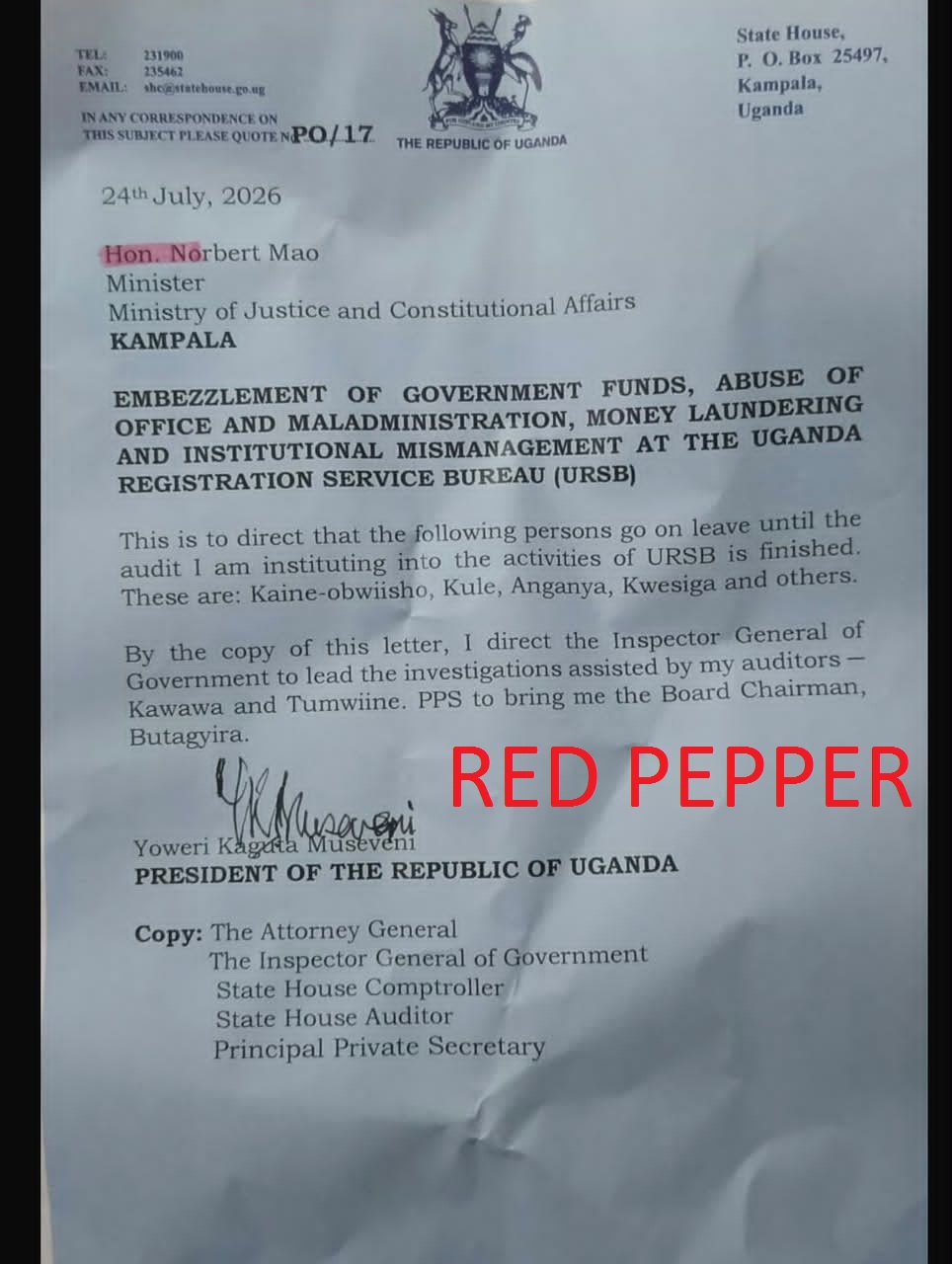
The bombshell order by President Yoweri Museveni sending top officials of the Uganda Registration Services Bureau (URSB) on leave pending investigations did not, according to documents and insiders who spoke to Red Pepper, come out of nowhere.
At the centre of the storm is Gilbert Agaba, the Commissioner for Business Registration, whose bitter dispute with the URSB management and Board allegedly triggered a chain of events that eventually reached the Office of the Attorney General under the Ministry of Justice and Constitutional Affairs and, ultimately, State House.
The fallout has now engulfed the very leadership of the institution.
Registrar General Mercy Kainobwisho, Assistant Commissioner for Business Registration Walid Kule, Commissioner for ICT Arthur Kwesiga, and Deputy Registrar General for Finance and Administration Alex Anganya are among officials affected by the presidential directive.
President Museveni ordered the officials to go on leave as investigations into allegations of embezzlement of government funds, abuse of office, maladministration, money laundering and institutional mismanagement at URSB get underway.
But documents seen by Red Pepper paint a much more complicated picture.
They show that long before the President issued his July 24 directive, URSB management and its Board had already been locked in a serious administrative battle with Agaba over his leadership, conduct, relationships with staff and compliance with management directives.
And when disciplinary action was eventually taken against him, Agaba rejected the findings and sanctions.
He instead raised allegations of criminal conduct and misuse of institutional resources against management and referred the matter to outside authorities.
That move changed the entire direction of the dispute.
THE FIRST CRACKS
According to an internal brief seen by RedPepper on the matter, URSB management had received repeated complaints about Agaba’s leadership, performance, communication and working relationships within the Business Registration Department.
The complaints were not presented as a one-off disagreement.
Management said the problems were affecting departmental coordination, staff relations and service delivery.
Interestingly, the concerns allegedly predated Agaba’s current posting.
The brief states that similar complaints concerning teamwork, cohesion and leadership had previously emerged during his tenure as Commissioner for Intellectual Property.
His transfer to Business Registration was therefore reportedly viewed as an opportunity for him to provide leadership to an already established team.
Instead, according to management, relations within the department deteriorated further.
Among the concerns raised were allegations that Agaba was persistently absent from duty and not sufficiently available to provide direction to his department.
Management also complained of inadequate supervision and coordination of staff.
There were further concerns over failure to convene regular departmental and management meetings.
Communication between Agaba and his immediate supervisees was also said to have broken down.
Management accused him of failing to implement and report back on assigned decisions.
There were also broader concerns over teamwork and cohesion, with management saying the situation was negatively affecting planning, performance reviews, accountability and service delivery.
Then came another serious allegation — repeated insubordination against institutional leadership.
Gilbert Agaba, the Commissioner for Business Registration
MANAGEMENT TRIES TO PUT OUT THE FIRE
The matter did not immediately become a presidential issue.
According to the internal brief, URSB management initially tried to solve the dispute internally.
The Deputy Registrar General responsible for Registries and the Deputy Registrar General responsible for Finance and Administration reportedly intervened several times.
Agaba was counselled and guided on improving communication, supervision and working relationships with his team.
Practical measures were proposed to restore normal departmental operations.
But according to management, the situation did not improve.
The working relationship had allegedly deteriorated to the point where the Registrar General personally intervened.
A meeting was convened to try to resolve the dispute.
Agaba was directed to engage his departmental team and agree on clear working arrangements aimed at improving supervision, communication, accountability and service delivery.
He was also required to submit the agreed arrangements within a specified period.
According to management, that direction was not complied with.
The proposed corrective arrangements were not implemented.
The matter was consequently escalated for formal investigation under the URSB Human Resource Manual and applicable administrative procedures.
That was the beginning of what would become a much bigger institutional war.
AGABA GOES OUTSIDE URSB
Before the internal administrative process could be concluded, Agaba raised allegations with the Chairperson of the URSB Board Amb. Francis Butagira.
He subsequently referred substantially similar allegations to external institutions, including the Economic Crimes Division of the Uganda Police Force and the Office of the Attorney General headed by Dr Sam Mayanja.
The allegations included claims of criminal conduct, corruption and misuse of institutional resources.
The Board responded by constituting an Investigation Committee.
The committee was tasked with examining both sides of the dispute — the allegations raised by Agaba and the management concerns regarding his performance, leadership and governance.
Agaba was reportedly asked to allow the committee to complete its work and avoid actions that could expose URSB to reputational damage before the process was concluded.
But the dispute continued to escalate.
THE BOARD TAKES A POSITION
On June 8, 2026, Agaba was invited to respond to allegations concerning leadership and governance challenges in the Business Registration Department.
The matter was subsequently considered by the URSB Board at an extraordinary meeting held on July 15.
The Board made findings which were later communicated to Agaba through a warning letter.
One of the findings was that there was a lack of teamwork and cohesion within the Business Registration Department.
The Board cited the entire 2025/2026 financial year, saying the department had not held a departmental meeting or retreat to plan and evaluate its performance.
The Board attributed this largely to what it considered inadequate leadership, teamwork and cohesion.
It also noted that similar concerns had previously emerged during Agaba’s tenure in the Intellectual Property Department.
The Board further found that Agaba had failed to implement and report back on assigned management decisions.
That conduct was treated as insubordination under Section 7.2.4(b)(viii) of the URSB Human Resource Manual.
But the most explosive finding concerned language allegedly used by Agaba against the Registrar General.
According to the Board’s findings, Agaba referred to the Registrar General as a criminal and alleged that the Registrar General was in charge of a criminal enterprise within the institution.
The Board treated the conduct as contrary to the same provision of the URSB Human Resource Manual.
THE WARNING
The Board did not immediately recommend dismissal.
Instead, it imposed what it described as corrective and progressive measures.
Agaba was ordered to submit a written apology to management within five days of receiving the warning.
He was also placed on a proposed 12-month Performance Improvement Plan under the direct supervision of the Deputy Registrar General responsible for Finance and Administration.
The objective was to improve his leadership and governance style.
The measures were intended to address the conduct established by the Board, restore professional working relationships and give him a structured opportunity to improve.
But Agaba rejected both the findings and the sanctions.
And that is where the URSB battle took another dramatic turn.
THE ATTORNEY GENERAL ENTERS THE WAR
Instead of accepting the Board’s decision, Agaba made ran to the Attorney General, Dr Sam Mayanja.
The Attorney General then escalated the matter to President Museveni.
The move effectively transformed what had started as an internal administrative and disciplinary dispute into a matter involving the highest levels of government.
But insiders are now asking a pointed question:
Why did the matter go through the Attorney General instead of being handled directly by the Minister of Justice and Constitutional Affairs, Nobert Mao, who is the political head of the ministry responsible for URSB?
The question has become even more important because the Attorney General’s office operates within the Justice and Constitutional Affairs docket headed by Mao.
THE JULY 8 LETTER THAT CHANGED EVERYTHING
A letter dated July 8, 2026, from Attorney General Sam Mayanja to URSB Board Chairman Ambassador Francis K. Butagira provides a crucial piece of the puzzle.
The letter was titled:
“Investigations into Agaba Gilbert, Commissioner Business Registration.”
In it, Mayanja acknowledged that Agaba had brought to his attention what he described as certain criminal activities allegedly taking place at URSB.
The Attorney General stated that he had escalated the matters to President Museveni for guidance.
Then came the dramatic instruction.
Mayanja directed the URSB Board to stop its investigations and inquiries into Agaba.
The letter stated:
“This is to direct that you and the URSB Board ceases all investigations/inquiries into Mr. Agaba and await the guidance of His Excellency the President.”
The letter was copied to President Museveni and Minister Nobert Mao.
That instruction effectively froze the disciplinary process against Agaba as the allegations moved to the presidential level.
FROM AGABA’S DISCIPLINARY CASE TO A FULL URSB AUDIT
Three weeks later, President Museveni wrote directly to Minister Mao.
The July 24 letter, bearing the State House reference NPO/17, was titled:
“Embezzlement of Government Funds, Abuse of Office and Maladministration, Money Laundering and Institutional Mismanagement at the Uganda Registration Service Bureau (URSB).”
Museveni directed that several URSB officials go on leave until an audit he was instituting into the activities of the Bureau was completed.
Among those named were Kainobwisho, Kule, Anganya and Kwesiga, with the letter also referring to “others.”
The President directed the Inspector General of Government to lead the investigations, assisted by his auditors Kawawa and Tumwiine.
He also directed his Principal Private Secretary to bring the URSB Board Chairman, Butagira, to him.
The directive dramatically widened the scope of the dispute.
What had begun as a disciplinary case involving one commissioner was now an investigation into the wider operations and leadership of URSB.
The presidential directive uses some of the strongest language possible in an administrative order.
It lists allegations involving government funds, abuse of office, maladministration, money laundering and institutional mismanagement.
Importantly, these are allegations under investigation, not findings of guilt.
The investigations are expected to establish whether the allegations are true and whether any officials breached the law or administrative procedures.
But the consequences were immediate.
The institution’s top leadership was ordered out of the office as the audit commenced.
And at the centre of the chain of events was the dispute involving Agaba.
WE WERE NOT HEARD
According to the affected officials, URSB management does not oppose investigations.
Instead, management says it is ready to cooperate with all lawful investigations.
Its major complaint is about the circumstances in which the presidential directive was reached.
Management argues that the President may not have received the full picture because, according to them, the Attorney General reported the allegations to State House without first giving management an opportunity to present its side.
The officials affected by the suspension therefore want the presidential directive reviewed.
They have also asked for support to expedite a meeting between the URSB Board Chairman and President Museveni so that the Board can present its side of the story.
They further want to meet the Inspector General of Government before the investigations begin.
THE BIG INSTITUTIONAL DILEMMA
The URSB management acknowledges that Agaba’s allegations must be investigated.
In fact, management says the Board had already asked the Department of Internal Audit to investigate them.
But management says there is another side to the story.
Its position is that it had progressively dealt with Agaba’s conduct through counselling, supervisory intervention, direct intervention by the Registrar General, formal investigation and Board consideration.
The Board made specific findings.
It issued corrective measures.
Agaba rejected those findings and refused to apologise.
He also rejected the Performance Improvement Plan.
He instead sought to defer administrative action until investigations by external authorities, including those initiated at the presidential level, were completed.
This has created what management describes as a prolonged institutional uncertainty affecting leadership, staff relations, discipline and service delivery.
WAS IT A COUNTERATTACK?
Within URSB, there are now concerns over the timing and circumstances in which the allegations against management were raised.
Some insiders believe the allegations may have been retaliatory and intended to frustrate or escape the disciplinary process.
But that remains a contention from one side of the dispute.
Agaba’s allegations are now in the hands of external authorities and are subject to investigation.
The very fact that President Museveni ordered a wider audit means that the matter can no longer be dismissed as a simple personality clash between a commissioner and his superiors.
The allegations raised by Agaba will have to be tested.
So too will the allegations and findings made against him by URSB management and the Board.
WHO WILL EXPLAIN WHAT HAPPENED AT URSB?
The July 24 presidential directive has now opened a much bigger question over the management and governance of the government agency responsible for business registration services.
If the investigations establish wrongdoing, those responsible will have questions to answer.
If the allegations prove unfounded, those whose reputations and careers have been affected will also demand answers.
And if both sides made allegations that require investigation, the process will have to determine where the truth lies.
For now, the biggest question remains:
Did Gilbert Agaba blow the whistle on a rotten system, or did an internal disciplinary battle explode into a wider institutional crisis after he rejected sanctions?
That is the question the IGG-led investigations will have to answer.
URSB FIRST DENIES — THEN CONFIRMS AUDIT
Red Pepper contacted URSB for comment before publication.
Initially, the Bureau flatly denied the reports.
“This is not true at all. Utterly false at all fronts,” URSB said.
But only minutes later, the Bureau sent Red Pepper a holding statement confirming that an audit was indeed underway.
In the statement dated August 17, 2026, URSB acknowledged online reports concerning the ongoing audit processes at the Bureau.
The statement said the audit was being undertaken in accordance with established procedures and applicable laws.
URSB also sought to reassure clients, partners and the public that service delivery had not been interrupted.
The Bureau said it continues to provide services through its established channels and remains committed to transparency, accountability and professionalism.
It added that further information would be provided where appropriate upon conclusion of the relevant processes.
The dramatic shift from “utterly false” to an official confirmation that an audit is underway is itself likely to raise more questions about what exactly is happening behind the doors of URSB.
GOT A HOT STORY? LET US KNOW!
Got breaking news, explosive secrets, or hard evidence?
Uganda has never really struggled to produce talent. The harder question has always been what happens to that talent once the song leaves the studio.
For years, the country has produced singers, songwriters and producers capable of making records that travel far beyond Uganda. But while the music itself is increasingly finding audiences abroad, the systems needed to turn that creativity into sustainable international careers have not grown at the same pace.
That is the gap a new player in Uganda’s music business is trying to tackle.
Creator, a professional music development company and creative ecosystem built by Practical Stream Uganda Limited, has launched its flagship One-Year Professional Music Production Program under Creator Academy, with a bigger ambition than simply teaching people how to operate a studio.
The idea is to produce music professionals who understand not only how to make a good record, but also what to do with it once it is finished. And that distinction could matter.
Because in today’s music industry, making the song is only one part of the business. Getting it commercially ready, understanding publishing and licensing, building a professional portfolio, navigating international markets and finding ways to actually earn from the work are increasingly just as important.
Creator says the idea grew out of its own experience trying to take Ugandan music into international commercial spaces.
While building Practical Stream’s global music licensing platform and pursuing opportunities in international markets, founder Moise Chitwara and his team repeatedly encountered the same problem: Uganda had plenty of creative ability, but too few structured pathways preparing music professionals for the commercial demands of the global industry.
In other words, the problem was not necessarily the music. It was the machinery around the music.
“Uganda doesn’t have a talent problem, it has an infrastructure problem,” Chitwara said at the launch.
That infrastructure problem is where Creator is placing its bet.
Rather than positioning itself as another conventional music school where students attend classes, graduate and are left to figure out the industry on their own, Creator is being built as an ecosystem that connects training to production, business, professional services and eventually international opportunities.
Its first major intervention is the one-year professional production programme, combining hands-on music production with music business education and character development.
Students are expected to leave with more than certificates. The programme is designed around professional portfolios, practical workflows, commercial production standards and an understanding of how the modern music business actually operates.
That could be particularly important for a generation of Ugandan producers entering an industry where the definition of success is rapidly changing.
A producer today can no longer afford to think only about making a beat for an artist in Kampala. Their work can potentially end up in films, advertising campaigns, television, playlists, international catalogues and sync licensing markets.
But accessing those opportunities requires a different level of preparation.
Creator’s longer-term answer is what it calls the Creator Export Pipeline — an initiative intended to connect suitably prepared Ugandan music professionals to international opportunities in music publishing, licensing, sync placements, distribution and other commercial markets.
The academy, therefore, is being presented as the beginning rather than the destination.
That is perhaps the most interesting part of the model.
The traditional education cycle is straightforward: learn, graduate and look for work. Creator wants to blur that line by creating a pathway where learning can lead into actual commercial production, creative campaigns, consultancy, events and international opportunities.
It is a response to one of the music industry’s oldest frustrations: talented people can know how to create but still have no idea how to build a career around what they create.
And Uganda is not alone in facing that problem.
Across Africa, the global appetite for African music and culture has grown dramatically, but the infrastructure supporting the people behind the music has not always kept pace. Streaming may have made the world smaller, but international access does not automatically translate into professional opportunity or sustainable income.
Creator’s proposition is that Uganda’s next export should not only be hit songs.
It should also be the professionals behind them.
The company says the programme will be taught by practitioners with experience in the global music industry, rather than relying exclusively on classroom theory. The production and monetisation principles being taught, it says, have already been applied by its founder and instructors to music that has generated millions of streams across Europe and the United States.
That real-world experience is central to the pitch.
For Uganda’s music industry, the bigger question now is whether initiatives such as this can help shift the conversation from “How do we make better music?” to “How do we build better music businesses?”
Because the country is already making the music. The next challenge is making sure the people making it can build careers from it.
And that is where Creator says it wants to come in.
Its wider ecosystem will bring together Creator Academy, a Production Hub, brand and creative campaigns, consultancy, events and the planned Export Pipeline, all built around the same idea: turning creative ability into professional opportunity.
“Our goal isn’t simply to teach people how to make music. It is to develop professionals who can build sustainable careers, compete internationally, and contribute meaningfully to the growth of Uganda’s music industry,” Chitwara said.
If the model works, the impact could stretch beyond the producers enrolled in one programme.
Better-trained producers mean stronger recordings. Stronger recordings can create better opportunities for artists and songwriters. Better understanding of publishing, licensing and distribution can unlock additional revenue streams. And a more commercially aware generation of music professionals could make Uganda better prepared to participate in the global music economy.
For an industry that has spent years proving that it has talent, perhaps the next phase is proving that it can build the systems to support it.
Creator’s message says that the studio is only the beginning. The real business starts when the music leaves it.
Don’t want to miss out on any story? For updates on all Sqoop stories, follow this link on Telegram: https://t.me/Sqoop
About UGNEWS24
UGNEWS24 is a Uganda local news service, a product of
SOLAVIA GROUP LIMITED,
Reg. No. 80048169153974.